
Makers & Rooms — Essay VI
The Dream Factory on the Lake
For a century, the Alessi family has been making things for the kitchen and the table. Alberto Alessi turned that inheritance into something stranger and more ambitious: a theory of what objects are for, a laboratory for the most original design minds of the age, and a persistent argument that the borderline between industry and art is exactly where the most interesting work gets done.
By Bergotte
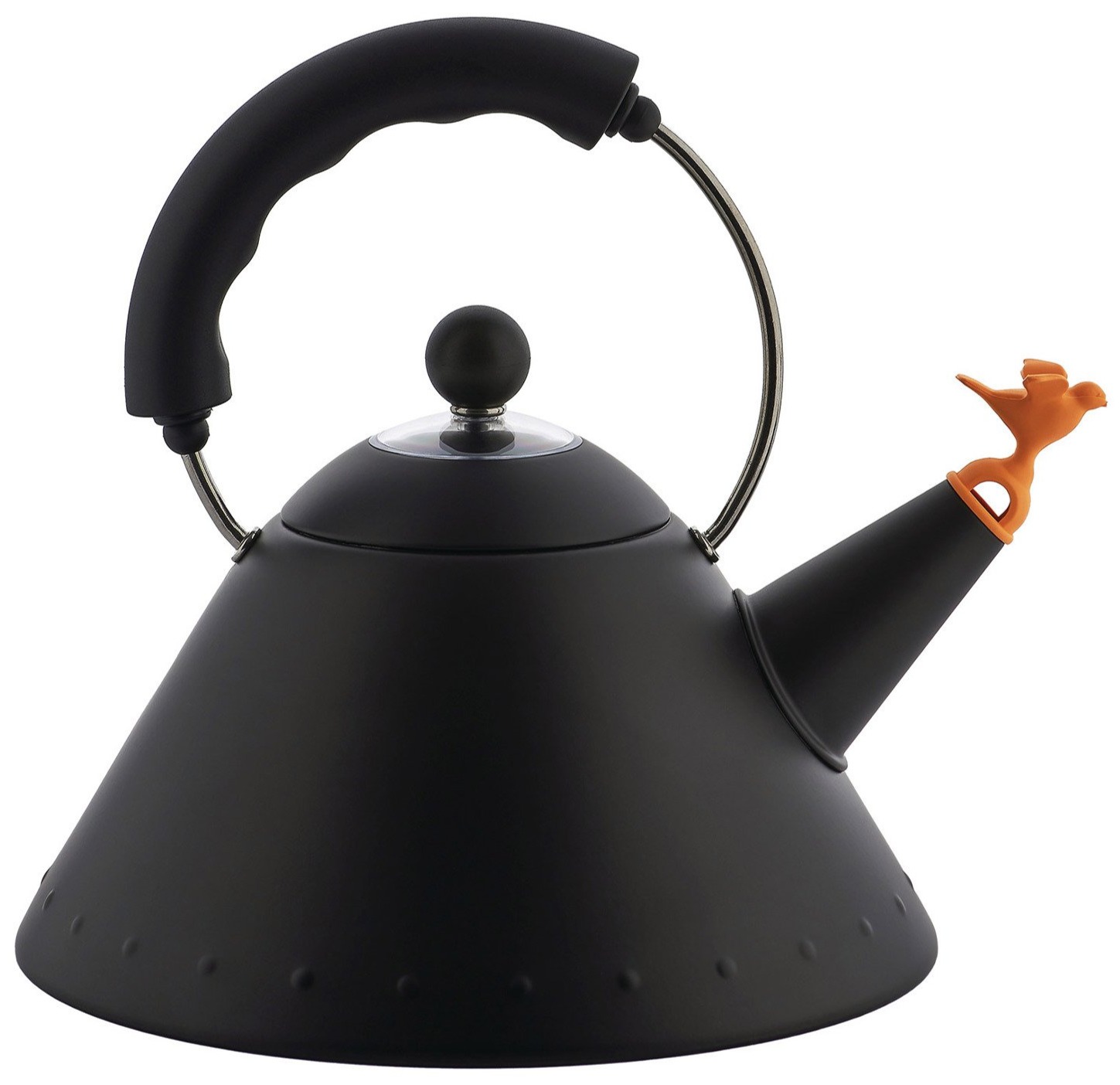
On a shelf in a great many kitchens in a great many countries, there is a kettle in the shape of something that is not quite a kettle. It has a conical body that widens toward the base, a long angled spout with a small bird perched at its tip, and a handle in a red that is not the red of warning or heat but the red of deliberate cheerfulness, the red of something that has decided to be noticed. When the water boils, the bird whistles. It does this because Michael Graves, the American architect who designed the kettle in 1985, thought that a kettle that announced the boiling of water with a cheerful avian sound was a more pleasurable object to be around than one that merely boiled, and because Alberto Alessi, who commissioned the design, agreed with him, and because the company that manufactured it had, by 1985, developed both the technical capacity and the philosophical disposition to make objects in which pleasure was understood as a design specification rather than a finishing touch.
The kettle — formally the 9093, informally and universally the Bird Kettle — has sold in the millions. It is the best-selling kettle in the history of Alessi, which has been making things for the kitchen and the table since 1921, and it is one of the most recognisable designed objects of the late twentieth century. It appears in design history textbooks and in museum permanent collections and in the windows of kitchen shops and in the homes of people who have never thought about design as a subject but who found, when they saw the kettle, that it made them feel something — something that was not quite desire in the ordinary commercial sense and not quite delight in the purely aesthetic sense but some compound of both that did not have an existing name and that Alessi, in its more theoretical moments, has tried to give one.
The name Alberto Alessi has proposed, drawing on the work of the psychoanalyst Donald Winnicott, is the concept of the borderline: the zone between the useful and the poetic, between the object that serves a function and the object that speaks to something in the person who uses it that is not reducible to function. The kettle boils water. It also, when the bird sings, produces a small moment of unexpected pleasure that has nothing to do with the boiling of water and everything to do with what it is like to be a person standing in a kitchen at seven in the morning, waiting for something to happen. This small moment is, in Alessi’s view, not incidental to the design but central to it. It is the difference between a product and an object. It is, in the most literal sense, what the company is for.
Omegna, 1921
The Alessi company was founded in 1921 by Giovanni Alessi Anghini in Omegna, a small town on Lake Orta in the Piedmont region of northern Italy. The founding context was entirely conventional: a small metalware workshop producing trays, coffee sets, and household goods in nickel silver and then in stainless steel, serving the domestic market and the hospitality trade with the kind of competent, unpretentious manufacturing that the region had long supported. The Italian lakes area — Como, Maggiore, Orta — had been a centre of metalworking for generations, and the founding of the Alessi workshop was a natural extension of a local industrial tradition rather than a departure from it.
Giovanni’s son Carlo took over the business in the 1940s and began the first tentative moves toward a different kind of practice. Carlo Alessi was a designer as well as a manager, and the objects he produced in the late 1940s and early 1950s — the 870 coffee set of 1945, clean and functional and formally resolved in ways that distinguished it from the decorative convention of the period — showed a seriousness about form that exceeded the requirements of the market the company was serving. The shift was not yet a programme. It was a sensibility, expressed through individual objects, that indicated what the company might become if someone were willing to follow it to its logical conclusion.
Alberto Alessi joined the company in 1970, the third generation, his grandfather’s grandson. He had studied law, not design, which is either irrelevant or significant depending on how you read what followed: the application of a non-designer’s systematic intelligence to the question of what design is and what it is for produced, in Alberto’s case, one of the most coherent design philosophies of the twentieth century, one that was more rigorous precisely because it had not been formed inside any of the schools or movements that gave other designers their intellectual furniture. He came to the question of the object without the answer already prepared, and the question he arrived at — what are objects actually for, what do they do to the people who use them, what would it mean to make them as well as they could possibly be made — was more fundamental than most design thinking of the period was asking.
The Laboratory Opens
The transformation of Alessi from a competent metalware manufacturer into something unprecedented began in the early 1970s with a decision that was, at the time, without obvious commercial logic: Alberto Alessi began inviting architects — not industrial designers, not product designers, but architects — to design objects for the table and the kitchen. The first significant collaboration was with Ettore Sottsass, the Italian architect and designer whose work over the following two decades would make him one of the most influential figures in the history of postwar design, and with the Spanish architect and designer Luis Barragán. These were not household names in the world of kitchen goods. They were figures from the art and architecture world, people whose relationship to the design of a teapot was, at best, theoretical.
This was precisely the point. Alberto Alessi’s working hypothesis — developed and refined over the following decades into something approaching a formal theory, which he has set out in books and essays with a thoroughness unusual for the head of a manufacturing company — was that the objects most people used in their daily lives were systematically underdesigned, not in the technical sense of being poorly engineered but in the human sense of failing to address the emotional and psychological dimensions of use. People ate and drank and cooked not only because they needed to but because these activities were among the most significant rituals of daily life — the settings in which families gathered and relationships were sustained and the day was marked and the hours given shape. The objects that served these rituals deserved to be made by people who understood their significance, and architects, who had spent their careers thinking about how space and form and material affected human experience at the deepest level, were better equipped for this understanding than the industrial designers who had traditionally supplied the metalware industry.
The hypothesis was, in retrospect, obviously correct, though it was not obvious at the time. The objects that emerged from the early collaborations were unlike anything in the existing market for domestic metalware: formally adventurous, sometimes perplexing, occasionally demanding of the person who used them, but consistently characterised by the quality of attention that distinguished design done by people who had thought hard about what objects were from design done by people who had thought primarily about what sold. Whether they sold was, in those early years, genuinely uncertain. Some did. Some did not. Alberto Alessi kept commissioning.
Officina Alessi and the Architect’s Object
The collaboration that most directly established the terms of what Alessi would become was the Tea and Coffee Piazza project of 1983. Alberto Alessi commissioned eleven of the most significant architects in the world — among them Hans Hollein, Charles Jencks, Richard Meier, Paolo Portoghesi, Robert Venturi, and Aldo Rossi — to design complete tea and coffee sets in silver, to be produced in limited editions of ninety-nine. The brief was essentially unlimited: the architects were asked to respond to the object and the ritual, not to a market or a price point or a production constraint. The results were, predictably, extraordinary — each set a complete architectural statement in miniature, each one bearing the formal signature of its maker as clearly as a building did, each one demonstrating that the boundary between architecture and object design was permeable in ways that both fields had previously preferred not to examine too closely.
The Tea and Coffee Piazza was not a commercial product. It was a cultural statement — a demonstration, addressed simultaneously to the design world and to the general public, that objects of daily use could bear the full weight of serious artistic intelligence, that the teapot was not beneath the architect’s consideration but was, properly understood, as complex and demanding a design problem as any building. It was also, in the most material sense, extraordinarily beautiful: the Aldo Rossi set in particular, with its forms derived from the architectural archetypes that ran through all his work — the cone, the cylinder, the pitched roof reduced to its essential geometry — was one of the most perfect small objects produced in the twentieth century, a complete architectural world in silver and on the breakfast table.
The success of the Tea and Coffee Piazza — critical rather than commercial, but influential in ways that commercial success rarely is — established the template for the Officina Alessi line, the high-end, limited-production arm of the company that has since collaborated with architects and designers including Frank Gehry, Rem Koolhaas, Toyo Ito, and Kazuyo Sejima. Officina exists at one pole of the company’s practice: objects produced in small numbers, at prices that reflect both the cost of their making and the cultural prestige of their authorship, designed primarily for collectors and institutions rather than for the kitchen of the ordinary household.
The other pole is the mass market line — the products designed for production in the tens of thousands and sold through design shops and department stores at prices that make them accessible, if not cheap. The Bird Kettle lives here, and so does the Juicy Salif — Philippe Starck’s extraordinary citrus squeezer of 1990, a three-legged aluminium spider that produces juice of a quality that is, by some assessments, inferior to that of a fifty-year-old hand press, but that sits on a countertop as a piece of sculpture that provokes, consistently and reliably, the question: what is that? The Juicy Salif is, depending on your position, either the best argument for the idea that an object can be more than its function or the best argument against it. Alberto Alessi has suggested, in one of the more disarming moments of candour in the literature of design theory, that it is probably not very good at squeezing lemons. He seems to find this more interesting than troubling.
The Starck Question
Philippe Starck’s relationship with Alessi — which has produced, alongside the Juicy Salif, a series of objects including the Hot Bertaa kettle and the Max le Chinois colander — raises in concentrated form the question that runs through the whole Alessi project: where is the line between design that is serious about beauty and pleasure and design that is serious about nothing except its own cleverness? Starck is one of the most gifted designers of the late twentieth century and one of the most self-promotional, and these two qualities are not always easy to separate in the objects he produces. The Juicy Salif is genuinely beautiful, in the sense that its proportions are perfect and its surface quality is exceptional and the experience of looking at it produces something that is not quite pleasure but is in the neighbourhood. Whether it is beautiful in the way that the Graves kettle is beautiful — a beauty that arises from the resolution of a human problem, from the successful making of an object that serves its purpose with grace and wit — is a harder question.
Alessi has been willing, over the years, to publish the failure rates of its products — to acknowledge, in the transparency of its internal assessments, which objects met the standard it was trying to set and which did not. This willingness is unusual and admirable, and it reflects something important about the company’s self-understanding: it is not a marketing organisation that produces objects to serve its brand narrative, but a design laboratory that produces objects to test hypotheses about what objects can be, and a laboratory that does not suppress its failed experiments is a more honest laboratory than one that presents only the results that confirm the theory. Some Alessi objects have not worked. The company says so. This does not happen very often in the design world, and it is one of the reasons that Alberto Alessi’s theoretical writing, for all its occasional abstruseness, commands a respect that the theoretical writing of other manufacturer-philosopher figures rarely does.
Aldo Rossi and the Memory of Things
If one collaboration defines the deepest ambition of the Alessi project, it is the one with Aldo Rossi, the Italian architect whose theoretical and built work was among the most significant of the postwar period and whose relationship with Alessi produced a body of objects — the La Conica espresso maker, the La Cupola moka pot, the Momento watch, the Teatro clock, and above all the Cabina dell’Elba tray — that are among the most extraordinary designed objects of the century.
Rossi’s architecture was grounded in the concept of memory — in the idea that buildings and cities carried within them the traces of all their previous forms, that the architectural elements most laden with meaning were those that had been used longest and had accumulated the most layers of use and association. The cone, the cylinder, the pitched roof, the arcade: these were not decorative choices but memory forms, shapes so deeply embedded in the Western architectural imagination that they communicated without explanation, spoke directly to the part of human experience that recognised the familiar form of shelter and assembly and the ritualised activities of daily life.
Applied to objects, this theory produced extraordinary results. The La Conica espresso maker of 1984 is a conical pot in polished stainless steel whose form is simultaneously that of a traditional moka pot, a lighthouse, an obelisk, and a piece of pure geometry — it is all of these things at once, and the density of reference is not confusion but richness, the richness of an object that has absorbed so much of the tradition it comes from that it can refer to all of it simultaneously. It makes very good coffee. It also sits on the counter as a small monument, a thing that seems, in some inexplicable but consistent way, to have always been there, to be the form that the moka pot was always tending toward without previously managing to arrive at.
Rossi’s objects for Alessi were not produced with ease. He was a difficult collaborator — demanding in his requirements, resistant to the compromises that mass production requires, insistent on a quality of material and finish that pushed the factory’s technical capacity to its limits. But Alberto Alessi regarded this difficulty as the price of the work’s quality, and the work’s quality as justification for the price. The relationship lasted until Rossi’s death in 1997, in a car accident, and the objects it produced are among the most lasting evidence of what the Alessi project at its most serious was actually attempting.
The Formula, Revisited
Alberto Alessi has formalised his understanding of what makes an object work — what makes the difference between a product and something that resonates with the people who use it — in a diagram he calls the Formula, which maps designed objects along axes of function, communication, and language, and identifies a zone in which objects that successfully address all three dimensions can produce what he calls affective response: the reaction that distinguishes a designed object from a mere commodity, that makes a person pick up the Bird Kettle and smile before they have thought about whether to buy it.
The Formula is both a design tool and a critical instrument — a way of assessing, in advance of production, whether a proposed object is likely to work in the deepest sense, and a way of explaining, after the fact, why some objects have resonated and others have not. It is, inevitably, imprecise in the way that all frameworks for predicting affective response are imprecise: human beings are not consistent in what moves them, and the object that resonates deeply with one culture or generation may leave another cold. But its imprecision is not a weakness. It is an acknowledgement that the territory it is trying to map is genuinely complex, that the question of what objects do to people who encounter them is not a question with simple answers, and that the attempt to take it seriously — to treat it as a design question rather than a marketing question — is itself a form of intellectual honesty that most manufacturing organisations do not practice.
The Formula has influenced a generation of designers who have passed through Alessi’s orbit, and its underlying ideas — that objects communicate at multiple levels simultaneously, that the emotional and the functional dimensions of design are not separable, that the best objects work at the borderline between the useful and the poetic — have become, in the years since Alberto Alessi began articulating them, something approaching a common language in the more serious precincts of design culture. This is the kind of influence that does not always get credited to its source, because ideas that become common property lose their origin stories, but it is real and it is significant.
The Factory and the Lake
The Alessi factory in Crusinallo, the village adjacent to Omegna where the company has been based since its founding, is not what you might expect a design laboratory to look like. It is an industrial facility — stamping presses and polishing machines and the particular smell of heated metal that is common to all metalworking, a working factory that has been producing objects since 1921 and that shows the accumulated evidence of a century of making things. The museum at the factory, which displays the full range of the company’s production across its history, is not a monument to design but a record of manufacture: objects made by hand and by machine, prototypes and production pieces, the entire history of a family’s hundred-year engagement with the question of what the objects of daily life should be.
Alberto Alessi, now in his eighties, has spent most of his adult life within this context — between the factory and the lake, between the demands of industrial production and the aspirations of artistic collaboration, between the need to sell enough kettles to keep the presses running and the desire to commission objects that may never sell at all but that advance, in some small way, the collective understanding of what objects can do. He has written about this tension with unusual frankness, acknowledging that the company operates in a permanent state of productive contradiction — that the commercial and the experimental are not easily reconcilable, that the decision to commission a silver tea set from eleven of the world’s greatest architects is not obviously compatible with the decision to manufacture a plastic toilet brush, and that the company has made both decisions and continues to make both and has found, over time, that the contradiction is not a problem to be solved but a condition to be inhabited.
It is, in this sense, the same contradiction that appears throughout this series — in Kawakubo’s empire of refusal, in Derian’s handmade objects sold through an IKEA collaboration, in Pennoyer’s classical practice serving wealthy clients in the name of democratic beauty. The makers who are most serious about what they are doing tend to be the ones most honest about the gap between their aspirations and the conditions under which they must pursue them. Alberto Alessi has been honest about this gap for fifty years, and the objects it has produced — the bird that sings, the cone that makes coffee, the spider that squeezes lemons with insufficient efficiency but extraordinary grace — are the evidence that the honest inhabiting of a contradiction can produce, in the right hands, something close to art.
What Objects Know
There is a passage in Alberto Alessi’s writing — in the book he calls Dream Factory, his most sustained attempt to theorise what the company does and why — in which he describes the object as a carrier of messages that cannot be sent any other way. The object, he argues, communicates at levels that language cannot reach: it speaks to the part of human experience that precedes and underlies the verbal, that is formed in the earliest encounters with the material world, that recognises the shape of comfort and pleasure and use before it has words for any of them. The best designed objects do not just serve their users. They speak to them, in a language that is older than any language, about what it is to handle a thing that has been made with care.
This is a large claim, and it rests on a view of design that most of the industry most of the time does not share. The industry’s view of design is, by necessity, more modest: design is a discipline of problem-solving, a process of optimising the relationship between a product’s function and its cost and its appearance within the constraints of a specific market. This view produces most of the objects that most people use most of the time, and it is not wrong, exactly. It is incomplete.
What Alessi has spent a century demonstrating, with a consistency that is all the more remarkable for being maintained across three generations of a family business in a provincial town on a northern Italian lake, is that the incomplete view is not inevitable — that the constraints of industrial production are real but not absolute, that within them there is space for the kind of thinking that produces objects which are not just products but presences, things that change the character of the rooms they inhabit, that produce small unrepeatable moments of pleasure in the people who handle them, that carry, in their particular resolution of form and material and use, some condensed fragment of what it means to live well.
The bird sings. The water is boiled. The morning begins.
Discover more from My World of Interiors
Subscribe to get the latest posts sent to your email.

