
By Bergotte
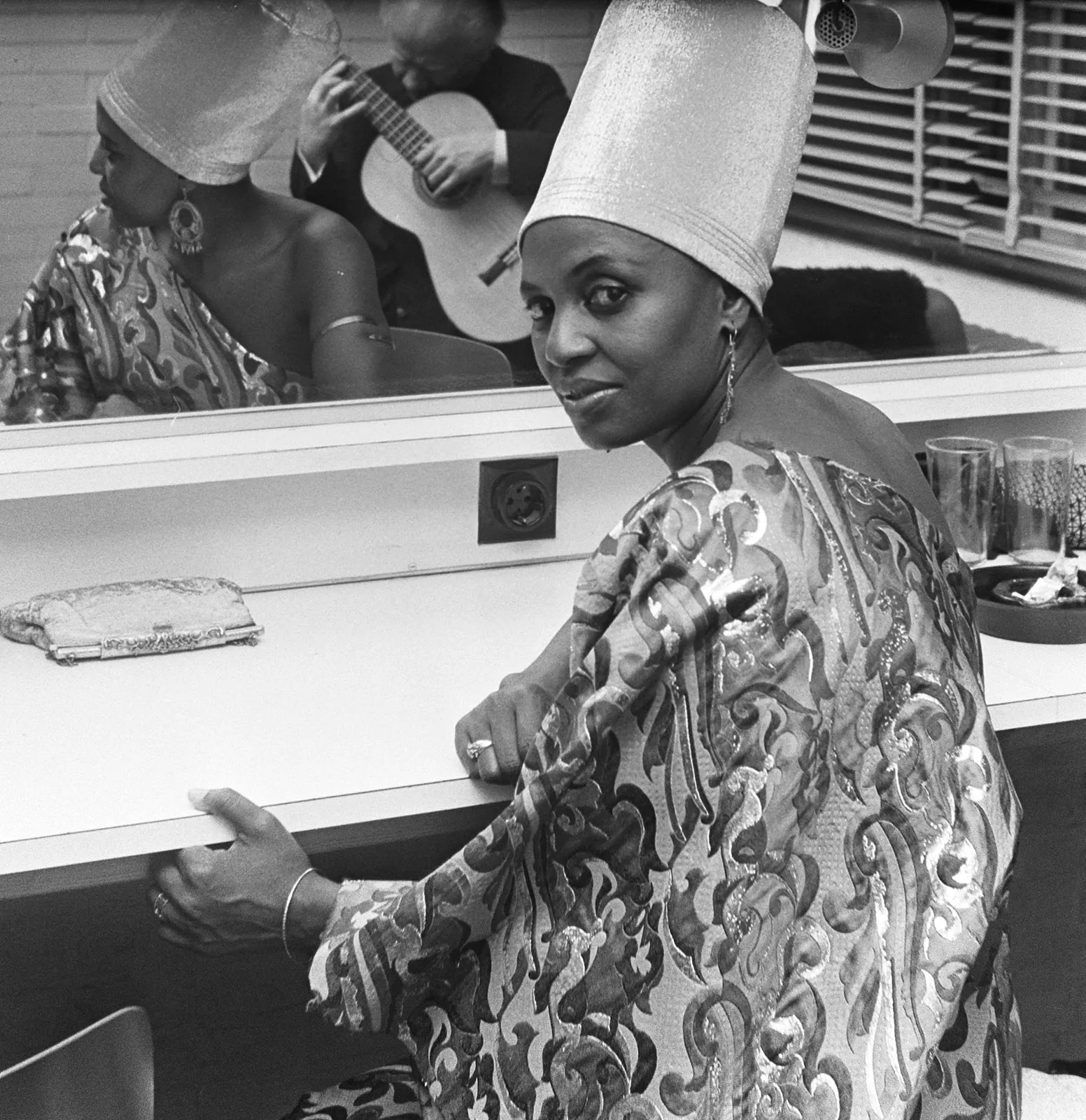
Miriam Makeba was exiled from her country for thirty-one years. She was stripped of her passport, banned from attending her mother’s funeral, and prevented from returning home to South Africa by a government that understood, correctly, that her voice was more dangerous to apartheid than most weapons available to the opposition. She responded by doing the only thing available to her: she sang. She sang on every stage the world offered her, in front of every head of state and every ordinary audience willing to listen, in Xhosa and Zulu and Sotho and English and Portuguese and a dozen other languages, and she made of her exile not a wound to be pitied but an argument to be won. What she proved, over five decades of performance and activism and sheer relentless presence, is that a voice rooted in a specific place and a specific people can become, without losing that specificity, a voice for the world — and that popular music, at its greatest, is not entertainment but testimony.
The girl from Prospect Township
She was born Zenzile Miriam Makeba in Johannesburg in 1932, the daughter of a Swazi mother and a Xhosa father, and she was eighteen days old when her mother was arrested for brewing traditional beer — an illegal act under the colonial laws governing Black South Africans — and taken to prison with her infant daughter, who spent the first six months of her life in a jail cell. This is not biographical colour. It is the opening statement of a life in which the relationship between a Black South African woman and the law was always one of the law’s violence and her survival.
She grew up in the townships outside Johannesburg — Prospect Township, later the Western Native Township — in the dense, improvised, extraordinarily creative urban culture that apartheid and its predecessors had confined Black South Africans to, and which those South Africans had made into something vibrant and self-sustaining almost in spite of the confinement. Township life in the 1930s and 1940s had its own music, its own fashion, its own politics, its own languages that moved fluidly between Xhosa and Zulu and Sotho and Afrikaans and the street argot called tsotsitaal. It was not the culture of defeated people. It was the culture of people who had decided that dignity was non-negotiable.
She sang in church choirs and school choirs and understood early that her voice was exceptional — not simply in its technical range, though the range was extraordinary, but in its quality of presence, the way it seemed to come from somewhere deeper than the lungs, to carry within it a weight of experience that most singers spend their whole careers trying to acquire and never do. She married young, had a daughter, Zimbabwe, lost a son at birth, survived tuberculosis, and by her early twenties was performing with the Cuban Brothers and then with the all-female vocal group the Skylarks, whose sound combined African melody with the American jazz harmonies that had been absorbed into township music through the records that circulated on the Johannesburg black market.
The music of the South African townships in this period was doing something structurally similar to what Mulatu Astatke was doing in Addis Ababa: taking the materials of American popular music — jazz, swing, the vocal group harmonies of doo-wop — and remaking them in an African idiom, producing a hybrid that was genuinely new rather than simply imitative. The difference was the political context. Where Mulatu worked in a country that had preserved its sovereignty, Makeba and her contemporaries worked in a country whose entire social and legal architecture was designed to tell them that their culture, their language, their humanity were subordinate. The music was not just music. It was insistence.
The click and what it carries
Before anything else can be said about what Makeba’s voice does, something must be said about the Xhosa language and its clicks.
Xhosa is one of the Nguni languages of southern Africa, and it contains three distinct click consonants — sounds produced by creating a vacuum with the tongue against different parts of the mouth and releasing it sharply — that are among the most striking features of any language to ears trained on European phonetics. There is the dental click, sharp and light. There is the lateral click, richer and more resonant. There is the palatal click, deep and percussive. In ordinary Xhosa speech these clicks are simply consonants, as unremarkable to a native speaker as a p or a t. In song they become something else: rhythmic events, tonal colours, percussive punctuation that no European instrument can replicate and no European vocal tradition employs.
Makeba brought the clicks into her music without apology and without explanation. She did not present them as exotic. She did not smooth them out for international audiences. She sang in Xhosa when the song was a Xhosa song, and the clicks were there because they belonged there, because they were part of the language and the language was part of the song and the song was part of who she was. This sounds like a simple decision. In the context of the 1950s and 1960s international music market, where African artists were routinely expected to westernise their sound in order to be taken seriously, it was a radical one.
The clicks are not merely a formal curiosity. They change the sound of the human voice in the act of singing — introduce into it a percussive, rhythmic dimension that most vocal music lacks, a sense of the body in the voice, of the mouth and tongue as instruments in their own right. When Makeba sings in Xhosa, the voice is doing several things simultaneously: carrying the melody, carrying the meaning of the words for those who understand them, and providing a rhythmic counter-pattern through the clicks that gives the music a texture unavailable in any other tradition. The famous “Click Song” — “Qongqothwane” in Xhosa, a traditional song about a beetle that brings good luck to brides — became, in her performances, something of a demonstration piece: she would introduce it to international audiences by explaining the clicks, inviting them to try, and then showing them what the language actually sounds like when you know how to use it. The effect was invariably to make the audience understand, viscerally, that they were in the presence of a tradition they had never imagined.
The film, the discovery, the exile
In 1959 she appeared in Come Back, Africa, a film made secretly in South Africa by the American documentarian Lionel Rogosin — secretly because the apartheid government would never have granted permission for a film that showed the reality of Black South African life. The film was a dramatised documentary, shot on the streets and in the shebeens of Johannesburg, and Makeba appeared in it as a singer performing in a shebeen scene. The film was screened at the Venice Film Festival and then in London, and Makeba was invited to attend the screenings.
She left South Africa in 1959, and the South African government, having seen what the film contained and who was in it, cancelled her passport. She could not return. She was twenty-seven years old and she had just been made a person without a country, separated from her daughter Zimbabwe, separated from the only world she had known, because a government was afraid of what her presence in it might mean.
In London she encountered Harry Belafonte, who recognised immediately what she was and understood what she needed. He became her mentor and advocate, brought her to America, helped her establish herself on the New York concert circuit, introduced her to the world of Black American cultural and political life in the early 1960s — a world that was itself in the midst of its own historic confrontation with a system designed to deny Black people their full humanity. The parallels were not lost on anyone. Makeba was not simply an African singer who had turned up in New York. She was living evidence that the system she had fled and the system being confronted in the American South were expressions of the same thing, administered at different latitudes.
She performed at Carnegie Hall. She appeared on The Tonight Show. She was nominated for a Grammy. She sang for President Kennedy at his birthday celebration. She moved through the highest circles of American cultural life with a combination of grace and absolute refusal to be anything other than what she was: a South African woman in exile, singing the music of her people, on behalf of a political cause that she understood was not incidental to the music but continuous with it.
The sound of a continent finding its voice
The recordings she made in the early 1960s — collected variously on Miriam Makeba (1960), The Many Voices of Miriam Makeba (1962), and The World of Miriam Makeba (1963) — are documents of an extraordinary moment: the moment when African popular music first reached a genuinely international audience on its own terms, not filtered through the arrangements of Western producers or the expectations of Western markets, but presented as what it was.
The sound of these records is warm and various. Makeba moved easily between registers — between the traditional Xhosa and Zulu songs she had grown up with and the jazz-inflected township pop of her professional formation, between the intimate and the expansive, between the celebratory and the mournful. Her voice had a quality of grain, of texture, that placed it in a different category from the smooth professionalism of the American female singers she was being compared to. It was not a voice that had been trained to remove all roughness. The roughness was the character, the signature, the proof that the voice had been somewhere and come back.
“Pata Pata” — recorded first in South Africa in 1957 and re-recorded for American release in 1967 — became her international signature song, a piece of township jive with a lyric about a dance, irresistible in its rhythmic simplicity, the kind of song that seems like it must have always existed. Its success on the American charts in 1967 was a genuine cultural event: here was a song in which the African origin was not hidden or diluted but fully audible, a song that required nothing from its listener except the willingness to move, and that was number one in several countries simultaneously. Makeba used its success with clear-eyed pragmatism — it was the vehicle through which she reached audiences who would then, she hoped, follow her to the more demanding parts of the catalogue, to the political speeches and the concerts at the United Nations and the testimony before the Special Committee on Apartheid.
She gave that testimony in 1963 and again in 1975. She told the United Nations what was happening in her country in plain language, without euphemism, and she was the first African woman to address that body on the subject of apartheid. The South African government responded by extending her exile and announcing that her records were banned in South Africa. This was not merely petty vindictiveness, though it was that too. It was a recognition that her voice — on stage and in that chamber — was having effects that they could not permit.
Guinea, Carmichael, and the costs of conviction
In 1968 she married Stokely Carmichael, the Black Power leader and one of the most controversial political figures in America. The response from the American music industry was immediate and total: her concert bookings were cancelled, her recording contracts evaporated, her American career effectively ended overnight. This was not a misunderstanding or an excess of caution. It was a political act by an industry that had been willing to embrace an African singer as long as she remained, in its terms, simply a singer. The moment she became, through marriage, directly associated with the most radical wing of the Black American liberation movement, she became too political to be commercially viable.
She followed Carmichael to Guinea, where President Sékou Touré offered them both citizenship and a home. She spent most of the next decade there, then in exile across Africa, performing where she could, recording when she had the means, continuing to speak at every international forum that would have her. This is the period that is most easily romanticised and that is most important to resist romanticising. She was not a wandering free spirit choosing an adventurous life. She was a woman without a country, separated from her family — her daughter Zimbabwe died in 1985 during childbirth, a grief Makeba described as the wound from which she never fully recovered — continuing to do the work she believed in because the work was what she had.
What kept the work going, across those decades, was not optimism. She was not a naive person and she did not pretend that the situation was better than it was. What kept it going was something more like vocation — the deep conviction, impossible to argue out of someone who genuinely holds it, that the singing and the speaking and the presence were necessary, were doing something real in the world, regardless of the personal cost.
Her recordings from this period are uneven in production quality — she was working with limited resources on multiple continents — but the voice itself never wavered. It deepened, as great voices deepen, acquiring new weight without losing its essential character. The songs she chose to record were increasingly political in their explicit content, but the politics were never at the expense of the music. She understood, as the greatest politically engaged artists always understand, that a bad song in service of a good cause does no service to the cause. The music had to be the argument, not just the vehicle for it.
The homecoming
Nelson Mandela was released from prison in February 1990. In the months that followed, as the apparatus of apartheid began its managed dissolution, the bans were lifted, the exiles were invited home. Makeba returned to South Africa in 1990, thirty-one years after her passport was cancelled, and the homecoming was one of the great symbolic moments of that extraordinary period: the woman whose voice had been banned from the country for three decades, returning to sing in it.
She was fifty-eight. She continued performing for another eighteen years, until two days before her death. She played at a concert in Castel Volturno in Italy in November 2008, a benefit for the victims of a Camorra massacre of African immigrants, walked off stage, suffered a heart attack, and died before the ambulance reached the hospital. She was seventy-six, and she had been singing, in one form or another, in service of the same convictions she had formed in the townships of Johannesburg in the 1940s, for her entire adult life.
What the voice actually was
There is a temptation, writing about Miriam Makeba, to let the political biography overwhelm the music — to treat the singing as the soundtrack to the activism rather than as the thing that was, in itself, the primary act. This would be a mistake, and it is a mistake she would have resisted.
The voice was not the symbol of the struggle. The voice was the struggle, conducted by other means. When she sang a Xhosa lullaby to an audience in Geneva or Tokyo or New York, she was not illustrating a political argument. She was making one — making it at the level of sensation, of physical response, of the involuntary recognition that happens when you hear something true. The argument was: this tradition is real, this language is alive, this people exists and has existed long before the system designed to diminish them, and here is the proof, in the frequencies your body is receiving right now.
This is what the greatest political art does. It does not ask you to change your mind about an issue. It changes what you feel is possible. It enlarges the imagination of what human life looks and sounds like. Makeba’s voice did this for audiences who had never heard Xhosa, who had no previous image of South Africa beyond whatever the news had given them, who had no reason to expect that an evening at a concert hall was going to alter their sense of the world’s dimensions. It altered it anyway. The clicks did it. The grain of the voice did it. The absolute conviction with which she inhabited the music, as if there were no distance between the person and the sound, as if singing were simply the most natural form of breathing — all of it together produced an experience that left audiences, reliably, changed in some small but permanent way.
This is a high claim and it is a defensible one. The measure of it is simply the arc of her career: fifty years of audiences, on every continent, responding to this voice in this way. That consistency is not the result of novelty or fashion or marketing. It is the result of something genuine being genuinely communicated across every barrier of language and culture and geography that stood between the singer and the people she was singing to.
She once said that her life had been shaped entirely by the South African government’s decision to take her passport — that everything she had become, everywhere she had been, every person she had met and every stage she had stood on, had come from that act of intended erasure. She did not say this bitterly. She said it with the equanimity of someone who had understood that what was meant to silence her had instead given her the world to sing to.
The passport they took from her in 1959 was a document belonging to a system that no longer exists. The voice they tried to silence is still in the recordings, available to anyone with ears. The calculation, in the end, was not even close.
Sources and further reading
Primary works
Makeba, Miriam. Miriam Makeba. RCA Victor, 1960. The American debut recording; still the best single introduction to the range and warmth of her voice in its early form.
Makeba, Miriam. The Many Voices of Miriam Makeba. Kapp Records, 1962.
Makeba, Miriam. The World of Miriam Makeba. RCA Victor, 1963.
Makeba, Miriam. Pata Pata. Reprise, 1967. The album that carried “Pata Pata” to international audiences; a useful document of the tension between commercial accessibility and artistic ambition that she navigated throughout her career.
Makeba, Miriam, and the Skylarks. Various recordings from the early and mid-1950s, available through Gallo Records compilations. The South African township jazz context from which she emerged; essential listening for understanding what she was working within and transforming.
Makeba, Miriam. Homeland. Polygram, 1988. Among the strongest of her later recordings, made in the years immediately before her return to South Africa.
Biographical and critical writing
Makeba, Miriam, with James Hall. Makeba: My Story. New American Library, 1987. Her autobiography, written in the years of exile; direct, unsentimental, and remarkable as a first-person account of the twentieth century’s political upheavals witnessed from a position of intimate proximity.
Veit Erlmann. African Stars: Studies in Black South African Performance. University of Chicago Press, 1991. The most rigorous academic account of the tradition from which Makeba emerged — the township performance culture, the interaction between African and American musical forms, the political context of Black South African music under apartheid.
Feldstein, Ruth. How It Feels to Be Free: Black Women Entertainers and the Civil Rights Movement. Oxford University Press, 2013. Places Makeba in the context of the Black American cultural politics of the 1960s; the most useful account of what her American years meant within that specific historical moment.
Documentary
Mama Africa, directed by Mika Kaurismäki, 2011. A documentary portrait of Makeba’s life and career, drawing on archival performance footage and interviews with collaborators and friends. The performance footage is indispensable; her presence on stage, the relationship between body and voice, cannot be fully conveyed in words and must be seen.
On the Xhosa musical tradition
Dargie, David. Xhosa Music: Its Techniques and Instruments, with a Collection of Songs. David Philip, 1988. The most thorough available account in English of the Xhosa musical tradition — the scales, the click language, the relationship between song and ritual and community. A specialist text, but the opening chapters are accessible to any general reader and provide the grounding in the tradition that makes Makeba’s formal choices fully audible.
Discover more from My World of Interiors
Subscribe to get the latest posts sent to your email.

