

How a boy from Northern Ireland transformed Loewe, dismantled the boundaries between fashion and culture, and arrived at Dior with more creative power than any designer since Christian Dior himself
By Bergotte
Fashion periodically decides that one designer matters more than everybody else. The reasons are never entirely aesthetic. A designer becomes important because he appears to understand something about the moment that his competitors have not yet articulated: how people wish to dress, certainly, but also how they wish to consume images, objects, culture and identity. In the mid-1990s this quality belonged to Tom Ford; around the millennium it belonged to John Galliano and Alexander McQueen; in the middle of the following decade Alessandro Michele seemed able to anticipate the cultural appetite before it had properly formed. In 2026, that peculiar position belongs to Jonathan Anderson.
The evidence is difficult to ignore. After eleven years transforming Loewe from a respected but comparatively quiet Spanish leather house into one of the most culturally influential brands in fashion, Anderson was given Christian Dior in 2025. Not one section of it, as had become customary, but the entire creative direction of the house: womenswear, menswear and haute couture. He became the first designer since Christian Dior himself to exercise that degree of control over Dior’s fashion universe. At the same time, instead of abandoning his own JW Anderson label, he radically reconstructed it, withdrawing from the conventional runway system and turning it into something closer to a shop, gallery, cabinet of curiosities and personal manifesto. Furniture, ceramics, silver pens, Irish linens and honey might now sit beside knitwear, bags and jeans.
This astonishing accumulation of responsibility might suggest an old-fashioned auteur, another Galliano commanding a great luxury machine through force of imagination. Anderson is something rather different. His great talent is not simply invention. It is selection. He understands relationships between objects, images and ideas with unusual acuity, and he has made taste itself into a form of design.
At Loewe, an obscure ceramicist could become as relevant to the identity of the house as a handbag. At JW Anderson, an absurd clutch shaped like a pigeon could sit within the same intellectual universe as an exhibition of British craft. At Dior, an eighteenth-century frock coat may be worn with ordinary trousers, while the most sacred object in the archive, the Bar jacket, can be knitted, softened, collapsed or almost dissolved. Anderson understands that modern luxury no longer consists simply of making expensive things beautifully. It consists of constructing a world convincing enough that people want to enter it.
His career is consequently an illuminating history of what the fashion designer has become in the twenty-first century. Anderson is designer, curator, collector, image-maker, retailer, art director, collaborator and cultural editor. His rise also poses a question that reaches beyond fashion: in an age drowning in images and objects, might the ability to choose intelligently be as valuable as the ability to invent?
THE EDUCATION OF AN OUTSIDER
Jonathan William Anderson was born in Magherafelt, Northern Ireland, in 1984. His father, Willie Anderson, was an international rugby player who captained Ireland; his mother, Heather, was a teacher. His grandfather worked with textiles, establishing an early connection to materials and making, although the world into which Anderson was born hardly resembled the cosmopolitan fashion universe he would eventually occupy.
Northern Ireland was still living through the Troubles. Anderson has described a childhood in which violence and normality existed beside one another, while periods spent with his family in Ibiza provided an almost surreal contrast. The geographical opposition is tempting because it resembles so much of his later work: severity beside sensuality, tradition beside escape, convention beside something unexpectedly permissive. Anderson’s fashion would repeatedly depend upon the friction produced when two apparently incompatible things were forced into the same frame.
He did not initially intend to become a designer. At eighteen he travelled to the United States hoping to act, but theatre gradually redirected his attention from the performer to the clothes that created the character. Costume revealed something that fashion would later confirm: identity could be manipulated through objects. Clothing was not merely decoration placed on a body but one of the mechanisms through which a person became legible.
After returning to Ireland, Anderson worked at Brown Thomas in Dublin. His visual merchandising caught the attention of Manuela Pavesi, the formidable fashion coordinator and close collaborator of Miuccia Prada, who would become one of the important figures in his education. Anderson subsequently studied menswear at the London College of Fashion while working in visual merchandising for Prada.
The importance of Prada to his development is difficult to overstate, although the influence was less about copying Miuccia Prada’s aesthetic than understanding her method. Prada had demonstrated that ugliness could become desirable, that bad taste could be intellectually sophisticated, and that fashion could create an argument rather than simply provide adornment. Anderson absorbed another lesson too: the apparently ordinary object becomes interesting when its context changes.
That principle would eventually govern almost everything he produced.
JW ANDERSON AND THE USEFULNESS OF DISCOMFORT
Anderson launched his own menswear label in 2008 and introduced womenswear shortly afterwards. His early work entered London fashion at a moment when the city was again becoming an experimental laboratory. Christopher Kane, Gareth Pugh, Meadham Kirchhoff, Simone Rocha and others were contributing to an environment in which limited resources frequently encouraged conceptual freedom.
Anderson quickly became difficult to categorise. His menswear was particularly provocative because it questioned what menswear was supposed to contain. Men appeared in ruffles, bandeau tops, dresses and garments whose gender was intentionally difficult to determine. Today such propositions appear considerably less startling; in the early 2010s they could produce genuine outrage.
It would be misleading, however, to treat Anderson simply as an early evangelist for gender-fluid fashion. His interest was more fundamentally structural. Why, he seemed to ask, had a particular garment become male or female in the first place? What happened when the conventions governing it were rearranged? The question was consistent with a method he would later apply to almost everything: identify the assumption, preserve enough of it to remain recognisable, and then move one element until the whole object becomes strange.
The British fashion establishment recognised his talent unusually quickly. Collaborations with Topshop and Versus brought him to a broader audience, while successive British Fashion Council awards established his critical reputation. In 2013 LVMH acquired a minority stake in JW Anderson. In the same year, Anderson was appointed creative director of Loewe.
He was not yet thirty.
Two years later he achieved the unusual distinction of winning both menswear and womenswear designer of the year at the British Fashion Awards. What initially appeared to be the experimental work of a clever London provocateur was becoming something larger. Anderson possessed the rare combination luxury conglomerates endlessly seek and seldom find: he could disturb fashion insiders without frightening consumers away.
THE REINVENTION OF LOEWE
When Anderson arrived at Loewe, the house had history in abundance. Founded in Madrid in 1846 from a collective of leather craftsmen, it possessed genuine artisanal legitimacy and had supplied the Spanish royal household. What it lacked was urgency. Outside Spain and knowledgeable luxury circles, Loewe did not possess anything approaching the cultural visibility of Louis Vuitton, Gucci, Prada or Dior.
Anderson understood that attempting to manufacture relevance through fashion alone would be insufficient. He therefore reconstructed not merely Loewe’s collections but the intellectual identity of the house.
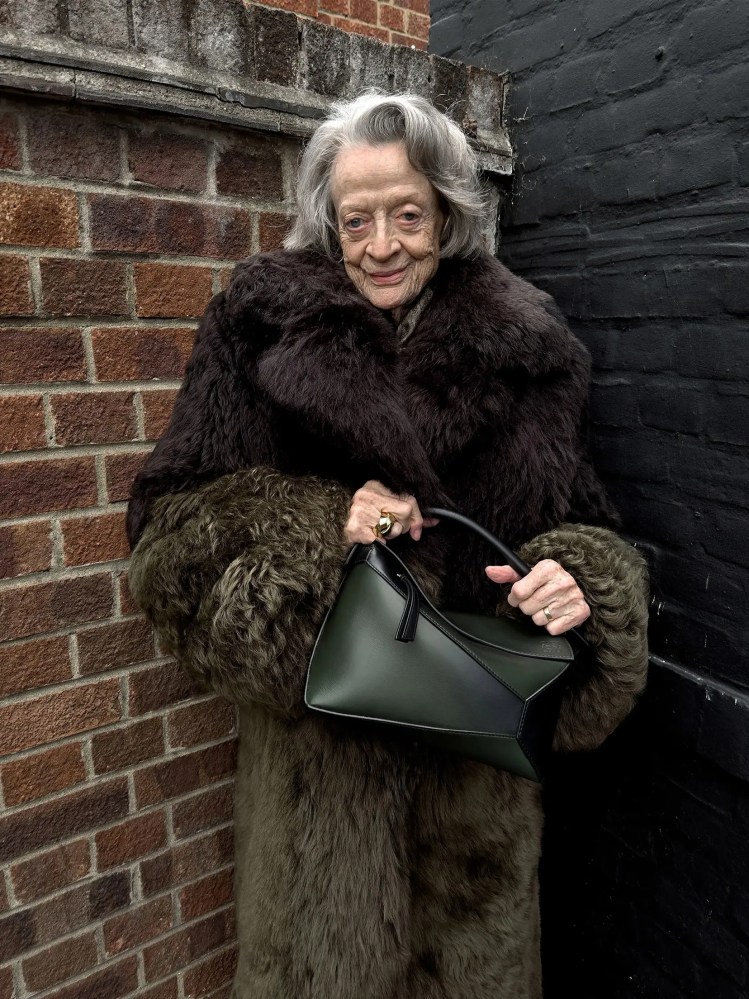
The logo and graphic language were redesigned with M/M Paris. Stores changed. Advertising changed. Casting changed. Art entered the conversation. Ceramics, furniture, sculpture, photography and architecture began to surround the clothing. Craft, previously something luxury companies tended to mention solemnly in advertisements about heritage, became central to Loewe’s contemporary identity.
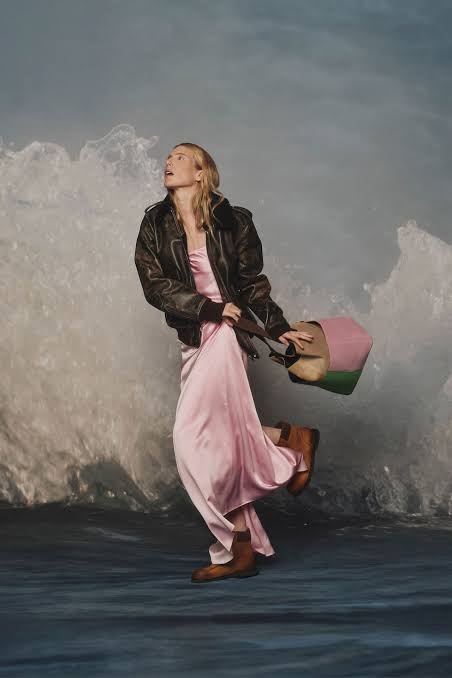
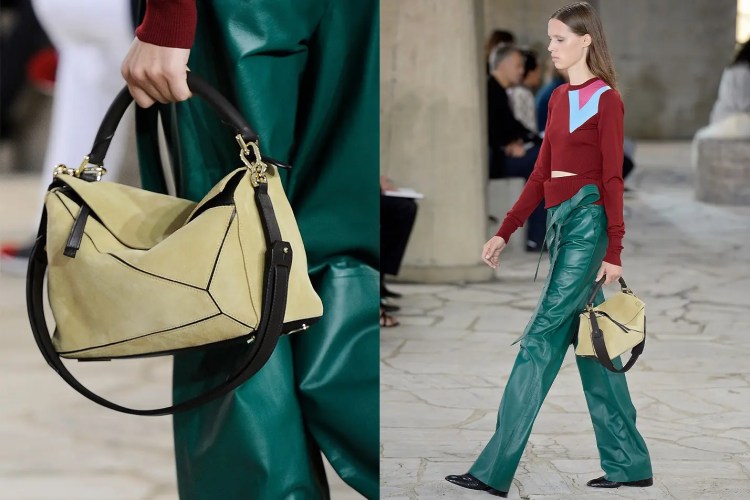
The Puzzle bag, introduced in 2015, demonstrated the commercial intelligence underneath the cultural project. Constructed from geometrically arranged leather panels, it looked distinctive without becoming ridiculous, complicated without being impractical. It became an identifiable Loewe object at precisely the point when the house needed one.
The following year Anderson established the Loewe Foundation Craft Prize, an international award celebrating contemporary craftsmanship across ceramics, wood, textiles, metal, glass, jewellery and other disciplines. This was far more consequential than a conventional luxury sponsorship. Anderson was constructing an argument about cultural value. Craft was not to be treated as the quaint predecessor of contemporary design; it was contemporary design.
This mattered because the luxury industry was becoming increasingly digital. Images circulated faster, trends accelerated, and products were consumed on screens before most people encountered them physically. Anderson moved deliberately in the opposite direction. He emphasised the hand, the irregular surface, the ceramic vessel, the woven fibre and the evidence of labour.
Yet he simultaneously proved exceptionally adept at the digital culture against which these things appeared to stand.
That contradiction became the defining brilliance of Loewe under Anderson.
THE HAND AND THE SCREEN
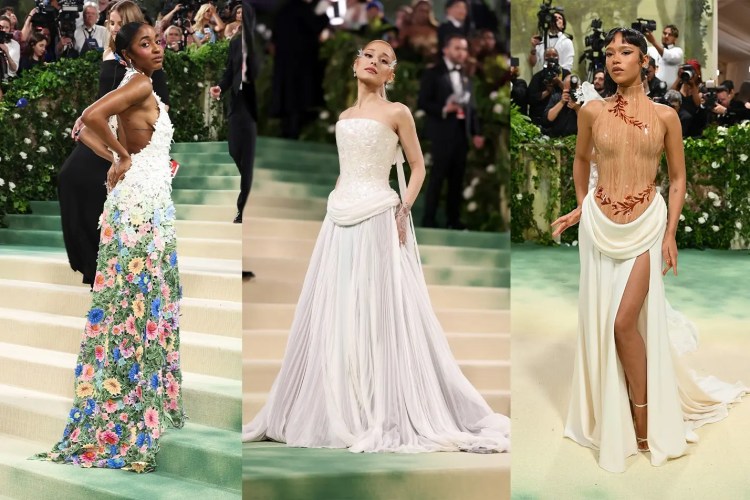
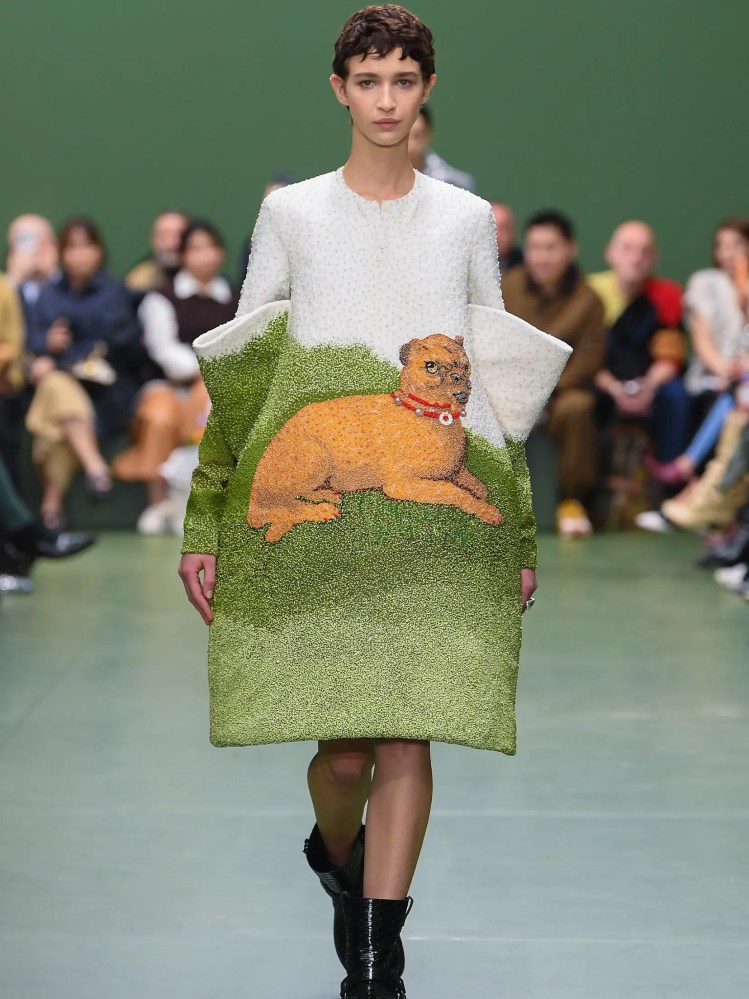
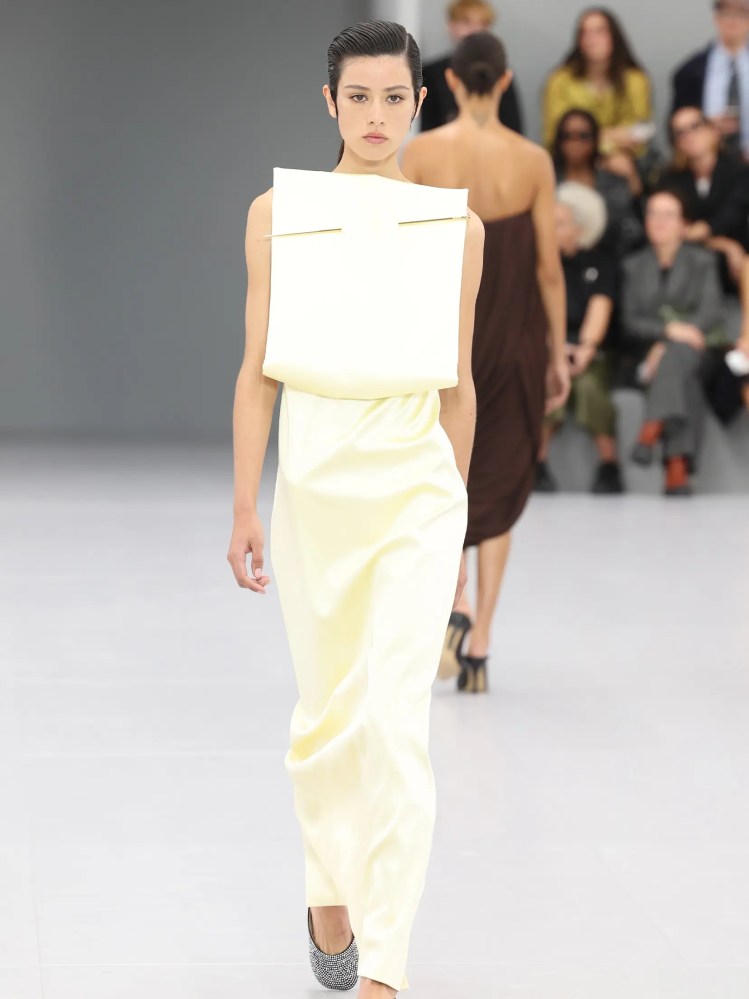
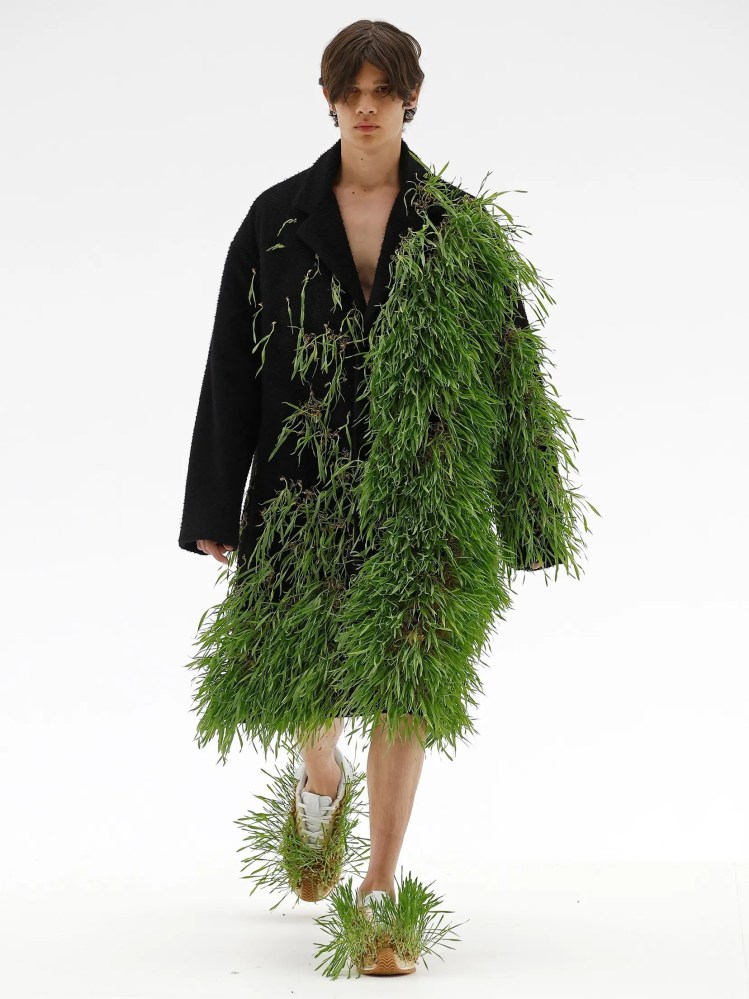
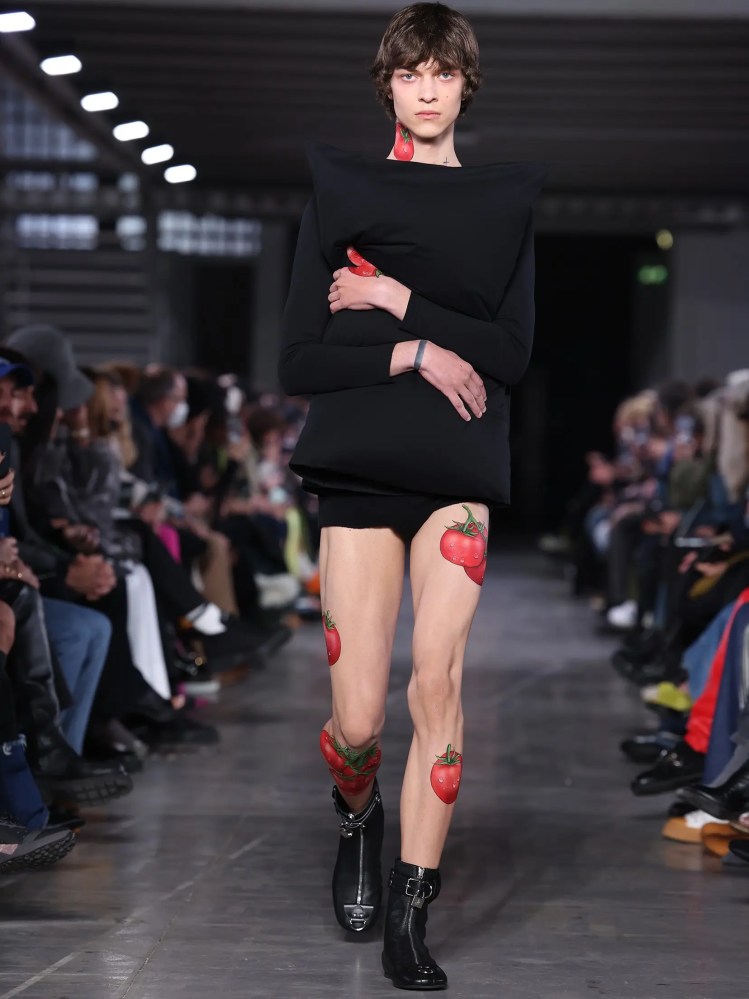
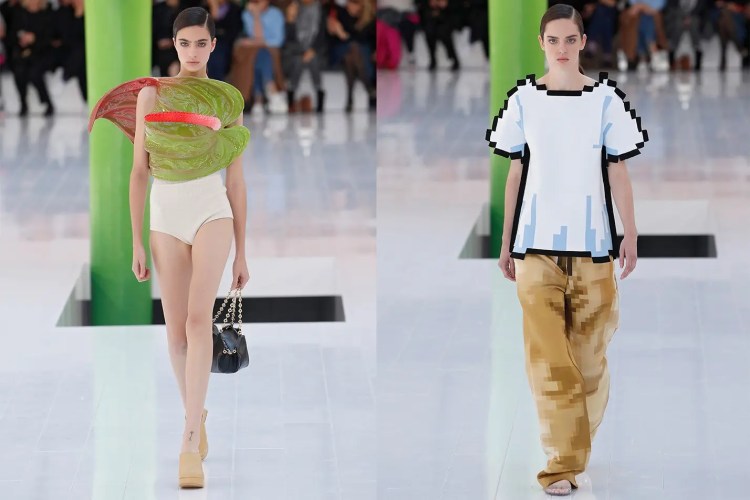
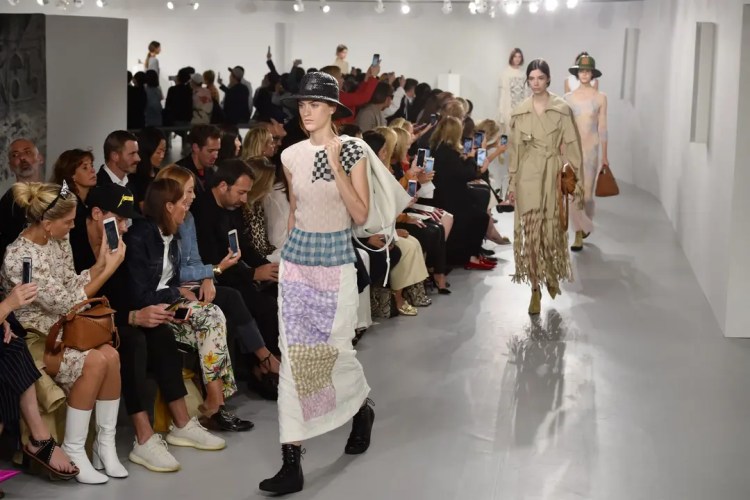
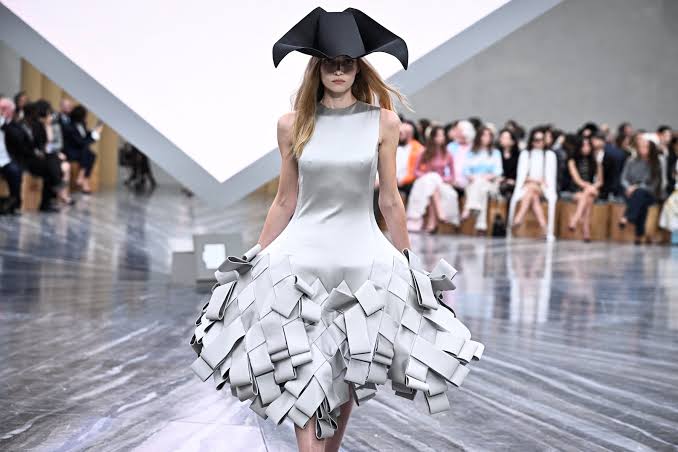
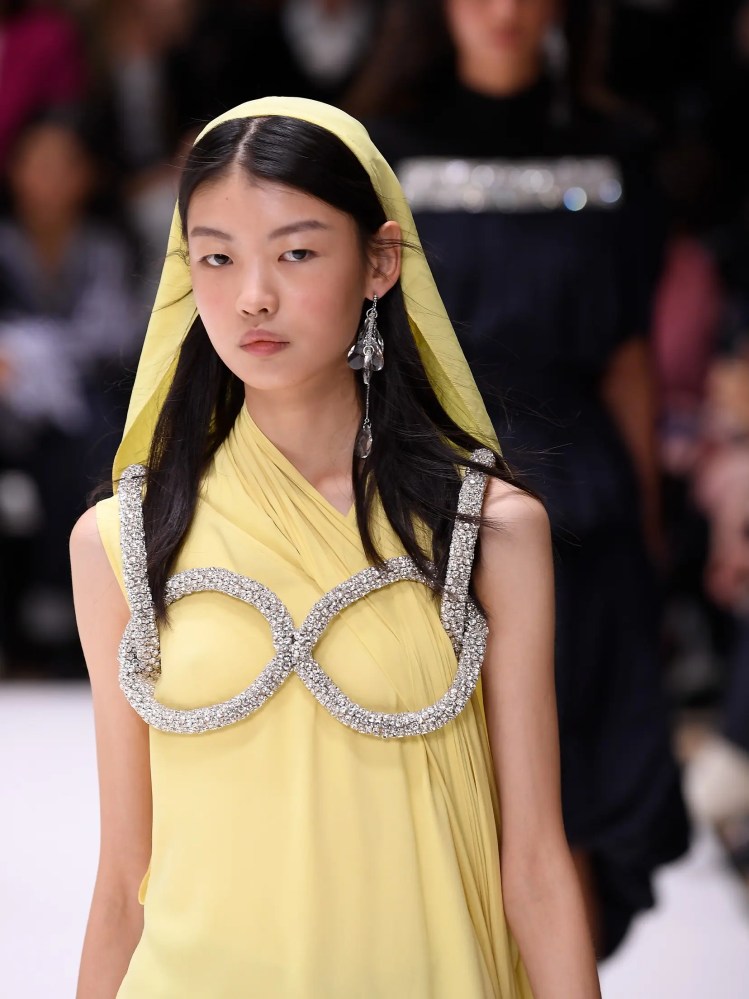
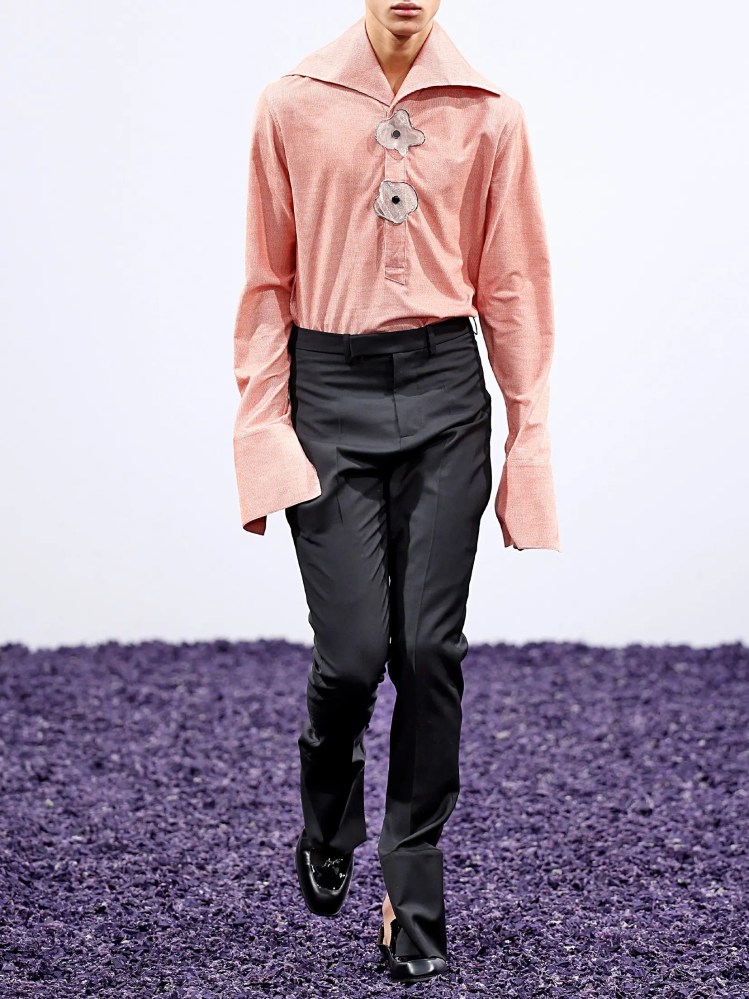
Perhaps no luxury house of the past decade balanced seriousness and absurdity as effectively as Loewe. Anderson could stage exhibitions around little-known artists and commission some of the world’s most accomplished craftspeople, then produce a dress with a car embedded in its hem. Balloons became clothing. Anthuriums turned into sculptural breastplates. Garments appeared as pixelated computer images made three-dimensional. Grass was cultivated directly onto coats and trainers.
These ideas succeeded because Anderson understood the visual economy of the internet without designing exclusively for it. The pixel clothes were instantly comprehensible in photographs, but their point concerned precisely the uncertainty between the digital and physical worlds. Fibreglass flowers looked natural and artificial simultaneously. Living plants growing from manufactured garments reversed the relationship again.
Fashion under Anderson repeatedly asked a simple question: what exactly are we looking at?
The apparent jokes were often unusually sophisticated investigations into perception. Trompe-l’oeil has existed in fashion for centuries, but Anderson understood its renewed relevance in a culture where the majority of garments are initially encountered as compressed images on small screens. A dress printed to resemble another dress, a sweatshirt apparently constructed from computer pixels, or a garment distorted almost beyond recognition becomes an inquiry into how reality is mediated.
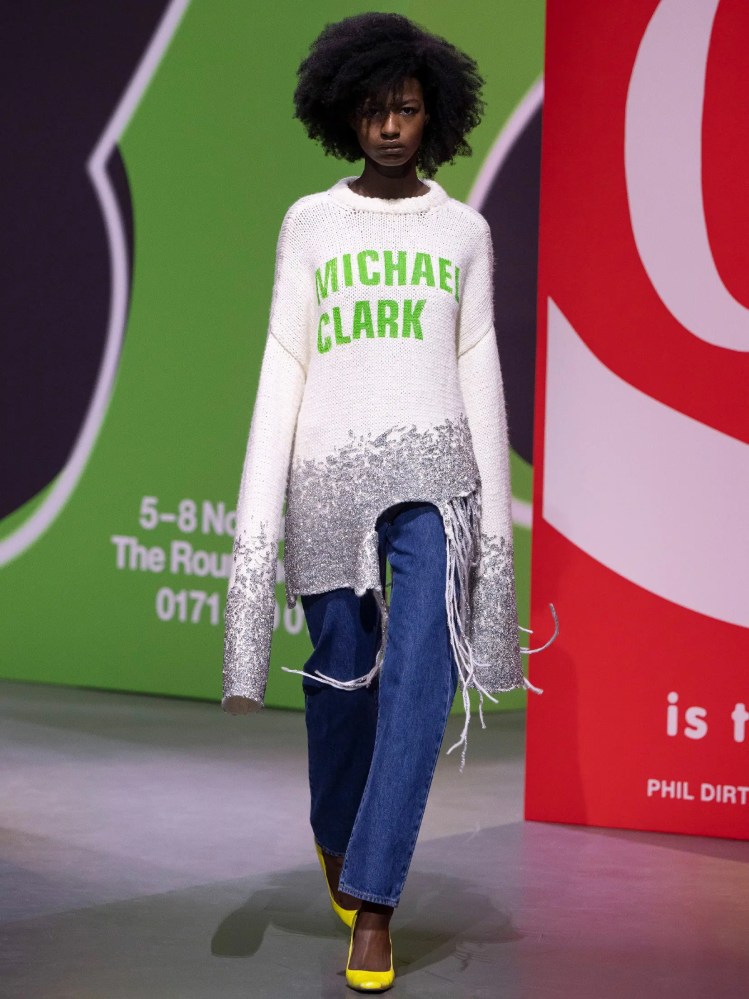
At JW Anderson, the same sensibility could produce the famous pigeon bag: an exquisitely fabricated object that also looked like something one might encounter outside a railway station. The joke involved category. Was it sculpture, accessory, souvenir, meme or luxury product? The answer was all of them, which is precisely why it worked.
Anderson never regarded virality as the opposite of intellectual seriousness. He understood that a cultural object could operate at several levels simultaneously. Someone might purchase a Loewe basket bag because it was beautiful; another might know the particular craft history behind it; another might simply recognise the Anagram on Instagram. Luxury historically depended upon exclusion. Anderson increasingly understood it as a system of multiple entrances.
The commercial consequences were extraordinary. Estimates cited by Reuters suggest that Loewe’s annual revenues grew from roughly €200 million around the time of Anderson’s arrival to approximately €1.6 billion by 2024. Lyst named Loewe the world’s hottest fashion brand in 2023 and again in 2024. The transformation was not simply the resurrection of a dormant heritage name. Anderson had demonstrated that a relatively small house could compete culturally with vastly larger brands by creating a sufficiently distinctive intellectual universe.
CULTURE AS INFRASTRUCTURE
Many fashion houses collaborate with artists. Anderson did something more ambitious at Loewe: he made artistic collaboration part of the infrastructure of the brand.
The distinction is important. Art was not simply borrowed to add prestige to handbags. Painters, sculptors, ceramicists, photographers and designers became part of an expanding network through which Loewe described itself. Anderson collected extensively himself and brought the temperament of the collector into his professional practice. Collectors do not merely accumulate. The serious ones create relationships between things.
His exhibitions and fashion shows increasingly operated according to this principle. A collection might begin with the work of an overlooked painter, a piece of eighteenth-century ceramics, domestic furniture or an apparently insignificant object. Anderson was interested not only in canonical masterpieces but in the strange residue of material culture: things that had acquired beauty through making, age, use or eccentricity.
This explains why his fashion can appear simultaneously erudite and strangely democratic. Anderson does not seem especially interested in dividing the world cleanly into high and low culture. An ancient ceramic vessel, a supermarket object, a masterpiece of modern sculpture and something faintly ridiculous can coexist. What matters is the quality of attention brought to them.
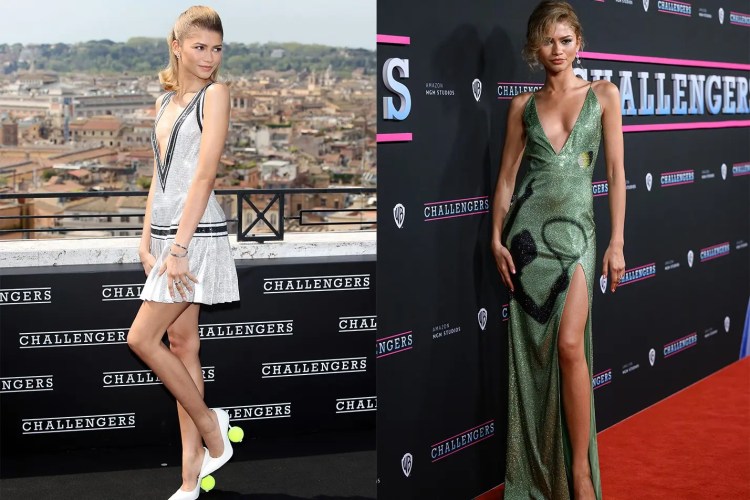
His work in cinema extended the method further. Anderson designed the costumes for Luca Guadagnino’s Challengers and subsequently Queer. The famous “I TOLD YA” T-shirt from Challengers became yet another example of his ability to move an object rapidly between fiction, fashion and popular culture. For Queer, by contrast, he immersed himself in historically appropriate garments for 1950s Mexico City. Cinema allowed him to return to the very thing that had first attracted him to clothing as a young aspiring actor: the capacity of costume to build character.
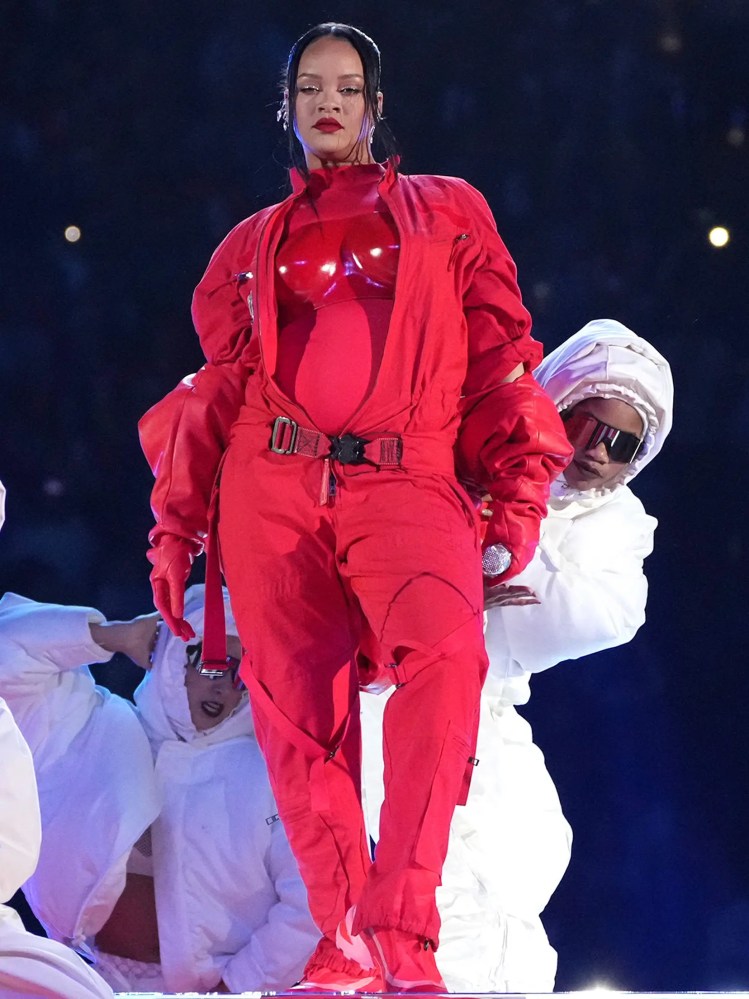
Meanwhile, Loewe increasingly appeared on some of the world’s most visible performers. Rihanna wore the house during her 2023 Super Bowl performance; Beyoncé appeared on the Renaissance tour in Anderson’s surreal bodysuit patterned with hands; Zendaya’s Challengers publicity wardrobe extended the relationship between film costume, celebrity styling and fashion into a single cultural event.
None of this was accidental. Anderson had understood that the modern fashion house is not merely a producer of seasonal collections. It is a cultural broadcasting system.
THE MERCHANT AND THE CURATOR
This capacity became even clearer after Anderson left Loewe in 2025. The obvious assumption was that the increasing demands of Dior would lead him to close or diminish JW Anderson. He did the opposite, although not by preserving the label in its existing form.
“The show is the store,” he declared when unveiling its new direction.
The runway would cease to be the organising principle. JW Anderson would instead become a world of clothes and objects shaped by Anderson’s own habits of collecting. Furniture appeared alongside garments. Wedgwood produced cups based on ancient Greek vessels in Anderson’s collection. Traditional British silver manufacturers made writing instruments. Handmade chairs, textiles, domestic objects, artworks and even food entered the proposition.
At first this might seem like yet another manifestation of the luxury industry’s endless expansion into “lifestyle”. Yet Anderson’s project is more peculiar than the usual attempt to persuade a handbag customer to purchase branded cushions. The new JW Anderson resembles the historical shopkeeper more than the contemporary lifestyle conglomerate. Its organizing principle is not that everything should bear the same logo but that everything has been chosen by the same eye.
There is something distinctly nineteenth-century about this idea and something remarkably contemporary. William Morris would have understood the desire to erase the hierarchy between a chair, textile, cup and garment. So would the great twentieth-century shopkeepers who understood retail as a form of cultural education. Anderson has described the approach as moving backwards towards the corner shop: smaller, personal, dependent upon relationships with customers rather than an endless conveyor belt of seasonal novelty.
It also reveals his commercial sophistication. Anderson recognises that the luxury industry’s old model is under pressure. Consumers are questioning relentless price increases; enormous seasonal collections create waste and fatigue; runway images are consumed and forgotten within hours. His response is not austerity but intimacy. Instead of producing more fashion, he proposes a more particular world.
This may ultimately prove one of his most influential ideas.
ENTERING THE HOUSE OF DIOR
Dior presents a considerably more dangerous challenge.
Loewe offered history without suffocating mythology. Dior is mythology. The Bar jacket, the New Look, 30 Avenue Montaigne, flowers, Versailles, haute couture and Christian Dior himself have been repeated so insistently that each new creative director confronts an enormous archive of symbols before making a single garment.
There are also the ghosts of previous designers. Yves Saint Laurent, Marc Bohan, Gianfranco Ferré, John Galliano, Raf Simons and Maria Grazia Chiuri have each produced a different interpretation of Dior womenswear, while Hedi Slimane and Kim Jones created influential menswear identities. Anderson did not inherit an empty house. He inherited one crowded with ancestors.
His appointment in 2025 nevertheless represented a profound structural change. Dior reunited menswear and womenswear under one creative director and added haute couture to Anderson’s responsibilities. The decision effectively asked one designer to construct a unified language across one of the largest luxury houses in the world.
His first menswear collection in June 2025 immediately revealed his method. Rather than obediently reproduce Dior codes, he destabilised their context. The Bar jacket met shorts and schoolboy sandals. Elaborate eighteenth-century-style embroidered coats appeared beside ordinary trousers and hiking shoes. Formality was neither destroyed nor revered; it was made available for rearrangement.
Even the pre-show communication was characteristically Anderson. Dior’s Book Tote was redesigned to resemble actual book covers, including Bram Stoker’s Dracula. Images of Jean-Michel Basquiat and Lee Radziwill photographed by Andy Warhol circulated as clues. Anderson was again building meaning through association, allowing a constellation of cultural references to surround the clothes before the collection had appeared.
His first womenswear show that October confronted Dior’s history more explicitly. Anderson commissioned Adam Curtis, the British documentary filmmaker famous for his collages of political history and media imagery, to construct a film from the house’s past. The archive became not a shrine but material to be edited. Anderson’s task, as he described it, was to negotiate reverence without becoming trapped by it.
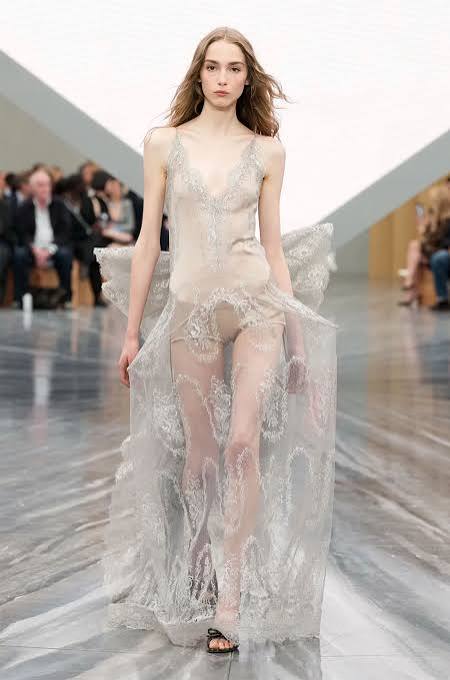
The clothes followed the same logic. Dior’s familiar femininity was present, but temporal boundaries collapsed. Historical silhouettes met polo shirts, jeans and odd proportions. Lace became lighter. Familiar house shapes were reduced, distorted or placed beside apparently mundane garments. Anderson seemed less interested in asking what Christian Dior would design today than in asking what happens when Dior’s history is forced into contact with the contemporary wardrobe.
By 2026, the experiment had become considerably more assured.
THE SOFTENING OF DIOR
Anderson’s first Dior haute couture collection in January 2026 carried an unusually poignant connection to the designer we considered in the previous chapter of this fashion history: John Galliano.
As a boy, Anderson had attempted to find Galliano in the telephone directory because he wanted to ask for an internship, only to reach a taxi business instead. Decades later, Galliano visited Anderson’s Dior studio and attended his couture debut. A bouquet of cyclamens Galliano gave him became one of the collection’s starting points.
The encounter symbolised a generational transition. Galliano’s Dior was built upon theatrical escalation: history amplified until it became spectacle. Anderson’s initial instinct was almost the reverse. Structure became lighter. Couture techniques were applied to knitwear. The monumental architecture traditionally associated with Dior was treated with a surprising degree of informality.
By the Fall 2026 ready-to-wear collection and particularly the July couture collection, this softening had become one of the clearest arguments of Anderson’s Dior. The Bar jacket, perhaps the most intimidating object in the house archive, was no longer simply reconstructed. Its rigidity was dissolved. Tailoring moved towards draping; menswear checks became extraordinarily light dressmaking materials; the historically controlled Dior body became more fluid.
This is a more radical intervention than it first appears. The original New Look depended upon architecture. Christian Dior created an idealised body through internal construction, padding, corsetry and extraordinary control of volume. Anderson is asking whether the house can preserve the memory of that silhouette while removing much of the mechanism that produced it.
In May 2026, his first Dior resort show, staged at LACMA in Los Angeles, introduced cinema into the equation. Models appeared almost as characters moving through an atmospheric set; American artist Ed Ruscha entered the visual vocabulary; glamour and everyday clothes coexisted. A month later his Spring 2027 menswear show imagined Dior as the aftermath of a privileged teenage house party, with battered formalwear, distressed jeans and displaced aristocratic codes.
The archive was no longer behaving like an archive. It had become a box of things Anderson was prepared to play with.
THE DANGER OF GOOD TASTE
There is, however, a danger in Anderson’s extraordinary success, and it is precisely the quality for which he is most admired.
Everything can become interesting when filtered through his taste.
A forgotten painter becomes fashionable. A ceramic cup becomes desirable. An old chair acquires new cultural currency. A vegetable, pigeon, balloon or lawn becomes a luxury object. A piece of rugby clothing becomes a sophisticated fashion reference. Anderson possesses the curator’s gift for conferring attention.
But curatorial power can itself become a form of authority. If everything selected by the designer enters the cultural ecosystem of a major luxury conglomerate, the distinction between discovery and appropriation becomes complicated. The artist gains visibility, certainly, but the brand also gains the cultural value of the artist. Craftsmanship is protected and celebrated, but it simultaneously becomes an extraordinarily effective language through which a multinational company sells luxury goods.
Anderson is unusually intelligent about these contradictions, which does not make them disappear. Loewe’s success demonstrated that authenticity, craft, art and internet virality can coexist profitably. That achievement will inevitably encourage less thoughtful companies to imitate the surface of the strategy without its substance. The current luxury industry’s obsession with ceramics, artisans, obscure painters, artists’ houses and cultural foundations owes something to the world Anderson helped normalise.
Dior creates a second danger: scale.
Anderson’s greatest quality at Loewe was his ability to create surprising connections. Dior requires those connections to be produced across an industrial schedule of astonishing intensity. Menswear, womenswear, couture, pre-collections, resort, accessories, advertising and global retail require constant decisions. The contemporary luxury system is capable of turning even curiosity into production.
Galliano’s history provides an uncomfortable precedent. The circumstances and personalities are radically different, but his career demonstrated what can occur when fashion converts an individual’s creative imagination into industrial infrastructure. Anderson appears far more managerial, pragmatic and resistant to the romantic mythology of the tortured designer. Nevertheless, Dior now asks an immense amount from one mind.
The question is not whether Anderson has enough ideas. He seems almost pathologically incapable of running out of them. The question is whether an industry that discovers a particularly fertile imagination knows how not to exhaust it.
TASTE AS INTELLIGENCE
Jonathan Anderson’s importance ultimately lies in the fact that he has expanded our idea of what fashion intelligence looks like.
Galliano’s genius was narrative. McQueen’s was emotional and technical. Lagerfeld possessed extraordinary speed and cultural fluency. Miuccia Prada developed one of fashion’s most sophisticated languages of aesthetic contradiction. Anderson belongs to this lineage but operates differently. His principal medium may not finally be clothing at all. It may be context.
He understands that value changes according to proximity. Put an eighteenth-century object beside something mass-produced and both become visible in a new way. Place a great work of craftsmanship beside an internet joke and neither necessarily diminishes the other. Put a Bar jacket over something almost aggressively ordinary and the jacket can suddenly be seen again rather than merely recognised.
This is why describing Anderson simply as a provocateur misses the point. Provocation seeks reaction. Anderson more often seeks reconsideration. His clothes frequently begin with recognisable archetypes — the rugby shirt, the cardigan, the trench coat, jeans, the evening dress — because familiarity gives him something to disturb. The resulting strangeness forces attention back onto an object we had ceased properly to notice.
It is also why his extraordinary commercial success should not be treated as evidence against his intellectual seriousness. Anderson understands desire too well for that distinction to be useful. Fashion has always existed in commerce; Christian Dior himself built an international licensing business with remarkable speed. The relevant question is whether commerce merely distributes an idea or begins to replace it. Thus far, Anderson has demonstrated an unusual ability to make the two reinforce one another.
His achievement at Loewe was to turn craftsmanship into modernity without making it nostalgic, art into branding without entirely trivialising it, and internet culture into fashion without allowing the clothes to become memes alone. His reconstruction of JW Anderson suggests that he is already questioning the system that made him successful. Dior now offers the largest test of all: whether an institution of almost unimaginable scale can retain the curiosity, humour and eccentricity upon which his work depends.
There is something fitting about Galliano sitting in the front row of Anderson’s first Dior couture show. The two designers belong to different conceptions of the fashion auteur. Galliano entered the great house and enlarged himself until designer and institution became almost indistinguishable; Anderson has entered it as a collector might enter an enormous inherited house, opening cupboards, moving furniture, finding forgotten objects and wondering whether anything really needs to remain where somebody else placed it.
For the moment, this makes him the most compelling designer working at fashion’s highest institutional level. He understands history without becoming obedient to it and commerce without appearing embarrassed by it. He is capable of treating craft with seriousness and popular culture with curiosity, while recognising that contemporary life has rendered the old hierarchy between the two increasingly artificial.
The intelligence of Anderson’s work lies precisely there. In a culture obsessed with unprecedented novelty, he understands that very little is genuinely new; objects, images and histories continually return in altered configurations. The creative act lies not necessarily in inventing a world from nothing but in looking at the world already around us with sufficient acuity to rearrange it. At Loewe he demonstrated how powerful that method could become. At Dior, with the resources and history of one of fashion’s greatest houses now placed in his hands, he is discovering just how far it can go.
SOURCES / READ MORE
Vogue, “Radical Chic: Inside Jonathan Anderson’s Modern Vision for Dior,” January 2026. (Vogue)
Vogue Runway, Christian Dior Spring 2026 Haute Couture, Fall 2026 Ready-to-Wear, Fall 2026 Haute Couture and Resort 2027. (Vogue)
Vogue Runway, Dior Men Spring 2026 and Spring 2027. (Vogue)
Loewe, official history of the house and Jonathan Anderson’s tenure, including the Puzzle bag and Loewe Foundation Craft Prize. (Loewe)
Vogue, “Jonathan Anderson’s Loewe Was a Story of Contradictions,” and Loewe runway archive. (Vogue)
Reuters, reporting on Anderson’s departure from Loewe and estimates of the house’s commercial growth during his tenure. (Reuters)
Lyst Index, Loewe’s position as the world’s hottest fashion brand in 2023 and 2024. (Lyst)
British Fashion Council, Jonathan Anderson’s career milestones and Designer of the Year awards, 2023–2025. (British Fashion Council)
Vogue, “What JW Anderson’s Rebrand Says About the Future of Luxury,” and JW Anderson Resort 2026. (Vogue)
JW Anderson, current craft and lifestyle programme, including Wedgwood ceramics and British-made objects. (JW Anderson)
Vogue, Jonathan Anderson on designing the costumes for Queer, and coverage of his work on Challengers. (Vogue)
Discover more from My World of Interiors
Subscribe to get the latest posts sent to your email.

