
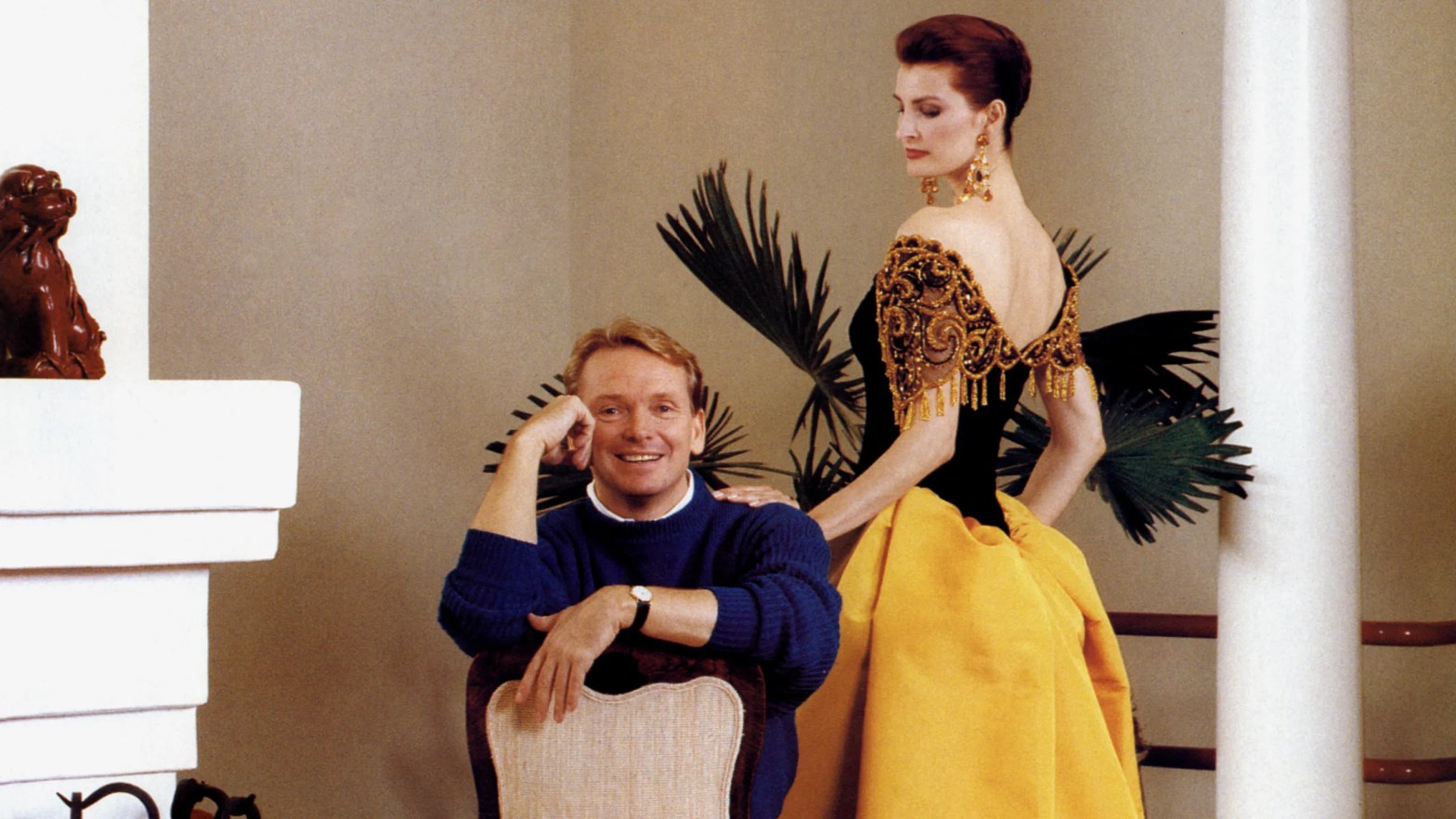
The Sultan of Sequins
Bob Mackie, who died on 14 September 2026 at the age of eighty-seven, dressed the century’s most luminous performers in the most theatrical clothes ever made for a body. He understood, better than almost anyone in the history of costume, that a great dress was not decoration but transformation — that what a woman wore on stage could change what was possible for her there. The rhinestones were not the point. They were just how you could see the point from the back row.
By Bergotte
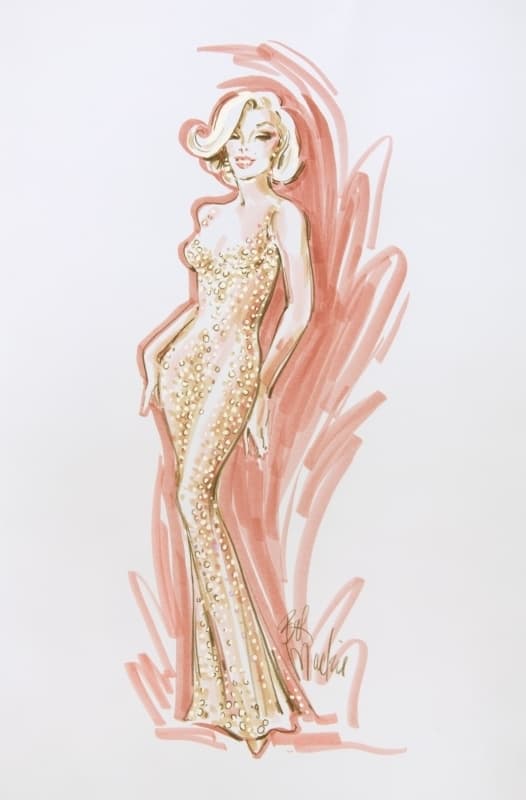
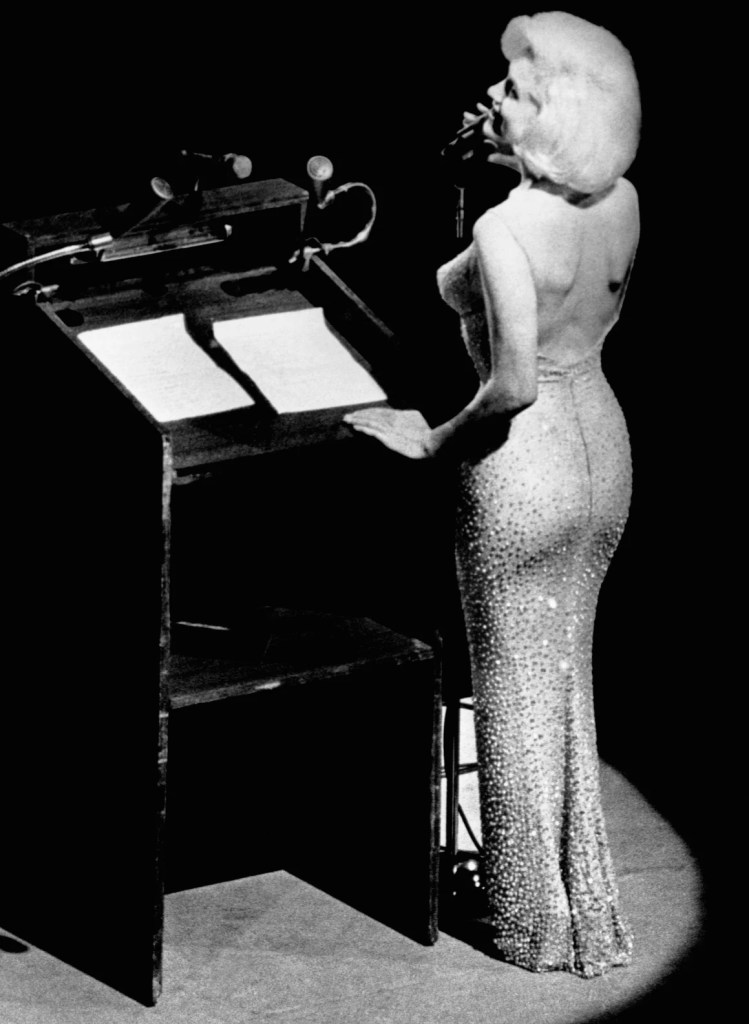
In the spring of 1962, at Madison Square Garden in New York, Marilyn Monroe walked onto a stage in a dress that appeared, from the audience, to consist entirely of light. It was flesh-toned, skin-tight, sewn with more than six thousand hand-stitched rhinestones, cut so close to the body it had to be sewn onto the wearer rather than fastened in any conventional sense. Monroe sang Happy Birthday to the President of the United States in a voice of such deliberate, ruinous softness that the joke and the seduction and the melancholy were all present simultaneously, and the dress was part of what made all three possible at once — the dress that made the body simultaneously present and absent, there and mythologised, real and entirely constructed. The dress was designed by Jean Louis. The sketch that made it possible was drawn by a twenty-three-year-old assistant named Bob Mackie, who was working his way through the ranks of Hollywood’s great costumers and who was, in that sketch, already fully formed: already the designer who understood that the costume was not what the performer wore but what the performer became.
Mackie died on Monday 14 September 2026 at a hospital in Palm Springs, California, of pneumonia. He was eighty-seven years old. He had been working for more than sixty years — had dressed Carol Burnett for the entire eleven-season run of her variety show, had created with Cher a body of costume work that constitutes the most sustained and most spectacular collaboration between a designer and a performer in the history of American entertainment, had clothed Tina Turner and Diana Ross and Liza Minnelli and Barbra Streisand and Bette Midler and Elton John and Bernadette Peters and Mitzi Gaynor and Bernadette Peters and Dolly Parton and a hundred others in the beads and sequins and feathers and sheer fabrics and extraordinary silhouettes that became, over five decades, the visual language of what it looked like when a performer was fully, completely, unapologetically themselves. He had won nine Emmy Awards from thirty-two nominations. He had been nominated three times for the Academy Award. He had won the Tony in 2019 for his costume design for The Cher Show, the musical that celebrated the career of the woman with whom his name would always be most completely identified.
Carol Burnett, who had chosen him in 1967 to costume her new variety show and who had worked with him for the following eleven years in one of the most productive relationships between a performer and a designer in television history, wrote on the day of his death: Bob did it all. There was no one like him. Cher wrote: My dear Bob has gone up to heaven. Knowing him, he’s bringing sequins, beads, and his sketch pad. Good night, sweet Prince. These are not the tributes of performers being polite about a collaborator. They are the tributes of women who understood, from direct experience, what it meant to be dressed by someone who genuinely saw them — who understood what they were capable of and built the costume around the capability rather than around the convention.
Monterey Park, 1939
Robert Gordon Mackie was born on 24 March 1939 in Monterey Park, a suburb of Los Angeles, and raised primarily by his grandparents after his parents separated — a childhood formation in the specific culture of Southern California in the 1940s, where the cinema was the primary visual education available and where the screen was the place where the most extraordinary things happened to the most extraordinary-looking people in the most extraordinary clothes. He loved to draw from childhood, and the transition from drawing generally to drawing clothes specifically was, by his account, a natural and early one: the discovery, at the movies, that the extraordinary things that happened on screen happened in a specific visual vocabulary that someone had designed, that costume designer was a job, was the moment that determined the rest of his life. He never seriously wavered from it.
He attended Pasadena City College and then the Chouinard Art Institute — which would eventually become the California Institute of the Arts — before dropping out in 1961 to work as a costume sketch artist, the entry-level position in Hollywood’s established hierarchy of costume production. The sketch artist drew what the designer conceived, translating the idea into the precise visual record that the workroom needed to execute it — a position that required not merely facility with the pencil but a thorough understanding of construction and fabric and the relationship between a drawn line and a three-dimensional garment. Mackie brought all of these to the job from the beginning, and the facility and the understanding together produced sketches of such quality that they came to the attention of the people who were hiring.
His first major position was as assistant to Jean Louis, whose atelier was producing some of the most technically accomplished costume work in Hollywood, and it was in this position that he drew the sketch for the Monroe birthday dress — a sketch that required understanding, from the drawing, how the finished garment would move on a specific body, how the rhinestones would catch the light at the specific angle of the specific stage, how the fit would be achieved with sufficient precision to make the seamlessness possible. These are not simple things to understand from a drawing. Mackie understood them. The dress proved it.
He also trained under Edith Head, the eight-time Academy Award winner whose understanding of the relationship between the costume and the performer was as sophisticated as anyone’s in the history of Hollywood, and the formation that Head provided — the insistence on the costume as a character decision rather than a decorative one, on the dress as something that told the audience who the person wearing it was before she spoke a word — ran through Mackie’s work throughout his career, visible most clearly in the moments when his most theatrical instincts were most fully deployed. The rhinestones were always in the service of something. The sequins were always saying something. The feathers always had a reason.
Carol Burnett and the Education of Television
In 1967, Carol Burnett chose Mackie to costume her new CBS variety show, and the choice changed both of their careers. The Carol Burnett Show ran from 1967 to 1978, eleven seasons, and across those eleven seasons Mackie designed thousands of costumes — for the sketches, for the musical numbers, for the guest stars, for the recurring characters — in a sustained exercise of comedic and theatrical intelligence that constituted his most complete education in the specific discipline he was mastering: the costume that served the performer’s intention rather than the designer’s vanity, that made the laugh land and the song soar and the character legible from the back of the studio without ever making the audience aware that they were looking at a design decision rather than at a person.
The Carol Burnett Show was comedy, primarily, and the comedy costume has specific requirements that the drama costume and the concert costume do not share. It has to be funny, or at least capable of being funny, which means that it has to be legible enough to register immediately — the audience has to know what they are looking at before the joke arrives — while being specific enough to have a point of view rather than merely a category. The Charwoman, Burnett’s recurring cleaning lady character, wore a costume of deliberate dowdiness that was, in Mackie’s hands, as precisely calibrated as any of the elaborate gowns he produced for the show’s musical sequences: every element of the frumpy housedress and the bucket and the mop chosen to reinforce the character’s specific quality of defeated dignity, of the person who is doing their best in circumstances that do not reward it.
The famous Scarlett O’Hara parody — Burnett descending the staircase wearing curtains, the curtain rod still across her shoulders — required Mackie to make a costume that was simultaneously a perfect replica of the Gone with the Wind dress and an instant visual joke, that communicated both the original and the parody at the same time, that the audience understood immediately and completely in the fraction of a second before the laugh. This is a precision instrument, not a party costume. It required the same quality of thought that the most serious couture required, applied to a completely different purpose, with results that were, in their way, equally impressive.
He won five of his nine Emmy Awards for his work on The Carol Burnett Show. The five seem, in retrospect, like the minimum the work deserved.
Cher and the Life’s Work
The collaboration with Cher began in 1971, when she and Sonny Bono launched The Sonny and Cher Comedy Hour on CBS, and it continued — through the divorce and the solo variety show and the film career and the concert tours and the red carpets and the decades of reinvention — until Mackie’s death. It is the central creative relationship of his career and one of the great sustained collaborations between a designer and a performer in the history of entertainment, comparable in its longevity and its mutual productivity to the relationships between Balenciaga and his clients, between Yves Saint Laurent and Catherine Deneuve, between Givenchy and Audrey Hepburn — except that none of those comparisons quite captures what Mackie and Cher were doing together, because the scale and the theatricality and the specific joy of their work has no precise parallel in the fashion world’s more restrained register.
What Mackie understood about Cher was what the best costume designers understand about the performers they dress: that the costume was not applied to the performer from outside but grew from an understanding of what the performer was and what they were capable of, that the dress was an extension of the performer’s identity rather than a disguise applied over it. Cher was, throughout her career, an artist of extreme physical self-presentation — a woman who understood that what she wore was as much a part of her artistic statement as what she sang, that the body and its clothing were the medium through which she communicated most directly with her audience. Mackie gave that understanding its most complete physical form: he made the costumes that let Cher be the most Cher it was possible to be, that took the performer’s instinct for the theatrical and the spectacular and the self-revelatory and gave it the craft and the precision it needed to work at the scale she was working at.
The nude illusion gowns — the sheer fabrics beaded and sequined in patterns that simultaneously revealed and concealed the body, that made the skin and the dress into a single designed surface — were his most distinctive formal innovation and his most culturally significant one. They arrived, in the 1970s, at a moment when the relationship between the female body and its public presentation was being renegotiated across the culture — when the question of what a woman was allowed to show and how she was allowed to show it was genuinely contested, when the conventions that had governed the presentation of the female body in entertainment were being challenged and sometimes broken. Mackie’s nude illusion gowns were part of this renegotiation, not in the theoretical vocabulary of feminism but in the practical vocabulary of the performer on stage: they said, in the most direct visual language available, that this woman’s body was hers to present as she chose, that the choice to be spectacular was not the same as the choice to be available, that glamour and autonomy were not in opposition.
The 1974 Academy Awards dress — a sheer confection of beads and feathers that made Cher, presenting alongside Tatum O’Neal, the most photographed person in the room by a considerable margin — is the single image most people reach for when they reach for Mackie and Cher together, and it is not a wrong image to reach for. But it is one image from a relationship that produced hundreds of equally extraordinary ones, across fifty years, and the relationship is more interesting than any single image it generated. It was, in the deepest sense, a creative partnership: two people who understood what they were making together and who kept making it, with full conviction and full seriousness, for longer than most creative partnerships manage to sustain themselves.
The Craft and Its Demands
The word glamour, applied to Mackie’s work as frequently as it is, tends to obscure rather than illuminate what the work actually required. Glamour suggests surface — the glittering exterior, the dazzling effect, the impression created in the eye of the beholder. What produced the glamour was something less immediately legible and considerably more demanding: the technical intelligence of the couture atelier applied to the specific requirements of the stage and the television studio, the understanding of how a garment moved under performance conditions, how the beading distributed its weight across the structure of the dress, how the sheer fabric could be cut to reveal and conceal simultaneously without the cutting showing, how the silhouette read from the twentieth row of a concert hall as well as from the first.
Mackie was, by every account of the people who worked with him, a designer of exceptional technical knowledge — someone who understood the construction of a garment from the inside out, who could work with the workroom as a fellow craftsperson rather than as an authority issuing instructions from above. The sketch that began each design was the starting point rather than the finished statement, and the conversation between the sketch and the execution, between what he drew and what could be made, was a conversation in which he participated at every stage with full technical engagement. The nine Emmys were given for costume design. They were earned by costume making, which is a different and more demanding thing.
He was also, through all of this, unfailingly kind — a quality that the people who worked with him and for him returned to consistently in their tributes on the day of his death. The fashion world and the entertainment world are not always environments that reward kindness, and the designer who is also a generous collaborator, who makes the people around him feel capable rather than diminished, is a rarer figure than the technical brilliance alone would require. Mackie was this figure. The tribute from Coco Rocha — that she had the privilege of not only wearing his extraordinary creations but working alongside him and getting to know the wonderful man behind all that glamour — speaks to something that the clothes alone cannot communicate but that the clothes, in some sense, expressed: the generosity of spirit that produced work whose purpose was always to make someone else more completely themselves.
The Legacy in the Light
In the series this essay belongs to, we have written about designers who worked in concrete and in glass and in pressed steel and in bent plywood and in chrome spheres and in lacquered wood and in latex blocks — about people who shaped the physical world with every material the physical world offered, in pursuit of the same underlying ambition: to make something that served the human being who encountered it fully and without condescension, that took seriously the quality of the experience of the person inside the building or the room or the car or the lamp’s pool of light.
Mackie worked in rhinestones and feathers and sheer beaded fabric, which are not materials that the design world’s serious precincts typically discuss in the same register as concrete and glass. They should. The intelligence required to understand what a performer needed and to give it to them in a garment that would survive performance conditions and serve the purpose of the performance and make the audience feel what the performer intended them to feel is not a lesser form of design intelligence than the intelligence required to design a building or a lamp or a chair. It is the same intelligence, applied to a different problem, with different materials, at a different scale. The problem was: how do you help a human being be fully what they are, in the specific conditions of the stage, in front of an audience that needs to see and feel it? Mackie solved this problem, with full craft and full seriousness and extraordinary technical skill, for sixty years and for some of the most gifted performers the entertainment world has produced.
The rhinestones caught the light. The light reached the back row. The audience saw what was there. This is what design is for. Bob Mackie knew it better than almost anyone.
Bob Mackie. Monterey Park, 24 March 1939 — Palm Springs, 14 September 2026.
Discover more from My World of Interiors
Subscribe to get the latest posts sent to your email.

