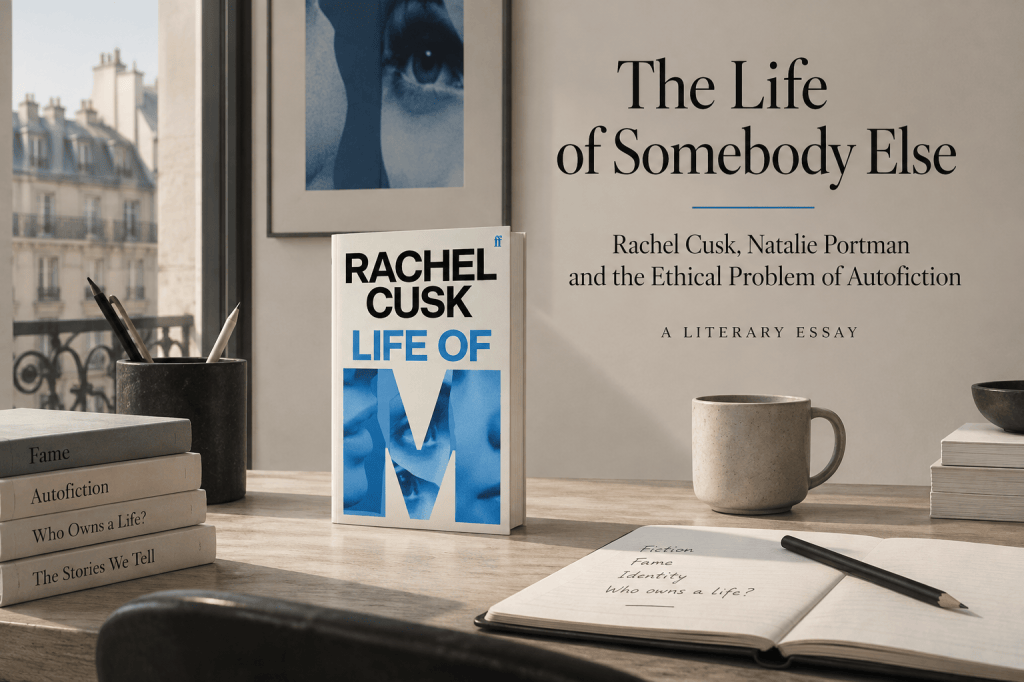
Rachel Cusk, Natalie Portman and the Ethical Problem of Autofiction
Rachel Cusk’s Life of M has produced one of the strangest literary controversies of the year. Its famous actress is fictional, yet recognisably assembled from details belonging to Natalie Portman. The resulting argument is larger than celebrity gossip: it asks who owns a life, what fiction is permitted to borrow, and whether the novelist’s traditional defence — that a character is never identical to the person who inspired it — still works when recognition has become part of the book’s machinery.
Rachel Cusk has spent much of her career dismantling the assumption that a human being can be securely represented. The conventional novel depends upon character: the belief that a person possesses a coherent interior self that can be observed, described and ultimately understood. Cusk’s mature fiction has repeatedly treated that assumption with suspicion. In the Outline trilogy, the narrator Faye becomes deliberately recessive, allowing other people to narrate themselves while remaining peculiarly elusive herself. In Second Place and Parade, identity becomes unstable, art rearranges relationships, and the distinction between the person one is and the role one performs becomes increasingly difficult to maintain.
Her new novel, Life of M, appears at first to continue this project. M is a celebrated actress whose existence has become so publicly available that it no longer seems entirely to belong to her. She is recognised before she can introduce herself, turned into an image before she can arrive as a person, and obliged to inhabit the peculiar division between private consciousness and public figure. Fame becomes not simply a condition of excessive visibility but a crisis of personhood.
The complication, and the reason the novel has generated an unusual amount of attention outside the ordinary sphere of literary criticism, is that M is very difficult not to recognise as Natalie Portman. The similarities are not simply generic features of celebrity. M becomes famous as a child in a film whose sexual implications trouble her parents; her mother intervenes in the material; she is bullied afterwards; and later she appears in a psychologically extreme film about a ballerina. Portman began her screen career as a child in Léon: The Professional, has spoken about the sexualisation that followed, and later won an Academy Award for Black Swan. Portman and Cusk also both live in Paris, have encountered one another socially, and Portman has previously expressed admiration for Cusk’s writing.
None of this proves that M “is” Natalie Portman in any uncomplicated sense. Fiction has never worked so neatly. A character may begin in observation and become composite, altered, exaggerated or entirely detached from the person who provided the original spark. Yet the density of recognisable detail creates another problem: what happens when a novelist borrows enough of a living person’s biography to guarantee recognition and then claims the freedom to invent everything that recognition appears to authenticate?
That is where Life of M becomes considerably more interesting than the gossip surrounding it.
Is This Actually Autofiction?
The word autofiction has been stretched so broadly over the past two decades that it now risks describing almost any fiction contaminated by life. Originally associated with writers placing recognisable versions of themselves inside fictional structures, the form has become one of contemporary literature’s dominant modes. Annie Ernaux reconstructs personal experience through memory and social analysis; Karl Ove Knausgård subjects his life and family to extreme documentary attention; Sheila Heti and Ben Lerner allow the authorial self to hover visibly inside their novels while refusing the contractual certainty of memoir.
Cusk belongs naturally within this history. Her memoirs about motherhood and divorce made private experience brutally public, and the criticism they generated profoundly influenced the fiction that followed. The Outline books can partly be understood as an elegant solution to the problem of autobiographical exposure: the authorial self remains present while becoming structurally difficult to locate.
Yet Life of M complicates the category because the recognisable life at its centre does not principally belong to the author. Traditional autofiction carries a peculiar ethical justification: however many other people are inevitably exposed, the writer is presumed to be taking the greatest risk with herself. The author puts her own vanity, memory, family history and contradictions into circulation. In Life of M, by contrast, the conspicuously recognisable biographical architecture belongs to another woman, while the novelist retains considerably greater freedom to determine what that architecture means.
The novel therefore sits uneasily between autofiction, fictional biography and the roman à clef, that older form in which real people appear behind fictional names. What makes Cusk’s case more intellectually complicated is that the instability of the relationship between model and character is itself one of the book’s subjects. She is not simply disguising a real person. She is asking whether the idea of a stable “real person” can survive representation in the first place.
That is a serious philosophical question. It is not, however, an automatic ethical defence.
Recognition Is Part of the Method
Novelists have always borrowed from life. Dickens, Proust, Woolf, Hemingway and countless others transformed acquaintances, lovers, relatives and enemies into fictional material, while readers have always enjoyed identifying originals behind invented characters. The traffic between observation and invention is one of the foundations of the novel.
What makes Life of M unusual is the degree to which recognisability becomes part of the reading experience before the novel asks us to distrust recognition itself. The Portman parallels are specific enough that critics identified them almost immediately. Once the reader makes that association, everything that follows is affected by it. Descriptions of M’s emotional limitations, privileges, habits and social behaviour inevitably begin to acquire the force of insinuation, even when the psychological material may have been wholly invented.
The factual details therefore do something important. They create an atmosphere of authenticity around material whose truth status is unknowable. Because some aspects of the biography are recognisable, invented elements can begin to feel adjacent to knowledge. Fiction gains a peculiar authority through proximity to fact.
This is where the familiar defence that fiction transforms reality becomes less convincing. Of course fiction transforms; without transformation it would merely be transcription. But transformation does not erase the reader’s knowledge of the original. When enough biographical fingerprints remain to make recognition possible, the relationship between reality and invention becomes part of the work’s aesthetic effect.
The novel cannot comfortably benefit from recognition while simultaneously declaring recognition beside the point.
What Does Cusk Do to M?
The ethical problem would be considerably weaker if M were merely identifiable. Fictional versions of living people are hardly unusual. The difficulty lies in the nature of the portrait to which that recognisability becomes attached.
Several reviewers have observed that M is represented as strangely deficient in forms of ordinary emotional reciprocity. She often appears remote from experiences that other people take for granted, shaped by fame to such an extent that authenticity itself has become difficult to locate. Acts of apparent generosity can appear selected rather than instinctive, and ordinary vulnerability sometimes seems to exist beyond her field of comprehension. Parul Sehgal’s particularly severe reading of the book argues that Cusk’s actress comes across as pampered, emotionally vacant and almost incapable of meaningful human relation.
Other critics have been considerably more sympathetic to the novel. The Los Angeles Times, for instance, has argued that reducing M to a disguised Portman portrait misses Cusk’s real subject: the widening gulf between public persona and private self, a phenomenon intensified by celebrity but increasingly generalised through social media. Vanity Fair has similarly suggested that the novel may be less interested in revealing Portman than in examining the cultural idea of Natalie Portman — the intelligent, beautiful, highly controlled actress who has become a projection surface for assumptions about fame, intellect, femininity and privilege.
Those readings need not cancel one another. Cusk may genuinely be interested in fame as a philosophical condition rather than in Portman as a personality. But she has nevertheless chosen Portman’s recognisable biography as the vessel through which that philosophy becomes concrete. Portman may not be the novel’s ultimate subject, yet something recognisable about her life supplies much of the material through which its questions acquire urgency.
The ethical issue therefore becomes less whether M “really is” Natalie Portman than whether the novelist can use another person’s recognisability while denying that the judgments attached to the resulting character have anything to do with her.
The Novelist’s Traditional Alibi
Fiction gives writers a defence unavailable to journalists and biographers. A biographer can be challenged on evidence, and a journalist can be asked to substantiate a claim. The novelist may answer that the work is invented. Similarity is not identity, and fictional people necessarily emerge from combinations of observation, imagination, exaggeration and transformation.
There are excellent reasons to protect this freedom. Literature would become impoverished almost immediately if writers could draw only upon experiences entirely detached from people they had encountered. Human beings learn about one another by watching one another, and fiction has always depended upon the conversion of observed life into imaginative form.
The defence becomes more complicated, however, when factual specificity helps create precisely the identification the novelist later disclaims. If M were given a completely different childhood, filmography and personal history, Cusk could still examine celebrity, selfhood and the estrangement between public and private identity. The recognisable Portman details therefore perform an additional function. They create the pleasurable and unsettling sense that the novel may contain privileged knowledge about somebody we already know.
That sensation has commercial as well as aesthetic value. Life of M has generated a level of mainstream media attention unusual for formally demanding literary fiction, and the Portman question has supplied journalists with an irresistible entry point. The Guardian’s description of the phenomenon as “biogossip” may be slightly flippant, but it captures something important about the way literary prestige and celebrity recognition have converged around the novel.
There is consequently an uncomfortable possibility at its centre. Cusk may be critiquing our appetite for celebrity speculation while relying upon precisely that appetite to create some of the book’s electricity.
The Novel That Contains Its Own Accusation
Cusk is far too intelligent not to understand the problem, and Life of M eventually makes the ethical objection part of the fiction itself. Near the end, M confronts the writer over the way she has been represented. She objects that recognisable elements of her life have been retained while experiences and characteristics she does not recognise have been attached to them. The authorial response is essentially the novelist’s traditional defence: the character is not M and, ultimately, “isn’t anyone.”
Cusk has described the ending as an attempt to make the novel almost self-destruct, forcing the reader to reconsider the stability of everything that preceded it. Formally, the device is clever because the book becomes aware of its own potential violation. The fictional subject is allowed to challenge the authority that has constructed her.
Ethically, however, self-awareness does not automatically resolve anything. Anticipating an accusation is not the same as answering it. Contemporary fiction has become increasingly adept at internalising the criticism that might otherwise be levelled against it, as though the novelist’s acknowledgement of an ethical difficulty converts the difficulty into a formal achievement.
It certainly can become a formal achievement, but artistic sophistication and ethical innocence are different matters. A writer may understand perfectly that transforming a recognisable person into fiction can cause discomfort or harm. Turning that discomfort into additional material enriches the artwork while potentially extending the original act of appropriation.
The situation becomes especially peculiar because any objection made by the real-life subject has effectively been anticipated inside the novel. If Portman were publicly to say that M bears no resemblance to her actual personality, the book has already incorporated a fictional version of that protest. Cusk has created an interpretive structure capable of absorbing its own prosecution.
That is an extraordinary degree of authorial power.
Who Owns a Famous Life?
Celebrity makes the ethical question more difficult because famous people already exist within a culture of collective appropriation. A movie star’s face is reproduced millions of times; interviews turn private history into public narrative; fashion houses use bodies as advertising surfaces; profiles construct personality through carefully selected details; fans create intimate ideas about people they have never met.
Fame therefore produces a strange inversion of ordinary privacy. The famous person becomes culturally familiar to millions of strangers while remaining personally unknown to almost all of them. The public figure can become more socially substantial than the private individual.
This is one of Cusk’s most compelling subjects. M enters rooms already interpreted. Other people have seen her face, watched her performances and formed conclusions about her character long before she encounters them. The famous person is denied the ordinary privilege of presenting herself because a version of her has always arrived first.
Portman is an unusually effective figure through which to explore this phenomenon. She has been famous since childhood and has spent decades negotiating contradictory expectations routinely imposed upon famous women: beauty without vanity, intelligence without pretension, ambition without aggression, privacy without aloofness and openness without overexposure. Her public identity has repeatedly become evidence in cultural arguments about Hollywood, femininity, intellectual seriousness and celebrity that are substantially larger than anything she herself could control.
Yet precisely because this is Cusk’s subject, the novel generates an unusually sharp paradox. If fame has already deprived a woman of authority over her own public meaning, what does it mean for a novelist to use her recognisable biography in order to demonstrate the point? The artistic act risks reproducing the very condition it diagnoses.
The Famous Woman as Public Property
Gender cannot easily be separated from this problem. The famous woman has historically occupied an especially unstable position between public figure and public property. Her body, clothes, marriage, sexuality, fertility and ageing are treated as legitimate collective subjects in ways still less routinely demanded of famous men.
A female celebrity consequently becomes more than visible. She becomes a surface on which competing cultural ideals are written. M’s beauty is not incidental to the novel because it forms part of the economy through which her life has been organised. Her body operates simultaneously as professional instrument, commodity and public image, while her intelligence and discipline are themselves transformed into aspects of the celebrity persona.
Cusk understands this very well. The difficulty is that the novel remains willing to exercise its own interpretive power over the woman whose excessive interpretation it analyses. The public’s entitlement to the famous woman is treated with suspicion, but the novelist retains a privileged entitlement of her own: she may speculate about what fame has done to M’s emotional capacities, relationships and sense of self.
The justification for that privilege is literature. Whether literature is sufficient justification is the more difficult question.
Literature Has Always Taken People
Nothing about this controversy is wholly new. Proust populated his fiction with transformed versions of people from Parisian society. Truman Capote destroyed friendships when women within his social world recognised themselves in his late fiction. Philip Roth repeatedly played with the instability between author, narrator and biography, while Karl Ove Knausgård’s My Struggle generated profound conflict among relatives and former partners whose private histories entered his project of radical self-exposure.
What autofiction altered was less the use of reality than the reader’s contract with it. The uncertainty became explicit. This happened, perhaps; this person exists, perhaps; the writer is speaking as herself, perhaps not. The instability between fact and invention became part of the aesthetic pleasure.
The ethical justification frequently rested upon shared vulnerability. Knausgård may expose his family, but he also exposes himself with almost grotesque completeness. Cusk’s earlier memoirs similarly subjected their author to judgment alongside the people she described.
Life of M alters that balance. Cusk remains comparatively protected by the formal structures of fiction while M becomes the object of examination. Portman may possess vastly greater public fame than Cusk, but visibility is not the same as narrative authority. Indeed, the novel’s own argument suggests that the excessive visibility of celebrities may be precisely what deprives them of control over their public meaning.
The asymmetry is therefore subtler than celebrity hierarchy suggests. Portman has greater fame; Cusk has greater power within the book. The novelist chooses where the narrative begins, which details count, how actions are interpreted and where judgment finally settles.
The writer gets the final edit.
Cusk and the Dissolution of Character
The controversy also makes greater sense when placed within Cusk’s longstanding suspicion of fictional character. She has repeatedly challenged the notion that an individual possesses a stable, self-contained essence that a novelist might faithfully reproduce. Critics including Becca Rothfeld have identified this resistance to conventional personhood as one of the defining intellectual projects of her later career.
M is particularly suited to such an inquiry because acting makes the instability of identity professionally visible. An actress repeatedly becomes other people, while celebrity creates an additional character bearing her own name. The supposed private self exists underneath a succession of performances, images and public interpretations that may eventually become impossible to disentangle.
There is genuine philosophical sophistication in this. Modern identity is unquestionably relational; people do not create themselves independently of the expectations, memories and judgments of others. Celebrity merely magnifies a condition that belongs to everyone.
Yet Cusk’s rejection of stable personhood creates its own ethical danger. If the autonomous self is treated as philosophically uncertain, the individual’s claim to possess a privileged interpretation of her own experience can begin to appear naïve. Biography becomes more readily available for rearrangement because the premise that anyone “owns” the meaning of her life has already been weakened.
A literary theory designed to liberate fiction from conventional character can therefore have a less liberating consequence for the person who becomes its material.
Beyond the Question of Generosity
Cusk has often been criticised for an ungenerous imaginative attitude towards other people, and some reviews of Life of M have returned to that complaint. There are moments in her work when other people seem less like autonomous consciousnesses than specimens undergoing an exceptionally intelligent dissection. Her narrators often possess a coolness that can make understanding and judgment difficult to distinguish.
Yet making Life of M simply another exhibit in the case against Cusk’s worldview would risk overlooking the more interesting issue. The ethical problem would remain if the portrait of M were warm, flattering and affectionate. A generous fictionalisation can still appropriate another person’s recognisable life.
The more important question is therefore structural rather than temperamental. What kind of claim does fiction make when it borrows a living person’s biography, and how much responsibility remains once that biography has been transformed into art? The difficulty belongs not only to Cusk but to a literary culture increasingly fascinated by the porous boundary between fiction and reality.
That makes Life of M useful even where one finds its moral position uncomfortable. It has brought into unusually sharp focus a problem that contemporary literature has often preferred to treat as a matter of aesthetic freedom alone.
Has Cusk Thrown Natalie Portman Under the Bus?
The phrase is deliberately colloquial, but it captures the ordinary human question beneath the literary theory. There has been no public statement from Portman herself accusing Cusk of betrayal, and reports of anger have come principally through people described as being close to her. It would therefore be irresponsible to present Portman’s reaction as established fact.
The separate question is whether the novel has placed her in an unfair position. On that point, a stronger argument can be made.
The difficulty is not that novelists should require permission to use reality. They should not, and a fictional character inspired by a living person has no obligation to be flattering. Literature cannot operate according to the rules of authorised biography.
The problem lies instead in the combination of recognisability and deniability. Life of M appears to provide enough factual material to lead readers towards Portman, after which fiction protects everything that cannot fairly be attributed to her. The real person supplies specificity and cultural charge; the invented character supplies the novelist with freedom.
That arrangement disproportionately benefits the writer. If M fascinates us, Cusk has created an extraordinary character. If we recognise Portman, the novel acquires additional significance through the association. If Portman were to object that the fictional psychology bears no relation to her, the reply remains available that M was never supposed to be Natalie Portman in the first place.
The subject is placed inside a game whose rules are controlled by somebody else.
In that limited but meaningful sense, one can understand why the phrase “thrown under the bus” has arisen. Portman’s biography appears recognisable enough to carry the burden of identification while she possesses no corresponding control over the inventions attached to it.
The Portman Paradox
There is another reason Portman makes the controversy unusually resonant. She has repeatedly experienced the process by which strangers impose narratives upon famous women. Her early celebrity exposed her to sexualised attention while she was still a child. Later she acquired a highly specific adult public persona: intellectually serious, disciplined, private, beautiful, cosmopolitan and somehow imagined to stand at a slight distance from the vulgarity of ordinary celebrity culture.
These descriptions may contain elements of truth. They are also constructions, assembled from performances, interviews, photographs and assumptions. Cusk is perceptive when she asks whether a person eventually becomes trapped within such externally generated identities.
But by producing another Natalie-Portman-adjacent construction — the emotionally remote, intensely controlled M — the novel contributes another image to the accumulation. The book’s critical intelligence does not exempt it from the system it describes.
This may be its most revealing contradiction. Cusk is simultaneously the anatomist of celebrity culture and a participant in it. She sees how a famous woman becomes material for other people’s interpretations, yet the temptation to interpret remains irresistible.
Does the Ending Solve Anything?
The strongest defence of Cusk is that the novel knows all of this. M’s eventual protest exposes the violence of turning another person into narrative, and the writer’s authority is deliberately destabilised. The book may therefore be understood not as an unconscious act of appropriation but as a novel about appropriation.
That defence deserves to be taken seriously. A fictional narrator’s behaviour cannot automatically be attributed to the author, and a novel may stage an ethical violation precisely in order to scrutinise it. Cusk’s ending makes it impossible to finish Life of M with complete confidence in the authority through which M has been presented.
Yet metafiction cannot completely erase the reality outside the book. Whatever the narrator may claim, Rachel Cusk selected the recognisable details. She constructed the resemblance, managed the ambiguity and designed the reader’s uncertainty.
The ending therefore makes the novel more sophisticated without necessarily making the act behind it more innocent. Indeed, the inability to resolve that contradiction may be one of the book’s most productive qualities. The reader is left confronting a genuine collision between artistic freedom and personal sovereignty rather than being offered an easy moral verdict.
Autofiction After Innocence
For much of the recent history of autofiction, the central question has concerned truth. How much really happened? Is the narrator the author? Does memory distort? When does autobiography become fiction, and does changing somebody’s name meaningfully change the ethical situation?
Life of M suggests that the more interesting question may now concern ownership. Whose reality may a writer transform, and what happens when the person whose life supplies the recognisable material does not possess equal power over the resulting interpretation?
The answer cannot simply be that writers may use only themselves. Such a principle would make much of fiction impossible. Every novelist observes, remembers, borrows and combines, and human imagination is inevitably social.
Nor can the answer plausibly be that artistic transformation eliminates ethical responsibility. The fact that something has become literature does not render its consequences imaginary. Artistic legitimacy and moral discomfort can exist simultaneously, and some of literature’s most interesting territory lies precisely between those positions.
This may be the point at which autofiction has lost whatever innocence it once claimed. The form began with the provocative question of how much of the writer could be exposed. It increasingly confronts the harder question of how much of everybody else may be exposed along with her.
Who Owns a Life?
Perhaps the deepest conflict in Life of M lies between two claims that cannot easily be reconciled. The first belongs to the novelist: nobody owns completely the meaning of his or her life because every person exists within the memories, judgments, desires and misunderstandings of others. To participate in social life is already to surrender total control over one’s representation.
The second claim belongs to the person represented: being interpreted by others does not abolish an individual’s moral authority over her own experience. A person may reasonably object when recognisable parts of her life are transformed into a portrait that seems to say something about who she is.
Cusk’s novel occupies the uncomfortable territory between those truths. The writer cannot promise to leave other lives untouched, but neither can she plausibly maintain that touching them has no consequences. The problem becomes particularly acute when the source material belongs to somebody already subjected to extraordinary levels of public interpretation.
This is why the Portman question matters, even if the endless speculation over whether M literally “is” Natalie Portman ultimately leads nowhere. The resemblance is substantial enough to generate recognition and incomplete enough to prevent simple identification. What matters is what happens inside the gap.
Cusk has turned that gap into literature, and the result is both intellectually provocative and ethically unsettling. She has written a novel about the way fame turns a human being into material for strangers while apparently using the recognisable biography of a famous woman as material through which to make the argument. The contradiction does not invalidate Life of M, but neither should its formal sophistication be allowed to dissolve the contradiction into cleverness.
The novel’s importance may finally lie in making a familiar literary freedom newly uncomfortable. For generations, novelists have insisted upon the right to take from life and transform what they find there. Life of M asks us to consider the other side of that privilege: what it feels like to discover that somebody else has transformed your recognisable life into a form whose meaning you no longer control. That tension between imaginative freedom and personal sovereignty is not likely to be resolved, but Cusk has produced a book that makes it unusually difficult to pretend that no conflict exists.
Sources / Read More
- Rachel Cusk, Life of M. Faber & Faber / Farrar, Straus and Giroux, 2026. The primary text and the essential source for the novel’s treatment of celebrity, identity, authorship and the final confrontation between M and the writer.
- Becca Rothfeld, “Rachel Cusk’s Protest Against Personhood,” The New Yorker, August 2026. A substantial reading of Life of M within Cusk’s longstanding resistance to conventional character and stable personhood.
- Alexandra Jacobs, “Can Celebrities Be People, Too? In a New Novel, Rachel Cusk Isn’t Sure,” The New York Times, August 2026. Particularly useful on the novel’s treatment of M’s privilege, emotional detachment and the Natalie Portman parallels.
- Parul Sehgal, “Rachel Cusk Tried to Caricature Natalie Portman. She Only Caricatured Herself,” The New York Times Magazine, August 2026. The strongest critical prosecution of the ethics and psychology of Cusk’s portrait.
- Clare Clark, “Life of M by Rachel Cusk review – is this story of a film star based on Natalie Portman?”, The Guardian, August 2026. A more measured assessment of the Portman question and the novel’s broader concern with celebrity and unstable identity.
- Elle Hunt, “Is Natalie Portman really the subject of Rachel Cusk’s new novel?”, The Guardian, August 2026. Useful on the biographical correspondences, Portman’s previous admiration for Cusk and Cusk’s explanation of the novel’s deliberately destabilising ending.
- Greta Rainbow, writing on the rise of “biogossip,” The Guardian, August 2026. Places Life of M within the longer tradition of the roman à clef and readers’ appetite for identifying real people inside fiction.
- Hillary Busis, “The Supposed Natalie Portman Novel Isn’t That. So What Is It?”, Vanity Fair, August 2026. A useful corrective to the most sensational interpretations and a consideration of M as an exploration of the cultural idea of Natalie Portman rather than straightforward fictional biography.
- Marc Weingarten, “Some say this hot new novel is about Natalie Portman. They’re missing the point,” Los Angeles Times, August 2026. The strongest argument for understanding the book principally as an examination of the collapsing boundary between public and private identity.
- Thomas David, interview with Rachel Cusk, Die Zeit, August 2026. Useful for Cusk’s own discussion of celebrity as projection, the risks of the novel and her interest in the relationship between fame, solitude, gossip and literary representation.

