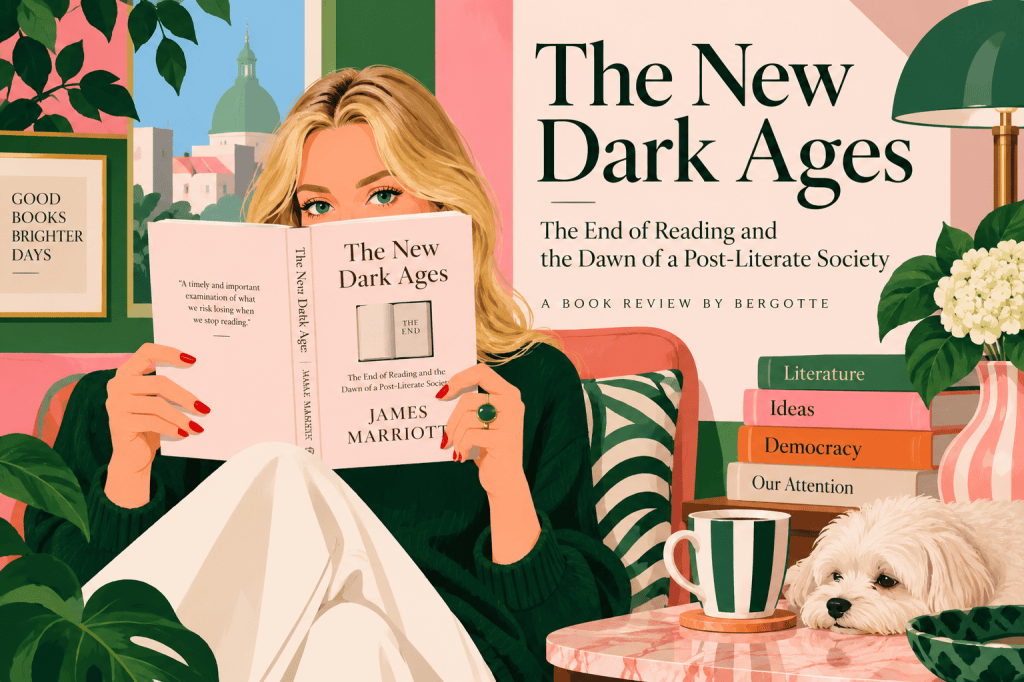
What We Lose When We Stop Reading
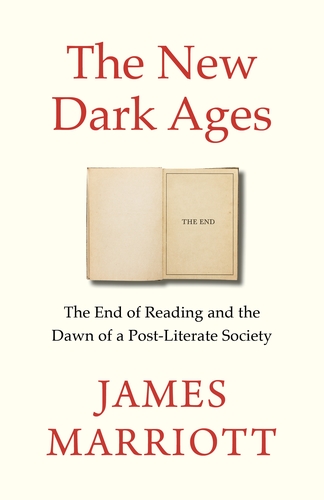
Book: The New Dark Ages: The End of Reading and the Dawn of a Post-Literate Society
Author: James Marriott
Publisher: The Bodley Head
Publication: 3 September 2026
Pages: 208
ISBN: 9781847929518
Genre: Cultural criticism / Social commentary / Media studies
There is something almost quaint about worrying about the death of reading. We have been told, after all, that every new technology will destroy the old one. Radio was supposed to kill conversation; television was going to kill books; the internet was going to kill newspapers. The book has proved an unusually tenacious object.
James Marriott’s The New Dark Ages: The End of Reading and the Dawn of a Post-Literate Society, however, makes a considerably more disturbing argument. His concern is not simply that fewer people are buying novels, or that the printed book may eventually become an artefact for enthusiasts. His contention is that we are beginning to lose something much larger: the particular kind of mind that reading created.
That distinction matters.
Marriott’s argument begins with a historical proposition. The spread of literacy in early-modern Europe was not merely one technological development among others. Print helped create the intellectual architecture of modernity itself. Once ideas could circulate widely, remain stable on the page and be examined independently by thousands of readers, knowledge ceased to belong exclusively to priests, courts and small educated elites. Scientific inquiry, political dissent, religious reformation and eventually democratic government all became imaginable on a new scale.
The Enlightenment was, among other things, a reading revolution.
And Marriott believes we may now be travelling in the opposite direction.
The smartphone is central to his case, but it would be a mistake to reduce The New Dark Ages to another denunciation of TikTok. Marriott traces the movement away from sustained reading back through television and earlier audiovisual culture. What distinguishes the smartphone is the completeness of its occupation of our attention: an object carried everywhere, designed around interruption and capable of supplying an effectively infinite succession of small stimuli.
What disappears under these conditions is not information. We have never possessed more information.
What disappears is depth.
Reading a difficult book makes peculiar demands upon the human mind. It requires us to remain with an argument after the initial pleasure has disappeared. It asks us to remember something encountered fifty pages earlier, tolerate ambiguity, infer motives that have not been explicitly stated and inhabit a consciousness radically unlike our own. Above all, it requires sustained attention without continual reward.
The digital economy increasingly asks precisely the opposite of us.
Its ideal subject does not linger. He scrolls.
And here Marriott’s book becomes more interesting than the familiar lament that young people spend too much time on their phones. The real question is not whether the screen has replaced the book as entertainment. It is whether a civilisation organised around one medium gradually acquires the intellectual characteristics of that medium.
Marshall McLuhan understood this decades ago. A technology does not simply deliver content; it reorganises perception. Neil Postman subsequently argued in Amusing Ourselves to Death that television had transformed public discourse by forcing politics, religion and journalism to obey the logic of entertainment. Marriott belongs recognisably to this intellectual tradition.
The smartphone takes that transformation considerably further.
A culture of reading rewards continuity, memory and argument. A culture of scrolling rewards novelty, speed, emotional intensity and instant intelligibility. Inevitably, culture begins adapting itself to the latter.
Marriott calls part of this process the “Great Simplification”: complexity and difficulty are progressively squeezed out of culture as producers compete for fractured attention.
One can see evidence of it everywhere. Films increasingly explain themselves. Political arguments are compressed into slogans. News becomes a sequence of emotional provocations. Ideas are judged before they have properly been understood. Even works supposedly designed for leisure are expected to compete with the second screen held in the viewer’s hand.
This has consequences far beyond literary culture.
Literacy and Democracy
The strongest section of Marriott’s argument concerns democracy.
Liberal democracy assumes a surprisingly demanding conception of the citizen. Citizens are expected to distinguish evidence from assertion, tolerate competing interpretations, understand arguments with which they disagree and occasionally defer judgement until sufficient information is available.
These are not instinctive human behaviours.
They are learned habits.
And reading is one of the institutions through which societies have historically cultivated them.
The frightening possibility raised by The New Dark Ages is therefore that democracy may survive institutionally while losing some of the cognitive habits upon which democratic culture depends.
Marriott envisages an increasingly oral or post-literate public sphere in which rumour, tribal allegiance and emotionally compelling narratives regain their power. A population less accustomed to sustained argument becomes easier to manipulate, not because people suddenly become stupid, but because the cultural environment rewards different modes of cognition.
This distinction is crucial.
The opposite of literacy is not stupidity.
Human beings possessed intelligence, imagination and extraordinarily sophisticated cultures long before Gutenberg. But literacy externalised thought. It allowed an argument to be preserved, scrutinised, compared and contradicted. Writing separates an idea from the charisma of the person speaking it.
A written claim sits there rather inconveniently.
It can be checked.
That makes literacy not simply an educational achievement but a technology of accountability.
Where Marriott’s Argument Needs Resistance
Yet there is a danger in the grandeur of Marriott’s thesis.
The history of literacy is not quite identical with the history of enlightenment.
Mass literacy produced Darwin and Dickens, but it also produced propaganda, sensationalist newspapers, racial pseudoscience and Mein Kampf. Printed cultures have been perfectly capable of irrationality, persecution and political hysteria.
Nor should oral culture simply be treated as civilisation’s primitive condition. Oral traditions can possess enormous intellectual sophistication, collective memory and formal complexity.
The phrase “Dark Ages” itself consequently does rather a lot of rhetorical work.
Marriott is writing a polemic, not a neutral cultural history, and occasionally the apocalypse threatens to become too tidy: print equals complexity; screens equal simplification.
Reality is less obedient.
The internet has also made archives, scholarship, lectures, newspapers and books available to people who would once have struggled to reach them. Digital culture can disseminate intellectual life as easily as it can trivialise it. The problem is therefore perhaps not the screen itself, but an economic system that has discovered that human attention can be harvested, measured and sold.
That distinction deserves greater emphasis.
TikTok’s principal innovation is not that it puts moving pictures on a telephone. It is that an algorithm learns exactly how long it can hold us before supplying the next stimulus.
The crisis Marriott identifies may consequently be as much political-economic as technological.
We are not simply choosing distraction.
Distraction has become an industry.
The Radical Act of Reading
And this is where The New Dark Ages ultimately becomes rather more hopeful than its title suggests.
If attention can be captured, it can also be reclaimed.
The printed book possesses a quality that now seems almost revolutionary: it does nothing.
It does not vibrate.
It does not know what you read yesterday.
It does not insert something more exciting halfway through Middlemarch because your attention appears to be wandering.
It does not care whether you continue.
The reader must supply the attention herself.
That apparent technological deficiency may turn out to be the book’s greatest virtue.
To read seriously in the twenty-first century is therefore becoming something more than a cultural preference. It is a refusal to permit every unoccupied second of consciousness to be commercially colonised.
Reading restores privacy to the mind.
And perhaps this is the most important insight contained in Marriott’s argument. Civilisations are not sustained only by constitutions, universities, libraries and museums. They are sustained by habits of mind.
Curiosity.
Patience.
Memory.
The ability to remain with difficulty.
The willingness to discover that one’s first interpretation was wrong.
For several centuries the book has been one of our most effective machines for cultivating precisely those qualities.
We should be extremely careful before deciding that we have outgrown it.
Marriott’s book is deliberately alarmist, occasionally nostalgic and perhaps too willing to place the enormous contradictions of modernity on either side of a page/screen divide. But the central warning survives those objections.
The real danger is not a world without books.
Books will survive. Beautiful editions will be printed. Libraries will remain. People will collect novels and photograph their bookshelves.
The more unsettling possibility is a society still surrounded by books but increasingly incapable of giving them the attention they require.
That would indeed constitute a kind of dark age: not the disappearance of knowledge, but the gradual disappearance of our capacity to sit still long enough to encounter it.
And unlike the burning of a library, we might barely notice it happening.
Key Takeaways
Reading is a cognitive technology, not merely a pastime. Marriott’s most important proposition is that sustained reading trains particular mental capacities: concentration, abstraction, memory, inference and tolerance of complexity.
The rise of mass literacy helped construct modernity. Print enabled ideas to circulate beyond traditional elites and contributed to the intellectual conditions in which science, political dissent and democratic government developed.
We may be entering a genuinely post-literate culture. This does not mean people cannot read. It means reading may cease to be the dominant cultural technology through which society understands itself.
The smartphone represents a qualitative change. Television competed with reading for a few hours; the smartphone accompanies us almost continuously and places distraction within permanent reach.
The problem is attention rather than information. Digital society has solved the scarcity of information while creating a scarcity of sustained attention.
The “Great Simplification” extends beyond books. Culture adapted to fragmented attention tends towards immediacy, explicitness and emotional intelligibility, potentially making ambiguity and complexity harder to sustain.
The decline of reading has political consequences. Democratic societies depend upon citizens capable of following arguments, assessing evidence and tolerating competing perspectives. A post-literate public sphere risks privileging tribalism, rumour and emotional persuasion.
Marriott’s historical argument should nevertheless be treated critically. Literacy has never guaranteed rationality or democracy, and print culture has produced propaganda and fanaticism alongside enlightenment. The binary between rational print culture and irrational screen culture is sometimes too clean.
The attention economy may be the deeper antagonist. Screens are not inherently intellectually impoverishing. The more fundamental problem is a commercial architecture designed to maximise engagement by continually interrupting attention.
Reading is becoming a form of resistance. In an economy competing relentlessly for our attention, sustained reading preserves an increasingly rare space for private, uninterrupted thought.
Final Thoughts
The New Dark Ages is best read not as a prediction that books are about to vanish, but as a warning about what happens when a civilisation loses the habit of sustained thought.
Marriott occasionally overstates his historical case, but perhaps polemics are permitted a little thunder. The essential question he poses is both simple and profound:
If reading helped make the modern mind, what sort of mind are we creating when we stop?
It is a question considerably more important than whether the printed book survives. It asks what happens to us when the intellectual habits the book cultivated no longer occupy the centre of cultural life.
And that is what makes The New Dark Ages worth reading.

