
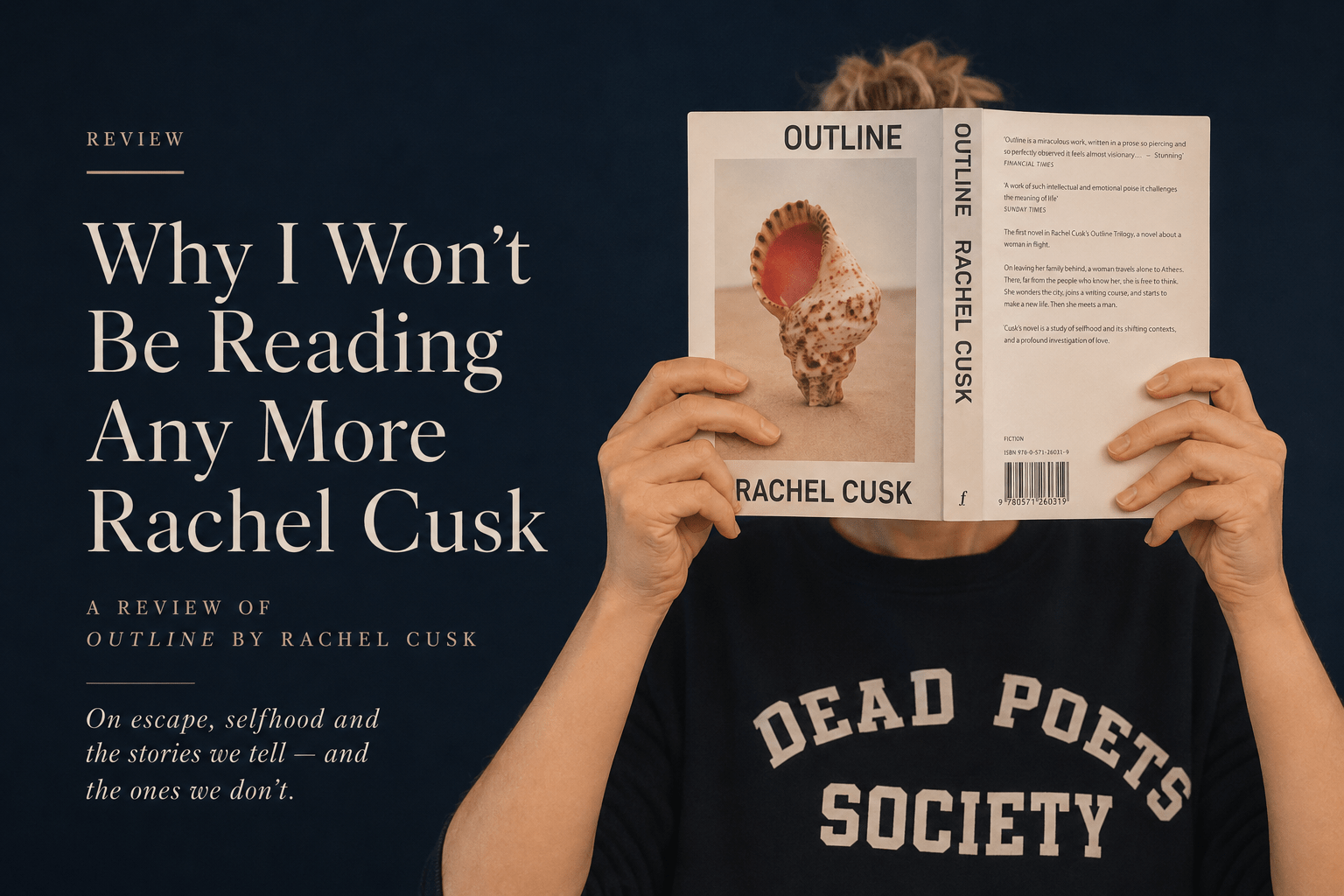
Author: Rachel Cusk
Title: Outline
First published: 2014
Genre: Literary fiction
Length: approximately 250 pages (256 pages in the Picador paperback edition)
Series: Outline Trilogy, Book One
Rating: ★★☆☆☆
What It Is
Rachel Cusk’s Outline is a novel constructed largely through ten conversations. Its narrator, Faye, is a writer who travels to Athens to teach a summer creative-writing course. During her journey and stay she encounters a succession of people — a man sitting beside her on the aeroplane, fellow writers, friends and students — who tell her about their marriages, divorces, children, ambitions, disappointments and private theories about themselves and other people. Faye says relatively little. Instead, a picture of her own life, including the aftermath of the collapse of her marriage, emerges indirectly through what others choose to tell her.
The result is a novel with very little conventional plot. Its principal subject is storytelling itself: the stories people construct about their lives, the discrepancy between those stories and what may actually have happened, and the strange intimacy that can arise when one person speaks and another listens.
It is an intriguing idea.
I simply did not particularly enjoy the novel that Cusk made from it.
The Review
Outline has been widely admired for dismantling some of the usual machinery of the novel. Plot is attenuated almost to vanishing point; characterisation is displaced by testimony; dramatic incident gives way to conversation. At the centre is Faye, less a conventional protagonist than a listening presence, an absence around which other people arrange their stories.
As a formal proposition, I can understand the fascination.
As a sustained reading experience, however, I found it considerably less satisfying. Having finished Outline, I am left not merely indifferent to continuing the trilogy but with very little inclination to read more Cusk. The problem is not that the novel is difficult, slow or plotless. I like slow novels. I like books in which very little happens. Nor do I object to autofiction, interiority or formally experimental fiction.
My objection is much more specific.
I found Outline intellectually interesting but emotionally sterile; perceptive about human weakness but curiously ungenerous towards the people whose weaknesses it observes.
The celebrated conceit of the novel is that Faye is defined largely through absence. Rather than explaining herself, she listens. Other people disclose themselves to her and, through their stories, an outline of the woman listening gradually becomes visible.
But absence is never really neutral.
Faye may speak less than the people around her, but she nevertheless possesses enormous structural authority. She — or, more precisely, the novel operating through her — determines what is recorded, which absurdities are allowed to expose themselves and where our attention is directed. Her silence therefore does not remove judgement from the novel. It merely makes the source of that judgement less visible.
Other characters confess. Faye observes.
They become objects of interpretation while she retains the privilege of interpreting.
That imbalance became increasingly noticeable to me as the novel progressed. Almost everyone who enters Outline arrives carrying some mixture of vanity, self-deception, resentment, failed ambition, sexual disappointment or wounded pride. None of this is implausible; these are perfectly ordinary components of human life. But the cumulative effect is not, for me, one of an expanding understanding of human frailty.
It is one of diminution.
Again and again, people are permitted enough rope with which to hang themselves.
There is an asperity beneath Cusk’s controlled prose, an almost anthropological coolness towards the people being described. She is extremely good at noticing weakness. What interested me less was what she chose to do with what she noticed.
The characters are anatomised rather than inhabited. Their contradictions become evidence against them.
This is perhaps where my resistance to Outline became strongest. Fiction has no obligation to be nice. Great writers can be extraordinarily cruel towards their creations. Muriel Spark certainly was; Nabokov could be merciless. Yet there is often something else taking place alongside the judgement — imaginative abundance, comedy, pity, strangeness, sensuality — which allows a character to exceed the judgement being passed upon them.
They remain larger than the diagnosis.
In Outline, I repeatedly had the opposite sensation: that a person had entered the novel principally in order to illustrate a proposition.
And that becomes particularly problematic because Outline ostensibly depends upon multiplicity. This is, after all, a novel built from other people’s voices. Its characters have different lives, nationalities, relationships and experiences.
Yet I rarely experienced it as genuinely polyphonic.
They may possess different biographies, but they frequently possess remarkably similar forms of consciousness. Their speech is articulate, retrospective, analytical and densely shaped. Again and again, people convert an experience from their lives into an exquisitely formulated miniature essay about marriage, parenthood, failure, desire or identity.
After a while, I stopped hearing a roomful of different people.
I started hearing Rachel Cusk.
This seems to me a fairly substantial weakness in a novel that has voluntarily given up so many of fiction’s other resources. If conventional plot is almost entirely abandoned and the novel instead places its weight upon a succession of human voices, then those voices need tremendous differentiation. They ought to surprise us linguistically, socially, psychologically.
Here I frequently had the impression that every consciousness had first been translated into the same immaculate literary register.
The apparent naturalism of these conversations is therefore highly artificial. People speak for pages with extraordinary coherence. Their lives arrive already interpreted. Messy experience has somehow been processed into finished meaning before it reaches the page.
For some readers this will doubtless be part of the pleasure. For me it gradually became monotonous.
The structure itself compounds the problem.
Someone encounters Faye. Someone tells Faye about themselves. Faye listens. We gradually notice discrepancies between the person’s account of themselves and what the novel encourages us to perceive. The conversation ends. Another encounter begins.
What initially feels radical eventually becomes surprisingly predictable.
Cusk may have dismantled one form of narrative architecture, but underneath it she has constructed another — and one that, by the middle of the novel, I found nearly as formulaic as the conventions it replaces.
Faye herself remains the greatest difficulty.
A character created through absence can be extraordinarily powerful if that absence is charged with something — grief, shame, longing, rage, desire, trauma, even simple mystery. Silence can generate tremendous emotional pressure when we sense something struggling beneath it.
Given the dissolution of Faye’s marriage and family life, there is ample material for such pressure.
But I seldom felt it.
Instead, she often seemed simply inert: a receptive surface rather than a consciousness whose suppressed life I could feel vibrating beneath the text. I did not need to like her. I did not need conventional psychological exposition. But I did need some sense that the vacancy at the centre of the novel was alive.
Too often it simply felt vacant.
This is also where I part company with some of the reverence surrounding Cusk’s restraint.
Restraint is not intrinsically profound.
Omission does not automatically create depth.
A refusal to dramatise emotion can make emotion more powerful by forcing the reader to perceive what cannot be said. But it can also result in the emotion simply failing to materialise.
For me, Outline repeatedly crosses that line.
There is another discomfort I found difficult to shake: the novel’s relationship to class. Cusk’s world is recognisably bourgeois — writers, teachers, property, travel, marriage, divorce, cultural capital, cultivated disappointments — and there is nothing inherently objectionable about this milieu. Plenty of extraordinary fiction has been written about precisely such people.
What bothered me was the posture the novel adopts towards them.
Cusk is close enough to this world to reproduce its codes perfectly, but far enough away to subject them to elegant dissection. The result can feel less like social criticism than social superiority. Her characters’ pretensions and self-deceptions are exposed, certainly, but I was less convinced that the novel was interested in what lies beyond those pretensions.
There is an important difference between seeing through somebody and seeing them clearly.
Outline sometimes seems to confuse the two.
Chekhov is perhaps the obvious counterexample. Few writers were better at recognising vanity, delusion, selfishness and absurdity. Yet his people are never reducible to their shortcomings. He exposes them without exhausting them. Some final mystery of personhood remains intact.
With Cusk, I increasingly felt that the misunderstanding a character harboured about themselves was the destination rather than the beginning of inquiry.
That is why I ultimately found the novel less humane than its subject might suggest.
Athens, too, contributes to the strange sense of abstraction. There is heat, water, restaurants, apartments, classrooms and the sea, yet the city rarely acquired for me the thickness of an independently existing place. Like the people Faye encounters, it often seems to exist primarily as material for consciousness to move through.
For a novel composed almost entirely of encounters, Outline consequently felt surprisingly airless.
And then there is the simplest criticism of all.
I was bored.
It took me approximately three weeks to read a novel of barely 250 pages. I would read a section, put it aside and feel remarkably little desire to pick it up again.
That seems worth saying without embarrassment. Literary prestige sometimes encourages a peculiar suspicion of boredom, as though being bored by an acclaimed novel necessarily represents a failure of sophistication on the reader’s part.
It does not.
Boredom can itself be an aesthetic judgement. Repetition, monotony, insufficient differentiation, emotional narrowness and an absence of narrative pressure are characteristics of a novel just as surely as lyricism, suspense or psychological complexity are.
There is, of course, a substantial critical case to be made for Outline. Its rejection of conventional characterisation is interesting. So is its inquiry into the relationship between listening and authorship, the stories through which people construct themselves, and the impossibility of completely reliable autobiography.
I can see what the novel is doing.
I can even admire parts of what it is doing.
But there is a considerable difference between admiring the architecture of a novel and wanting to inhabit it.
I admired the idea of Outline far more than I enjoyed reading Outline.
The novel is intelligent. It is controlled. It is frequently perceptive.
But perception without sufficient generosity eventually begins to feel merely diagnostic, and austerity without enough emotional, linguistic or psychological variation begins to feel less like radicalism than deprivation.
By the end, I did not feel that Cusk had opened other people up to me.
I felt that she had reduced them.
And after roughly 250 pages of being invited to watch it happen, I had had enough.
★★☆☆☆
Discover more from My World of Interiors
Subscribe to get the latest posts sent to your email.


One thought on “Outline by Rachel Cusk — Review”