Makers & Rooms — Essay V
The Classical Present
Peter Pennoyer builds in the tradition of McKim, Mead and White and sees nothing remotely conservative about it. In an architectural culture that treats ornament as embarrassment and history as weakness, he has spent thirty years making the case that the classical orders are not a retreat from the present but a way of taking it seriously.
By Bergotte
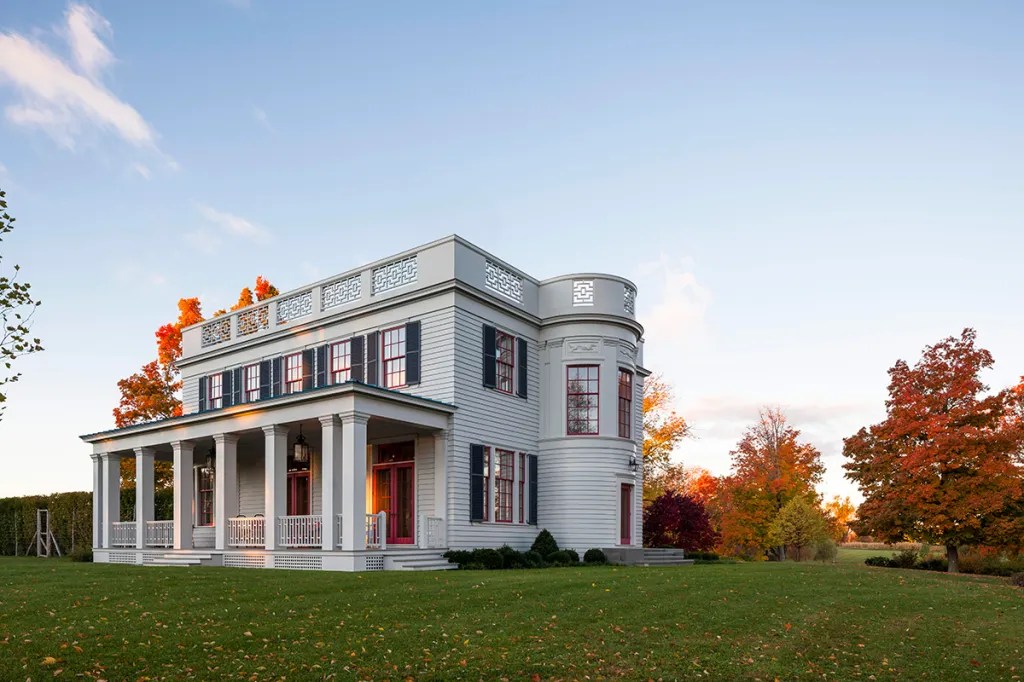
On a street in the East Seventies in Manhattan, there is a building that most people walking past will not immediately identify as new. It sits in its block with the settled authority of a building that has been there for a long time — the stone facade proportioned correctly, the windows properly related to the wall surface surrounding them, the cornice doing what cornices are supposed to do at the point where wall meets sky. The details are precise: the mouldings have profiles that reward close examination, the ironwork at the entrance has been thought about rather than specified from a catalogue, the relationship between the building and the sidewalk has been handled with the kind of care that announces, to anyone who knows how to read a building, that someone paid serious attention here. Only on reflection, or on checking, does it become apparent that the building was completed in the twenty-first century, designed by an architect who was born in 1957 and who works from an office in midtown Manhattan with a staff of contemporary designers using contemporary tools.
The architect is Peter Pennoyer, and the building’s apparent anachronism is, in his view, precisely the wrong way to think about it. It is not, he would insist, pretending to be old. It is not historicist in the pejorative sense that the architectural establishment tends to use the word — meaning, roughly, dishonest, escapist, a refusal to engage with the present moment in favour of a comfortable fantasy about a better past. What it is, rather, is a building designed in a tradition that has been developing and refining its answers to the fundamental questions of architecture — how should a wall be proportioned, how should an opening be framed, how should a building address the street and the sky and the human being standing in front of it — for approximately two and a half thousand years, and that has, over the course of that development, arrived at answers of unusual reliability. To use those answers is not to copy the past. It is to take seriously the accumulated intelligence of the longest design research project in Western history.
This is a position that requires, in the current architectural culture, a certain kind of courage. The dominant institutions of that culture — the schools, the journals, the prize committees, the critics — have operated, since the middle of the twentieth century, on the assumption that the tradition Pennoyer works in is finished, that the project of classical architecture was closed by the advent of modernism and that any architect who continues to work within it is, at best, engaged in a specialised form of heritage preservation and, at worst, making an ideological statement of a reactionary kind. Pennoyer does not accept this assumption. He has spent his career making the case against it, in buildings and in books and in the long institutional labour of the organisations dedicated to the survival and transmission of classical knowledge. The buildings are the argument. But the argument, stated, is worth understanding on its own terms.
Formation
Peter Pennoyer was born in 1957 and grew up in New York, in a family with connections to the city’s cultural and social life that gave him early access to the kinds of buildings — the great Beaux-Arts mansions and apartment buildings and institutional structures of the late nineteenth and early twentieth centuries — that would become the primary reference points of his architectural imagination. He has spoken of childhood visits to buildings by McKim, Mead and White, the firm whose work between roughly 1880 and 1910 constituted perhaps the greatest single concentrated achievement in the history of American architecture, and of the experience of being inside those buildings as something that registered at a level below conscious analysis — a sense that here, in these rooms, something about the relationship between architecture and human experience had been worked out with exceptional intelligence and care.
He studied architecture at Columbia, graduating in 1983, and the Columbia of the early 1980s was, like most American architecture schools of the period, a place dominated by the intellectual energies of postmodernism — the movement that had emerged, in the 1970s, as a critique of modernism’s austerity and its hostility to historical reference, and that proposed, in various forms, the reintroduction of historical elements into contemporary architectural design. Postmodernism was, in this sense, adjacent to where Pennoyer would eventually land, and he has acknowledged its influence on his formation. But there is a critical difference between the postmodern use of historical reference — quotational, ironic, deployed for its associative and communicative charge rather than for its structural logic — and the classical practice that Pennoyer eventually committed to, and that difference is the whole story. Postmodernism borrowed from history. Pennoyer works in history, which is a different thing entirely, in the way that speaking a language is different from quoting from it.
The distinction was clarified for him, in part, by his encounter with the scholarship and practice of the classical revival that was developing, quietly, outside the mainstream architectural schools in the 1980s. Figures like the architect Allan Greenberg, the theorist Demetri Porphyrios, and the urban designer Léon Krier were making the case for a return not to the quotational games of postmodernism but to the genuine practice of classical and traditional architecture, grounded in a thorough understanding of the orders and the principles that had governed Western building from antiquity through the early twentieth century. This was not a mainstream position, and it attracted the kind of institutional hostility that unconventional positions attract in fields with strong orthodoxies. Pennoyer was drawn to it precisely because it was serious — because it demanded real knowledge, real discipline, real engagement with a body of accumulated wisdom that could not be mastered quickly or deployed superficially.
McKim, Mead and White and the Standard They Set
To understand what Pennoyer is doing, it is necessary to understand what McKim, Mead and White did, because the earlier firm is the standard against which he implicitly measures his own work and against which, with appropriate historical humility, he invites it to be measured. Charles Follen McKim, William Rutherford Mead, and Stanford White formed their partnership in 1879 and over the following three decades produced a body of work that transformed the American built environment: the Boston Public Library, Pennsylvania Station in New York, the Morgan Library, the campus of Columbia University, hundreds of private houses and clubs and civic buildings across the eastern seaboard that constituted a coherent vision of what American architecture could be at its most ambitious and most accomplished.
The vision was grounded in the classical tradition as it had been transmitted through the Italian Renaissance and the French Beaux-Arts system, but it was not imitative. McKim, Mead and White took the grammar of classicism — the orders, the principles of proportion and symmetry and the relationship between structure and ornament — and used it to make buildings that were unmistakably American in their scale and ambition and in the particular quality of their relationship to the landscape and the street. Their buildings were not reproductions of European models. They were responses to a specific time and place, made with the tools of a tradition that had proven, over centuries, its capacity to produce buildings of great civic and domestic quality.
Pennsylvania Station, demolished in 1963 in an act of civic vandalism that the architectural community still mourns as a collective trauma, was the measure of what was lost when the tradition was abandoned — not merely a beautiful building but a demonstration that the classical language was capable of producing, in the conditions of the twentieth century, spaces of genuinely extraordinary power. The main waiting room, modelled on the tepidarium of the Baths of Caracalla, was one of the great interior spaces in the history of American architecture: a volume that made every person who entered it feel simultaneously small and exalted, that used the classical orchestration of light and structure and ornament to produce an experience that no shed of steel and glass, however elegantly engineered, has subsequently managed to replicate.
Pennoyer has written extensively about McKim, Mead and White — co-authoring, with Anne Walker, a major monograph on the firm that remains the most thorough account of its work — and the depth of his engagement with their practice is evident in everything he designs. He is not, to be clear, copying them. His buildings are of his time in their programme, their materials, their detailing, their relationship to contemporary life. But they are made in the knowledge of what McKim, Mead and White achieved, held against the standard of that achievement, and designed with the understanding that classicism is not a style to be approximated but a discipline to be mastered.
What the Orders Actually Are
The classical orders — Doric, Ionic, Corinthian, and their variations — are not decorative systems. This is the most important thing to understand about classical architecture, and the thing that the architectural establishment’s dismissal of the tradition most systematically misrepresents. The orders are structural and proportional systems: sets of relationships between the elements of a building — the column, the capital, the entablature, the base — that have been developed and refined over two and a half millennia into systems of unusual sophistication and flexibility.
Each order specifies not just the form of its elements but the ratios between them: the height of the column in relation to its diameter, the height of the entablature in relation to the column, the projection of the cornice in relation to the height of the frieze. These ratios are not arbitrary. They have been worked out, through centuries of practice and refinement, to produce proportional relationships that the human eye finds satisfying — that register, at a level below conscious analysis, as correct in the way that a well-tuned instrument is correct, not because correctness has been imposed from outside but because it has been arrived at through sustained engagement with the experience of people in space.
This is a form of design research, conducted over a very long time, that the modernist abandonment of the tradition threw away on ideological grounds. The ideological grounds — that ornament was crime, as Adolf Loos memorably declared; that the historical forms of architecture were irrecoverably compromised by their associations with power and class; that the honest expression of modern construction required the elimination of everything that was not structurally necessary — had their own logic, and the buildings they produced at their best were genuine achievements. But the logic was not so complete as to justify the wholesale abandonment of accumulated knowledge that modernism, at its most doctrinaire, demanded. The orders are not ideology. They are information.
Pennoyer understands and uses this information with a fluency that is genuinely rare. His buildings work not because they look like old buildings but because they are organised according to principles that have proven, over a very long time, to produce environments in which people feel well located in space — environments where the relationship between the human body and the architectural elements surrounding it has been thought about with sufficient care to produce something like comfort in the deepest sense: not merely physical ease but the ease of being in a space that has been made for you, that takes seriously the fact of your presence.
The New York Practice
Pennoyer established his practice in New York in the late 1980s, initially as Peter Pennoyer Architect and now operating as Peter Pennoyer Architects. The firm’s work has been concentrated primarily in high-end residential architecture — houses and apartments in New York and the surrounding region, country houses in Connecticut and the Hamptons and further afield — with a body of institutional and commercial work that includes libraries, clubs, and cultural buildings. The residential focus is, in the architectural culture, sometimes used to diminish the significance of the work: residential architecture, particularly at the expensive end, is not the field in which reputations are made in the way that museums and cultural institutions make reputations, and the association with wealthy clients carries a whiff of the merely decorative, the architecture-as-luxury-product, that serious critics tend to hold at arm’s length.
This is, in Pennoyer’s case, a significant misreading. The residential tradition in American classical architecture is one of the richest in the field, and the houses designed by McKim, Mead and White, by Delano and Aldrich, by John Russell Pope, and by the other masters of the Beaux-Arts period are not minor works. They are the settings in which the classical language was developed and refined in response to the particular conditions of American domestic life, and they constitute a tradition of practice that is as serious and as demanding as any other branch of architecture. To work in that tradition, as Pennoyer does, is not to retreat from ambition but to engage with an exceptionally high standard — one that the buildings must meet on their own terms, without the institutional prestige of the cultural commission or the monograph-generating novelty of the formally unprecedented.
The domestic interiors that Pennoyer’s firm produces are, by any measure, exceptional. The organisation of rooms — the sequence of spaces, the relationship between public and private areas, the way that movement through a house creates a series of experiences rather than a neutral passage between functional destinations — reflects a deep understanding of how people actually live and move and gather, of what a house is for at a level more fundamental than the provision of sleeping and cooking and storage. The rooms feel inhabited before they are inhabited, in the sense that they have been designed around the fact of human presence rather than around the fact of the programme. This is rarer than it sounds.
Ornament and Its Enemies
The question of ornament is the place where the argument between classicism and modernism becomes most direct, and it is worth examining it with some care, because the modernist position on ornament — that it is dishonest, unnecessary, a residue of aristocratic privilege that democratic culture should shed — has been so thoroughly absorbed into the institutional common sense of architecture that it rarely gets examined as the position it is, as one possible answer to a genuine question rather than a settled conclusion.
Loos’s famous declaration, in his 1908 essay, that ornament was crime was a polemic rather than an analysis, and like most polemics it contained a powerful partial truth deployed in the service of a conclusion that the partial truth did not fully support. The partial truth was that the ornament of the late nineteenth century had in many cases become disconnected from structural logic — applied to surfaces as pattern rather than growing from the building’s organisation of structure and space — and that this disconnection produced a kind of visual noise that genuine architectural intelligence should resist. This much was true, and the best modernist buildings demonstrate the force of it.
But from this specific critique of specific ornamental practices, modernism drew the general conclusion that ornament itself — the principle of enriching a surface or an element beyond what bare structural necessity requires — was illegitimate. And this conclusion does not follow. The ornament of classical architecture is not applied decoration. It is articulation: the marking of structural and spatial significance through the variation of surface, the emphasis of junctions, the gradation of elements from the simple to the complex in ways that tell the person moving through the building where they are and what the space they are in means in relation to the spaces around it. A Doric capital is not a decoration. It is the resolution of the relationship between the vertical thrust of the column and the horizontal weight of the entablature, made visible and given the kind of formal precision that allows the eye to understand the building’s structural logic at a glance.
Pennoyer makes this argument in his buildings and in his writing, and he makes it with the patient clarity of someone who has understood that the argument cannot be won quickly — that the institutional prejudice against classical architecture is too deeply embedded in too many powerful places to be dislodged by any single building or any single essay, and that the only way to make the case is to keep making it, carefully and well, over a very long period of time.
The Institute and the Transmission
Part of what makes Pennoyer unusual among practising architects is the seriousness of his engagement with the institutional project of transmitting classical knowledge to the next generation. He has been deeply involved with the Institute of Classical Architecture and Art, the New York-based organisation that offers training in classical and traditional architecture to practitioners and students outside the mainstream schools, and he has served in various leadership capacities that have shaped its programmes and its direction.
The ICAA exists because the mainstream architecture schools do not teach classical architecture, or teach it only as history — as a set of forms to be understood historically and academically rather than as a living practice to be learned and used. This is not, in Pennoyer’s view, a neutral pedagogical choice. It is an ideological one, and it has produced, over several generations, a situation in which the majority of practicing architects in the United States have no direct working knowledge of the tradition that produced the greatest buildings in their own country’s history. They cannot draw a Doric order from memory. They do not know the proportional relationships that govern classical composition. They are, in the most literal sense, illiterate in the language of the buildings around them.
The ICAA’s programmes address this illiteracy with a directness that the mainstream schools find alternately irrelevant and threatening, depending on the institutional mood. Students learn to draw the orders by hand — a practice that the digital turn in architectural education has rendered almost extinct in conventional schools, and that Pennoyer regards as essential not for its own sake but for what it produces: a knowledge of proportion and detail that is held in the body, in the hand and the eye, rather than in the abstract cognitive register in which most architectural knowledge is now stored. You cannot design a classical building well from a position of purely intellectual understanding. You have to have drawn it enough times to know, without calculation, when the proportions are right and when they are not.
The City and Its Memory
Pennoyer’s work is, in a fundamental sense, urban work — work about what buildings owe the cities they are part of, about the relationship between a new building and the existing fabric of the street. This is an aspect of classical architecture that its modernist critics have tended to undervalue, partly because the most visible classical buildings — the grand civic set pieces, the Beaux-Arts palaces — seem to stand apart from the street in ways that suggest self-sufficiency rather than urbanistic responsibility. But the classical tradition, at its best, has always been a tradition of urban building: buildings that address the street with the correct degree of formality, that respond to the cornice lines and window rhythms of their neighbours without simply copying them, that contribute to the collective enterprise of the city rather than asserting their difference from it.
In Manhattan, this urban obligation is unusually legible, because the city’s existing building stock includes so much of the classical and traditional architecture of the late nineteenth and early twentieth centuries — the limestone apartment buildings of the Upper East and Upper West Sides, the brownstone townhouses of Greenwich Village and Brooklyn Heights, the institutional buildings that give the midtown grid its vertical punctuation — that a new building entering this context has a very clear set of responsibilities and a very clear measure against which to be judged. Pennoyer’s buildings in New York meet this measure. They understand what the street is doing and they participate in it intelligently. They add to the collective fabric rather than asserting against it. This is, in architectural culture terms, an almost political statement, and it is one that Pennoyer makes without apology.
Beauty as Obligation
There is a word that Pennoyer uses in conversation and in writing with a frequency that is, in the current architectural culture, slightly startling. The word is beauty. He talks about beauty as a goal, as a standard, as an obligation that architects owe to the people who will use their buildings and to the cities those buildings are part of. He talks about it without embarrassment and without the elaborate qualification that the word tends to require in intellectual contexts where beauty is suspected of being either ideologically loaded or philosophically naïve.
The suspicion is not without foundation. Beauty, as a critical category, has a complicated history in the twentieth century. The modernist critique of ornament was partly a critique of a particular kind of beauty — decorative, surface-oriented, disconnected from structural truth — and the critical theory that followed modernism went further, questioning whether beauty as a concept could be separated from the power relations that had historically determined what was and was not beautiful. These are not trivial concerns. The history of architecture includes many buildings that claimed beauty while serving exclusion, that wrapped authority in aesthetic prestige, that used the classical language as a vehicle for the assertion of cultural and political power.
Pennoyer’s response to this is not to deny the history but to refuse to let it close the question. Beauty is not the exclusive property of power. The classical tradition has produced buildings that served every purpose and every class — not only palaces and court buildings but public libraries, post offices, courthouses, schools, hospitals, apartment buildings for working people — and the beauty of these buildings was not an assertion of power over the people who used them but a form of respect, a demonstration that the people who used a public library or a neighbourhood post office were entitled to architecture that took their experience seriously. The opposite of beautiful public building is not democratic public building. It is indifferent public building, which is what most public building has been since the abandonment of the tradition.
This argument — that beauty is not a luxury but an obligation, that the people who spend their lives in buildings are owed the quality of environment that serious architecture can provide — is not confined to the classical revival. But it is stated with particular force and clarity in Pennoyer’s work, because the tradition he works in has beauty as one of its constitutive goals, in a way that the dominant strains of contemporary architecture have, by and large, declined to maintain. He has not declined. The buildings are the evidence.
The Long Argument
Peter Pennoyer is not famous in the way that Zaha Hadid was famous, or in the way that the architects who appear on the covers of design magazines are famous. His work does not produce the kind of images that travel well on the internet — the dramatic aerial view, the rendering that looks more spectacular than any actual building can look, the formal gesture so extreme that it registers as a kind of architectural theatre. His buildings require proximity. They require time. They reward the kind of attention that most contemporary architectural coverage does not encourage and that most architectural media platforms are not designed to provide.
This is, from one angle, simply a description of work that is calibrated to a different set of values from the ones the current culture rewards. From another angle, it is itself a statement — a refusal to compete on the terms that the current culture has set, an insistence that the work will be what it is and will be judged on its own terms or not at all. This insistence has a family resemblance to the insistences of the other figures in this series — to Henningsen’s refusal to accept the bad lamp, to Kawakubo’s refusal to explain herself, to Hadid’s refusal to accept that what could not be built today could not be built tomorrow. The forms of the insistence are very different. The underlying stubbornness is the same.
What Pennoyer is arguing for, across thirty years of practice and writing and institutional labour, is something that sounds modest and is actually quite radical: that architecture does not need to be new to be serious, that the most demanding thing a designer can do is not to invent a new formal language but to master an existing one, that the tradition is not a ceiling on ambition but a floor beneath it — a foundation of accumulated intelligence that makes possible, for anyone willing to do the work of learning it, buildings of a quality that formal novelty alone cannot achieve.
The buildings stand on their streets. They are proportioned correctly. The cornices are doing what cornices are supposed to do. The people inside them, on most evidence, feel well. The argument continues.
