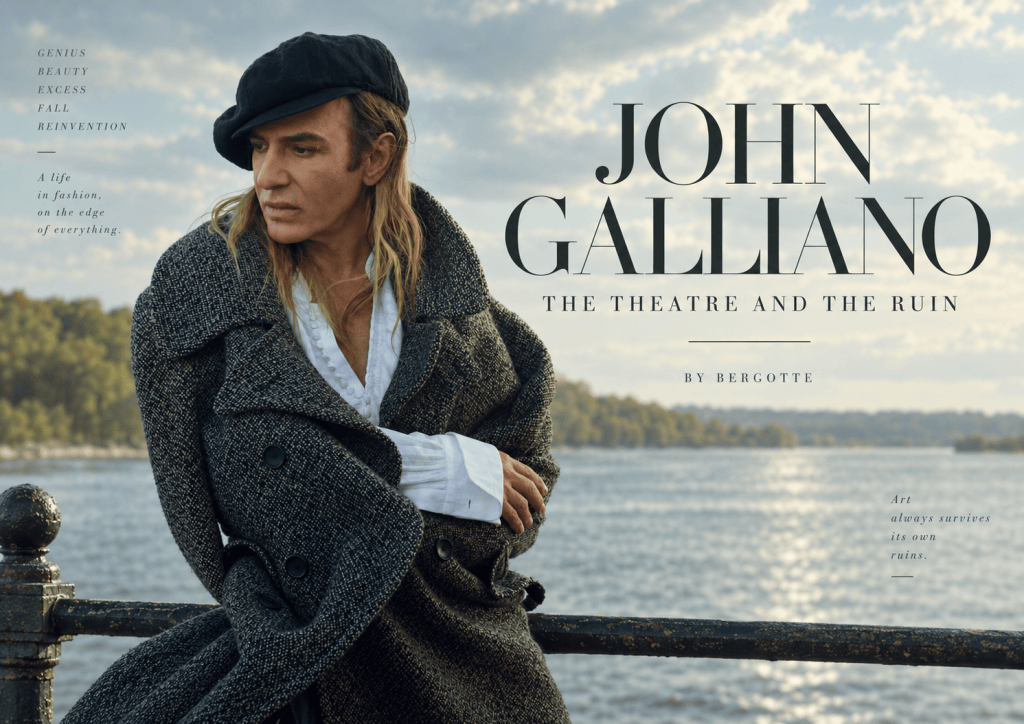
The cancelled Metropolitan Museum retrospective has reopened one of fashion’s most difficult questions: what should history do with an artist whose creative achievement is inseparable from an act of profound disgrace?
By Bergotte
The Metropolitan Museum of Art did not merely cancel an exhibition when it abandoned John Galliano: Horizons, the major retrospective that had been planned for its Costume Institute in the spring of 2027. It interrupted what had begun to resemble the final movement in one of fashion history’s most extraordinary redemption narratives. Conceived as a survey of four decades of Galliano’s work, from his 1984 Central Saint Martins graduation collection through Givenchy, Christian Dior and Maison Margiela, Horizons would have been the first major museum exhibition devoted entirely to him. More significantly, it would have placed Galliano within a remarkably exclusive historical category: among the very small number of living designers granted the highest level of institutional recognition by the Costume Institute.
The exhibition was to be launched around the 2027 Met Gala, effectively transforming fashion’s most visible annual spectacle into a celebration of Galliano’s career. The symbolism would have been unmistakable. Sixteen years after Christian Dior dismissed him following the emergence of recordings in which he made antisemitic and racist remarks, the institution that has done more than almost any other to elevate fashion into the museum canon appeared prepared to declare the rehabilitation complete.
Instead, opposition intensified. The coincidence of the planned Gala with Yom HaShoah, Holocaust Remembrance Day, made an already contentious proposition more difficult to defend, while Jewish organisations, politicians and members of New York’s cultural establishment questioned whether historical examination had slipped into institutional honouring. By the end of August 2026, Galliano and the Met announced that the exhibition would not proceed. The Met Gala itself was not cancelled; rather, the Galliano exhibition around which the Costume Institute’s season had been structured was withdrawn.
There is an obvious temptation to treat this simply as another argument about “cancel culture”, but Galliano’s story deserves something more intellectually serious. His career presents a particularly difficult problem because his importance to late twentieth- and early twenty-first-century fashion is not speculative. He changed it. One may condemn what he said in Paris in 2010 and 2011 without pretending that his work at Dior did not transform the language of the runway, just as one may acknowledge his extraordinary gifts without converting aesthetic achievement into moral absolution. The difficulty resides precisely in holding these propositions together.
Galliano’s history is therefore not simply the story of a designer who rose, fell and returned. It is a story about fashion itself: about imagination becoming industry, about the manufacture of the designer as celebrity, about addiction and institutional complicity, about the moral limits of rehabilitation, and about our persistent tendency to confuse artistic greatness with personal exception.
THE MAKING OF GALLIANO
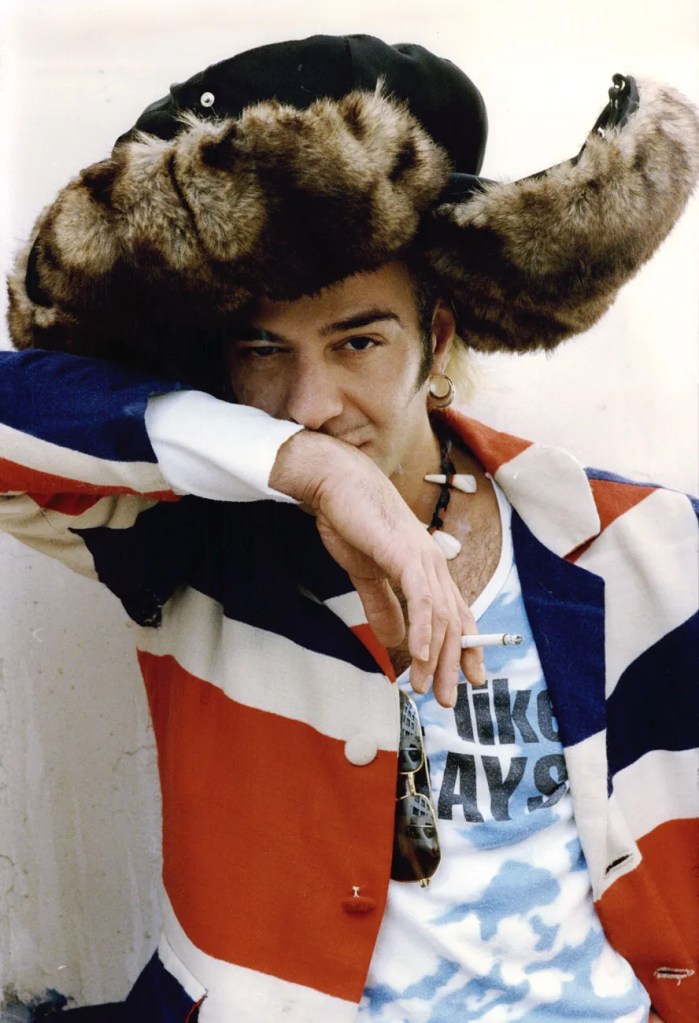
John Galliano arrived in British fashion at the moment when London was learning how successfully marginality could be converted into cultural capital. Born in Gibraltar in 1960 and trained at Saint Martins in London, he belonged to the generation that emerged after punk, when clubs, art schools, second-hand clothes, theatrical self-invention and historical quotation became parts of the same cultural vocabulary. His graduation collection, Les Incroyables, presented in 1984, already contained virtually everything that would later define him. Inspired by the extravagant dandies and merveilleuses of post-Revolutionary France, its distressed fabrics, exaggerated silhouettes and historical references transformed research into theatre. It was history reconstructed not as archaeological fidelity but as atmosphere.
The collection caused something close to a sensation. Joan Burstein of Browns bought it, and Galliano’s emergence acquired the quality that would repeatedly characterise his career: the instantaneous conversion of precariousness into triumph. The young designer had discovered that fashion history could be treated as a vast imaginative archive. Eighteenth-century France, Edwardian portraiture, 1930s cinema, Japonisme, Belle Époque Paris, revolutionary Russia and fin-de-siècle decadence could be taken apart and reassembled through cutting, draping and character.
What distinguished Galliano even then was not simply his appetite for the past. Fashion has always recycled history. His particular gift was narrative. He did not begin with a skirt or jacket so much as with a person who might wear it. Models were given biographies; collections acquired plots; clothes emerged from invented worlds. A woman might be an aristocrat escaping a revolution, a fading film star, a traveller marooned in some imaginary port, a courtesan, a runaway princess or a widow carrying the relics of a vanished life. The garment was evidence that the character had existed.
This method made Galliano one of the supreme romantic stylists of his generation, but it also contained the seeds of later criticism. His imagination was voracious and frequently indiscriminate. Cultures, ethnicities, historical traumas and social identities could become elements within his enormous visual vocabulary. What the 1990s often praised as eclecticism or exoticism would increasingly be examined through questions of Orientalism, appropriation and power. Galliano’s fantasy worlds were magnificently learned, but they belonged to an era when fashion assumed a considerably broader licence to turn other people’s histories into aesthetic material.
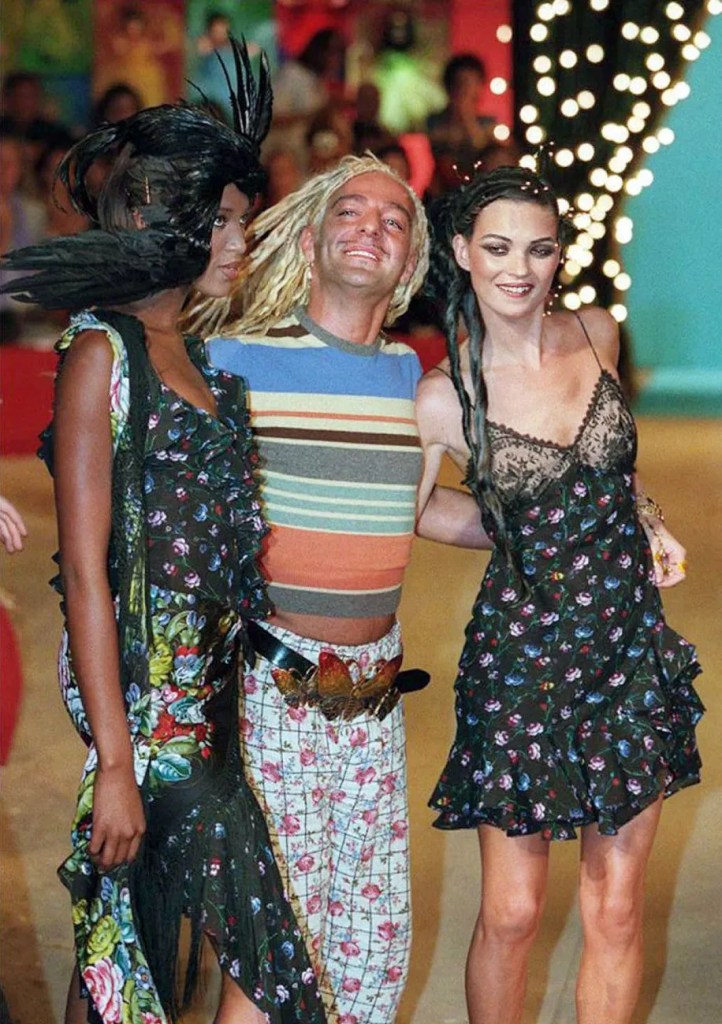
Success did not initially bring stability. His independent label repeatedly struggled financially, and by the early 1990s his reputation vastly exceeded his resources. The crisis produced one of fashion’s foundational modern legends. In 1994, with little money and his business precarious, Galliano was assisted by friends and supporters including Amanda Harlech, Stephen Jones and André Leon Talley. The Portuguese-born Paris hostess São Schlumberger lent him her hôtel particulier, while models including Kate Moss, Naomi Campbell and Linda Evangelista agreed to appear. Working with severe material limitations, Galliano produced a small collection of extraordinary precision and romantic intensity. The show rescued his career.
The importance of that moment is easily obscured by its mythology. Galliano demonstrated that scarcity could intensify rather than diminish his imagination. With only a handful of looks, beautiful cutting, intelligent historical reference and complete control of atmosphere, he created something far more persuasive than the enormous spectacles that money would later allow him to stage. The 1994 collection established the contradiction that would follow him throughout his career: Galliano required extraordinary resources to fulfil the scale of his imagination, yet some of his greatest work emerged when resources were almost nonexistent.
CONQUERING PARIS
In 1995 Galliano was appointed to Givenchy, becoming the first British designer to lead an established French couture house. The appointment represented a remarkable rupture in Parisian fashion culture. Haute couture had traditionally maintained an aura of continuity, discretion and Frenchness. Galliano arrived from the London club world carrying historical pastiche, theatricality and the instincts of an outsider. Bernard Arnault, whose LVMH empire was beginning to reconceive heritage houses as global luxury businesses, recognised that precisely this instability could be commercially useful.
Galliano’s tenure at Givenchy was brief, comprising only a handful of collections, but its historical importance exceeds its duration. Within little more than a year, Arnault moved him to Christian Dior, while Alexander McQueen succeeded him at Givenchy. Two British designers educated in London had suddenly been inserted into the highest institutions of French fashion. It was not merely a personnel change. It announced the emergence of a new luxury economy in which the designer’s personality, provocation and capacity to generate cultural attention had become central assets of the house itself.
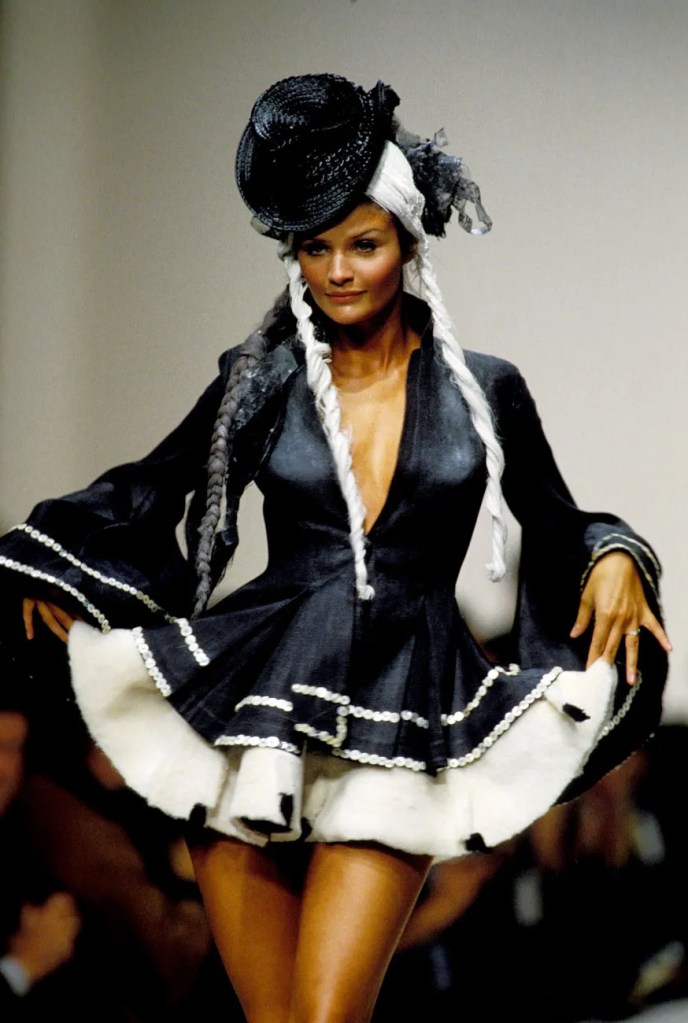
At Dior, Galliano found the institution large enough to accommodate his imagination. He also found an extraordinary archive. Christian Dior had constructed his house around nostalgia, femininity and spectacular silhouette; Galliano understood that the most interesting way to honour that history was not through obedience but exaggeration. Dior’s hourglass became more hourglass. Its historical romance became delirious. Its femininity became performance.
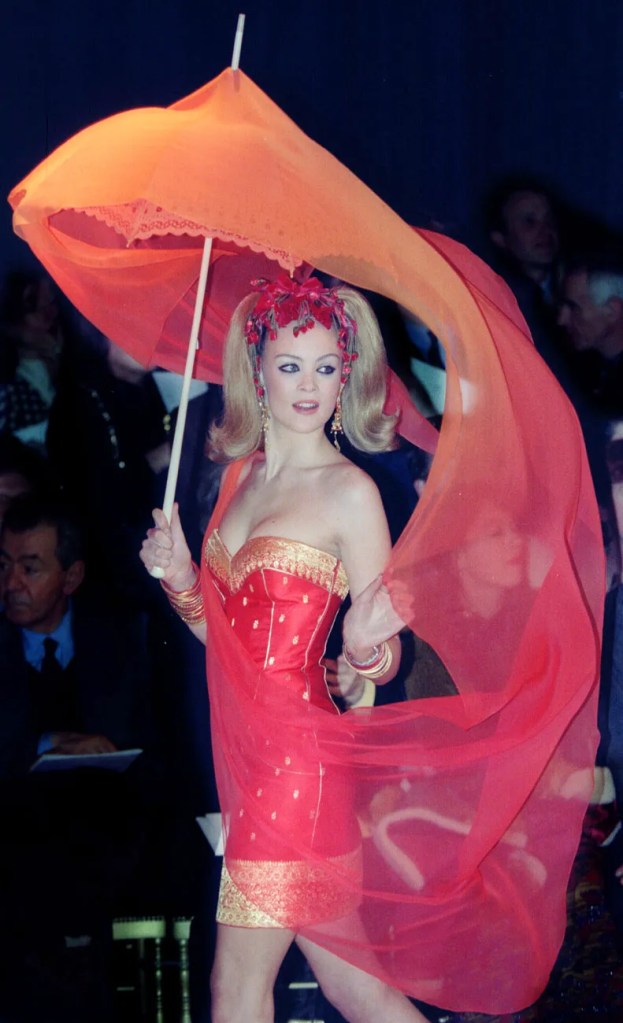
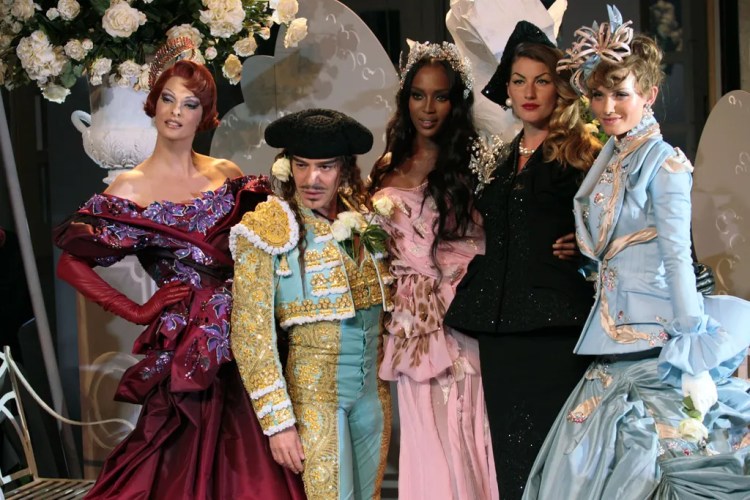
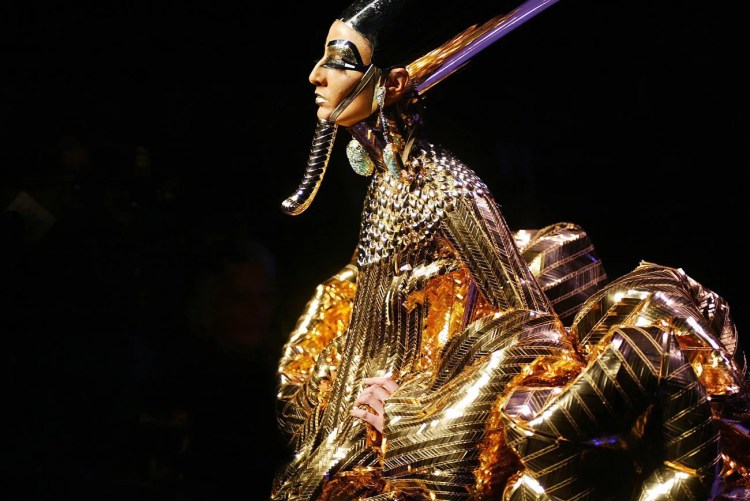
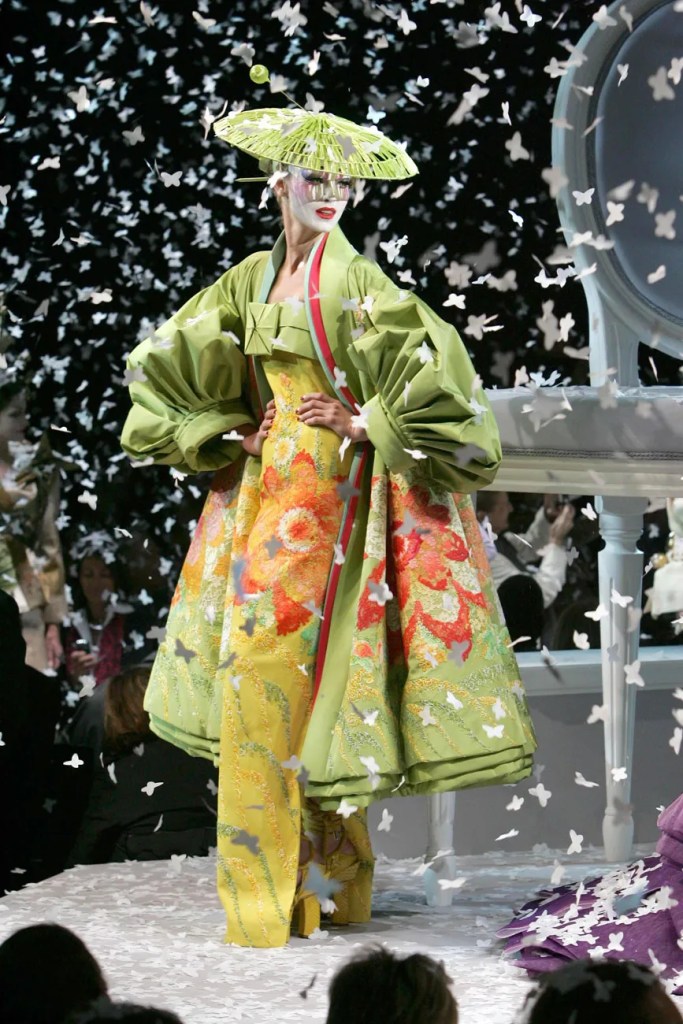
The resulting collections could resemble operas more than conventional fashion presentations. The Paris Opéra, railway stations, palaces and enormous purpose-built environments became stages on which models ceased to function simply as clothes hangers and became members of a cast. Couture could contain Edwardian heiresses, circus performers, ancient queens, aristocrats, geishas, film stars and figures apparently recovered from forgotten photographs. Galliano understood something fundamental about modern luxury: the fantasy surrounding an object could become as economically important as the object itself.
His cutting, however, prevented the spectacle from becoming merely decorative. Beneath the styling lay formidable technical knowledge, particularly his mastery of the bias cut. Fabric could spiral around the body with remarkably little visible construction. Jackets twisted, dresses appeared suspended, and historical silhouettes could be dismantled into surprisingly modern forms. The theatricality attracted cameras; the construction gave the work longevity.
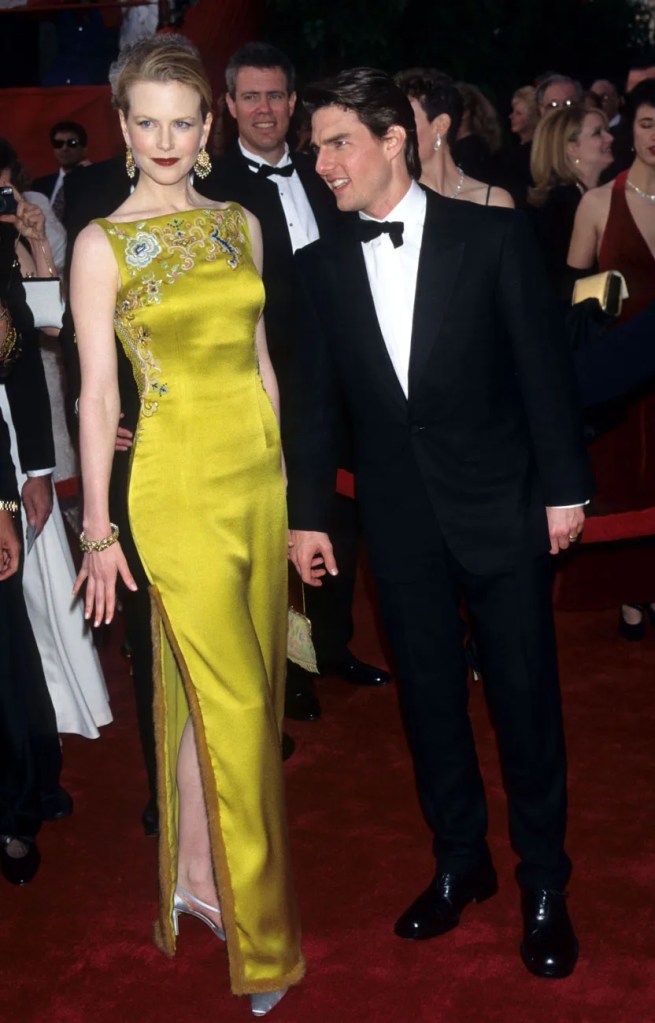
The Spring 1998 couture collection at the Palais Garnier, inspired partly by the Marchesa Casati, remains emblematic of this period: an almost absurd expenditure of fantasy in which couture seemed capable of swallowing architecture itself. Yet Galliano could also produce objects that entered mass culture. Dior’s Saddle bag, introduced around the turn of the millennium, became one of the defining accessories of the period. His newspaper prints became instantly recognisable. Dior under Galliano could move simultaneously between virtually impossible couture garments and aggressively desirable global commodities.
This duality helps explain his extraordinary importance to the modern luxury system. Galliano was not merely creating beautiful clothes for Dior. He was helping redefine what a heritage house could become in an era of conglomerates, global advertising and celebrity culture. History could be transformed into content; couture into publicity; the runway into mass entertainment. A house founded in 1946 could appear both venerable and dangerously contemporary.
There were warning signs within the work itself. Galliano’s Spring 2000 haute couture collection, popularly remembered as the “homeless” collection, transformed the clothing and survival strategies of people living on the street into luxury fashion. Newspaper layers, distressed garments and objects associated with homelessness became couture propositions costing sums unimaginable to the people whose appearance had partly inspired them. Galliano defended the work through historical and aesthetic references, but the controversy exposed a recurring problem in his practice: the assumption that imagination conferred permission. The designer who could turn almost anything into beauty did not always sufficiently consider whether everything ought to become material for beauty.
WHEN THE FANTASY BECAME AN INDUSTRY
By the 2000s Galliano was no longer simply a designer. He had become a performance of the idea of the designer. His own appearances at the end of Dior shows were elaborate theatrical events involving costumes, characters and cultivated eccentricity. The transformation was significant. Earlier couturiers had often dressed soberly so that attention remained on the clothes; Galliano became another image produced by the house.
The fashion industry rewarded the spectacle because spectacle generated attention. Dior required numerous collections, couture, ready-to-wear, accessories, advertising, travel, fittings and continual reinvention. Galliano’s imagination, once sustained by friends working through the night in tiny rooms, now sat at the centre of an industrial apparatus. The romantic myth of the inspired couturier concealed something much less romantic: relentless production.
Accounts of his final Dior years describe increasingly serious dependence on alcohol and medication. Galliano himself has subsequently spoken extensively about addiction and the extraordinary pressure under which he was living. These circumstances matter because they help explain the deterioration of a human being who had spent years functioning inside a system that treated inexhaustible creativity almost as an employment condition. They cannot, however, function as an ethical eraser. Addiction may explain loss of control; it does not transfer responsibility for the words spoken while that control was lost.
This distinction became unavoidable in February 2011. Following an altercation at La Perle in Paris, Galliano was arrested after allegations that he had directed antisemitic and racist abuse at other patrons. Shortly afterwards, a video emerged showing him, intoxicated, declaring admiration for Hitler. Dior suspended and then dismissed him. His own John Galliano label, controlled by LVMH, also severed its relationship with him. Later that year a French court found him guilty of making public insults on the basis of origin, religion, race or ethnicity and imposed a suspended fine.
The speed of the collapse remains astonishing. Galliano had spent decades manufacturing transformations on the runway; now his own identity underwent one with appalling efficiency. He moved almost overnight from celebrated couturier to international symbol of disgrace.
There was also something deeply revealing about the industry’s response. Fashion had tolerated excess while the excess remained productive. Eccentricity, insomnia, intoxication and volatility could be incorporated into the mythology of genius for as long as the collections appeared and the business continued. Only when private collapse became public scandal did the machine discover its limits. Galliano bore responsibility for his behaviour, but the conditions surrounding him raised a larger question about an industry that romanticised creative self-destruction until the consequences became commercially impossible to absorb.
EXILE AND THE PROBLEM OF REDEMPTION
Galliano entered treatment and disappeared almost entirely from fashion. In the years that followed he apologised repeatedly, acknowledged responsibility and began a lengthy process of engagement with Jewish figures and organisations intended to educate him about antisemitism and the Holocaust. Support gradually returned from influential people within fashion. In 2013 Oscar de la Renta invited him into his studio for a temporary residency. In 2014 Renzo Rosso appointed him creative director of Maison Margiela.
The appointment was immediately controversial, but it was also intellectually fascinating. Galliano and Martin Margiela appeared, superficially, to represent opposite conceptions of fashion. Galliano had made the designer into theatre; Margiela had attempted to erase the designer from view. Galliano loved historical romance, narrative and spectacle; Margiela exposed seams, linings, discarded materials and the mechanics of clothing. One constructed fantasy while the other seemed determined to reveal its scaffolding.
Galliano eventually discovered that these languages were less incompatible than they appeared. Both designers were obsessed with construction, transformation and the afterlife of garments. At Margiela, Galliano’s imagination became more analytical. Clothes were stripped back, inverted and reconstructed. Linings became exteriors; fragments became dresses; historical techniques collided with synthetic materials. He developed an almost private vocabulary for these methods, turning the laboratory of Margiela into a place where his theatrical instincts could coexist with conceptual rigour.
The culmination came with the Maison Margiela Artisanal collection of January 2024. Staged beneath the Pont Alexandre III beside the Seine, it summoned the nocturnal Paris photographed by Brassaï: prostitutes, dolls, damaged glamour, corseted bodies and figures apparently emerging from fog, rain and memory. Pat McGrath’s extraordinary translucent make-up gave the models the appearance of porcelain creatures. Gwendoline Christie closed the show in a spectacle that rapidly escaped the boundaries of fashion media and became a broader cultural phenomenon.
What made the collection significant was not nostalgia for Dior-era Galliano. It demonstrated that he had continued developing. The clothes contained everything historically associated with him — character, corsetry, storytelling, eroticism, historical research — but subjected to Margiela’s culture of dismantling and reconstruction. Critics responded accordingly. When Galliano departed the house at the end of 2024 after a decade, he did so not as an exhausted relic of the 1990s but from a position of extraordinary creative strength.
This success created the conditions for the Met retrospective. Fashion had, for practical purposes, readmitted Galliano. A generation too young to remember 2011 discovered his archive through social media. Vintage Dior became intensely desirable. The Margiela collection demonstrated his continuing relevance. Kevin Macdonald’s documentary High & Low: John Galliano attempted to confront both achievement and disgrace, while Galliano himself continued to speak publicly about sobriety, shame and atonement.
Yet reintegration into an industry is not equivalent to resolution in public culture. Fashion insiders might conclude that a decade of sobriety, apology, education and work constituted meaningful rehabilitation. A museum has different responsibilities. When an institution stages a retrospective, it does not merely acknowledge that a person existed or that their work mattered. It selects, frames, interprets and, inevitably, confers prestige.
This is why John Galliano: Horizons became so contentious.
THE EXHIBITION THAT COULD NOT YET EXIST
The Met appears to have understood the difficulty. The exhibition was intended not simply as a celebration but as an examination of Galliano’s career, including the conduct that altered it and the relationship between artistic achievement and ethical accountability. In curatorial terms, this was potentially more interesting than a conventional retrospective. Galliano’s career offers almost ideal material through which to examine the cult of genius, institutional power, addiction, prejudice, cultural appropriation, celebrity and redemption.
But the distinction between critical examination and honour is difficult to sustain when the exhibition concerned anchors the Met Gala. The Gala is not an academic symposium. It is one of the most visible celebrity events in the world, surrounded by luxury sponsorship, red carpets and an extraordinary machinery of publicity. However critically the galleries themselves might have treated Galliano’s past, the imagery surrounding the opening would almost inevitably have communicated celebration.
The timing further complicated matters. That the 2027 Gala was scheduled to coincide with Yom HaShoah transformed what might otherwise have remained an abstract debate about rehabilitation into something far more immediate. For those whose families were marked by the Holocaust, the prospect of one of the world’s most glamorous cultural events celebrating a designer whose disgrace had involved praise for Hitler was not merely provocative. It appeared grotesquely tone-deaf.
The cancellation should nevertheless trouble anyone interested in cultural history, because the opposite danger also exists. If museums exhibit only morally uncomplicated artists, museums will very quickly cease to describe human culture accurately. Caravaggio, Wagner, Picasso and countless other canonical figures confront institutions with acts, beliefs or relationships that cannot simply be reconciled with contemporary ethics. Historical significance does not disappear when the person who produced it becomes repellent.
Galliano’s case differs in one crucial respect: he is alive. A retrospective therefore participates not simply in historical interpretation but in an ongoing negotiation of reputation. The question becomes less whether museums may show difficult artists than whether, and under what circumstances, an institution should bestow one of its highest forms of recognition on a living figure seeking rehabilitation.
There is no intellectually satisfying formula for this. Redemption cannot mean permanent punishment irrespective of subsequent conduct, because a culture in which atonement is structurally impossible provides remarkably little incentive for genuine change. Yet redemption also cannot mean that sufficient contrition eventually restores every honour that would otherwise have been received. Forgiveness and reinstatement are not synonyms. A person may deserve the possibility of rebuilding a life without acquiring an entitlement to every platform, prize or retrospective.
Galliano makes this distinction unusually visible. He has worked again. He has created important fashion again. He has been praised again. He has participated in public conversations about his behaviour and has repeatedly expressed remorse. None of this requires the Jewish people wounded by his remarks, or any other community, to experience his rehabilitation according to a timetable established by the fashion industry.
And yet his achievement remains inseparable from the history of modern fashion. Les Incroyables, the 1994 Paris collection, his arrival at Givenchy, the extraordinary Dior couture spectacles and his transformation of Margiela cannot be removed without making the history of the last forty years substantially less intelligible. His influence can be seen in the contemporary runway’s obsession with storytelling, immersive spectacle, archival revival, historicism and character. The industry in which designers are expected to function simultaneously as historians, image-makers, celebrities and mythologists is partly the industry Galliano helped create.
The devastation belongs to that history too. The antisemitic and racist remarks were not unfortunate footnotes appended to an otherwise pristine career. They changed the meaning of everything that followed. They exposed the human cost concealed inside the mythology of creative excess and permanently complicated the relationship between Galliano’s imagination and the institutions that celebrate it.
Perhaps this is why the title Horizons now seems unexpectedly poignant. Galliano’s career has repeatedly been organised around the possibility of another horizon: London after Saint Martins, Paris after financial collapse, Dior after Givenchy, Margiela after disgrace, the Met after Margiela. Each promised that the previous chapter might finally be absorbed into a larger story of survival.
History, however, does not move so neatly. Some events cannot be edited into satisfying narrative arcs. They remain ruptures, altering everything that comes after them without necessarily erasing what came before.
The most serious assessment of Galliano therefore requires neither canonisation nor erasure. It requires the more demanding task of remembering everything simultaneously: the astonishing clothes and the hateful words, the intellectual curiosity and the ethical blindness, the vulnerable addict and the responsible adult, the young man pushing a rail of clothes through London because he could not afford conventional means and the imperial couturier commanding one of the richest fashion houses in the world, the disgraced figure entering rehabilitation and the designer who, decades after Les Incroyables, could still make a Paris audience feel that fashion had momentarily become theatre again.
Galliano’s rise was extraordinary because he persuaded fashion that imagination could construct entire worlds. His fall was devastating because the mythology surrounding him had encouraged the belief that extraordinary imagination somehow placed its possessor outside ordinary limits. His return has been meaningful precisely because those limits finally became unavoidable. The abandoned Met retrospective does not settle the argument about John Galliano, and perhaps no retrospective ever could. Instead, its cancellation reveals the form in which his legacy may ultimately survive: brilliant, influential, wounded and permanently unresolved, a history in which beauty and disgrace can neither cancel nor redeem one another, but must remain uncomfortably visible side by side.
SOURCES / READ MORE
The Metropolitan Museum of Art — announcements relating to John Galliano: Horizons and the Costume Institute’s 2027 programme.
Reuters — reporting on the cancellation of the Galliano retrospective and the controversy surrounding its timing.
The Metropolitan Museum of Art Costume Collection — holdings and curatorial material relating to Galliano’s Les Incroyables and later work.
Vogue Runway Archive — John Galliano, Givenchy, Christian Dior and Maison Margiela collections, 1980s–2024.
The Guardian — contemporary reporting on Galliano’s 2011 arrest, dismissal from Dior and subsequent court proceedings.
Kevin Macdonald, High & Low: John Galliano, 2024.
