
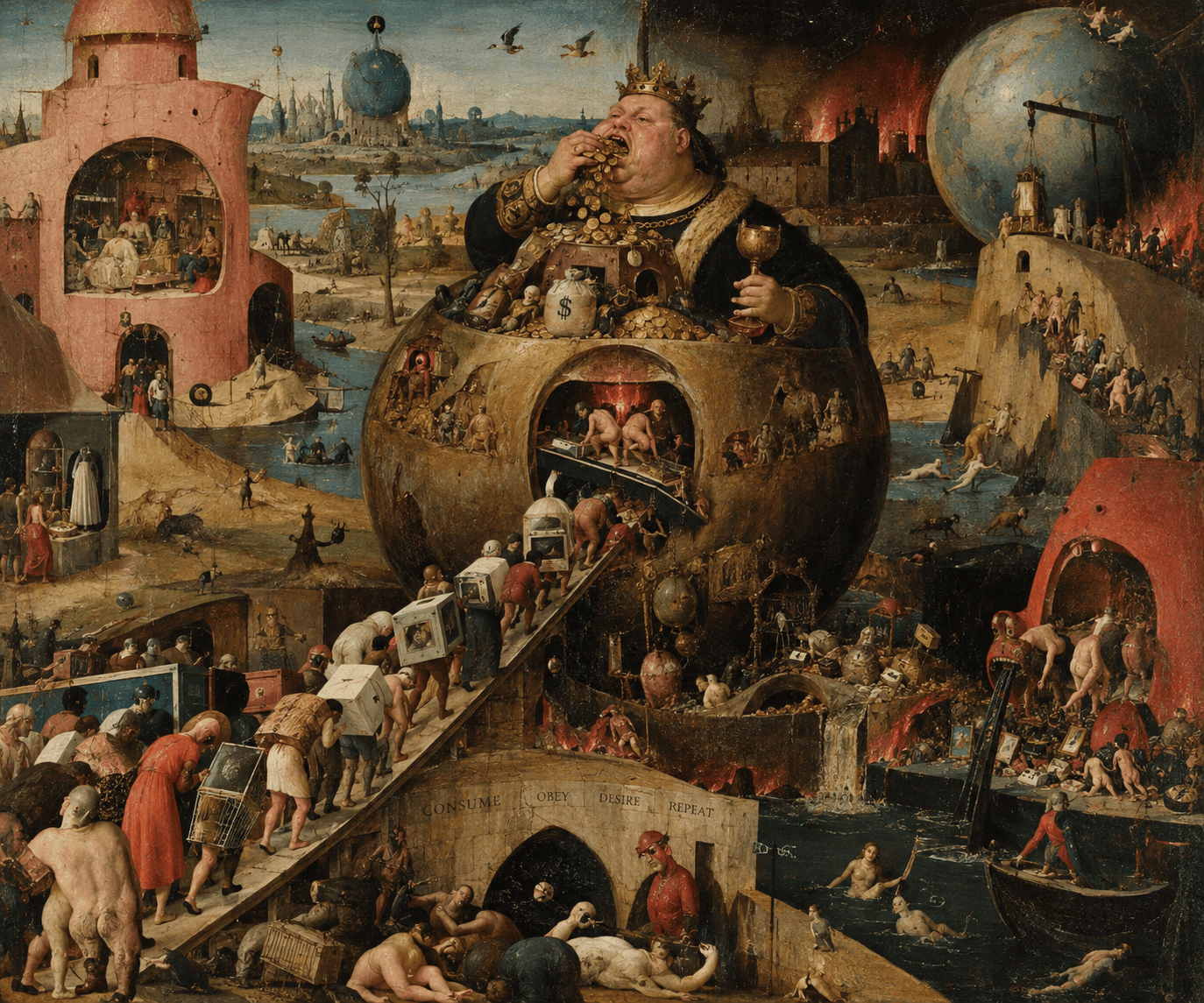
I think about this a lot…by Bergotte
Greed, Consumption and the Failure of Enough
Late capitalism has produced one of the strangest societies in history: we have more of almost everything and yet live inside a permanent rhetoric of lack. We have too many clothes, too much furniture, too much technology, too much food, too much entertainment, too much choice, and still the governing message is the same: not enough. Not new enough, not beautiful enough, not expensive enough, not successful enough. The system depends on keeping desire alive long after need has disappeared.
Greed is ancient. What is new is its organisation.
King Midas wanted everything he touched to turn to gold and discovered that limitless acquisition was indistinguishable from ruin. Medieval Christianity called avarice a deadly sin because greed was understood as a failure of proportion: the inability to recognise when one already had enough. Dickens gave the same moral failure to Scrooge, whose wealth had become useless because it had severed him from other people.
Modern capitalism altered the structure of greed. The miser hoards. The consumer replaces.
That shift matters. Contemporary economies do not simply need us to own things; they need us to tire of them. The coat must date, the phone must age, the kitchen must look wrong, the sofa must become embarrassing, the face must suddenly require another serum. Consumption no longer ends with acquisition. It begins there.
Zola understood this early in Au Bonheur des Dames. The department store did not merely sell goods; it manufactured appetite. Marx, writing from another direction, described how commodities arrive before us stripped of the labour and social relations that produced them. A cheap dress appears cleanly on a rail, detached from the worker, the dye, the factory, the shipping container, the warehouse and the waste it will eventually become.
Digital commerce has perfected this disappearance. Touch a screen and an object appears at your door. The factory is elsewhere. The labour is elsewhere. The landfill is elsewhere. The commodity seems almost magical because everything inconvenient about its existence has been hidden.
Veblen saw another part of the mechanism: we buy to be seen. Consumption is social language. The house, the bag, the watch, the car, the holiday, the restaurant table all announce who we believe ourselves to be. Social media has simply made that old impulse continuous. Status no longer needs a ballroom, a country house or a Rolls-Royce. It can be broadcast from breakfast.
René Girard helps explain why the cycle never settles. Desire is mimetic. We want what other people appear to want. A chair becomes desirable because it appears in enough interiors. A destination becomes necessary because everyone seems to be there. A handbag acquires meaning because other people recognise it. The algorithm has industrialised envy with extraordinary efficiency.
Baudrillard pushed the argument further: we no longer simply buy objects, we buy signs. A kitchen is not just a kitchen; it can signify taste, restraint and wealth. A coat can signify sophistication. A candle becomes “self-care.” A bookshelf becomes intellectual identity. Capitalism discovered that the most profitable commodity of all is not the object but the self we imagine the object will create.
This is why modern consumption so often feels strangely empty. The promise is rarely that the thing will function. The promise is that the thing will transform us.
Literature has been circling this delusion for centuries. Emma Bovary consumes fantasies before she consumes goods. Gatsby surrounds himself with houses, shirts, cars and parties because he believes wealth can overcome time, class and loss. In American Psycho, Patrick Bateman can read the minute distinctions between suits, business cards and restaurants more easily than he can read another human being. Commodities have become more legible than people.
Cinema tells the same story. Chaplin’s Modern Times showed bodies disciplined by production. Fellini’s La Dolce Vita turned luxury into exhaustion. Antonioni filled beautiful spaces with people unable to feel at home inside them. By the time Wall Street arrived, greed could be presented openly as virtue. Later, Fight Club and WALL-E turned abundance itself into a form of suffocation.
But the contemporary argument becomes dishonest if it stops with the shopper.
There is something morally convenient about lecturing ordinary people on overconsumption while treating the accumulation of billions as a natural expression of talent. The handbag becomes a moral problem; the private fortune does not. A fast-fashion order attracts scrutiny while enormous concentrations of wealth are discussed in the bloodless language of markets, valuations and “wealth creation.”
The billionaire is not separate from the culture of excess. The billionaire is its purest expression.
At a certain point, wealth no longer buys comfort. It buys power. No one needs ten billion dollars to live well. The difference between one billion and ten billion is not really one of lifestyle; it is one of influence. Extreme wealth can buy companies, land, media, political access, lobbying, legal armies, tax expertise and the ability to shape the conditions under which everyone else lives.
This is why the billionaire class matters philosophically. It raises an old question in a new form: when does possession stop being freedom and become domination?
The question becomes sharper when taxation enters the picture. Billionaire fortunes are often narrated as though they were created alone, almost by force of personality. But no fortune exists outside society. Wealth depends on courts, roads, schools, research, energy grids, financial systems, contract law, infrastructure and workers educated and sustained by public institutions. The fantasy of the entirely self-made billionaire is exactly that: a fantasy.
Taxation therefore concerns more than revenue. It concerns reciprocity.
The resistance of the ultra-wealthy to taxation reveals something morally significant. It suggests a desire to enjoy the benefits of an organised society while minimising the obligations of belonging to one. The fortune is treated as private achievement; the infrastructure that made it possible is treated as someone else’s responsibility.
Older moral traditions had a word for this: greed.
The striking thing is how readily modern culture has sanitised it. A person who hoards food during a shortage is condemned. A person who hoards wealth on a scale beyond any possible personal use is often admired. One form of excess is considered antisocial; the other is treated as aspiration.
This inversion tells us something about the values of the age.
The billionaire and the ordinary consumer are, of course, not morally equivalent. Their power is radically different, and so are the consequences of their choices. But they are governed by the same cultural command: more.
The consumer wants the next object. The corporation wants the next quarter of growth. The billionaire wants the next billion. None is allowed to arrive.
That is why Erich Fromm’s distinction between having and being remains so useful. The point is not that possessions are inherently corrupting. Beautiful things can deepen life. A chair repaired for decades, a coat worn until it softens, a book covered in notes, a piece of furniture inherited through a family: these are not signs of mindless consumption. They are signs of attachment.
The deeper problem is that contemporary capitalism produces more objects while weakening our relationship with them.
We own more and keep less. We replace rather than repair. We discard before things are worn out. Objects enter our lives without history and leave without consequence. Earlier material cultures often had fewer possessions but more intimate ones. Things acquired biography.
William Morris understood that the quality of objects and the quality of labour were connected. A society that produces disposable goods under disposable conditions will eventually normalise disposability itself. The worker becomes replaceable. The object becomes replaceable. The environment becomes somewhere else.
The environmental crisis has made the old moral argument impossible to dismiss as mere puritanism. Greed no longer damages only the soul. It damages landscapes, climate systems, rivers, forests and bodies. The consumer sees a clean parcel. Somewhere else there is extraction, labour, transport and waste.
This is what makes the modern problem different from Midas. His catastrophe was private. Ours is collective.
And still the system cannot tolerate the idea of enough.
This is the central contradiction of consumer capitalism. Abundance should produce sufficiency. If we have enough, we should need less. But an economy built on endless growth cannot permit sufficiency to become culturally attractive. So satisfaction must be continually destabilised.
Yesterday’s purchase becomes today’s embarrassment. The fashionable becomes dated. The adequate becomes inadequate. Comparison does the work that scarcity once did.
Schopenhauer believed that human beings move endlessly between desire and boredom. We suffer because we want; when we obtain what we want, we soon begin wanting again. Late capitalism did not solve this problem. It monetised it.
The perfect consumer is never miserable enough to abandon the system and never satisfied enough to stop buying.
Even resistance is marketable. Minimalism becomes a shopping category. Sustainability becomes branding. Digital exhaustion produces digital-detox retreats. Anti-consumerism acquires an aesthetic. Capitalism’s greatest talent may be its ability to absorb criticism and sell it back as lifestyle.
This is why the answer cannot simply be “shop less.” The problem is not confined to personal virtue. It lies in a culture that treats endless acquisition as economic health, extreme wealth as evidence of merit and restraint as something close to failure.
The older stories were more suspicious.
Midas had too much gold. Gatsby had too much spectacle. Emma Bovary had too many fantasies. Bateman had too many objects and too little humanity. The vanitas painters filled their tables with silver, fruit and flowers, then placed death beside them.
Their warning was not against beauty.
It was against the delusion that accumulation can save us.
Late capitalism has built an entire system around that delusion. The shopper wants another parcel. The corporation wants another market. The billionaire wants another billion. Everyone is told that the next increment will finally be enough.
It never is.
A civilisation is not only defined by what it can produce. It is defined by whether it knows when to stop.
Discover more from My World of Interiors
Subscribe to get the latest posts sent to your email.

