
Encounters · No. 5
The Ballad
Nan Goldin spent decades photographing the people she loved — in bed, in bars, in hospital, in death. Then she turned the same unflinching attention on the family that had helped kill them.
By Bergotte
There is a photograph taken in 1984 that Nan Goldin has described as the most important image she ever made. It is a self-portrait. She is looking directly into the camera, her left eye swollen almost shut, the skin around it a deep purple-black shading to yellow at the edges, the white of the eye washed red with broken blood vessels. She is wearing lipstick. Her expression is entirely level — not defiant, not pitying, not performing anything. The photograph is called Nan One Month After Being Battered, and it was made after her then-boyfriend Brian had beaten her badly enough to nearly blind her in one eye. She made it because she needed to see what had been done to her. She has shown it ever since because she needed other people to see it too.
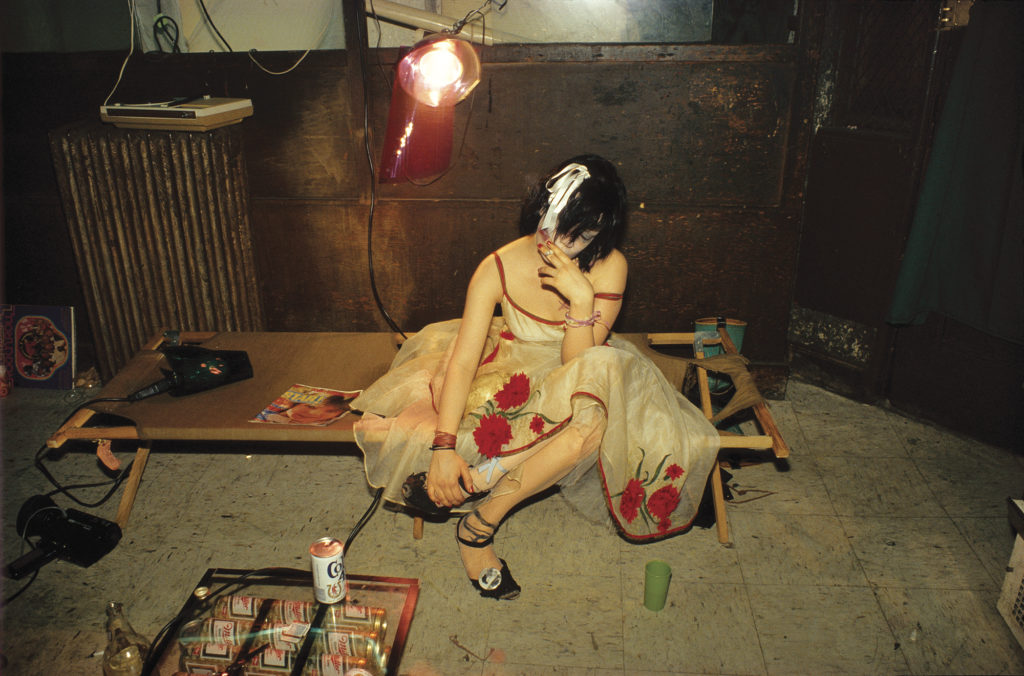
This is, in miniature, the whole of Goldin’s method: the camera as witness, the image as evidence, visibility as the first condition of survival. She has spent fifty years photographing the people she loves — in the raucous intimacy of shared apartments, in the particular light of bars at two in the morning, in the slow terrible diminishment of hospital beds — and the cumulative work is not a record of a subculture, though it is that too, and not a document of an era, though it is that as well. It is, most essentially, an argument: that the lives of people society has decided not to see are worth seeing, and that the act of seeing them, unflinchingly and with love, is itself a moral position.
The camera as witness, the image as evidence, visibility as the first condition of survival. This is, in miniature, the whole of Goldin’s method.
Barbara
Nan Goldin was born in Washington D.C. in 1953, the youngest of four children in a middle-class Jewish family that moved frequently and was, beneath its surface of suburban respectability, in serious difficulty. Her sister Barbara was eighteen years older, brilliant and troubled, in perpetual conflict with their parents over her sexuality and her refusal to be contained by the expectations placed on young women of her generation and class. When Nan was eleven, Barbara walked in front of a commuter train and died. She was thirty-two.
Goldin has returned to Barbara’s death throughout her career, circling it, trying to understand what happened and what it means and what it cost. What she has concluded, stated plainly and often, is that Barbara was destroyed by a society that could not tolerate the kind of woman she was — too sexual, too independent, too unwilling to perform the docility that the institutions around her required. She was institutionalised, subjected to electroconvulsive therapy, given the full weight of mid-century psychiatric medicine’s capacity for harm. She did not survive it.
Goldin has said that photography, for her, began as a response to Barbara’s death — a determination to make a record that could not be suppressed or revised or tidied into something more comfortable. If she photographed her friends, they could not be erased. If she photographed herself, the truth of what had happened to her could not be denied. The camera was, from the beginning, a form of testimony against forgetting.
The Family She Made
At eighteen, Goldin left home and moved to Boston, into a world of drag queens and artists and runaways and people who had, like her, decided that the families they were born into could not hold them. She began photographing immediately and compulsively — with a small camera, using available light, standing close enough to her subjects that the images have the quality of something overheard rather than staged. Her early subjects were the drag performers she lived among: David Armstrong, with whom she would maintain a lifelong friendship and creative exchange; the performers at the drag bars of Boston’s South End, who had built from scratch an identity and an aesthetics and a community that the world outside did not recognise as real.
What Goldin understood, very early, was that the snapshot — the form that serious photography had always slightly disdained, associated with tourists and family albums and the amateur — was precisely the right instrument for what she was trying to do. The snapshot carries no claim to artfulness. It does not impose a composition on its subject. It simply records what was in front of the camera at a specific moment, with all the contingency and imperfection that implies. By working in this mode with absolute seriousness and total commitment, Goldin transformed the snapshot from a form of accidental documentation into a form of radical intimacy. Her photographs look like they were taken by someone who was there because they were taken by someone who was there — who was, in most cases, also drunk, also in love, also inside the moment she was recording.
The work accumulated for years in slide carousels and then in performances: Goldin would project the images in sequence, set to the music she and her friends were listening to — the Velvet Underground, Screamin’ Jay Hawkins, Maria Callas — in bars and clubs and galleries, with the subjects often present in the audience, watching themselves. The show was called The Ballad of Sexual Dependency, after a song from Brecht and Weill’s Threepenny Opera, and it grew and changed as her life grew and changed, absorbing new images and new music, never quite finished, always in motion. It was published as a book in 1986 and immediately recognised as one of the most important photographic works of the century.
By working in the snapshot mode with absolute seriousness and total commitment, Goldin transformed it from a form of accidental documentation into a form of radical intimacy.
The Plague Years
In the early 1980s, the people Goldin was photographing began to get sick. AIDS moved through the communities she lived in and loved with a speed and completeness that, seen from the outside, might suggest catastrophe but that, seen from the inside — from the inside of these photographs, from the perspective of someone who was there — looked more like a sustained act of collective grief conducted in public, because there was nowhere private left to conduct it. The government was not interested. The mainstream press was not interested, or was interested in ways that were worse than not being interested. The people dying were gay men, were transgender women, were drug users, were people who existed at the intersection of several categories of social expendability.
Goldin photographed them. She photographed Cookie Mueller, the writer and actress who had appeared in John Waters’s films and who died of AIDS in 1989, across many years of friendship — at parties, at the beach, in her apartment, at her wedding. She photographed her friends in hospital beds, their bodies changed by illness, their faces carrying the particular expression of people who know they are dying and have decided to be present to it anyway. She photographed the memorials. She photographed the grief. She did not look away, and she did not allow her camera to aestheticise — to impose on the images a beauty that would have softened the reality of what she was recording.
The work of these years, collected in the 1993 exhibition and book Witnesses: Against Our Vanishing and in subsequent retrospectives, constitutes one of the most significant documentary responses to the AIDS crisis made by any artist in any medium. It is significant not primarily because of its formal qualities, though those are considerable, but because of what it refused: refused to let these people be statistics, refused to let them be cautionary tales, refused to let them be anything other than specific, beloved, irreplaceable individuals whom she had known and photographed and lost.
The Reckoning
In 2017, Goldin nearly died. She had become addicted to OxyContin, the opioid painkiller manufactured by Purdue Pharma and owned by the Sackler family, whose name adorned wings and galleries in many of the most prestigious art institutions in the world — the Met, the Guggenheim, the Louvre, the Tate, the National Portrait Gallery. She went through rehabilitation, survived, and emerged with the focused fury of someone who has identified a specific injustice and decided to spend whatever time and energy she has left on it.
She founded P.A.I.N. — Prescription Addiction Intervention Now — and began organising protests at the institutions that bore the Sackler name. The protests were choreographed with the visual intelligence you would expect from a photographer of her gifts: demonstrators in the Guggenheim’s rotunda letting thousands of fake prescription slips fall from the upper levels, a slow blizzard of paper descending through the building’s beautiful spiral. Protesters in the Met’s Egyptian wing lying down among the sarcophagi, the ancient architecture of death made newly legible.
The campaign was, by any measure, extraordinarily successful. Institution after institution removed the Sackler name from its walls — the Tate, the National Portrait Gallery, the Guggenheim, the Louvre, eventually the Met. Purdue Pharma pleaded guilty to federal criminal charges. The Sackler family paid billions in settlements. None of this undid the deaths — the estimates run to half a million Americans killed by the opioid crisis, a number that dwarfs the AIDS deaths of the 1980s and that received, in its early years, a similar quality of official indifference.
She emerged from rehabilitation with the focused fury of someone who has identified a specific injustice and decided to spend whatever time and energy she has left on it.
Laura Poitras’s 2022 documentary All the Beauty and the Bloodshed — which won the Golden Lion at Venice — weaves together the Sackler campaign with the arc of Goldin’s life and work, and the effect is to make visible something that had perhaps always been there but that is easier to see in retrospect: that the entire project, from Barbara’s death onward, has been about the same thing. About who gets to be seen. About who gets to be mourned. About what happens when institutions — the family, the state, the hospital, the museum — decide that certain people’s lives are less worth protecting than other people’s money or comfort or reputation. About what one person with a camera and a sufficient quantity of grief can do about it.
She is in her seventies now, still working, still photographing, still showing up. The early images have the quality of all great documentary photography: they look more real, with time, not less. The faces of the people she loved and lost look out from them with a specificity — a particular quality of being exactly themselves, unrepeatable, irreplaceable — that forty years have not dimmed. This is what the work was always for. Not to aestheticise. Not to memorialise in the softening sense. To insist, with a stubbornness that time has only confirmed, that these people were here, and that their being here mattered, and that anyone who says otherwise will have to get past her first.
Works referenced: The Ballad of Sexual Dependency (slideshow from 1979, book 1986); Witnesses: Against Our Vanishing (1989); The Other Side (1993); I’ll Be Your Mirror (retrospective, 1996); The Devil’s Playground (2003). Laura Poitras (dir.), All the Beauty and the Bloodshed (2022). This essay is part of an ongoing series, Encounters, on artists whose practice cannot be easily categorised.
Discover more from My World of Interiors
Subscribe to get the latest posts sent to your email.

