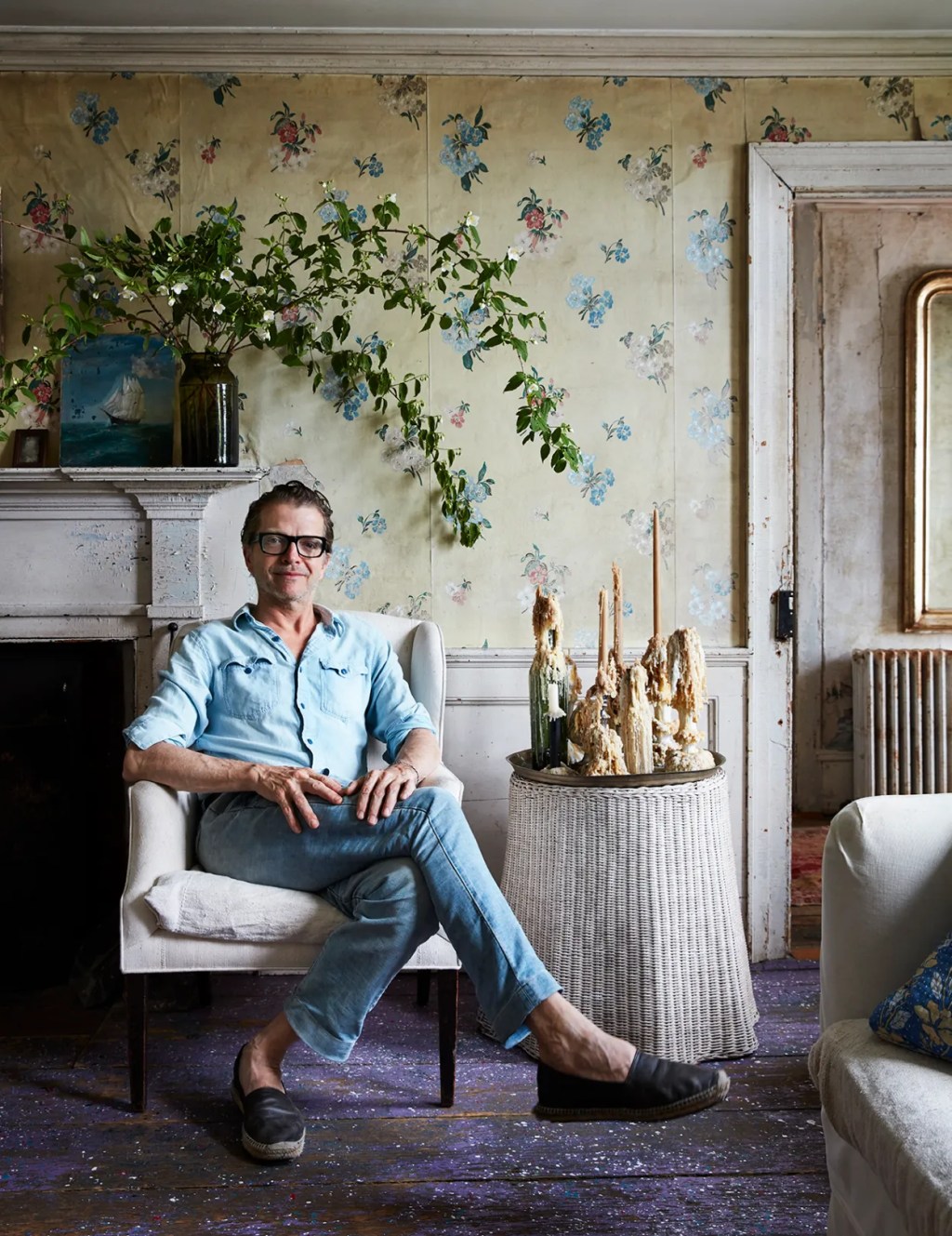
Makers & Rooms — Essay II
The Man Who Saved the Image
John Derian didn’t invent decoupage. He did something harder: he convinced the world that beauty could come from what had already been beautiful once, that the archive was inexhaustible, and that a shop on a quiet street in downtown Manhattan could function as a form of philosophy.
By Bergotte
The shop is easy to miss. It sits on East Second Street in the East Village, between Avenue A and Avenue B, in a stretch of lower Manhattan that has been many things over the decades — immigrant tenement district, heroin corridor, punk epicentre, and now a neighbourhood of dog walkers and brunch restaurants, gentrified into something comfortable without quite losing the memory of what it was. The storefront is modest, the signage restrained. You would not necessarily stop unless you already knew to stop. But once you do, once you push open the door and let your eyes adjust to the quality of the interior light — warm, curated, faintly amber in a way that suggests the nineteenth century without pastiche — you understand that you have entered somewhere with its own rules, its own tempo, its own idea about what a commercial space is actually for.
John Derian has been running his shop at this address since 1993. For more than thirty years, the same door, the same street, the same proposition: that the world is full of beautiful images that deserve to be preserved, and that the best way to preserve them is to put them under glass, fix them to objects people will use and look at and hand on to their children, and sell them at prices that are high enough to communicate seriousness but not so high as to make the whole enterprise feel like an investment vehicle. The objects are decoupage: glass plates, paperweights, trays, ornaments, coasters, mirrors, all of them carrying fragments of old illustration — botanical prints, anatomical diagrams, playing card faces, Victorian valentines, natural history engravings, insects and fish and birds rendered with the fanatical precision of an age that believed that looking carefully at the world was a form of moral discipline. Under glass, sealed and fixed, these images acquire a new life. They glow. They seem, somehow, more themselves than they were on the printed page.
Derian did not invent decoupage. The technique is centuries old — a method of decorating surfaces with cut paper imagery, sealed under layers of varnish, that was popular in Europe from at least the seventeenth century, reached its peak of fashionable gentility in the Victorian drawing room, and subsequently fell into the category of craft hobbies pursued by people who hadn’t yet found their medium. What Derian did was something different and considerably harder to describe. He took a technique associated with amateur gentility and patient ladies with scissors and turned it into something with genuine cultural weight. He found a visual vocabulary — the archive of Western illustration, particularly from the eighteenth and nineteenth centuries — and mined it with such intelligence and consistency that the objects he produced began to feel not like decoration but like a sustained argument about beauty and time and the ethics of the image. And he built, around those objects, a physical environment — two shops, a studio, a body of books and collaborations — that constitutes one of the most coherent and influential aesthetic visions in contemporary American design.
Boston, Then Downtown
John Derian was born in 1962 in Boston, the son of an Armenian-American family whose specific texture he discusses rarely and obliquely in interviews. He has spoken of a childhood spent in a household that valued making things, that understood craft as a natural part of life rather than a special category of activity set apart from the everyday. This is, in accounts of artist-makers, a familiar piece of origin mythology, and like most such myths it probably contains more truth than the speaker intends. The move from seeing making as ordinary to making things that other people would find extraordinary is the whole story, really, and everything else is chronology.
He came to New York in the 1980s, as so many people of his generation did, because New York was where the action was — or rather, where the particular kind of action that his sensibility required was concentrated. The downtown Manhattan of the mid-to-late 1980s is now heavily mythologised, the loft buildings and art spaces and cheap restaurants reconstructed endlessly in memoirs and documentaries, the texture of a particular kind of creative poverty that was also, paradoxically, a kind of freedom. Rents were low enough, in certain neighbourhoods, that artists and writers and people whose career category had not yet been invented could exist without immediately becoming economically productive. This was not comfort, but it was space: space to work out what you were, what you were making, whether any of it mattered.
Derian began making his decoupage objects in the late 1980s. The story, as he has told it, is of accidental discovery: he began working with imagery under glass without a fully formed theory of what he was doing, following his eye rather than a programme, and discovered only by doing it that the results were interesting enough to show to other people. The imagery he was drawn to — old illustrations, antique prints, the visual language of an age before photography when the engraver’s art was the primary technology of visual communication — came from the same archive that serious collectors had always known was there but that the design world had largely declined to engage with directly. It was too old, perhaps. Too associated with a certain kind of musty, overheated interior that modernism had specifically rejected. To pick it up and use it, in 1988 or 1989, required either enormous confidence or total indifference to the prevailing aesthetic conversation. In Derian’s case it was probably both.
The Shop as Proposition
The shop on East Second Street opened in 1993. At the time, this part of the East Village was still genuinely rough — the neighbourhood’s long association with heroin was not yet historical, and the transformation that would eventually make it comfortable enough for the kind of clientele that now fills Derian’s shop was still years away. To open a shop selling handmade decorative objects at this address, at this moment, was either extremely brave or extremely naive, and the distinction probably matters less than the fact that he did it.
What he built inside was not, at first, what it is now. The early shop was smaller, more provisional, stocked with his own objects and with the vintage prints and ephemera that served both as his source material and as inventory in their own right. But the intention was present from the beginning: this would be a space that operated by a logic different from the logic of the retail environments around it. It would be slow. It would reward attention. It would ask more of the person who entered it than simply that they identify what they wanted and pay for it.
This is harder to pull off than it sounds, and most attempts to create what might be called experiential retail — a term that came into fashion decades after Derian had already mastered the reality it describes — fail by trying too hard. The curated shop-as-environment is a genre now, with its own conventions and its own inevitable drift toward self-parody: the reclaimed wood, the hand-lettered labels, the staff who are too young and too beautiful and who regard customers with a carefully calibrated blend of welcome and indifference. Derian’s shop resists this. It resists it partly because it was doing it before there was a genre to resist, and partly because its intelligence runs deeper than aesthetics. The objects in the shop are genuinely strange and genuinely made, and their strangeness is not performed. It is the strangeness of things that have crossed time — that carry, in their imagery, the entire weight of a visual tradition — and arrived intact.
There is now a second shop, John Derian Dry Goods, a few doors down on the same street, which carries textiles, furniture, ceramics, and the wide range of objects — by Derian and by other makers he admires — that constitute the physical expression of his taste. Together, the two spaces function as a kind of extended argument: this is what a room might look like if it were assembled with real attention to what images and objects do in space, how they speak to each other, what they ask of the person living among them. Walking through both shops in sequence is not entirely unlike walking through a particularly well-edited small museum, except that everything is for sale and nothing is behind glass except the things that are meant to be behind glass.
The Image Archive and Its Ethics
The question of where Derian’s images come from is, in some respects, the central question about his work. He is not an image-maker in the conventional sense. He does not draw or paint or engrave. What he does is find: he searches through old books, printed ephemera, antique botanical atlases, Victorian gift annuals, natural history folios, medical and scientific illustrations, playing cards, holiday decorations, trade cards, sheet music covers — the enormous, largely unexamined visual production of the eighteenth and nineteenth centuries — and he identifies images that reward the kind of sustained, intimate attention that his process of mounting them under glass will invite.
This is not simple work. The archive is vast and most of it is not interesting — the competent but perfunctory illustration that filled the pages of mass-market periodicals is abundant and almost entirely forgettable. What Derian is looking for is something harder to specify: an image that has enough visual intelligence to survive being removed from its original context, that will hold up to scrutiny at close range, that will, when sealed under glass and placed on a table or a shelf, communicate something worth communicating. The eye required to find these images consistently, over thirty years, is a form of connoisseurship that has no institutional name but is real nonetheless.
There is also an ethical dimension to this work that Derian does not often address directly but that hovers around it. The images he uses are old enough to have passed out of copyright, which resolves the legal question cleanly enough. But the question of what it means to appropriate visual material from one context and fix it, transformed, in another has become considerably more fraught in the decades since he started. The art world’s long argument about appropriation — from Duchamp through Warhol through Richard Prince, an argument that has never been fully resolved and probably cannot be — establishes one frame for understanding what Derian does, though he himself would likely resist that framing. He is not making arguments about originality or authorship in the way that appropriation artists typically are. He is doing something quieter and, in its own way, more radical: he is insisting on the continued vitality of imagery that the culture has largely decided to file away, and he is doing so not by ironising it but by taking it entirely seriously.
The 2016 book, John Derian Picture Book, published by Artisan, makes this project explicit. It is a very large, very heavy volume containing over three hundred images from his collection — the raw material, unsupported by any framing text beyond the most minimal captions. The images are reproduced at varying scales, arranged by a visual logic that is rhythmic rather than taxonomic, so that a page of butterfly specimens faces a page of playing card queens, and a seventeenth-century anatomical diagram of the human hand faces a page of illustrated lemons. The effect is not collage exactly — there is no spatial relationship between the images, no attempt to create meaning from juxtaposition. It is more like being given access to a very unusual person’s visual memory: this is what I have found, this is what I keep coming back to, this is what seems to me to justify sustained attention. The book sold very well. It seems to have found its way into the studios and homes of a remarkable proportion of people who make things for a living.
Craft in the Age of Reproduction
There is a complication in Derian’s work that his admirers tend to pass over somewhat quickly. He makes objects by hand, in relatively small quantities, and sells them at prices that reflect this — a glass paperweight might cost eighty or ninety dollars, a large plate considerably more. But he has also collaborated with mass manufacturers, most notably with IKEA, for whom he produced a limited collection in 2019 that brought versions of his aesthetic to a considerably wider audience at prices his usual customers would consider absurdly low. He has collaborated with the French ceramics company Astier de Villatte, producing objects that exist at the opposite end of the price spectrum from IKEA. He licenses his imagery. He sells through wholesale accounts as well as through his own shops.
None of this is unusual in the contemporary design world, where the line between studio practice and commercial production has been permeable for decades. But it creates a tension in Derian’s case that is worth examining, because his whole project rests on the premise that objects deserve to be treated with care — that the handmade, the singular, the object that carries the evidence of attention in its making, has a different value from the mass-produced. When that imagery and that aesthetic are reproduced at industrial scale, what happens to the argument?
Derian’s apparent answer, insofar as he has given one, is a shrug of principled pragmatism. More people encountering the images is not a bad thing. The handmade objects are still handmade, still limited, still what they are. The IKEA version is not a degraded copy of the real thing; it is a different object serving a different purpose in a different life. This is probably correct as far as it goes, but it leaves something unresolved: there is a version of his project that is about rarity and a version that is about dissemination, and these are not quite the same project. He seems to hold both simultaneously, which may be a form of honesty or a form of evasion, and the difference, in practice, is not always clear.
Influence and the Invisible Hand
It is difficult to overstate how thoroughly Derian’s sensibility has permeated the visual culture of the past three decades without being credited for it. The current taste for what interior design journalism calls maximalism — the collected, layered, pattern-rich interior that represents a deliberate rejection of the spare Scandinavian aesthetic that dominated the 2000s and early 2010s — owes a significant debt to what Derian was doing on East Second Street long before maximalism had a name. The appetite for vintage imagery, for natural history illustration, for the visual language of the nineteenth century deployed in contemporary spaces: all of this has antecedents in the broader culture, but Derian was among the first to make it feel not nostalgic but genuinely alive.
He is also, less visibly, an influence on a generation of shopkeepers and makers who have built businesses around the same basic proposition — that a shop can be a form of curation, that the physical act of gathering objects in a space and arranging them thoughtfully is a creative act with real value. The small, serious, carefully edited shop has become, in the cities that can still support such things, a cultural institution in a way it perhaps has not been since before the department store. Derian did not invent this, any more than he invented decoupage. But he demonstrated, with unusual clarity and consistency, what it could look like when it was done well.
His influence on the designers who design for other people — the interior decorators and architects and set designers who fill the rooms of the world — is perhaps even more direct. His name appears, regularly, in the acknowledgement sections of design books, in the sourcing notes of magazine interiors, in the answers designers give when asked where they actually shop. He is, in a profession not known for generous attribution, someone whose contribution is widely acknowledged by the people who know the field. The rest of the world tends not to know his name even as it lives, comfortably, inside the sensibility he helped create.
What Decoupage Actually Is
It is worth, at this point, being precise about the technique itself, because the precision matters. Decoupage — from the French découper, to cut out — is in its simplest form the process of decorating a surface with cut paper imagery sealed under varnish or lacquer. In its Victorian domestic form it was practised with commercially produced prints and applied to boxes, screens, trays, and furniture. The result could be charming or dreadful depending on the quality of the imagery and the skill of the practitioner, and it often managed to be both.
Derian’s method differs from this tradition in one crucial respect: he works under glass rather than on top of a surface. The image is placed face-down on the glass, and the layers of medium are applied from the back, so that when the object is turned over the image is seen through the glass itself — sealed, protected, and subtly transformed by the medium it is suspended in. This reversal is not merely technical. It changes the visual quality of the image in ways that are hard to specify but immediately apparent: the colours are deepened, the details clarified, the whole thing given a jewel-like quality that flat decoupage cannot achieve. More importantly, it means that the glass is not a protective layer added after the fact, but an intrinsic part of the object’s visual character. You are not looking at an image with glass in front of it. You are looking at an image that is, in some sense, of glass.
The objects are made entirely by hand, in Derian’s studio in New York, by a small team. Each one is different — the positioning of the image within the glass, the slight variations in the application of the medium, the individual character of the particular print being used — in ways that are not always dramatic but are always present. They are, in the technical sense, multiples rather than unique works: the same image might be applied to dozens of objects of the same size and shape. But each carries the evidence of its making in a way that machine production does not. This is not incidental to their value. It is, for the people who buy them, close to the whole point.
The Question of Taste
There is a criticism of Derian’s work that is rarely made directly but is implicit in certain reactions to it: that what he does is essentially the elevation of personal taste into a commercial proposition, that the whole enterprise depends on the customer’s willingness to defer to his eye, and that this deference — however well-founded — is a form of aesthetic dependency that the most demanding design culture should perhaps resist. The collector who buys Derian objects is, in some sense, buying his judgment rather than exercising their own. The shop on East Second Street, for all its apparent modesty, is a fairly confident assertion that one person’s way of seeing is worth adopting.
This is true, up to a point. But it is also true of every designer whose work has achieved the kind of cultural penetration that Derian’s has. The PH lamp, sitting on your dinner table, is also an adoption of someone else’s considered position about what light should be. The difference is that Jacobsen and Henningsen operated within a discourse — functionalism, Scandinavian modernism — that provided a theoretical framework for their choices, a vocabulary in which the rightness of a design could be argued and defended. Derian operates largely without such a framework, or rather within one that he has constructed himself from the materials of his own attention, and which resists reduction to principles.
What he offers, in place of theory, is something more like testimony. This is what I find beautiful. This is what I keep returning to. This is what, after thirty years of looking, still seems to me worth making and worth selling. The objects on the shelves of his shop are evidence of a sustained engagement with visual experience that is rare in any field. Whether or not you share his taste — whether the Victorian butterfly or the botanical lemon or the anatomical hand speaks to you the way it speaks to him — there is something in the consistency and seriousness of the engagement that demands respect, and something in the objects themselves that, for a very large number of people, demands more than that.
Time and the Archive
The deepest thing about Derian’s work, and the thing that distinguishes it most clearly from the many imitators who have followed his lead, is its relationship to time. The images he uses are not vintage in the merely fashionable sense — they are not chosen because old things are currently considered interesting, though they are, and this has been good for business. They are chosen because they come from a moment in the history of visual representation when looking carefully at the world was understood to be a form of knowledge, when the production of an accurate image of a plant or an insect or a human bone was a serious intellectual undertaking that required years of training and a kind of patient attention that the contemporary world finds difficult to value.
To put these images under glass is to literalise their preservation — to make permanent, in a small domestic object, something that existed only in fragile paper, in editions that were never large, in the kind of books that end up in attic sales and library disposals and the boxes of print dealers in provincial towns. Derian is, in this sense, an archivist as much as a designer: someone who has made it his business to rescue images from the entropy that destroys most of what is made and to give them a second life in a form that will outlast the originals. The paperweight on the windowsill will carry the image of that seventeenth-century botanical engraving into futures the engraver could not have imagined, into rooms and lives and cultures that bear no relationship to the context in which it was first made. This seems to him worth doing. On most days, looking at the objects he produces, it is impossible to disagree.
There is something almost devotional in the consistency of his practice, in the daily return to the archive, the daily act of selection and making, the refusal to be deflected into theory or spectacle or the kind of institutional ambition that the art world offers to anyone who demonstrates that their work can sustain a certain kind of attention. He has stayed on East Second Street for thirty years. He has kept the shop the same size. He has not opened branches in London or Los Angeles or Tokyo, though he could certainly have done so and made considerably more money. He has, instead, kept doing the thing he was doing when he started, and has gotten better at it, and has trusted that the people who need to find it will find it.
This is, in the culture we actually inhabit, a genuinely unusual form of stubbornness. Most things that achieve the cultural penetration that Derian’s work has achieved expand, franchise, dilute, and eventually become a brand rather than a practice. He has resisted this with a consistency that looks, from the outside, almost effortless, and is almost certainly anything but. The shop is still there. The images are still extraordinary. The light inside, warm and amber and faintly nineteenth-century, still asks you to slow down. Most people, once they have slowed down, find that they are glad to have done so.

Leave a Reply