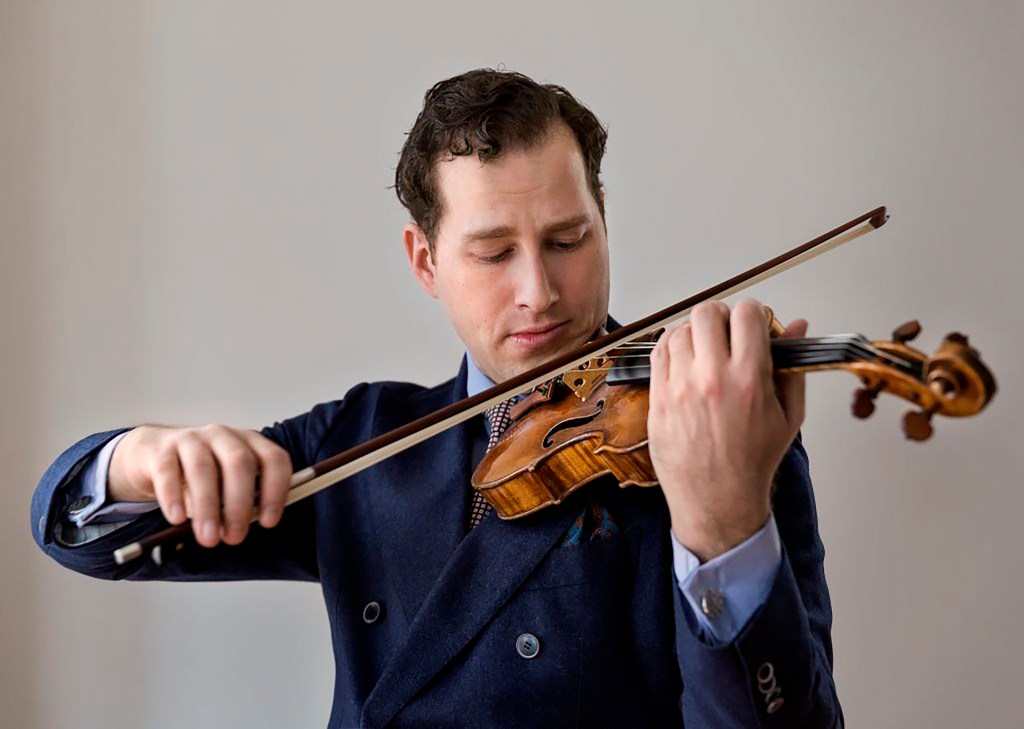
The Danish violinist and conductor returns to Copenhagen’s Royal Danish Theatre on 23 November with Schubert, Grieg and Kreisler — performing on the very instrument Kreisler used to premiere Elgar’s Violin Concerto in 1910.
On 10 November 1910, Fritz Kreisler gave the first performance of Edward Elgar’s Violin Concerto at London’s Queen’s Hall, with the composer conducting. The instrument he played was a Guarneri del Gesù made in Cremona in 1741. More than a century later, that same violin belongs to the Royal Danish Theatre and is played by Nikolaj Szeps-Znaider, who returns to Copenhagen on 23 November for a recital that includes music written by Kreisler himself.
Born in Copenhagen in 1975 to parents of Polish-Jewish origin, Szeps-Znaider began his musical education in Denmark, studying with Milan Vitek at the Royal Danish Academy of Music before continuing with Dorothy DeLay at Juilliard in New York and Boris Kuschnir in Vienna. He won the Carl Nielsen International Violin Competition in 1992, aged seventeen, and five years later took first prize at the Queen Elisabeth Competition in Brussels.
The latter victory established his international career. He subsequently appeared with orchestras including the Berlin Philharmonic, London Symphony Orchestra and New York Philharmonic, performing and recording much of the central violin repertoire. His recordings include concertos by Brahms, Nielsen, Korngold and Elgar, alongside a complete set of Mozart’s violin concertos with the London Symphony Orchestra, which he directed from the violin.
His parallel career as a conductor has become increasingly important. Since September 2020, he has been music director of the Orchestre national de Lyon, where his work encompasses the large-scale symphonic repertoire and opera. The orchestra’s 2026–27 season includes Mahler symphonies and a concert performance of Richard Strauss’s Elektra.
Szeps-Znaider has explained that his interest in conducting developed from a desire to understand the music beyond his own instrumental part. In a 2025 interview with the London Philharmonic Orchestra, he described the difference between preparing a work as a conductor and as a violinist. Conducting begins with the overall architecture of a score before moving towards its details; instrumental preparation tends to proceed in the opposite direction.
The distinction helps explain his interest in maintaining both careers. Conducting provides an understanding of the entire ensemble, while the violin demands the physical discipline of daily practice. Neither is easily abandoned for the other.
There is also a personal history behind his name.
For much of his professional life, he was known simply as Nikolaj Znaider. In December 2019, he announced that he would return to using his full birth name, Nikolaj Szeps-Znaider.
In a personal account subsequently published by the Chicago Symphony Orchestra, he explained that he had shortened his name in the late 1990s on the advice of people who believed a simpler surname would serve him better professionally.
His parents, both born shortly after the Second World War, had deliberately preserved their family names in the aftermath of the Holocaust. When Szeps-Znaider later researched databases documenting its victims, he discovered more than a dozen people bearing the name Szeps who had been murdered. He decided he could no longer allow the name to disappear from his public identity.
It was a considered decision, and one that reveals something of the family history behind a musician whose international career began unusually young.
The violin that belonged to Kreisler
The violin Szeps-Znaider plays is the 1741 Hart, Kreisler Guarneri del Gesù, made by Giuseppe Guarneri, among the most celebrated instrument makers of eighteenth-century Cremona.
According to research published by the specialist violin house Tarisio, Kreisler acquired the instrument in 1904 from the collector John Adam, who agreed to sell it after hearing the Austrian virtuoso play. Kreisler kept it until 1917.
It became one of his favourite instruments. In 1908, he declared that he could never expect to hear a violin voice more beautiful than that of his Hart Guarneri. It was this violin he used for the premiere of Elgar’s concerto two years later.
The instrument is now owned by the Royal Danish Theatre, acquired through donations from Villum Fonden, VELUX FONDEN and Knud Højgaards Fond, and placed on extended loan to Szeps-Znaider.
Its history is remarkable, although instruments of this age are far from static museum objects. Violins made in the eighteenth century have undergone adjustments to accommodate changing musical requirements, including alterations to their necks, fittings and strings. Their survival as working instruments depends on continuous maintenance and the accumulated knowledge of generations of restorers and musicians.
The Guarneri’s significance therefore extends beyond its distinguished former owner. It remains an instrument used for contemporary performance, with a musical life stretching across nearly three centuries.
Schubert, Grieg and the art of the violin sonata
The Copenhagen recital begins with Franz Schubert’s Sonata in A minor, D.385, composed in March 1816, when Schubert was nineteen.
It belongs to a group of three early violin sonatas published posthumously in 1836 under the title Sonatinas, presumably to appeal to the domestic amateur music market. The designation is misleading, particularly in the A minor work, whose four movements reveal a composer already experimenting confidently with harmony and musical form.
Schubert originally described these works as sonatas for piano with violin accompaniment, following an established convention inherited from Mozart and Beethoven. The relationship between the two instruments is central to the A minor sonata, especially in its Andante, where an apparently straightforward melodic idea develops through unexpected harmonic changes.
Szeps-Znaider will be joined by the pianist Robert Kulek, an experienced chamber musician with whom he has collaborated previously. Kulek has performed with numerous leading instrumentalists, and his work as a chamber music specialist makes him a particularly appropriate partner for this programme.
The second major work is Edvard Grieg’s Third Violin Sonata in C minor, Op.45, completed in 1887.
Nearly twenty years separate it from Grieg’s second violin sonata. By the time he wrote the third, his musical language had developed considerably, and the work displays a dramatic intensity quite different from Schubert’s earlier conception of the form.
Its opening movement combines forceful rhythmic writing with a contrasting lyrical theme in E-flat major. The second movement begins with an expressive piano melody before moving into a livelier central section influenced by Norwegian folk music. The finale gathers its material around a theme that eventually returns in a triumphant C major conclusion.
Grieg performed the piano part at the sonata’s premiere in Leipzig on 10 December 1887, with the violinist Adolf Brodsky. It would be the last violin sonata he composed, and one of his final major chamber works.
The two sonatas make an interesting pairing. Schubert’s music belongs to the early nineteenth-century world of domestic chamber music, although its invention consistently exceeds the expectations of that setting. Grieg’s later work demands a more expansive, frequently orchestral approach from both instruments.
Kreisler’s curious musical legacy
After the interval, the programme turns to works by Fritz Kreisler and other composers.
Kreisler was among the most admired violinists of the early twentieth century, renowned for his expressive phrasing and distinctive approach to tone. His short compositions, including Liebesfreud, Liebesleid and Caprice viennois, remain closely associated with the performance traditions of his generation.
His career as a composer also involved one of classical music’s more entertaining controversies.
For decades, Kreisler presented a collection of pieces as arrangements of previously unknown works by earlier composers, among them Antonio Vivaldi and Gaetano Pugnani. In February 1935, he acknowledged that the pieces were his own compositions, written in the styles of those historical figures.
The revelation provoked considerable debate over authenticity and musical scholarship. As the Library of Congress records, Kreisler had successfully presented his original compositions as rediscovered historical material for approximately thirty years. His explanation was practical: at the beginning of his career, he had been reluctant to fill concert programmes with works bearing his own name.
The episode says something about the authority attached to historical attribution in classical music. Audiences and critics had accepted the compositions as examples of an earlier musical language, while Kreisler’s ability to reproduce that language was itself evidence of considerable compositional skill.
The Royal Danish Theatre has yet to specify which of Kreisler’s pieces will be performed on 23 November. Their inclusion nevertheless provides the recital with a particular historical connection: Szeps-Znaider will be playing music by a former owner of his violin, on the instrument that helped establish that owner’s reputation.
Szeps-Znaider’s annual appearances at the Royal Danish Theatre’s Old Stage date back to 2007. This year’s recital is especially worth recommending for the combination of substantial chamber repertoire and the opportunity to hear the 1741 Guarneri in music associated with its most famous former owner.
Concert information
Nikolaj Szeps-Znaider with Robert Kulek
Monday, 23 November 2026, 7.30 pm
The Royal Danish Theatre, Old Stage, Copenhagen
Programme: Franz Schubert, Violin Sonata in A minor, D.385; Edvard Grieg, Violin Sonata No. 3 in C minor, Op.45; works by Fritz Kreisler and others.
Tickets: DKK 130–635, including service fees.
Programme and tickets — The Royal Danish Theatre
Cover photograph: Nikolaj Szeps-Znaider, photographed by Lars Gundersen, supplied in the Royal Danish Theatre’s press materials.

