The Gardener Who Thought in Light
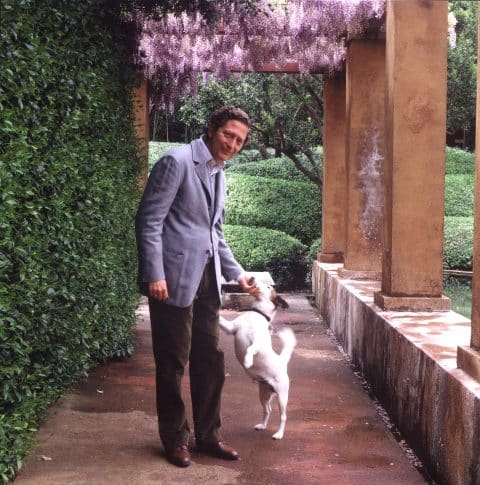
Fernando Caruncho, who died on 23 August 2026 at the age of sixty-eight, called himself a gardener rather than a designer. The distinction was not false modesty. It was a philosophical position — one he had held since he first understood that the garden was not a space to be imposed upon but a reality to be entered, that the light and the geometry and the wheat and the water were not materials to be arranged but forces to be met. His gardens are among the great works of the twentieth and twenty-first centuries. The light in them is still moving.
By Bergotte
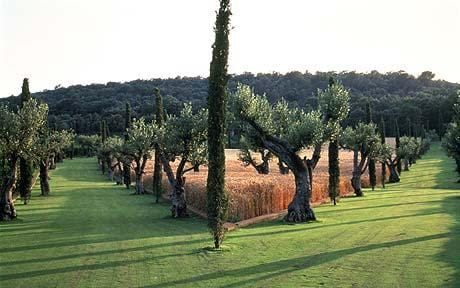
In the Empordà region of Catalonia, on a farm called Mas de les Voltes, there is a garden that does something gardens are not supposed to do. It makes you feel the passage of time as a physical sensation — not the melancholy passage of the tourist before a monument, not the comfortable passage of the person strolling through a park on a Sunday afternoon, but something more fundamental and more unsettling: the sense of being in the presence of a form of time that is older than the individual life, older than the century, older than the civilisation that produced the person standing in it. The wheat grows in its rectangular parterres, green in spring, gold in summer, cut and bare in autumn. The olive trees cast their shadows at angles that have not changed since the first olive was planted in Mediterranean soil. The reflecting pools hold the Catalan sky. The cypresses stand at their intervals like the markers of something that cannot be named. You are in Spain in this decade. You are also in Egypt in the third millennium before the common era, in Persia, in Babylon, in every agricultural civilisation that understood, before Plato and after him, that the garden was where human intelligence and natural order met and that the meeting place was sacred.
The garden was designed by Fernando Caruncho, who died on 23 August 2026 at the age of sixty-eight. He had been working for nearly fifty years — had designed more than a hundred and fifty gardens on several continents, had written books and given lectures and trained a generation of landscape designers including his own sons Fernando and Pedro, who had joined the studio and who will continue its work. He died too young, by any measure, in the middle of a career that had been developing in complexity and ambition throughout its five decades without any sign of having reached its limit. The gardens he will not now make are among the losses that the death of a serious maker always produces — the irreversible subtraction of a specific intelligence from the world’s store of intelligence, the work that existed only as possibility and is now permanently foreclosed.
He called himself a gardener. The insistence on the word was characteristic — Caruncho was precise about language in the way that people formed by philosophy tend to be precise, understanding that the word chosen determines the reality described rather than merely labelling it. A designer imposes. A gardener tends. A designer’s primary relationship is to the form. A gardener’s primary relationship is to what grows. The distinction was not a rejection of formal intelligence — his gardens were among the most formally rigorous of the twentieth century, their geometry deriving from sources as ancient and as demanding as Babylonian astronomical mathematics and the grid plans of the Egyptian agricultural landscape. It was a statement about humility: the acknowledgement that the garden ultimately belonged to the light and the season and the soil, and that the gardener’s role was to create the conditions in which those forces could do their work with the maximum of grace and the minimum of interference.
Madrid, Philosophy, and the Garden
Fernando Caruncho was born in Madrid in 1957 or 1958 — the sources disagree on the year, a small uncertainty that he would probably have found philosophically interesting rather than administratively annoying — and grew up in a city whose relationship to the garden tradition was as layered and as contradictory as its relationship to its own history. Madrid is not a garden city in the northern European sense, not a city whose public spaces are defined by the English landscape tradition or the French formal garden. It is a city of stone and sky and the particular quality of the Castilian plateau light — dry, high, fiercely bright in summer, crystalline in winter — that gives everything it falls on an uncommon precision of edge and shadow.
He studied philosophy at the Universidad Autónoma de Madrid from 1975, and the formation was decisive. Not in the way that architectural training is decisive, producing a vocabulary and a set of techniques that the practitioner deploys throughout their career. Philosophy gave Caruncho something different and more fundamental: a set of questions about the relationship between human intelligence and the natural order, between the mind that perceives and the world that is perceived, between the form that thought imposes and the reality that resists and exceeds it. The pre-Socratic philosophers — Heraclitus, Anaximander, Empedocles, the thinkers who had asked what the world was made of before the academy existed to tell them — fascinated him most. Their world was a world of forces rather than of objects: fire and water and air and earth in dynamic relationship, reality as a process rather than a state, the cosmos as something perpetually becoming rather than something permanently being.
He found, in the garden, the place where these questions were not theoretical but practical — where the relationship between human intelligence and natural process was not a matter of argument but of daily work, where the form imposed by the designer met, daily and seasonally and over the years, the resistance and the generosity of the living world. He moved from philosophy to landscape design without abandoning the philosophical formation — brought it with him, intact, into the studio he established in 1979, and applied it, throughout his career, to every decision about where to place a pool and how to orient a row of olives and what the relationship between the geometry of the garden and the geometry of the light falling on it at a specific hour of a specific season should be.
Epicurus, one of his most frequently cited influences, wrote that it is impossible to know outside of the garden. Caruncho spent fifty years testing this proposition and finding it reliable.
Geometry and Its Sources
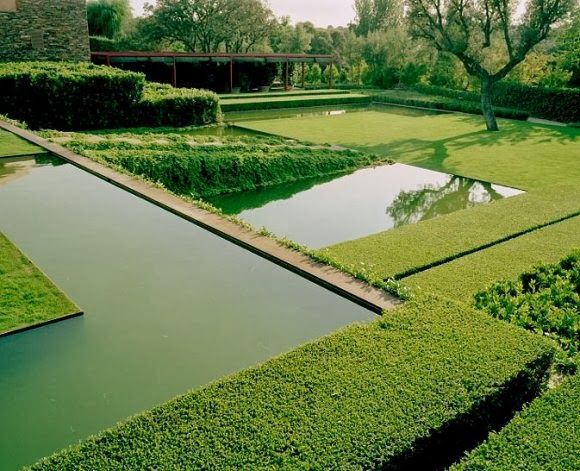
The formal language of Caruncho’s gardens is geometric in a sense that goes deeper than the merely decorative use of geometric form that the word sometimes implies in the garden context. His geometry was not the parterre geometry of the French formal garden, imposed on nature as a demonstration of human authority over the natural world. It was something older and more humble: the geometry of the agricultural landscape, of the irrigation grid and the field division and the orchard row, the geometry that human beings developed not to dominate the land but to work with it efficiently and to read it intelligibly.
He described himself as a geometrician who had inherited the culture of the Babylonians, the Egyptians, and the Persians — the civilisations that had first understood that the regular division of agricultural land was not merely a practical tool but a form of cosmological understanding, a way of bringing the human intelligence into alignment with the order that the natural world already contained. The grid of the wheat parterre at Mas de les Voltes was not imposed on the Catalan landscape. It was revealed from within it, recovered from the landscape’s own agricultural memory, the form that the land had always wanted to take and that Caruncho gave it the intelligence to take.
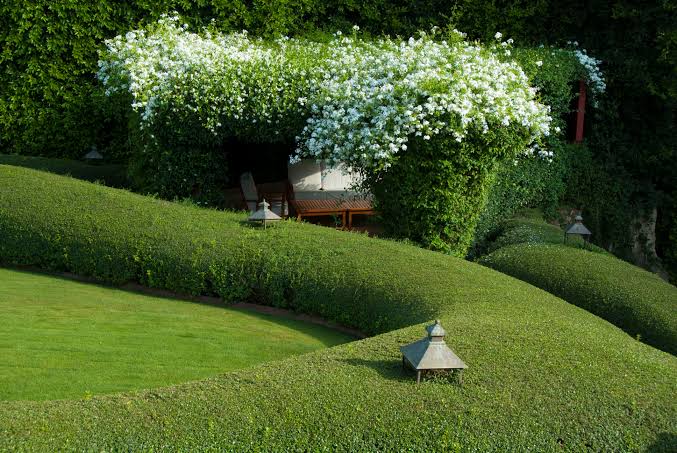
Light was his primary material — more primary than the wheat and the olive and the cypress, more primary than the stone and the water. He said: in our projects, the primary material is the light, but the way we control it is with geometry. The geometry was the receptacle of the light. The grid of the wheat parterre existed so that the light could fall across it at the angles the season produced and create, in the shadows between the rows and the brilliance of the open parterres, a visual experience that was simultaneously fixed in its formal structure and perpetually changing in its luminous content. The garden looked different at seven in the morning from the way it looked at noon from the way it looked at five in the afternoon, and all three were correct, all three were what the garden was designed to be. Caruncho designed for time as well as for space, which is the distinction between the garden designer and the garden maker and the measure of his seriousness.
Mas de les Voltes and the First Masterpiece
Caruncho’s career had been developing for fifteen years when he undertook the commission at Mas de les Voltes in 1994 — a Catalan farm estate in the Ampurdà region of Girona that the owners wanted transformed into a landscape of significance and permanence. What he produced there is the work by which he will be most remembered, the garden that established his international reputation and that constitutes, by the consensus of landscape designers and critics across the world, one of the great gardens of the late twentieth century.
The design was inspired by, among other sources, the ceiling panels of Piero della Francesca — the Early Renaissance painter whose geometric precision and whose understanding of light as a spatial force were as close to Caruncho’s own thinking as any visual source could be. The rectangular parterres of wheat, the reflecting pools aligned with the field divisions, the rows of olive trees and Mediterranean cypresses: each element was both formally and agriculturally correct, belonging to the Catalan landscape by cultural and ecological right rather than by the imposition of a foreign aesthetic. The boldness of the gesture was entirely the boldness of simplicity: Caruncho had stripped the garden to the elements that were most essential and most ancient, and trusted that those elements, handled with sufficient intelligence and sufficient care, would produce an experience more powerful than any complexity could achieve.
Dan Kiley, the American landscape architect whose own work in the modernist formal tradition had made him one of the most significant figures in twentieth century landscape design, wrote the preface to Mirrors of Paradise, the book that documented Caruncho’s first fifteen years of work, and described Caruncho as his successor — the designer who had continued and deepened the project of bringing formal intelligence and philosophical seriousness to the landscape in ways that the broader garden culture had largely abandoned. The recognition from Kiley was significant and deserved: Caruncho was not a follower of Kiley’s formal vocabulary, but he shared the conviction that the designed landscape was a serious cultural act, that the garden deserved the same quality of intellectual engagement as any other form of art, and that the designer who brought less than their full intelligence to the problem of what a garden should be was failing not only the commission but the tradition.
The Range of the Work
The more than hundred and fifty projects that Caruncho’s studio produced across his career ranged from private gardens in Spain and Italy and Morocco and New Zealand and the United States to public spaces and agricultural estates and the restoration of historic gardens including work at the Alhambra and the Patio de los Naranjos and the Alcázar in Seville — places where the garden tradition he was working in had been developed to its highest historical expression and where the weight of that tradition was both a resource and a responsibility.
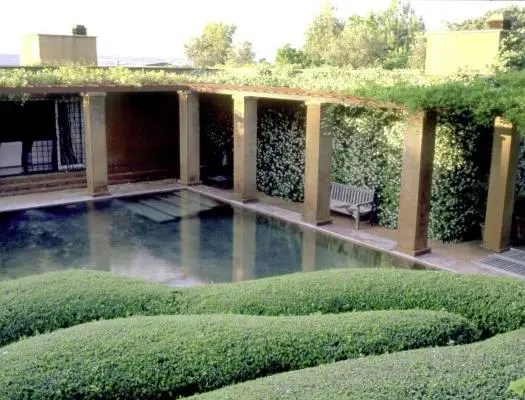
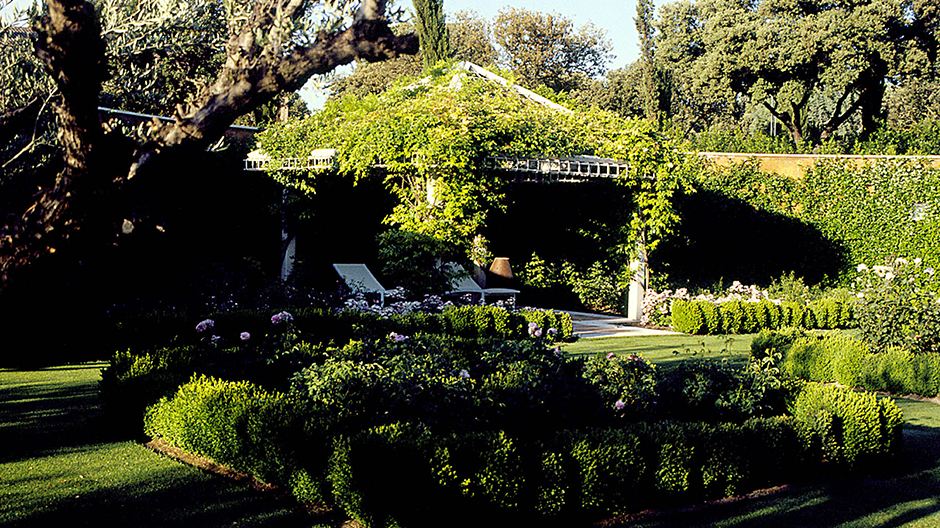
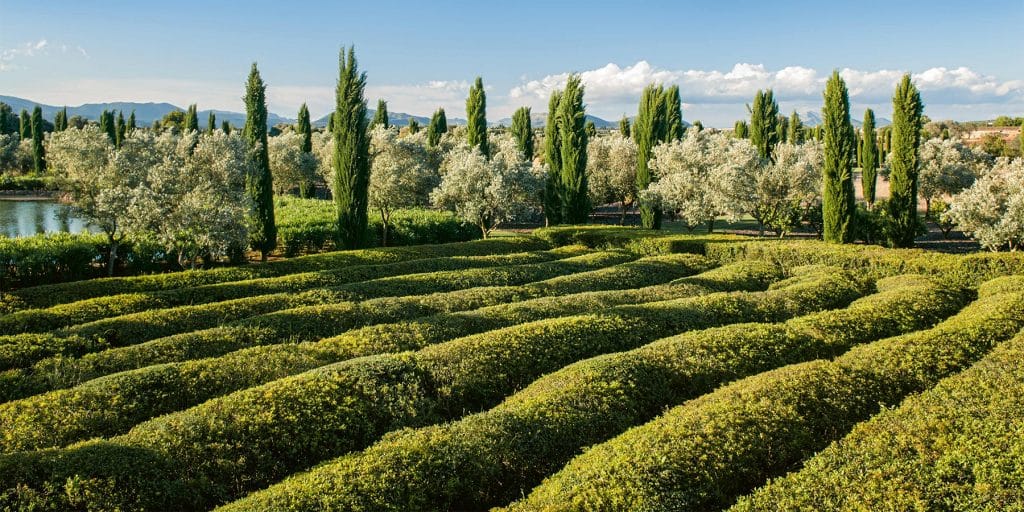
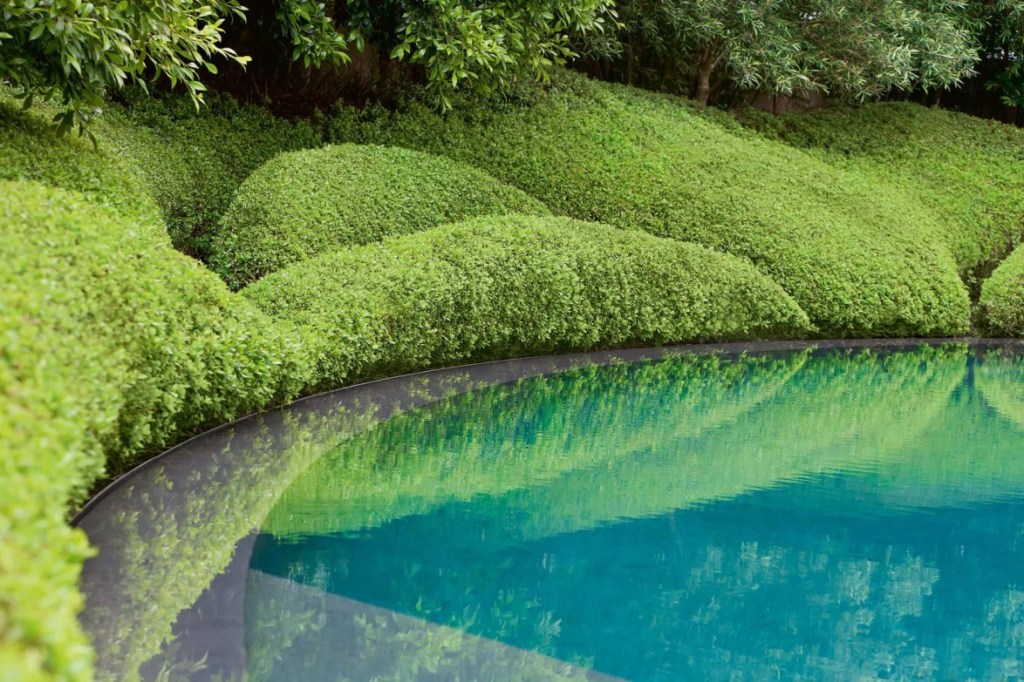
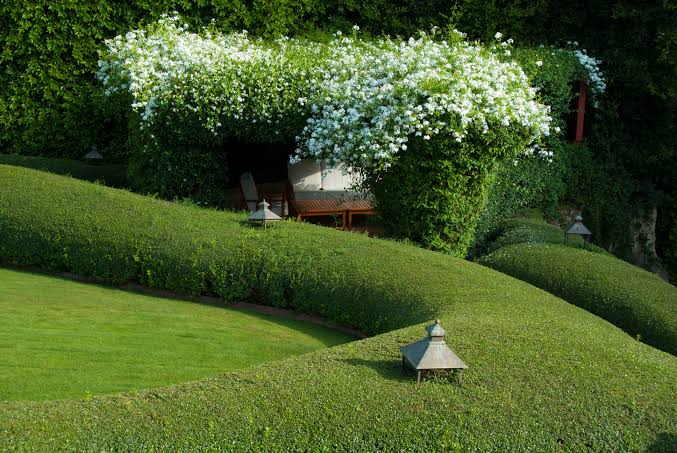
The private gardens demonstrated the full range of his formal vocabulary: the geometric rigour of the Mas de les Voltes parterres appearing in different materials and at different scales — hedges of mastic at the Cotoner garden in Mallorca, rolling in waves against the vertical punctuation of the cypresses; a crescent-shaped basalt pool bordered by sculpted escallonia in Auckland; a vineyard in Montalcino that combined the geometry of the agricultural grid with the organic impulse of the vine rows in ways that produced, as one critic wrote, the shock of the grid against the waves. Each garden was specific to its site and its climate and its cultural context, designed from an understanding of the genius loci — the spirit of the place — that Caruncho had developed through the philosophical formation of his youth into something approaching a systematic method: the sustained observation of a site across seasons and hours, the identification of its specific qualities of light and topography and existing vegetation, the design that emerged from those qualities rather than being imposed upon them.
The international projects — in Morocco, in Greece, in Italy, in England, in New Zealand, in the United States — demonstrated the portability of his formal intelligence across radically different landscape conditions. A Caruncho garden in Marrakech was not a Spanish garden displaced to North Africa. It was a garden that understood the specific light and the specific water and the specific cultural landscape of the Maghreb and responded to them with the same formal intelligence that had responded to the Catalan Empordà — finding, in each landscape, the geometry that was already there, the form that the land had always wanted to take.
The Philosopher in the Garden
Caruncho’s philosophical formation was not a biographical detail that happened before the career began and had no subsequent relevance. It was active throughout the career — present in the way he talked about his work, in the references he made to Plato and Aristotle and Epicurus and the pre-Socratics, in the quality of thought that the gardens embodied, in the insistence on the garden as a place of knowledge rather than merely of pleasure.
Plato’s Academy, the school of philosophy that provided the motto on Caruncho’s studio website — let no one ignorant of geometry enter — was itself a garden: a grove of olives outside Athens where philosophy was practised among trees and water and the particular quality of the Attic light. Aristotle’s Lyceum was also a garden. The great Islamic philosophers wrote in gardens and wrote about them. The garden, in the Western and the Islamic traditions simultaneously, had been understood as a place of knowledge — not merely a pleasant setting for intellectual work but an environment whose specific character, the meeting of the cultivated and the natural, the human order and the cosmic order, was itself productive of the kind of understanding that the enclosed room could not generate.
Caruncho recovered this understanding for the contemporary landscape — made it available again, in practical form, in gardens that people could inhabit and think in and be changed by. His gardens were not objects to be contemplated from outside. They were environments to be entered and experienced over time, across the hours of the day and the seasons of the year, in the full sensory richness of the living landscape. The knowledge they offered was not propositional — not the kind of knowledge that can be formulated and recorded and transmitted in words. It was the knowledge that Epicurus meant: the knowledge of being in the world, of being a body in a place, of understanding through the senses what the mind alone cannot fully grasp.
The Legacy and the Light
Fernando Caruncho is survived by his sons Fernando and Pedro, who have been working in the studio and who will continue its practice — a continuity of the kind that the most serious design practices achieve when the founding intelligence has been transmitted rather than merely inherited. The gardens he designed are distributed across the world, in climates and cultures that his Madrileño formation could not have anticipated, each one continuing to be what he made it: a specific response to a specific landscape, a geometry that holds a specific quality of light, a place where the wheat grows and the olives cast their shadows and the water reflects the sky above it.
The garden at Mas de les Voltes was designed in 1994. It is now thirty-two years old, and the olive trees that Caruncho placed in their grid are thirty-two years larger, and the wheat has grown and been cut thirty-two times, and the light has fallen across the parterres thirty-two thousand times at the angles that the hour and the season have always determined. The garden is more itself now than it was when it was made, which is the condition of all great gardens and the measure of Caruncho’s understanding: he designed not for the moment of completion but for the decades of growth and change and seasonal return that would follow it, trusting the light and the geometry and the living material to go on doing what he had understood they would do.
A Spanish colleague wrote, in the immediate aftermath of his death, that his gaze would remain in his gardens — in the still water, in the stone, in the geometry, in the trees, in the silence, and above all in the light that was one of his great obsessions. This is correct. The light is still moving in the gardens. It will move in them long after the names of the people who walk through them have been forgotten. That was what he intended. The gardener, he understood, works for a time beyond their own. He worked for it honestly, and at length, and with the full seriousness of the philosophical formation that sent him into the garden in the first place.
Fernando Caruncho. Madrid, 1957 — Madrid, 23 August 2026.

Leave a Reply