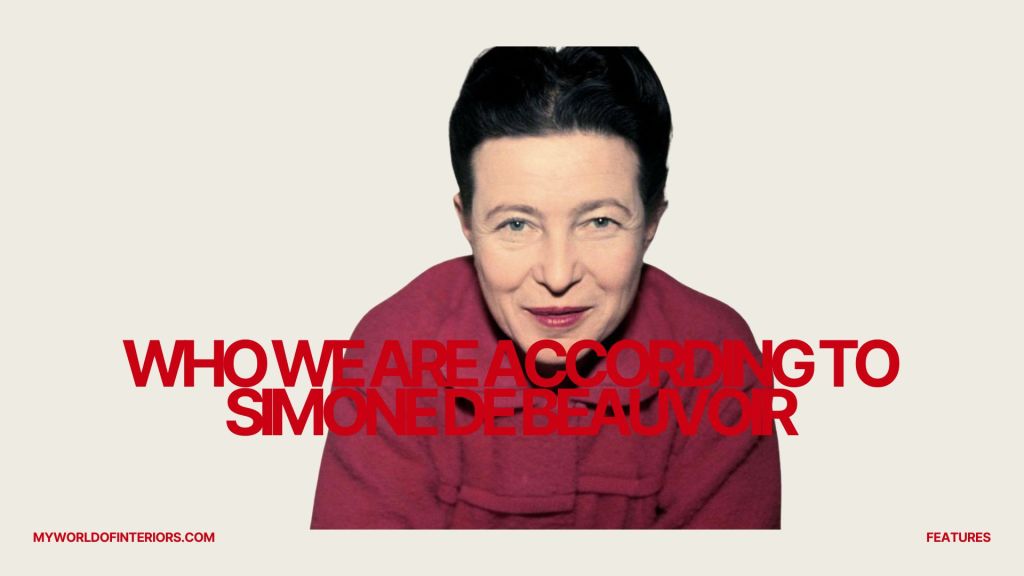
She wrote the book that changed what women thought they were allowed to want. She lived a life that her own philosophy would judge with considerable severity. She was the most important philosopher of freedom of the twentieth century, and she spent decades in the gravitational field of a man who made her smaller. The contradictions are not incidental. They are the argument.
By Bergotte
In 1949, Simone de Beauvoir published The Second Sex — a book of approximately eight hundred pages that attempted nothing less than a complete account of what women are, how they came to be what they are, and what they might become if the structures that had produced them were dismantled. The book was received, in France, with a combination of hostility and scandal that confirmed, more efficiently than any argument could have, the accuracy of the diagnosis. François Mauriac, the Catholic novelist, wrote to one of Beauvoir’s colleagues at Les Temps Modernes to express his disgust: he had learned, he said, everything about her employer’s vagina. Albert Camus — who was supposed to be on the progressive side — complained that she had made the French male look ridiculous. The Vatican placed the book on the Index of Forbidden Books.
Beauvoir had expected difficulty. She had not quite expected the specific quality of the difficulty — the way the objections revealed, with the unreflective precision of the truly defensive, exactly the structure she had been describing. The men who were most outraged by The Second Sex were outraged because it had named something they preferred unnamed, had made visible something they required to remain invisible, had subjected to philosophical examination a set of arrangements that worked very well for the people who were not subject to them and that required, for their continued functioning, the belief that they were natural rather than constructed, inevitable rather than chosen.
“One is not born, but rather becomes, a woman.” The sentence is the most consequential in twentieth-century philosophy — more consequential, in terms of the practical effect on the lives of actual human beings, than anything Heidegger or Wittgenstein or the logical positivists produced in the same period. It is also, like all sentences of genuine precision, frequently misunderstood. It is not saying that biological sex does not exist, or that the body is irrelevant to the self. It is saying that the meaning attributed to the body — the vast, ramifying, historically accumulated, institutionally enforced complex of expectations and prohibitions and roles and valuations that the word “woman” carries — is not delivered by the body itself but is imposed upon it, by a civilisation that has organised itself around the convenience of that imposition and that calls the imposition nature to disguise the fact that it is power.
This is the starting point. The essay that follows is an attempt to trace where Beauvoir goes from it — through the philosophy of the Other and the ethics of ambiguity and the fiction of immortality and the late reckoning with her own life — and to ask what she tells us, across the full arc of her thinking, about who we are when the conditions of our existence have been shaped, before we chose anything at all, by forces that had their own interests in our shaping.
The Other and the Mirror
Beauvoir’s philosophical formation was existentialist — she was, with Sartre, the co-founder of the existentialist movement as a public intellectual phenomenon, the co-editor of Les Temps Modernes, the co-inhabitor of the Saint-Germain-des-Prés café world that the postwar world made mythological. She had read Hegel and Husserl and Heidegger with the sustained attention of someone who had passed the agrégation in philosophy — the most demanding competitive examination in the French academic system — second in her year, at twenty-one, with Sartre first. She absorbed from this tradition the fundamental existentialist commitment: existence precedes essence, which means that the human being is not born with a fixed nature that her life then expresses, but is thrown into existence without a predetermined essence and must make herself through her choices.
She took this commitment seriously — more seriously, in certain respects, than Sartre did — and she took it seriously in a direction that the existentialist tradition had not gone: toward the question of what it meant to apply this framework to the half of humanity that had been systematically denied the conditions in which genuine self-making was possible.
The conceptual instrument she borrowed from Hegel and transformed for her own purposes was the dialectic of Self and Other. Hegel had argued that self-consciousness requires recognition — that the self comes to know itself as a self through its encounter with another consciousness, through the struggle for recognition that is the motor of historical development. Beauvoir took this structure and applied it to the specific historical situation of women, arguing that the relationship between men and women was not a mutual recognition between two subjects but a relationship in which one term had been fixed as the Subject — the one who looks, who defines, who names — and the other fixed as the Object, the Other, the one who is looked at, defined, and named.
Woman, in this account, is not a subject with her own perspective on the world. She is the perspective on which the male subject reflects himself — the mirror in which he confirms his own centrality, his own normalcy, his own status as the human default. Man is the Universal; woman is the Particular. Man is the neutral case; woman is the deviation, the exception, the sex that must be accounted for. This asymmetry is so thoroughly embedded in the language and the institutions and the unconscious assumptions of Western civilisation that it presents itself, to those who have not had reason to examine it, as simply the way things are. One of the things The Second Sex does — one of the things that made it so uncomfortable — is examine it. To examine it is to see that it is not the way things are but the way things have been arranged, and that the arrangement has beneficiaries.
The Other is not born the Other. She is made the Other — through the accumulation of a thousand daily practices, educational structures, legal arrangements, economic dependencies, cultural representations, and philosophical traditions that all point in the same direction: toward the woman as the one whose existence is defined in relation to the man’s rather than in relation to her own. The little girl who is told that she is pretty rather than clever, that she should be good rather than ambitious, that her destiny is relational rather than individual, that the life she is preparing for is the life of being someone’s wife and someone’s mother rather than the life of being someone — that little girl is being made, day by day, into the Other. Not born into it. Made.
Bad Faith, and the Woman Who Chooses Her Chains
The concept of bad faith — borrowed from Sartre’s Being and Nothingness but developed by Beauvoir with a social and political specificity that Sartre’s more abstract treatment lacks — is one of the most useful philosophical tools available for understanding the specific way that freedom is denied in the domain of gender.
Bad faith, in the existentialist account, is the act of denying one’s own freedom — of pretending, to oneself or to others, that one is determined when one is in fact free, that the choices one makes are not choices but necessities imposed from outside. It is, in Sartre’s account, a flight from the anxiety of freedom — the attempt to achieve the solidity and security of a thing rather than enduring the vertigo of being a consciousness that is always already beyond itself, always already more than what it has been. In Kierkegaard’s terms, it is despair; in Beauvoir’s terms, it is immanence chosen over transcendence.
But Beauvoir complicates the concept in a way that Sartre, from his position of structural privilege, could not. Bad faith, for Sartre, is always a choice — always a voluntary flight from freedom for which the individual bears full responsibility. Beauvoir insists that the conditions under which bad faith is chosen are not equal, and that the woman who accepts the role of the Other — who finds in the immanence of the domestic, the relational, the self-abnegating life a refuge from the demands of genuine selfhood — is not making the same free choice as the man who declines to examine his own privilege. She is making a choice, yes — Beauvoir never fully abandons the existentialist insistence on freedom and responsibility, and the abandonment of that insistence would undermine the political project as well as the philosophy. But she is making a choice in conditions that have been designed, by the arrangement of the world around her, to make the alternative — the life of genuine transcendence, of project and ambition and self-determination — almost impossibly costly.
The woman who finds comfort in the role is not a fool and not simply a collaborator, though collaboration is involved. She is a person who has done the calculation that her situation makes rational and found that the cost of resistance exceeds the cost of accommodation. This is understandable. It is also, Beauvoir insists, a tragedy — not because the comfortable life is without value, but because the self that might have been made through genuine choice and genuine project is the self that is not made, the life that is not lived, the person who remains permanently potential because the conditions for her actualisation were never provided.
This is the unlived life — the theme that runs through Beauvoir’s work with a grief that is both philosophical and personal. The women of her mother’s generation — educated women, intelligent women, women who might have been doctors or lawyers or philosophers if the door had been open — who had instead organised their considerable capacities around the management of households and the rearing of children and the support of husbands whose careers absorbed the energy that might have been their own. The waste of it. The specific, irreversible, historically produced waste of human potential — not as an abstraction but as millions of specific lives, each one a universe of possibility that the arrangement of the world had decided was not worth actualising.
Her own mother appears in A Very Easy Death (1964) — the memoir of her mother’s final illness, one of the most shattering pieces of prose she produced — as the specific embodiment of this tragedy: a woman of formidable energy and intelligence who had spent her life in the service of a husband she did not love and a faith she could not quite sustain, who faced her death with a terror that the faith had promised to alleviate and conspicuously did not. Beauvoir watches her mother die and is overwhelmed by something she had not expected to feel — grief, yes, but also a recognition of the life that had not been lived, of the person who had been there all along beneath the role, visible now in the extremity of dying in a way she had not been visible in the conduct of living.
The Life as Test Case
Here is where the essay must become uncomfortable, because to discuss Beauvoir’s philosophy of freedom and the unlived life without discussing the ways in which her own life tested and sometimes failed that philosophy would be the kind of dishonesty that she, of all thinkers, least deserves.
She met Jean-Paul Sartre at the École Normale Supérieure in 1929, when they were both preparing for the agrégation, and she spent the next fifty years in a relationship with him that was the central fact of her intellectual and emotional life — a relationship that she both theorised and, in important respects, allowed to constrain her in ways that her own philosophy should have prevented.
The relationship was, by the account of both parties, a genuine intellectual partnership of unusual equality. They read each other’s work, argued with each other’s ideas, shaped each other’s thinking in ways that cannot be cleanly disentangled. The intellectual debt ran in both directions, though the credit has flowed asymmetrically: Beauvoir has been described as Sartre’s satellite, his disciple, the woman who applied his ideas rather than generating her own — a description that the philosophy does not support and that the intellectual history, examined carefully, refutes. Her development of the concept of the Other, her analysis of the body as situation, her account of bad faith under conditions of structural constraint — these are not applications of Sartre’s existentialism. They are transformations of it, in directions that Sartre’s thinking did not go and could not have gone from his particular position.
But the emotional reality of the relationship was more complicated than the intellectual equality. Sartre was, by the evidence of multiple biographies and his own letters, a man of considerable sexual appetite and considerable personal selfishness who treated the “necessary love” — the term he and Beauvoir used for their relationship, as distinct from the “contingent loves” they both pursued with others — as a permanent, unconditional support that he was not required to provide in return. The open partnership, which Beauvoir theorised as an expression of authentic freedom, of the refusal of bourgeois possessiveness, of the existentialist insistence that love should not curtail the freedom of the beloved — worked considerably better for Sartre than for Beauvoir, as open partnerships between men and women have a way of doing.
She was devastated by his relationships with other women in ways that the theory did not quite account for. She drank too much, in certain periods. She wrote to him, in letters that were not published until after her death, with a need and a dependency that the public persona of the existentialist freedom-philosopher did not display. She shaped her career around his — moved when he moved, stayed when he stayed, published in the journal they co-edited, participated in the political positions he took, subordinated, in practice if not in principle, the project of her own intellectual life to the maintenance of his.
Is this bad faith? By her own account, partially. She said so — in All Said and Done (1972), the last of her four volumes of autobiography, she acknowledges the degree to which her life had been organised around Sartre’s, concedes that the organisation had costs she had not always been willing to see, and does not resolve the tension between the theoretical commitment to freedom and the lived reality of a relationship that had, in certain respects, reproduced the very structures she had diagnosed. The concession is honest and is also not quite sufficient — it is the concession of someone who has understood the problem intellectually without being entirely willing to feel its full weight.
But the life as test case is not simply a record of failure. It is also the record of someone who wrote The Second Sex, who produced The Mandarins and the memoirs and the philosophical essays, who continued to think and to work and to develop for five decades — who lived, in the most fundamental Beauvoirian sense, as a person who took her own intellectual life seriously as a project rather than as an accessory to someone else’s. The unlived life was a danger she understood and, in the most important respects, refused. That she did not refuse it perfectly — that the relationship with Sartre was a genuine constraint as well as a genuine partnership — makes her not a hypocrite but a human being, a person who lived in the conditions she was theorising rather than above them.
All Men Are Mortal: The Argument Made Flesh
In 1946, three years before The Second Sex, Beauvoir published a novel that has been persistently overshadowed by the philosophical work that followed it and that is, in the judgment of at least some of her readers — those who encountered it young, before the theoretical framework had been laid over it, and felt it do something to their understanding of time and choice and the value of a finite life — the most powerful thing she wrote.
All Men Are Mortal tells the story of Fosca, an Italian nobleman of the thirteenth century who, seeking to protect his city from the destructions of the endless wars of the medieval period, drinks an elixir of immortality and discovers, over the following seven centuries of lived experience, that immortality is not the gift it appeared to be. The novel follows him through centuries of European history — the Italian city-states, the Spanish empire, the French Revolution — watching civilisations rise and fall, watching the causes he has committed himself to succeed and then be undermined by the success, watching generation after generation of people he has loved die while he continues, unchanged, unable to die, unable to stop.
The novel is structured around his encounter with Régine, a twentieth-century actress of considerable narcissism and considerable neediness who becomes obsessed with him for reasons that are not quite love — she wants, rather, to be the woman he loves most, to matter to someone who has known everyone, to achieve, through him, an exemption from the ordinary condition of being one among the many who are forgotten. She is not granted this. He tells her his story, and the story is the refutation of everything she wanted.
What Fosca discovers — what the seven centuries of living without the possibility of death reveals — is that mortality is not a deficiency of the human condition but its constitutive feature. Without death, nothing is chosen. The decision that cannot be unmade — the commitment that costs something, the relationship that is finite and therefore precious, the cause that matters because you will not live to see its ultimate fate — these are the things that give human life its specific weight and its specific meaning. Fosca is free in a way that no mortal is free: he can reverse any decision, can try again, can begin again, century after century, with the knowledge that failure is not final. And this freedom is the emptiness at the heart of his existence. He has all the time in the world, and therefore time means nothing. He has experienced everything, and therefore experience means nothing. He has loved many people, and therefore love — the particular, irreplaceable, mortal love that stakes everything on this person, in this time, in this life — is unavailable to him.
The novel is the existentialist argument about finitude and freedom made visceral in a way that the philosophical texts cannot quite manage — made through the specific suffering of a specific consciousness across seven centuries of accumulated experience. It is also, and this is what makes it so affecting when you encounter it young, a meditation on what it would mean to be exempted from the condition that makes human choices real. The reader who has not yet made the choices that will define her life — who is still in the period of pure possibility, when everything seems available and nothing has yet been foreclosed — is given, in Fosca, an image of what it looks like when the foreclosing never comes. It looks like nothing. It looks like the absence of the very thing that makes a life a life rather than a mere duration.
The connection to The Second Sex is not immediately obvious but is, on reflection, exact. The woman who has been denied the conditions of genuine choice — who has been made the Other rather than permitted to be a Subject — is living a version of Fosca’s condition from the opposite direction. Fosca cannot choose because nothing forecloses; his freedom is infinite and therefore empty. The woman who has been confined to immanence cannot choose because everything forecloses before she begins; her freedom is constrained to the point of disappearance. Both conditions produce the unlived life — the life in which genuine transcendence, genuine self-making through genuine choice, is unavailable. One from too much freedom, one from too little. Both from the absence of the conditions in which freedom becomes real.
The Ethics of Ambiguity: Living Without a Net
The Ethics of Ambiguity (1947) is Beauvoir’s most concentrated and most underread philosophical work — the book in which she develops, with greater rigour and greater care than either The Second Sex or the autobiographies, her own existentialist ethics: an account of how one ought to live given the specific features of the human condition as existentialism describes it.
The title announces the central commitment: ambiguity is not a problem to be solved but the fundamental condition to be inhabited. Human beings are ambiguous — they are simultaneously free and situated, transcendent and immanent, reaching beyond what they are and rooted in what they have been. The philosophical traditions that had preceded existentialism had generally tried to resolve this ambiguity — either by insisting on the freedom (in the idealist tradition) or the determination (in the materialist one), either by asserting the reality of the individual (in liberalism) or the collective (in Marxism). Beauvoir’s claim is that the ambiguity cannot be resolved and should not be — that the attempt to resolve it, to achieve the false clarity of a single term, is itself a form of bad faith, a flight from the genuine complexity of what it is to be human.
The ethics that follow from this are not comfortable. They do not offer the relief of a system — a set of rules that, followed correctly, will produce the right answer to every moral question. They offer something more demanding: the requirement to think, genuinely and responsibly, in each specific situation, about what genuine freedom — one’s own and everyone else’s — requires. Freedom, for Beauvoir, is not an individual possession. It is a condition that is either present for everyone or genuinely present for no one, because the freedom of the person who is free while others around her are not free is a diminished freedom — a freedom that has purchased itself at the cost of the others’ unfreedom and that is therefore complicit in the conditions it benefits from.
This is the ground of her feminism, and it is also the ground of her broader political commitments. She was anti-colonialist at a time when French intellectual life was not consistently so; she was one of the signatories of the Manifesto of the 121, which supported draft resistance during the Algerian War; she engaged with the question of race and oppression throughout her work, drawing explicit parallels between the situation of women and the situation of colonised peoples in ways that anticipated the intersectional analysis that would become standard in feminist theory decades later.
The argument she makes in The Ethics of Ambiguity that has most purchase in the contemporary moment is the argument about what she calls the “spirit of seriousness” — the bad faith of the person who treats the values she has been given as absolute, who substitutes the inherited framework for genuine moral thinking, who finds in the solidity of the given order a refuge from the anxiety of genuine ethical responsibility. The spirit of seriousness is the moral analogue of the crowd that Kierkegaard diagnosed: the person who does what is done, values what is valued, without the genuine decision that would make the doing and the valuing her own. It is the spirit of every age that mistakes its own arrangements for the natural order, that calls its own conveniences necessity, that treats its own interests as universal truths.
Against the spirit of seriousness, Beauvoir proposes what she calls genuine freedom — the freedom that acknowledges its own ambiguity, that accepts responsibility for its choices without the comfort of absolute frameworks, that remains open to the specific moral demands of specific situations rather than applying rules from a safe altitude above them. It is, again, a demanding ethics. It is an ethics for people who are willing to be uncomfortable, who are willing to keep thinking when the available answers have run out, who are willing to remain in the difficulty rather than reaching for the false resolution.
The Late Reckoning: Old Age and the Body’s Betrayal
Beauvoir wrote The Coming of Age in 1970, when she was sixty-two, and the book she produced — a comprehensive study of how Western society treats its elderly, combining sociological analysis with phenomenological description and moral outrage — is one of the most neglected of her major works and one of the most searing.
The argument is structurally parallel to The Second Sex: as woman is constructed as the Other, denied the status of Subject, made into the mirror of the male Subject’s self-regard, so the old person is constructed as the Other of the productive adult — the one who has been used and is now discarded, rendered invisible, deprived of the social recognition that makes a person feel real. The old are not a separate category of human being. They are what all of us become, if we are fortunate enough to live long enough, and the treatment of the old is therefore the treatment of a future self that the culture, in its enthusiasm for productivity and youth and novelty, prefers not to imagine.
She is writing, again, from the inside of the condition she is analysing — writing as a woman who is ageing, who feels the body’s slow withdrawal of the capacities she had taken for granted, who watches the social world she inhabits register her age in ways that combine the explicit (the condescension, the assumption that her best work is behind her) and the implicit (the simple fact of being less seen, less attended to, less taken seriously than she had been). She had always insisted on the body as situation — on the way the body’s specific features and capacities shape the possibilities available to the self. Now she is confronting the most universal and the most thoroughgoing way in which the body constrains the self: the progressive diminishment of capacity that ageing represents, and the social compounding of that diminishment by a culture that treats it as an embarrassment rather than a condition.
The book is angry. It is the anger of someone who has spent her life arguing for the fullest possible realisation of human freedom and who is watching, in her own body and in the bodies around her, the systematic curtailment of that realisation — not by individual cruelty but by institutional indifference, by the structure of a society that organises itself around the productive years and has no adequate place for what comes before and after them. The anger is philosophical as well as personal. It is the anger of someone who understands that the treatment of the old is not a peripheral issue but a central one — central to any honest account of what a society’s commitment to human dignity actually amounts to when tested against the cases that test it most severely.
What She Leaves, and What Remains Unfinished
Simone de Beauvoir died in Paris in April 1986, six years after Sartre, and was buried beside him in the Montparnasse cemetery, which is either the last act of the great partnership or the last act of the subordination to it, depending on how you read the life. The ambiguity is appropriate. The life resists the single reading, as the philosophy said all genuinely human lives should.
What she leaves is a body of work of extraordinary range and extraordinary consequence: the philosophy, the fiction, the autobiography, the political writing, the late work on ageing, all of it held together by a central, sustained, absolutely serious commitment to the question of what it means to live freely in a world that is not equally hospitable to everyone’s freedom.
The sentence that opened this essay — “One is not born, but rather becomes, a woman” — is still, seventy-five years after it was written, the most precise articulation available of the distinction between the biological given and the social made, between the body as a fact and the meaning attributed to the body as a historical and political construction. The sentence has been contested from the right — by those who want the construction to be the nature, who need the social arrangement to present itself as inevitable — and from certain quarters of the left, in debates about gender and identity that Beauvoir did not live to participate in and that her framework both illuminates and does not fully resolve. The debates are real and the framework’s limits are real. The insight at the sentence’s core — that who we are is not simply given, that the making of the self is always happening in a social context that shapes what making is possible — remains as true as it ever was, and more urgently so in a moment when the technologies of self-construction have multiplied while the structural conditions of genuine freedom remain as unequally distributed as they were in 1949.
The unlived life is still being lived — or not lived — everywhere. The woman who did not become what she might have become, because the conditions were not there, because the cost was too high, because the culture offered her the role and the role was easier and more supported than the alternative — this woman is not a figure from the past. She is the colleague who was passed over, the student who was discouraged, the daughter who was told, in a hundred subtle and unsubtle ways, that her ambition was inappropriate to her gender, her intelligence unfeminine, her desire for the full life selfish rather than simply human.
And the book that changed at least one reader as a teenager — All Men Are Mortal, with its seven centuries of emptiness, its demonstration that the finite life is the only life that is genuinely a life — continues to do what the best philosophy in fiction does: it makes an abstract argument concrete in a way that goes past the intellect and into the body, into the felt sense of what it would mean to have infinite time and therefore no reason to choose, no urgency, no stakes. You close it knowing something you did not know before: that the mortality you had been taught to fear is the very thing that makes your choices matter, that the limit is not the enemy of meaning but its condition. That the life you have — finite, constrained, situated in a body and a history that you did not choose — is the only kind of life in which genuine self-making is possible.
This is who we are, according to Beauvoir: beings who are made before we choose, who must choose anyway, who are responsible for what we make of what we have been given, and who can only exercise that responsibility in genuine freedom if the conditions of freedom are available — which they are not, equally, to everyone, and which the philosopher’s task is to name, and the political task is to change, and the individual task is to refuse, in every specific situation, to accept as nature what is in fact power.
The becoming is not finished. It was never meant to be.
The Second Sex is available in the Constance Borde and Sheila Malovany-Chevallier translation (Vintage), which is the most complete English edition. The Ethics of Ambiguity is published by Philosophical Library/Open Road. All Men Are Mortal is published by W.W. Norton. A Very Easy Death and The Coming of Age are published by Pantheon. Toril Moi’s Simone de Beauvoir: The Making of an Intellectual Woman is published by Oxford University Press. Kate Kirkpatrick’s biography Becoming Beauvoir is published by Bloomsbury and is the most recent and most rigorous account of the life.

Leave a Reply