
Encounters · No. 2
The House That Light Built
Carl Larsson painted the same home, the same wife, the same children, hundreds of times. The result was not repetition. It was an argument — about beauty, about Sweden, about what a life is allowed to look like.
By Bergotte
There is a house in Sundborn, in the Swedish province of Dalarna, that has been visited by more than a million people and reproduced on more surfaces than almost any other domestic interior in history. It has appeared on calendars, on tins of biscuits, on tea towels, on the covers of books about Scandinavian living sold in airport terminals from Helsinki to Houston. IKEA owes it a debt it has never formally acknowledged. The house is called Lilla Hyttnäs, and it belonged to the painter Carl Larsson and his wife Karin, and it is so thoroughly saturated with intention — every curtain, every painted beam, every hand-embroidered cushion — that to walk through it is to feel you have entered not a home but a theory of one.
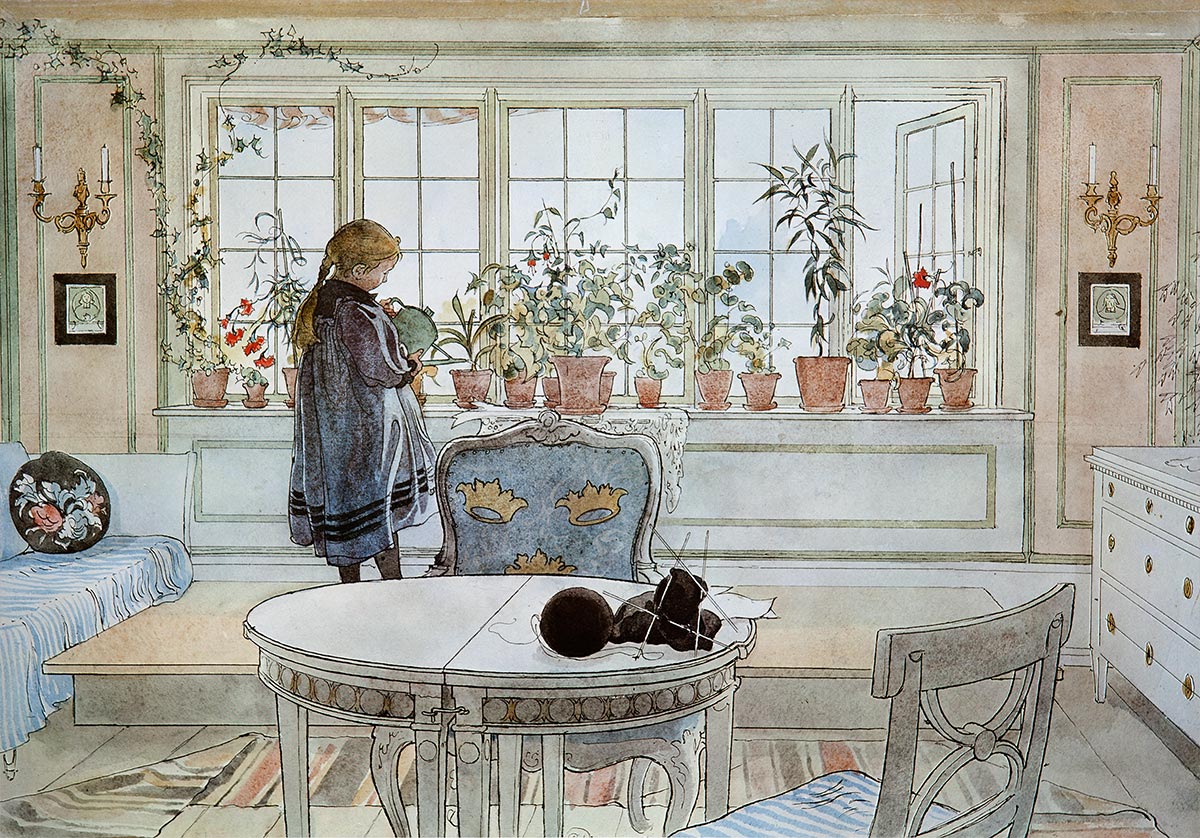
Larsson painted it obsessively across four decades, from the 1880s until his death in 1919. He painted his children reading at the kitchen table, his wife sewing by the window, the garden in summer with the light coming in sideways and gold across the wooden floors. He painted Christmas morning and midsummer and ordinary Tuesday afternoons. He painted the cat. He painted the curtains Karin had sewn from fabric she had designed herself. He painted the stove. He painted, with the same loving precision he brought to a human face, the red-painted cupboard at the end of the upstairs corridor.
To dismiss this as mere domesticity is to miss what Larsson was doing. The home was not his subject. It was his medium. Through it he was making a sustained and radical claim: that ordinary life, tended with care and filled with beauty, constituted a subject worthy of serious art. This was not, in the 1890s, an obvious position. And it was one for which Larsson had paid, in his earlier years, an extremely high price.
The home was not his subject. It was his medium. Through it he was making a claim: that ordinary life, tended with care, constituted a subject worthy of serious art.
The Boy from Prästgatan
Carl Larsson was born in 1853 in one of the worst slums in Stockholm, in a cramped apartment in Gamla Stan where the family had no running water and his father, a largely absent and frequently drunk labourer, contributed little beyond intermittent chaos. Larsson described his childhood in his autobiography, Jag — published in 1931, twelve years after his death, from a manuscript he had been too nervous to release in his lifetime — with a frankness unusual for its era. He wrote about hunger, about cold, about the shame of poverty in a city where poverty was not picturesque. He wrote about his mother’s exhaustion, her hands, the particular quality of her silence. He did not romanticise any of it. The childhood was terrible and he said so.
What saved him, at the age of thirteen, was the Stockholm Royal Academy of Fine Arts, where a teacher noticed something in the boy and enrolled him on a scholarship. Larsson was, by his own account, a difficult student — quick, proud, prone to resentment — but he was also extraordinarily gifted, and the Academy gave him the first stable structure his life had ever had. He worked. He drew constantly. He began to understand that beauty was not something that happened to other people in other circumstances. It was something you made, deliberately, out of whatever materials were available.
He spent much of his twenties in Paris, as Swedish painters of his generation were expected to do, working in the studios and haunting the salons, sending paintings back to Stockholm for exhibitions that were received with varying degrees of enthusiasm. He was capable, accomplished, ambitious. He was not yet interesting. The work of this period is technically assured and essentially inert — paintings that know their craft without yet knowing what they are for.
Karin
In 1882, Larsson met Karin Bergöö in the artists’ colony at Grez-sur-Loing, south of Paris. She was the daughter of a prosperous Stockholm merchant, educated, assured, and possessed of a visual intelligence at least equal to his own. They married the following year. It is not possible to understand Carl Larsson’s work without understanding that Karin Larsson was not his muse. She was his collaborator, his co-designer, his aesthetic conscience, and — in ways that the early twentieth century did not have the language to properly credit — his co-author.
When Karin’s father gave them the use of a small cottage in Sundborn in 1888, it was Karin who began transforming it. She designed the textiles: the curtains, the runners, the embroidered panels, the woven wall-hangings. She designed furniture. She developed a vocabulary of colour — strong reds, clear greens, warm whites — that departed decisively from the dark, heavy interiors fashionable among the Swedish bourgeoisie. The cottage, which they eventually bought and expanded into Lilla Hyttnäs, became a joint work of art, a total environment, a Gesamtkunstwerk assembled from two imaginations that had become, over years of working in close proximity, almost indistinguishable.
Carl painted it. Karin made it. The distinction matters, and it also doesn’t: without his paintings, the house would have remained a private experiment; without her work, there would have been nothing worth painting.
Karin Larsson was not his muse. She was his collaborator, his co-designer, his aesthetic conscience — in ways the early twentieth century did not have language to properly credit — his co-author.
Ett hem
In 1899, a portfolio of watercolours of the house was published in Sweden under the title Ett hem — A Home. It sold in extraordinary numbers. Within years it had been translated and distributed across Europe and North America. The images — loose, luminous, detailed without being fussy, suffused with a quality of light that seemed to come from inside the paper rather than from any external source — struck something deep in the reading public. Here was a home that looked genuinely inhabited. Here were children who appeared to be living their own lives rather than posing for a painter’s idea of childhood. Here was a table set for a meal in a room where someone had clearly also left their boots on the floor.
The influence was immediate and lasting and, eventually, somewhat difficult to trace because it became so diffuse. The Arts and Crafts movement in Britain found in Larsson a continental cousin. The Swedish Grace movement of the 1920s drew on his palette. The idea of the democratic, beautiful, unpretentious home — functional and warm, unintimidating, scaled to human life rather than to the performance of wealth — runs in a direct line from Lilla Hyttnäs through twentieth-century Scandinavian design and into the flat-pack furniture stores that now occupy retail parks on the outskirts of every European city of any size.
This is either Larsson’s greatest legacy or his most ambiguous one, depending on your view of what happens to an aesthetic when it becomes an industry. The particular quality of Sundborn — its handmade specificity, its slow accumulation of meaning over decades, the fact that every object in it was chosen or made by someone who lived with it — is precisely what cannot be replicated at scale. The flat-pack version of Larsson is charming and affordable and entirely without soul. He would, one suspects, have found it both flattering and faintly horrifying.
The Murals, the Controversy, the Myth
Larsson was not only a painter of domestic interiors. He spent years on large-scale historical and mythological murals for public buildings — the Nationalmuseum in Stockholm, the opera house, the grammar school in Gothenburg. These works are accomplished and largely forgotten, the obligatory monumental production of a painter whose real gift lay elsewhere. They tell us something useful, though: Larsson wanted to be taken seriously as a public artist, a painter of history and allegory, and the establishment was not always inclined to oblige.
The most dramatic instance of this came in 1896, when he submitted a vast painting called Midvinterblot — Midwinter Sacrifice — for the main staircase of the Nationalmuseum. The painting depicted a legendary Swedish king offering himself as a human sacrifice to end a famine, a scene of archaic ritual rendered with archaeological seriousness and considerable formal ambition. The museum rejected it. The rejection wounded Larsson deeply and permanently. He lobbied for decades for the painting’s installation, without success. It was finally hung in the Nationalmuseum in 1992, seventy-three years after his death.
The episode illuminates something in Larsson that the cosy domestic images tend to obscure: the ambition, the bruisability, the need to be recognised on terms beyond the hearth. The man who painted his children’s breakfast table with such loving attention was also a man who spent thirty years trying to get a monumental painting of ritual human sacrifice accepted by a national institution. Both impulses came from the same source: the boy from Prästgatan who had decided, very young, that beauty was something you fought for.
The Light in the Room
What Larsson actually painted, beneath the furniture and the children and the carefully arranged objects, was light. Swedish light specifically — the northern light that arrives in summer at an angle that makes everything it touches appear slightly more itself than it usually is: the wood more wooden, the white more white, the red of a painted chair more purely, unarguably red. He painted the way that light falls across a floor in the early morning, the way it fills a window frame in the hours before noon, the way it retreats in the afternoon and leaves the room to its own warmth.
This was, technically, a demanding thing to do. Larsson worked in watercolour for the domestic interiors — a medium that requires confidence and speed and an acceptance that mistakes cannot be corrected, only incorporated. The looseness in the finished paintings is not sloppiness. It is the record of a series of correct decisions made quickly under pressure, which is more or less a definition of grace.
There is also something almost paradoxical in the achievement. The images look effortless — you feel you could step into them without ceremony, pull out a chair, accept a cup of coffee. But the effortlessness is constructed with immense care. Every painting of a quiet Sunday morning at Sundborn is the product of a man who grew up without a quiet Sunday morning, who had to invent the very idea of one, and who spent his entire adult life making the invention more precise.
Every painting of a quiet Sunday morning at Sundborn is the product of a man who grew up without one — who had to invent the very idea, and spent his adult life making the invention more precise.
The house still stands. You can visit it. The rooms are preserved much as they were, the textiles faded slightly, the light coming in through the same windows at the same angle it came in when Larsson set up his easel and began, again, to paint what was in front of him. Visitors come in large numbers and tend to speak quietly, as people do in places that have been loved for a long time. Some of them will have grown up with reproductions of these images on the walls of their own homes, and the experience of standing in the original rooms will have the particular quality of meeting someone you have known for years through other people’s descriptions. Smaller, perhaps. More real. Still, somehow, more than you expected.
What Larsson understood, and spent forty years demonstrating, is that a home is not a given. It is a practice, a daily act of imagination, a choice renewed every morning when the light comes in and you decide, again, to pay attention to it. He had no model for this growing up. He made one. Then he painted it, over and over, until it was permanently and irrevocably true.
Works referenced: Ett hem (1899); Larssons (1902); Åt solsidan (1910); Midvinterblot (1915); Jag (autobiography, posthumous 1931). This essay is part of an ongoing series, Encounters, on artists whose practice cannot be easily categorised.
Discover more from My World of Interiors
Subscribe to get the latest posts sent to your email.

