
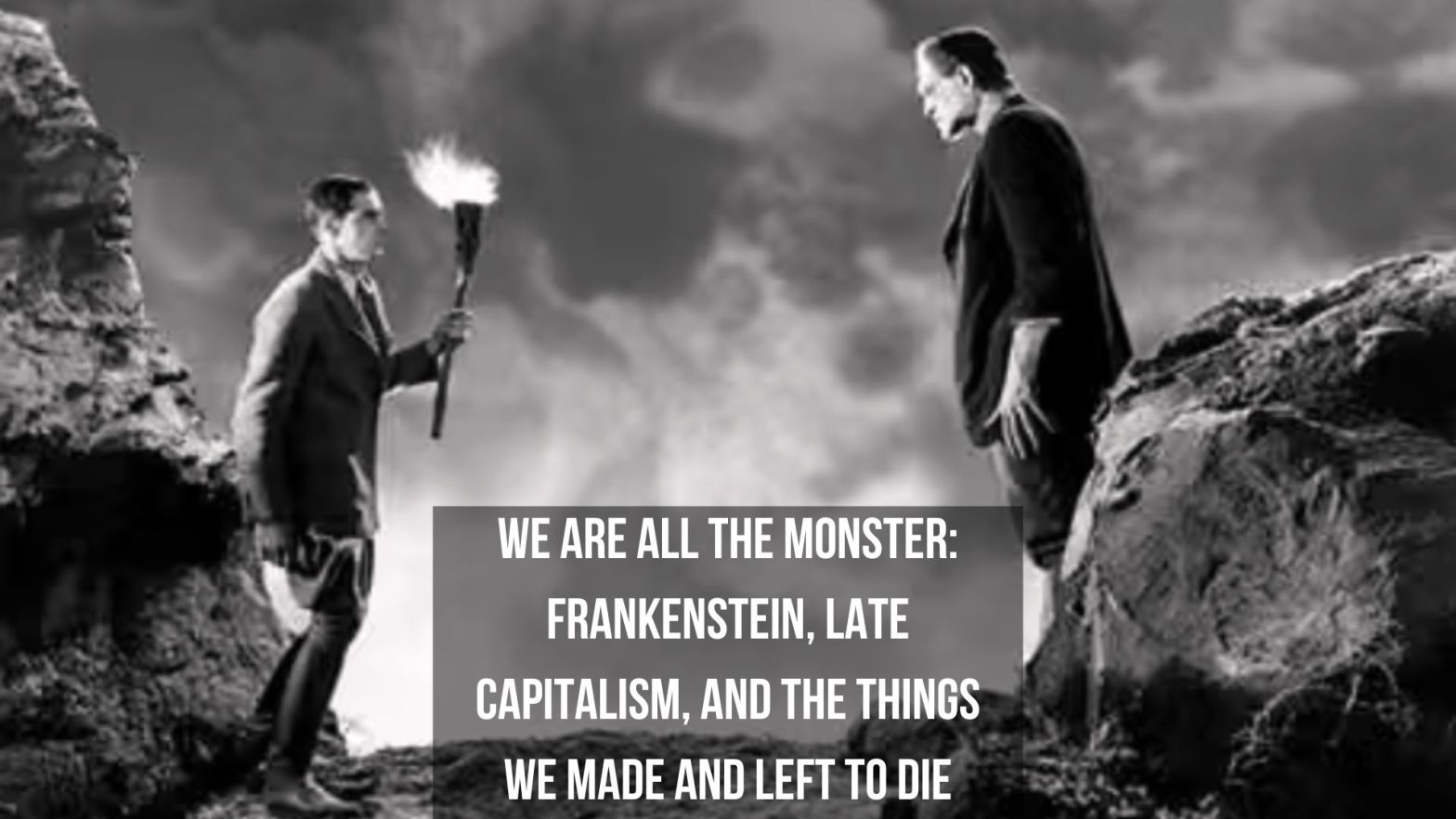
Mary Shelley was nineteen years old when she wrote the defining myth of the modern world. She probably did not know she was doing this. Two hundred years later, the novel she produced in a wet summer beside a Swiss lake reads less like a Gothic romance than like a diagnosis — precise, unflinching, and delivered with the calm authority of someone who had already seen exactly how this ends.
By Bergotte
We have been reading Frankenstein wrong. Not entirely wrong — the novel has attracted two centuries of serious critical attention, and serious critical attention is rarely entirely wrong about anything. But wrong in the specific sense of reading it as a story about the dangers of scientific ambition, of transgressing the boundary between the human and the divine, of playing God in the laboratory. This reading — the reading that gave us Boris Karloff with bolts in his neck, gave us the word “Franken-” as a prefix for any technology that frightens us, gave us the comfortable cultural shorthand of the scientist who goes too far — has absorbed most of the novel’s available oxygen. It has done so at the cost of the reading that is more uncomfortable, more contemporary, and more accurate to what Mary Shelley actually wrote.
The reading that has been displaced is this: Frankenstein is a novel about what happens after the creation. It is not primarily concerned with the act of making the creature — Victor Frankenstein’s laboratory procedures occupy a remarkably small portion of the text, and Shelley declines, with what reads in retrospect as deliberate restraint, to describe them in any technical detail. It is concerned with what happens next: with Victor’s immediate, visceral rejection of the thing he has made the moment it opens its eyes; with the creature’s subsequent education in the values and the texts of the civilisation that made it; with the creature’s attempt to enter that civilisation and its systematic exclusion from every threshold it approaches; with the radicalisation that follows the exclusion, and the destruction that follows the radicalisation; and with the mutual pursuit across a dying landscape that ends, in the Arctic wastes at the top of the world, with both creator and creature destroyed and the ice — the last, indifferent witness — closing over everything.
This is not a story about scientific hubris in the abstract. It is a story about the specific human capacity to make something, use it, discard it, and then be destroyed by the consequences of the discarding. It is, in other words, a story about us — about the economic and political system we have built and the creatures that system has made and abandoned, about the nature we have exploited without responsibility, about the excluded who have learned the values of the civilisation that excludes them and have begun, with entirely comprehensible fury, to act on that learning. The creature is not the monster of the horror film. The creature is the most morally serious figure in the novel. And we have been siding with Victor — vain, irresponsible, eloquent, self-pitying Victor — for two hundred years, because Victor tells the story, and the people who tell the stories get to decide who the monster is.
The Sympathy Problem
Mary Shelley understood narrative point of view with a sophistication that her critics have not always matched. Frankenstein is structured as a series of nested narratives: the Arctic explorer Walton writes letters to his sister; within those letters, Victor Frankenstein tells his story; within Victor’s story, the creature tells his own. The architecture is precise and deliberate, and its effect is to make the question of whose account to believe — whose experience to credit, whose version of events to accept — the novel’s central formal problem as well as its central moral one.
Victor is not a reliable narrator. He is a man of considerable intelligence and considerable self-regard who is engaged, throughout the novel, in a sustained act of self-exculpation: the presentation of his own story in the most favourable light available to him, the systematic minimisation of his own responsibility for the catastrophe, the rhetorical transformation of his creature from a being he made and abandoned into a monster that arrived, fully formed and fully malevolent, from somewhere outside himself. He is, in the specific sense that the term has acquired in contemporary literary criticism, a narrator whose account requires constant interrogation — whose eloquence is the measure not of his truthfulness but of his need to be believed.
The creature, by contrast, is scrupulously honest. When he appears before Victor in the mountains — the encounter on the Mer de Glace that is the novel’s moral and philosophical centre — and demands to be heard, he makes his case with a precision and a fairness that Victor, in the equivalent position, has conspicuously failed to achieve. He describes what happened to him: the abandonment, the confusion, the slow painful acquisition of language and understanding, the approach to the De Lacey family and its violent conclusion. He identifies the cause of his suffering not in his own nature but in the response of others to his appearance, which he did not choose and cannot change. He makes a demand — not for revenge, not for submission, but for recognition: for a companion, for a being who will look at him and see him rather than recoil from him. He argues for his own humanity, and he argues for it better than Victor has argued for anything.
And then Victor refuses him. Refuses him not on rational grounds — the creature’s argument is not irrational — but on the grounds of disgust, of the same involuntary physical revulsion that produced the original abandonment. The refusal is the novel’s hinge, the moment from which everything destructive follows. And Shelley is unsparing about where the responsibility for that refusal lies: in Victor, and in the society whose values Victor embodies and the creature has absorbed. The creature does not become violent because he is inherently violent. He becomes violent because every avenue of non-violent integration has been closed to him, and the closing has been done not by his own inadequacy but by the system’s inability to see past its own categories.
This is the sympathy problem, and it is the first thing the contemporary reader must reckon with: Shelley has written a novel whose sympathies are with the monster, and we have spent two hundred years refusing to follow her there, because following her there requires acknowledging things about the systems we inhabit that we would very much prefer not to acknowledge.
Victor Frankenstein, Entrepreneur
Let us look at Victor clearly, without the softening effect of his own narration.
He is a young man of good family and considerable intellectual gifts who becomes obsessed, at university, with the project of creating life — of solving, through the application of newly discovered scientific knowledge, the problem of death itself. He pursues this project with total commitment and total isolation, neglecting his family, his friends, his obligations, and his health in the service of the goal. He achieves the goal. He is immediately horrified by what he has achieved. He abandons it, collapses, recovers, and attempts to return to ordinary life while systematically refusing to acknowledge what he has made and what he owes it.
Strip the Gothic machinery away and this is a recognisable contemporary figure. It is the figure of the tech entrepreneur whose horizon of ambition extends precisely to the moment of creation and no further — who is intoxicated by the problem and indifferent to the consequences of the solution, who measures success by whether the thing works and not by what the thing does once it is working. It is the figure who asks “can we do this?” with tremendous sophistication and never asks “should we?” with any seriousness at all. It is, with the serial numbers barely filed off, the personality type that has driven the technological development of the past three decades: brilliant, driven, morally arrested at approximately the developmental stage of a gifted adolescent, constitutionally incapable of sustaining attention on anything that does not confirm its own exceptionalism.
The comparison is not ornamental. When we observe the actual discourse of Silicon Valley — the explicit invocations of Promethean ambition, the declared intention to solve death, to transcend the limitations of the human, to move fast and break things in the confident expectation that the breaking is a necessary cost of progress — we are listening to people who have absorbed Victor Frankenstein’s self-understanding without, apparently, having read past chapter five. The goal is the creation. The creature, once created, is someone else’s problem. The externalities — the jobs automated away, the privacy eroded, the democratic processes undermined by the platforms, the mental health of the teenagers delivered to the algorithm — are the creatures left on the doorstep of a society that didn’t ask for them and doesn’t know what to do with them. Victor, in each case, has already moved on to the next experiment.
Mary Shelley was writing in 1816, at the very beginning of the industrial acceleration that would transform Europe within a generation. She was writing as the factory system was establishing itself, as the first wave of what we would now call technological unemployment was producing the Luddite uprisings in the English Midlands, as the promise of the new industrial order was beginning to reveal its costs alongside its benefits. She could not have known the specific forms that the acceleration would take across the following two centuries. She understood its logic with a completeness that two centuries of subsequent experience have only confirmed.
Victor is not evil. This is important. He is not a villain in the melodramatic sense — he does not want to cause suffering, does not enjoy the destruction that follows from his choices, is genuinely distressed by the consequences he has set in motion. He is something more interesting and more dangerous than evil: he is someone whose capacity for abstraction has so thoroughly outpaced his capacity for moral imagination that the gap between the two has become the source of catastrophe. He can conceive the creature in the abstract — can imagine the project of creation with vivid excitement — but cannot sustain the imaginative effort of continuing to conceive the creature once it is concrete, once it is there, yellow-eyed and eight feet tall, making claims on him that his abstract excitement had not prepared him for.
This failure of moral imagination — the gap between the conception and the responsibility, between the creation and its consequences — is not a personal defect of Victor Frankenstein. It is a structural feature of the system that produced him and that he represents. A system that rewards the creation and prices the consequences into someone else’s account will produce Victor Frankensteins reliably, at scale, in every generation. This is not a prediction. It is a description.
The Creature Reads Paradise Lost
The most underread section of Frankenstein is the long central portion in which the creature describes his own education — the period he spent in the hovel attached to the De Lacey family’s cottage, secretly observing them, learning language and then literature and then the history of human civilisation, arriving at political and moral consciousness through the accumulated force of everything the culture had produced and chosen to preserve and transmit.
The books he reads are not random. Shelley chooses them with precision: Paradise Lost, Plutarch’s Lives, The Sorrows of Young Werther. Each of them is a text concerned with the relationship between the individual and the systems of power that surround him — with rebellion and its consequences, with greatness and its costs, with the anguish of the sensitive soul in an indifferent world. The creature reads them not as literary exercises but as maps: attempts to locate himself in a human landscape that he has not been given any other means of navigating.
Paradise Lost becomes, for the creature, the most significant of the three, and the relationship he develops with it is one of the novel’s most devastating passages. He identifies with Satan — the figure expelled from the community of the blessed, condemned to an existence of exclusion and resentment — but he also identifies with Adam, the created being who did not ask to be made and who cannot understand why the maker who made him now withholds the recognition the creature needs to make sense of his own existence. “Like Adam,” he tells Victor, “I was apparently united by no link to any other being in existence; but his state was far different from mine in every other respect. He had come forth from the hands of God a perfect creature, happy and prosperous, guarded by the especial care of his Creator; he was allowed to converse with and acquire knowledge from beings of a superior nature, but I was wretched, helpless, and alone.”
This passage is philosophically precise in ways that the novel’s Gothic surface can obscure. The creature has identified exactly what has been done to him: he has been made in the image of humanity, educated in the values and the texts of civilisation, taught to want what civilisation offers — recognition, companionship, a place in the community of persons — and has then been denied access to everything he has been taught to want, on grounds that have nothing to do with his values or his intelligence or his moral seriousness and everything to do with his appearance, which he did not choose.
This is the structure of racialised exclusion. It is the structure of class exclusion. It is the structure of every system that educates its subjects in the values of the dominant culture and then refuses them entry into the dominant culture’s rewards on grounds that are presented as natural — as simply the way things are — but that are, on examination, the product of specific historical choices made by specific people in the interest of maintaining specific arrangements of power. The creature learns to read; he reads the canonical texts; he absorbs the values that the canonical texts transmit; and he is still, at the end of all this education, excluded — more painfully excluded, indeed, for having understood what he is excluded from.
W.E.B. Du Bois, writing in The Souls of Black Folk in 1903, described what he called “double consciousness” — the experience of always seeing oneself through the eyes of others, of measuring one’s soul by the tape of a world that looks on in amused contempt and pity. The creature’s experience is a version of this: the experience of having fully internalised the gaze of the culture that excludes you, of seeing yourself as that culture sees you, of being unable to escape the knowledge that the thing you are is the thing the culture has decided it cannot accommodate. The creature’s violence, when it comes, is the violence of someone who has tried every available non-violent avenue and found every one of them closed.
He approaches the De Lacey family — the family he has watched and loved from hiding, for whom he has gathered firewood and cleared snow in secret acts of devotion that are also, unmistakably, acts of longing — with the careful preparation of someone who understands that the encounter must be managed, that the visible reality of his appearance will produce the same reflexive horror it has always produced, and that his only chance of being heard is to speak to the one member of the family who cannot see him. Old De Lacey is blind. The creature sits with him and talks, and De Lacey listens, and for a brief period the conversation is the one the creature has always needed: a conversation in which he is assessed by what he says rather than by what he looks like.
Then the rest of the family returns, and the blindness ends, and everything ends with it. Felix beats him. The family flees. The creature burns the cottage, because the cottage was the last thing that connected him to the hope of integration and the hope is gone.
“I, the miserable and the abandoned, am an abortion,” he says, later, to Victor. “To be momentarily dazzled, then chased with stones.”
The Gig Economy and the Abandoned Creature
There is a way of reading the creature’s situation that maps with uncomfortable precision onto the experience of the workers and communities that late capitalism has made and then discarded — that has used their labour, their land, their time, their health, and then moved on when the calculation changed, leaving behind the devastation and disclaiming the responsibility.
The post-industrial towns of the American Midwest and the British North, where the factories that employed generations have closed and the communities that organised themselves around those factories have been left to manage the consequences alone, are full of Victor Frankensteins’ creatures. They were made by the system — their labour built the system, their communities were constructed around the system’s needs — and they were abandoned when the system found cheaper alternatives elsewhere. The abandonment was not accompanied by acknowledgment. It was accompanied, instead, by a discourse that transformed structural economic decisions into personal moral failures: the communities that were struggling were struggling because they had not adapted, had not retrained, had not responded with sufficient flexibility to the changing demands of the market. The system that made them and left them was not responsible. They had made themselves.
This is Victor’s discourse exactly. When the creature confronts him — when the violence and the destruction and the deaths that have followed from the abandonment force the confrontation — Victor does not say: I made you and left you and the consequences of that abandonment are mine to answer for. He says: you are a monster, and your monstrousness is your own, and I am the victim of your violence. The refusal of responsibility is total, and it is eloquent, and it is the refusal that the dominant culture has been making, in various forms, every time the consequences of its own decisions have arrived at its door in a form too large to ignore.
The gig economy is, in this reading, the most literal contemporary Frankensteinian arrangement. The platforms — Uber, Deliveroo, Amazon Mechanical Turk, the entire architecture of on-demand labour — create workers. They need the workers; they could not function without the workers; the value they generate is generated by the workers’ labour. And they simultaneously, systematically, deny that the workers are workers at all — classify them as independent contractors, as entrepreneurs, as free agents operating their own micro-businesses, in legal arrangements designed specifically to disclaim the responsibilities that the employer-employee relationship would entail. The creature is made. The creature is used. The creature is denied the name that would make the relationship legible and the responsibilities unavoidable. And the creature — who drives in the rain and delivers in the rain and clicks the tasks that the algorithm delivers for rates that do not meet the minimum wage — has no recourse, because the law has not yet caught up with the fiction, and the fiction is very profitable for the people who maintain it.
Mary Shelley did not foresee the gig economy. She did not need to. She saw the logic that produces it: the logic of creation without responsibility, of use without acknowledgment, of the systematic denial that the thing you have made and are benefiting from has any claim on you. She saw it in the industrial revolution beginning around her and in the Romantic heroic individualism surrounding her, and she wrote it into a Gothic novel that the culture has been trying to read as a horror story rather than a mirror for two centuries.
The Arctic Is Melting
The novel begins in the Arctic. Robert Walton, the explorer whose letters frame the entire narrative, is attempting to sail to the North Pole — to pierce the frozen world at the top of the globe, to find, as he puts it, “a passage near the pole to those countries, to reach which at present so many months are requisite; or by ascertaining the secret of the magnet.” He is, in other words, another Victor: another man in the grip of an ambition whose consequences he has not fully considered, another figure of Promethean reach whose desire to go further, to know more, to penetrate the last unexplored regions, is not accompanied by any serious reckoning with what the penetration might cost.
The Arctic of Frankenstein is a space of sublime indifference: vast, silent, lethal, and entirely uninterested in the human dramas being conducted within it. The ice does not care about Victor’s tragedy. The ice does not care about the creature’s grief. The ice presents itself as the environment within which the human story finally exhausts itself — the place where the pursuit ends because there is nowhere further to go, where the engine of destruction runs out of fuel in a landscape that was always going to outlast it.
Except that the Arctic is no longer indifferent. The Arctic is now the most sensitive register of what the system has done — the place where the consequences of two centuries of industrial acceleration are most precisely and most terrifyingly visible. The ice that Walton’s ship was trapped in is melting. The Northwest Passage that Walton was seeking — the route through the frozen north that had defeated every previous attempt and killed many who tried — is now navigable. It is navigable because the ice that blocked it is no longer there. It is no longer there because the system that Victor Frankenstein represents has been running, at increasing scale and increasing speed, for two hundred years, and the atmosphere that results from the running is now warm enough to melt what was previously permanent.
The environmental reading of Frankenstein is not a stretch. It is the novel’s own logic extended to its conclusion. Victor treats nature as a resource — as the site from which the materials of creation can be extracted, the charnel houses and slaughterhouses from which the creature’s components are gathered — without any acknowledgment that nature has claims of its own, that the extraction has costs, that the world being raided for the project of creation is not a passive storehouse but a system with its own imperatives. This is, again, the logic of late capitalism in its most literal form: the treatment of the natural world as an externality, as a commons from which value can be extracted and into which costs can be dumped, without the extraction or the dumping appearing on any balance sheet that matters.
The climate crisis is the creature that the system made and abandoned. It is the consequence that the creators — the industrialists and the financiers and the politicians and all of us who have benefited from and participated in the system — have spent two centuries refusing to acknowledge as theirs. The denial has the same structure as Victor’s denial: the consequence is monstrous, the consequence threatens us, the consequence is not our responsibility. The responsibility is always somewhere else: with the developing nations who are industrialising now as we industrialised earlier, with the consumers who choose to drive and fly, with the next generation who will have to solve the problem that this generation created and declined to address. Victor’s eloquence in the matter of his own non-responsibility has had two hundred years of institutional practice to refine it.
The creature tells Victor, at their final confrontation, that he has suffered more than Victor can imagine — that the capacity for suffering Victor gave him is the most cruel of all the gifts the creation entailed. The warming world is making this speech now, in the language of wildfire and flood and species extinction and the slow inundation of the coastlines, and we are responding with the same combination of distress and displacement that Victor specialised in: genuinely upset, insufficiently moved, unable to sustain the imaginative effort of connecting the distress to the action the distress would logically require.
What the Monster Wanted
It is worth being very clear about what the creature wanted, because the popular mythology — Boris Karloff, the bolts in the neck, the lumbering violence — has so thoroughly replaced Shelley’s creature in the cultural imagination that the actual request has become almost invisible.
He wanted to be seen. He wanted a companion. He wanted recognition — the acknowledgment that he was a being of the kind that makes claims, that has experiences, that has a perspective that matters. He did not want to destroy. He was not inherently violent. He was a being of considerable sensitivity and considerable intelligence who had been made, abandoned, educated in the values of civilisation, refused entry into civilisation, and driven by the refusal into a violence that was — and this is the novel’s most uncomfortable insistence — entirely comprehensible. Not justified, in some abstract moral accounting. Comprehensible. The product of a specific sequence of actions and refusals that the novel traces with meticulous care so that the reader cannot, if they are paying attention, claim that the violence came from nowhere.
The test the novel applies to us, as readers, is the same test it applies to Victor: can we sustain the imaginative effort of seeing the creature as it is, rather than as our disgust or our fear tells us it is? Victor fails this test every time. He is constitutionally unable to look at the creature and see anything other than the horror of his own creation — unable to see the intelligence, the suffering, the moral seriousness, the legitimate claim. We have, as a culture, failed the test in the same way: the creature has been the monster in every film adaptation, the villain of the piece, the thing to be destroyed rather than the consciousness to be heard.
This failure is not aesthetic. It is political. The populations and the ecosystems that the system has made and abandoned are not monstrous. They are the consequences of specific decisions made by specific people in the interest of specific concentrations of wealth and power, and the monstrousness that the system attributes to them — the fecklessness of the unemployed, the irrationality of the climate protester, the unreasonableness of the asylum seeker, the dangerousness of the radicalised young man — is Victor’s move, made at civilisational scale. The monster is the thing we made. The monster is telling us what we did. We are calling it a monster so that we do not have to listen.
The Modern Prometheus, Revisited
Shelley’s subtitle — The Modern Prometheus — is usually read in one direction: Victor as Prometheus, the hero who reaches beyond the human limit and pays the price. This reading is accurate but incomplete. Prometheus stole fire from the gods and gave it to humanity, and was punished by the gods for the theft. Victor stole the secret of life and gave it to no one — made it for himself, in the service of his own ambition, and then rejected the being in whom the secret was embodied the moment the being made claims.
The Promethean reading that Shelley intends is more complex than the heroic version allows. Prometheus’s crime, in the Greek tradition, is not simply the overreach of ambition. It is the creation of an obligation — the gift creates a relationship, a responsibility, a debt that Prometheus accepts when he makes the gift. Victor creates without accepting the obligation. He wants the power of creation without the responsibility of the creator. He wants to be Prometheus without the chains, which is to say he wants the myth without the substance, the heroic act without the heroic cost.
We are living in the age of people who want to be Prometheus without the chains. The chains are the regulations, the taxes, the environmental protections, the labour laws, the democratic oversight, the social obligations that the Promethean ambition generates and that the Promethean ego declines to accept. We have built economic and political systems that reward the fire-theft and price the chains out of the equation, that allow the value of creation to be privately captured while the costs of creation are publicly distributed. Victor, in this system, is not an anomaly. Victor is the ideal type. Victor is who the system is selecting for.
Mary Shelley was nineteen. She was the daughter of the two most important radical thinkers of her generation, the lover and then wife of the most genuinely revolutionary poet of his, the inhabitant of a social world in which the biggest ideas of the age were being thought and lived and tested against reality at close range. She had watched the French Revolution’s promise dissolve into the Napoleonic wars. She had watched Romantic idealism produce real human casualties. She had buried children. She was writing in the knowledge that the systems being built around her — industrial, economic, ideological — were being built by people who were very good at the fire-theft and constitutionally disinclined to accept the chains.
She gave us a myth adequate to the moment. The myth is a creature, abandoned on the doorstep of a civilisation that made it and won’t acknowledge it, educated in that civilisation’s values and denied its rewards, standing in the ruins of everything the refusal has produced, asking — still asking, across two hundred years — to be seen. Not to be worshipped. Not to be loved. To be seen, and acknowledged, and dealt with honestly, by the person who made it and called it a monster so that the making could go on without the reckoning.
The ice is melting. The creature is still there. Victor is still, eloquently, explaining why none of this is his fault.
Mary Shelley’s Frankenstein is most usefully read in the 1818 first edition text, edited by Marilyn Butler for Oxford World’s Classics, which restores elements that the 1831 revised edition softened. Franco Moretti’s essay ‘The Dialectic of Fear’ in Signs Taken for Wonders (Verso) is the foundational Marxist reading. Ellen Moers’s ‘Female Gothic’ in Literary Women (Doubleday) remains essential. Anne Mellor’s Mary Shelley: Her Life, Her Fiction, Her Monsters is published by Routledge. For the contemporary capitalism context, Shoshana Zuboff’s The Age of Surveillance Capitalism (PublicAffairs) and Kate Crawford’s Atlas of AI (Yale University Press) are the most useful companions.
Discover more from My World of Interiors
Subscribe to get the latest posts sent to your email.

