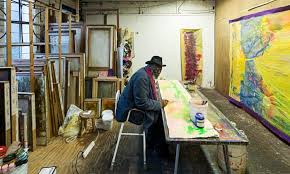
Essay · Art & Lives
The Painter Who Crossed Every Ocean
Frank Bowling arrived in London from British Guiana in 1953 with no art education and a desire to be a poet, and became, across the following seven decades, one of the most significant painters working in the English language — a phrase that would have surprised the art world of 1966 and should not surprise anyone now. The surprise is itself the story.
By Bergotte · London & New York · Art & Lives
He came by ship. In May 1953, nineteen years old, Frank Bowling left New Amsterdam in what was then British Guiana and crossed the Atlantic toward London, the imperial centre of the world he had been born into, carrying with him the education a colonial schooling provides — which is to say, a thorough grounding in the literature and history of a country he had never seen, and almost nothing about the visual arts. He wanted to be a poet. He joined the Royal Air Force, as colonial subjects of his generation often did, and in the RAF he met a fellow airman named Keith Critchlow who took him to the National Gallery, and in the National Gallery something happened that redirected the rest of his life. He stood in front of the English painters — Constable, Turner, Gainsborough — and felt, he has said, transfixed. Not by the subjects. By the paint. By the extraordinary fact of what paint could do when a sufficiently intelligent hand was directing it. He enrolled in art school. He never looked back, though he spent the next seventy years looking, with enormous attentiveness, at everything else.
The story of Frank Bowling is the story of a man who positioned himself, deliberately and with full understanding of what the positioning required, at the intersection of every major conversation in postwar painting — British figuration, American abstraction, colour field painting, the political debate about what Black art should be and whether the category was useful — and who made work, from that intersection, that belonged fully to none of these conversations and was enriched by all of them. It is also the story of a man who was, for decades, less celebrated than his work deserved, and who received, in his eighties, the retrospective at Tate Britain and the knighthood and the international recognition that his career had long since earned. The lateness of the recognition is not incidental. It is part of what the work is about.
The Royal College and the Silver Medal
Bowling won a scholarship to the Royal College of Art in 1959 and graduated in 1962 with the silver medal for painting. His fellow students were David Hockney, R.B. Kitaj, Peter Blake, Derek Boshier, Patrick Caulfield — the generation that would define British art for the following two decades, a cohort of such density and distinction that the RCA of those years has become almost mythological in retrospect. Bowling was among them, fully and as an equal, which is worth stating clearly because the art history of the period has not always stated it. He was also the only Black student in the painting school, which is a fact that the art history of the period has been even slower to engage with and whose implications — for what was available to him, for what was expected of him, for the particular navigation required of someone whose presence in that room was both historic and, to those around him, largely unremarked — the work he made in those years was already beginning to process.
The early paintings are figurative, expressionistic, alive with the influence of Francis Bacon and Leon Kossoff and Frank Auerbach — the painters he had encountered in the London galleries and absorbed with the thoroughness of someone who understands that influence is not imitation but digestion, that you take what the tradition offers and make it yours by submitting it to the pressure of your own experience. The experience he was bringing to the paint was specific and unrepeatable: the experience of a Guyanese man in postwar London, of the colonial subject in the imperial city, of the artist who belongs to a tradition that has not always acknowledged his right to belong to it. The paintings of those years carry this experience without illustrating it, which is the harder and more lasting thing.
New York, the Map Paintings, and the Question of Identity
When Bowling’s first marriage ended in 1966 he moved to New York, a decision that proved as consequential for his work as the visit to the National Gallery had been for his vocation. New York in 1966 was the centre of world art, the place where the arguments that would shape the next decade were being made — arguments about abstraction and figuration, about colour and form, about the relationship between political content and aesthetic form, about what it meant to be a Black artist in America in the years of the civil rights movement and the emergence of Black Power. Bowling arrived in the middle of all of this and took up residence, initially, at the Chelsea Hotel, where he was surrounded by Andy Warhol and Mark Rothko and a density of creative ambition that he met with his own.
The Map Paintings — the series he developed from the mid-1960s through the early 1970s, first exhibited in full at the Whitney Museum in 1971 — are the work that established his significance for the generation that came later and that rediscovered them, after decades in storage, at the 2003 Venice Biennale. They are large canvases washed in extraordinary colour — pinks, yellows, greens of extraordinary subtlety and richness — over which Bowling stencilled the outlines of continents: Guyana, South America, Africa, the shapes of the world he had crossed to get to the room in which the paintings were being made. The maps are not illustrations. They are not political statements in the simple sense. They are mediations — between the personal and the historical, between the place of origin and the place of making, between the body that has crossed oceans and the paint that carries the crossing without narrating it.
“Abstraction was a way to give up the obviousness of images. The shadow of the sun coming through the windows of the Hotel Chelsea — these shapes led me to the map paintings.” — Frank Bowling, in interview with SFMOMA, 2023
The debate that Bowling was navigating in New York in those years was a genuinely difficult one, and he navigated it with a clarity that was not always welcomed. The argument, made by various factions in the Black Arts Movement, was that Black artists had an obligation to make explicitly political work — work that addressed the conditions of Black life in America directly, representationally, in a visual language accessible to the communities it was about. Bowling’s position was different: that the highest form of political act available to a Black painter was to be as good a painter as it was possible to be, to engage with the full history and the full possibilities of the medium, to refuse the diminishment implicit in the demand that his work carry a political message at the expense of its painterly intelligence. He wrote about this in Arts Magazine, where he was contributing editor from 1969 to 1972, with the directness of someone who has thought the question through and is not interested in the comfortable position.
The position cost him alliances and earned him respect, and both things were appropriate, and the Map Paintings vindicate it entirely: they are simultaneously among the most personally and historically charged works in postwar painting and among its most formally beautiful, and the two qualities are inseparable, which was precisely his argument.
The Poured Paintings and the Surrender to Process
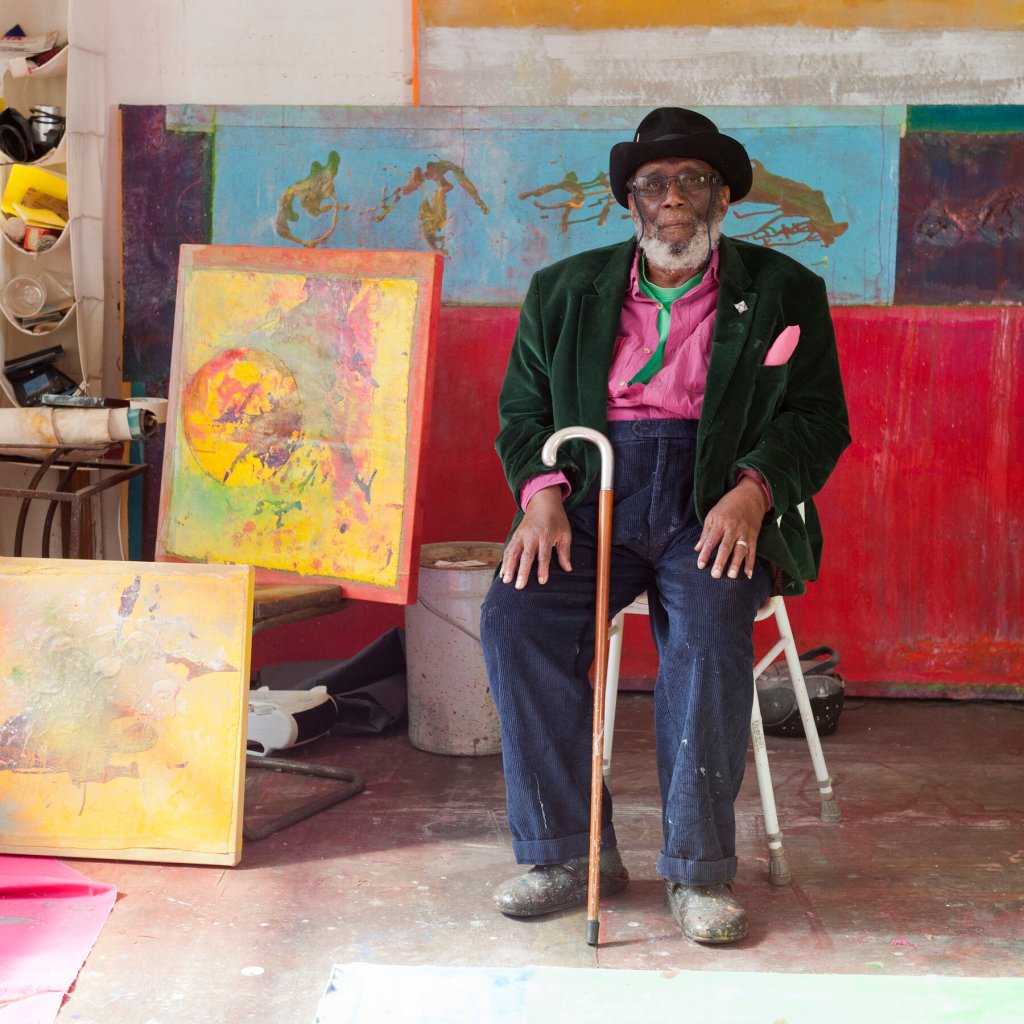
The New York years produced a second major body of work alongside the Map Paintings: the poured paintings, in which Bowling abandoned the easel, worked on canvases pinned to the floor or the wall, and poured paint down the inclined surface, allowing the material’s own logic — gravity, viscosity, the interaction of pigments — to participate in the outcome. The connection to Morris Louis and Helen Frankenthaler and the colour field tradition is real and acknowledged; the difference is equally real and equally important. Where the American colour field painters tended toward a certain immateriality, a desire to make the paint feel as though it had no body, Bowling was always interested in the body of the paint — in its weight and its texture and the evidence it carried of having been poured and pooled and dragged across a surface by physical forces, including his own hands.
The poured paintings are among the most sensually beautiful things in postwar British art, which is a category they complicate by insisting on their connection to the American tradition and to the Guyanese landscape and to the English painters of the nineteenth century simultaneously. Bowling has always refused the national categories that critics reach for when they are uncertain how to place him. He is a British painter and an American painter and a Caribbean painter and a painter in the tradition of Turner and a painter in the tradition of Morris Louis, and the refusal to choose is not evasion but precision: the work is genuinely all of these things, and to reduce it to any one of them is to lose most of what it is.
The Long Middle and the Objects in the Paint
The years between the early 1970s and the Tate retrospective of 2019 — nearly five decades — are the period that the critical narrative of Bowling’s career has most consistently underserved, partly because the Map Paintings provided so convenient a story and partly because the work he made in those years was harder to categorise and therefore harder to write about quickly. He embedded objects in the paint — newsprint, foam, plastic, fragments of canvas — creating surfaces of extraordinary complexity, paintings that are simultaneously flat and dimensional, that reward the viewer who gets close to them with a density of material incident that the reproductions cannot convey. He made sculptures. He made the Great Thames series, explicitly in homage to Turner and Gainsborough, returning to the English landscape tradition that had first transfixed him in the National Gallery in 1953 as a nineteen-year-old airman.
He kept working. He maintained studios in both London and New York, criss-crossing the Atlantic for decades, and the transatlantic orientation — the refusal to settle, to be placed, to be claimed entirely by any single art scene or national tradition — was not restlessness but method. The work required the crossing, as the Map Paintings had always understood: the meaning was in the movement, in the gap between the point of origin and the point of arrival, in the paint that carried the distance without collapsing it.
Venice, the Knighthood, and the Recognition That Arrived
In 2003, the Map Paintings that had been in storage since the early 1970s were the centrepiece of an exhibition at the 50th Venice Biennale, and the response — from critics, from curators, from the generation of younger artists who encountered them for the first time — was the response that great work held too long from public view tends to produce: the sense of something recovered rather than discovered, of a significance that had been there all along and had simply been waiting for the conditions of its acknowledgement. Bowling became a Royal Academician in 2005. He received the OBE in 2008 and a knighthood in 2020. The Tate Britain retrospective in 2019 — the first major survey of his six-decade career — drew the kind of sustained critical attention that his work had long deserved and that established, for anyone who had not been paying attention, that here was one of the most significant painters of the postwar period, whose significance had been insufficiently acknowledged for reasons that were not entirely to do with the work.
The reasons that were not to do with the work are not difficult to identify, though the art world has been understandably slow to identify them clearly. A Black painter from Guyana, working between London and New York, refusing the political categories that the art world of the 1960s and 1970s wanted to assign him, making work that was simultaneously too British for the Americans and too American for the British and too abstract for those who wanted his Blackness to be the explicit subject: this is a profile that the institutional art world has historically found difficult to accommodate, and the difficulty expressed itself, across several decades, as a relative absence of the major museum shows and critical attention that the work warranted.
What the Paint Knows
To stand in front of a large Bowling — and they need to be seen large, in person, where the colour does what it cannot do in reproduction — is to understand something about paint that is difficult to articulate and impossible to forget. The colour is not decorative. It is not even primarily beautiful, though it is beautiful, consistently and extraordinarily so. It is purposive: each colour is doing something specific in relation to the colours around it, creating a spatial logic that the eye can feel even when the mind cannot quite name it, producing an experience of looking that is simultaneously sensory and intellectual and, in the best works, something beyond both — something that arrives, as the best painting always does, as a kind of knowledge, a way of understanding something about light and space and time and the distances that a life crosses that no other medium can quite provide.
Turner understood this. Gainsborough understood it. Morris Louis understood it. Frank Bowling understood it from the moment he stood in front of them in the National Gallery in 1953, a nineteen-year-old from Guyana who had wanted to be a poet and found, in the paint, a language that could carry everything poetry could carry and everything it could not. He has been making that language for seventy years. It is, by now, unmistakably his own.
This essay draws on Frank Bowling’s published interviews, including his conversation with SFMOMA (2023), the catalogue of the Tate Britain retrospective (2019), Richard Shiff’s critical writing on Bowling’s work, and Bowling’s own essays in Arts Magazine (1969–1972). Frank Bowling was born in Bartica, British Guiana (now Guyana) in 1934. He received the OBE in 2008 and was knighted in 2020. The Map Paintings were first exhibited in full at the Whitney Museum of American Art, New York, in 1971.
