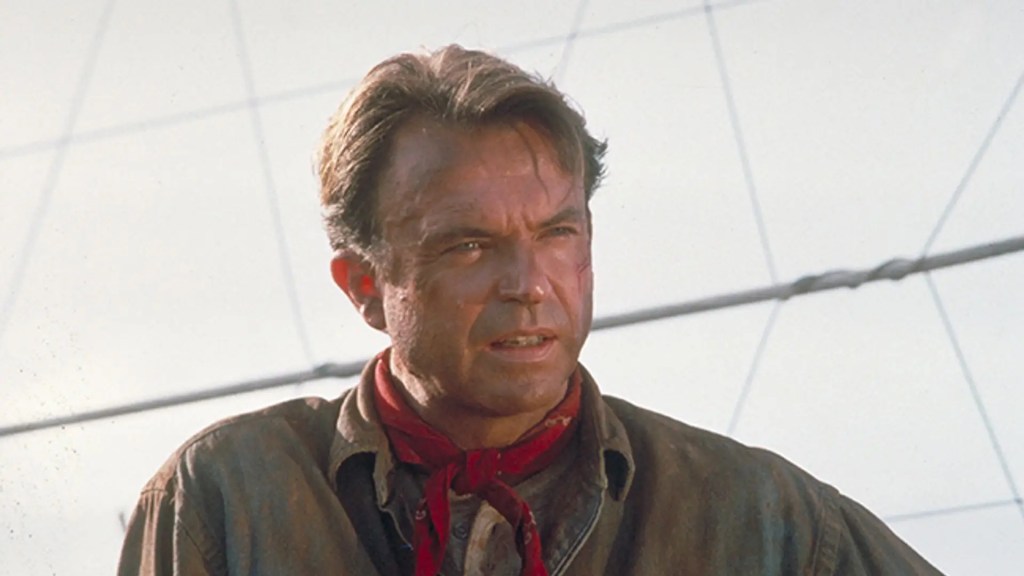
By Bergotte
Sam Neill, the New Zealand-born actor whose long, restless career carried him from the art houses of the Australian New Wave to the teeth of a Tyrannosaurus rex in “Jurassic Park,” and who brought a dry, watchful intelligence to nearly every part he played, died on Monday in Sydney, Australia. He was 78.
His family announced the death in a statement posted to his social media accounts, saying he had died in a Sydney hospital surrounded by relatives. The statement described the loss as sudden and unexpected, adding that Mr. Neill had remained free of the blood cancer he had spent several years fighting. No cause of death was given.
Mr. Neill’s career spanned more than four decades and dozens of films and television series, but he was perhaps proudest of, and most identified with, roles that traded on a certain rumpled decency: the paleontologist Dr. Alan Grant, dodging velociraptors across three “Jurassic Park” films beginning in 1993; the Soviet submarine captain in “The Hunt for Red October” (1990); and the beleaguered husband accused, alongside a character played by Meryl Streep, in the dingo trial drama “A Cry in the Dark” (1988).
He was born Nigel John Dermot Neill in Omagh, Northern Ireland, and moved with his family to New Zealand’s South Island at age 7, eventually settling in Christchurch. He adopted the name “Sam” as a schoolboy, partly to avoid being confused with other Nigels and partly, he later said, because “Nigel” struck him as too precious for a New Zealand playground. A childhood stutter made an acting career seem unlikely, and he studied English at the University of Canterbury without a clear plan for what came next.
He broke through in 1977 with “Sleeping Dogs,” a foundational film of New Zealand’s then-fledgling industry, and two years later starred opposite Judy Davis in Gillian Armstrong’s “My Brilliant Career,” a touchstone of the Australian New Wave. Roles across the 1980s and ’90s deepened his reputation for versatility: a British spy in “Plenty” opposite Ms. Streep, a menacing academic in “Dead Calm,” Jane Campion’s “The Piano,” and the horror thriller “In the Mouth of Madness.”
Younger audiences came to know him through Taika Waititi’s “Hunt for the Wilderpeople” (2016), as a gruff foster uncle, and through small, winking turns as an actor playing Odin in Mr. Waititi’s Marvel films. He also appeared in two seasons of “Peaky Blinders” as the ruthless Major Chester Campbell, and continued working steadily into his final years, including in the Netflix series “Untamed” and the Australian drama “The Twelve.”
In 2023, Mr. Neill disclosed that he was being treated for a rare, aggressive form of blood cancer, a battle he chronicled with characteristic candor in his memoir, “Did I Ever Tell You This?” He told The Guardian that year he hoped to live “another decade or two” but was “not afraid to die.” In April of this year, he announced he was cancer-free after participating in a clinical trial in Australia.
Off screen, Mr. Neill kept a working vineyard, Two Paddocks, in New Zealand’s Central Otago region, which he founded in 1993, and was an outspoken environmental advocate, releasing a documentary earlier this year opposing a proposed goldmine near his home. He was appointed an Officer of the Order of the British Empire in 1991 and accepted a knighthood in New Zealand’s honors system in 2022, having for years turned down the title as, in his words, “far too grand.”
He is survived by his four children and eight grandchildren.
Tributes poured in from across the film world and from political leaders in both New Zealand and Australia, where he had made his home for much of his career. New Zealand’s prime minister called him one of the country’s greatest cultural exports; Australia’s prime minister praised the wit and dignity Mr. Neill brought to both his work and his illness.
Fellow New Zealand actor Karl Urban, reflecting a sentiment widely echoed in the hours after his death, called Mr. Neill a national treasure and an inspiration to the generations of actors who followed him.

Leave a Reply