
Essay · Film & Memory
The Angels of Skåne
Hans Alfredson’s Den enfaldige mördaren — released in 1982 and almost entirely unknown outside Scandinavia — is one of the great films of its decade: a fable of class, cruelty, and avenging grace set in the flat southern Swedish countryside, carrying in its long frame a young Stellan Skarsgård and a blade and three angels singing Verdi.
The film begins at the end, which is the right place to begin a story about a man who has been living at the end of things his entire life. Sven Olsson and a young woman named Anna arrive at a derelict house somewhere in the flat, enormous landscape of Skåne — the southernmost province of Sweden, a land of beech forests and wide fields and skies that offer no relief from the fact of being observed. Sven is tall, loose-limbed, moving with the particular deliberateness of someone who has learned to be careful in a world that punishes the careless. He takes a large, bloodstained blade and throws it into a well. Then he lies down beside Anna and begins, in voiceover, to tell us how it came to this — the blade, the blood, the house, the fact of the film’s title, which announces from the outset both the act and the judgement the world will make of it, and leaves the question of whether that judgement is correct entirely, and wisely, open.
Den enfaldige mördaren — The Simple-Minded Murderer — was directed by Hans Alfredson and released in Sweden on February 12, 1982. It won the Guldbagge Awards for Best Film, Best Director, and Best Actor. It won Stellan Skarsgård, who plays Sven, the Silver Bear for Best Actor at the Berlin International Film Festival. Ingmar Bergman called it “a deep indignation, turned into a powerful fairy-tale.” It is almost entirely unknown outside Scandinavia, which is one of the more significant oversights in the international reception of European cinema, and this essay is, among other things, an argument for correcting it.
Alfredson and the Comedian’s Dark Turn
Hans Alfredson was, by 1982, one of the most famous comedians in Sweden — one half, with Tage Danielsson, of the partnership Hasse och Tage, whose sketches and films had defined Swedish popular comedy for two decades. This background is not incidental to understanding what he made with Den enfaldige mördaren. Comedians who turn to darkness tend to understand something about it that pure dramatists sometimes miss: that cruelty and comedy inhabit the same neighbourhood, that the laugh and the wince are physiologically adjacent, that the funniest things are often the ones that hurt most. Alfredson knew the territory from both sides, and the film moves between them — between the absurdity of Sven’s situation and its genuine horror — with the ease of someone for whom the border is not a border at all.
The story came from a single chapter in Alfredson’s book En ond man — An Evil Man — a chapter called “Idiotens berättelse,” “The Idiot’s Story,” which was an interior monologue by a then-nameless narrator. Alfredson had also, he later said, wanted for years to use Verdi’s Requiem in a film, having heard it and understood immediately that it was music of tremendous dramatic power, music that could carry a scene the way weather carries a landscape. In Den enfaldige mördaren he found the story for which both the chapter and the Verdi had been waiting, and the film he made from their combination has the quality of a work in which everything was inevitable, in which the pieces were always going to fit like this, as though the film had existed before it was made and the making was simply a matter of uncovering it.
“A deep indignation, turned into a powerful fairy-tale. Hasse Alfredson’s resources seem unlimited and my admiration for his creativity and the wealth of his ideas are absolute.”
Ingmar Bergman, on Den enfaldige mördaren, 1982
A colleague advised Alfredson against casting Skarsgård in the lead role. “Don’t use him. He’s no good.” Alfredson ignored the advice. Skarsgård, for his part, has said that Alfredson’s script for this film and Lars von Trier’s script for Breaking the Waves — made fourteen years later — are the two finest screenplays he has ever been given, which is a statement that locates Den enfaldige mördaren in the company it deserves and that von Trier, were he pressed, would probably not dispute.
Sven, the Harelip, and the Silence That Is Not Stupidity
Sven Olsson has a harelip. Because of it, he cannot speak correctly — his words emerge distorted, difficult to decipher, requiring patience and goodwill from the listener. The world of 1930s rural Skåne offers him neither. He is taken for an idiot, called one freely, treated as one systematically. The film’s great and sustained irony — present in every scene, never stated, entirely clear — is that Sven is not an idiot. He is observant, feeling, morally precise, possessed of an interior life of considerable richness that the voiceover allows us to access and that the people around him, hearing only the distorted surface of his speech, can not or will not enter. The disability is a speech impediment. The stupidity is theirs.
When his mother dies, Sven is taken in by Höglund — a factory owner, a local landowner, a member of the Swedish Nazi party, played by Alfredson himself with a performance of polished, entirely plausible evil that is the more unsettling for never becoming a caricature. Höglund’s cruelty is systematic and bureaucratic: Sven works without pay, sleeps with the cattle, is denied a motorcycle licence through the influence Höglund brings to bear on every institution within reach. He is not tortured dramatically. He is simply denied, at every turn and in every small particular, the ordinary conditions of a human life. This, the film understands, is how the worst things are usually done: not in eruptions of visible violence but in the accumulated weight of a thousand petty deprivations, each individually deniable, collectively crushing.
Alfredson’s decision to play Höglund himself — the comedian becoming the villain, the man who made Sweden laugh becoming the instrument of its darkness — is a formal choice with real thematic weight. It suggests that evil is not a separate species, not something we can recognise and quarantine, but a capacity available to the respectable, the talented, the socially integrated, the funny. Höglund is not a monster. He is a man of property who has decided that some people do not fully count, and who acts on that decision with the same efficiency and self-satisfaction that he brings to every other aspect of his life.
The Anderssons and the World That Is Briefly Possible
The film’s middle section — Sven’s period with the Andersson family, the tenant farmers who take him in, pay him fairly, and treat him, for the first time in his memory, as a person — is the most tender part of the film and the most politically precise. The Anderssons are not wealthy or powerful or even particularly educated. What they have is a moral clarity, the simple and radical conviction that the person in front of them deserves to be seen and treated as a person, and they extend this conviction to Sven with a matter-of-factness that is its own form of grace. They do not make a production of his humanity. They simply assume it.
Their daughter Anna — wheelchair-bound, played by Maria Johansson with a directness and a warmth that makes her Sven’s most important interlocutor — is the first person in the film to speak to Sven as an adult, to hear what he is saying beneath the distorted surface of the words, to understand that the intelligence is there and that it deserves to be met. The relationship between them is the film’s emotional centre, and its tenderness is not sentimentalised: they are two people in difficult circumstances finding in each other something the world around them has withheld, and the film is honest about the precariousness of what they have found.
Höglund destroys it, as the film has prepared us to expect he will. He calls in the Anderssons’ debts, expels them from their land, dismantles the small world in which Sven had briefly found something like belonging. This is not a dramatic act of violence. It is a legal one, conducted through creditors and notices and the machinery of property law, and it is more devastating than violence would have been precisely because it is so normal, so systemic, so entirely within the permissions that the society of 1930s Sweden granted to men of Höglund’s class and politics.
Verdi, the Angels, and the Theology of Revenge
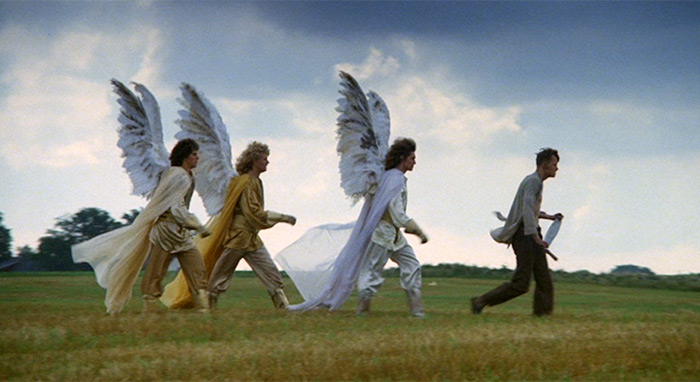
Three angels attend Sven throughout the film. They appear in the sky above Skåne, they visit him in the night, they accompany him, singing passages from Verdi’s Requiem, through the landscape of his particular trial. They are not explained. They are not hallucinations, exactly, or visions, exactly — the film presents them with the matter-of-fact clarity of a world in which the supernatural is simply one of the available registers of reality, as it is in the fairytale tradition that Bergman correctly identified as the film’s governing mode. The angels do not tell Sven what to do. They bear witness. They sing. And their presence — enormous, luminous, attended by Verdi’s most overwhelming music — gives the film its formal argument: that what is being done to Sven is not a private matter, not merely a local social injustice, but something that calls out to a larger order for a response.
“He goes to commit his act of justice accompanied by three angels singing the Verdi Requiem. This is not irony. This is the film’s deepest conviction.”
Bergotte
When Sven finally takes the blade from a chaff cutter and walks to Höglund’s factory, the angels walk with him and the Requiem swells, and the scene has the quality that only the most fully realised moments in cinema have: the sense that everything in the film has been building toward exactly this, that the formal preparation — the music, the landscape, the angels, the long accumulation of quiet outrages — has made the act not merely comprehensible but, in the film’s own moral language, right. The title calls it murder. The film calls it justice. Both are correct. The tension between them is the whole of the film’s moral argument, and it is not resolved, because it cannot be, because that tension is the actual condition of a world in which the machinery of the law and the machinery of justice are not always, or even often, the same machine.
Skarsgård at Twenty-Nine
Stellan Skarsgård was twenty-nine when the film was made, and the performance is one of those rare early performances in which a fully formed actor announces himself all at once, with nothing held back and nothing yet calcified into habit. The physical work is extraordinary: Skarsgård does not indicate Sven’s inner life, does not signal it, does not make it legible through the conventional signs of screen acting. He withholds, and the withholding is the performance — the sense of a person who has learned not to let what he feels show on his face because showing it has never been safe, and who communicates through gesture and movement and the quality of his attention what his speech cannot carry.
The scene in which Sven, having been paid for his work for the first time, counts his coins with a slow, absorbed concentration — the concentration of someone for whom this small transaction is not about money but about the recognition of worth, about the radical fact of being regarded as someone whose labour has value — is among the most quietly devastating things in the film. Skarsgård does almost nothing. The coins are counted. The scene ends. You feel it for days.
He went on to become one of the most significant European actors of his generation — the work with von Trier, with Lars Hallström, with a dozen other directors of consequence — and the career that followed the Silver Bear in Berlin has confirmed what the Berlin jury saw in 1982: that here was an actor of unusual range and unusual seriousness, willing to inhabit characters at their most exposed and to find in the exposure not pathos but precision. But it begins here, in Skåne, with a blade and a harelip and three angels singing in the wide Swedish sky.
The Film the World Has Not Seen
The question of why Den enfaldige mördaren has not entered the international canon of important European cinema — why it sits alongside the work of Bergman and Troell and Widerberg in the estimation of those who know Swedish film, and almost nowhere else — is one that does not admit of a single satisfying answer. The Silver Bear should have been enough. Bergman’s endorsement should have been enough. The quality of the film itself — its formal assurance, the Skarsgård performance, the Verdi, the landscape cinematography, the moral seriousness leavened by the comedian’s instinct for the precise dark joke — should have been more than enough.
What is clear is that those who have found it tend not to let it go. The film has a cult following in Sweden, where it is regularly cited among the greatest Swedish films ever made. The handful of international cinephiles who have encountered it — through festival screenings, through the advocacy of programmers like those at San Francisco’s Roxie Theatre, who distributed it in the United States in the mid-1980s — tend to speak of it with the particular fervour reserved for discoveries that feel personal, films that you feel you have been given rather than merely shown.
This essay is an act of advocacy, then, as well as of criticism. Den enfaldige mördaren deserves to be seen. It deserves the place in the international canon that its qualities have earned and that the accidents of distribution and language and geography have withheld from it. It is a film about a man who cannot make himself heard in the language available to him, and who is consequently denied the recognition he is owed. There is something in this, one cannot help but feel, that applies also to the film itself — which has been saying, for more than forty years, in the only language available to it, something that the world outside Scandinavia has not yet quite managed to hear.
Den enfaldige mördaren (The Simple-Minded Murderer), dir. Hans Alfredson, 1982. Sweden, 108 minutes. Distributed in Scandinavia by Svensk Filmindustri. The Guldbagge Awards (Best Film, Best Director, Best Actor) were presented at the 18th ceremony, 1982. Stellan Skarsgård’s Silver Bear for Best Actor was awarded at the 32nd Berlin International Film Festival, February 1982. Ingmar Bergman’s comment is drawn from published festival documentation. Hans Alfredson’s source novella is En ond man (An Evil Man), 1982. The film is based in part on a real person known to Alfredson named Hans. The music used is Giuseppe Verdi’s Requiem (1874).
Discover more from My World of Interiors
Subscribe to get the latest posts sent to your email.

