
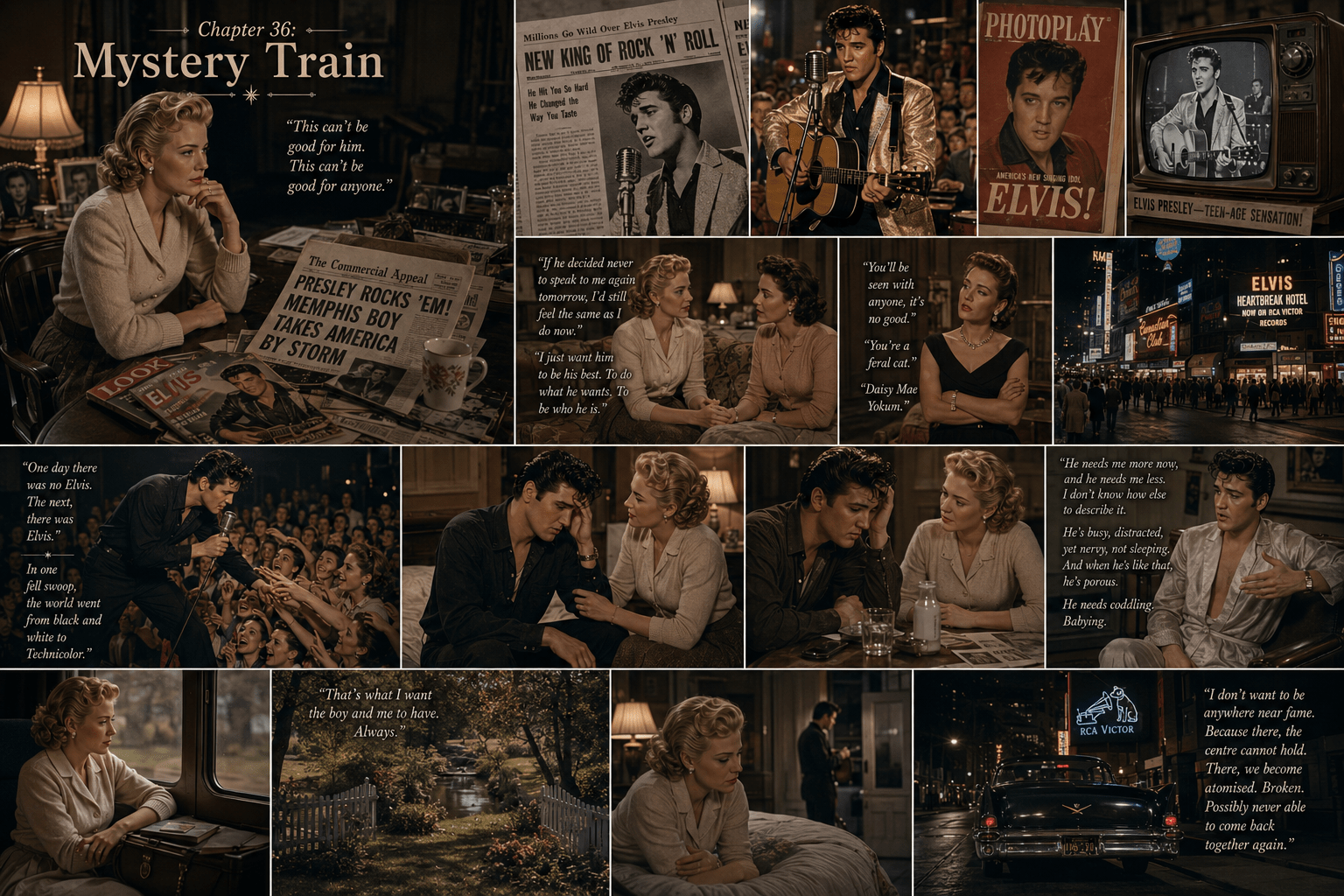
The boy is now a superstar. I can’t explain it. I’ve never experienced anything like it, nor, I believe, has America. It’s unnerving. It makes me nauseous. Sometimes, when it fully hits me, the realisation of it, I have what can only be described as a nervous breakdown: strange, weepy convulsions.
“This can’t be good for him,” I tell Miss Mary. “This can’t be good for anyone.”
It worries me. And, oddly, it also makes me not want to be around him.
Cornelia, who thinks the whole thing is fantastic, because she thinks everything is fun and wild and mad and just so, wonders if it’s because he’s given the world what he should have given me.
I try to explain that I love him in such a way that I have no agenda.
“If he decided never to speak to me again tomorrow, I’d still feel the same as I do now,” I tell her. “I just want him to be his best. To do what he wants. To be who he is.”
But fame scares me. I’m not comfortable with it. There’s something rotten at the core of it, something wrong in the hunger for it, in the dysfunction it breeds.
Tilly doesn’t understand any of it. Li’l Abner? Famous? How? She wants nothing to do with it.
And all along, sidling up beside her contempt, alongside upper-class and puritanical America’s fire-and-brimstone judgment, there he is: the boy, everywhere. On television. On the radio. In every magazine, every newspaper we open.
It becomes clearer how snobby Tilly really is. It’s a class thing. She’s almost embarrassed by me, by proxy. Because I know him. Because I have no standards. Because he’s stayed at our apartment. Because she’s been in the same room as him.
And yes, because he behaved badly in front of her, that I can understand. But the rest of it? I can’t.
I can’t understand how someone can dismiss a person entirely just because of cultural difference. It’s my least favourite thing about Tilly.
She calls me a feral cat. She calls me Daisy Mae Yokum.
“You’ll be seen with anyone, it’s no good,” she says.
But the boy is a superstar now. And there’s nothing anyone can do to stop this train from crashing into the station, only to leave again, crashing into the next, and the next, until I can’t see him anymore.
Until he vanishes into the country’s collective imagination.
***
He needs me more now, and he needs me less. I don’t know how else to describe it. He’s busy, distracted, yet nervy, not sleeping. And when he’s like that, he’s porous. He needs coddling, more than usual. Babying.
But it’s a fractured kind of need, the kind that leaves little care behind. It leaves a bitter taste, something resembling egotism. Emotional greed.
He’s becoming an American god at a speed that’s mind-boggling, to his parents, to Miss Mary, to all of America, and especially to the establishment, who remain sceptical and frightened because:
“You wouldn’t believe how hard he hit America.”
“He hit you so hard he changed the way you taste.”
“One day there was no Elvis. The next, there was Elvis.”
“In one fell swoop, the world went from black and white to Technicolor.”
As if his arrival made it so.
And then there was light.
I don’t want to be anywhere near the eye of the storm. So I run in the opposite direction, yet still feel obliged to watch from a distance.
If there’s one thing I know about the boy, it’s that he’s incapable of looking after himself. He needs me for that, me and Mrs P. But Mrs P is blinded by love when it comes to her son. So the weight falls on me.
His manager has claimed his life and soul, leaving only me to pull in the other direction. But I don’t want to. I don’t want to ruin anything, for him, or for us. I don’t want to push him away, or impose some know-it-all, what’s-best-for-you authority.
Because a person needs to feel free. Accepted. Able to run back to me when he wants to.
Even if I were just his guardian angel or imaginary friend, he could still shut me out. He can still decide he wants nothing to do with that side of his inner life. He is a rebel when it comes to well-meaning advice and moral whisperings. He wants to do it himself. He does not want to feel belittled.
I have no need to put myself above him. I don’t want to spoil that for him, nor do I want to be part of the electric stress and nerves of this new life. I want to be at the centre, the calm place. The essence of what it’s all about. That’s where I want to be, in all my relationships.
Not out there among those who wear masks, fake it, and chase self-serving agendas. I want to be where purity lives. Where peace of mind, body, and spirit fills us both with the same joy my grandmother’s country garden once gave me as a child, before I was sent to live with Miss Mary in the great white Memphis mansion.
That garden is the only place I still remember clearly from my old life, the trees, the grass, the stream, the open fields, the endless views. That’s what I want the boy and me to have. Always.
I don’t want to be anywhere near fame. Because there, the centre cannot hold. There, we become atomised. Broken. Possibly never able to come back together again. From there, a person might never recover.
And I fear I’ve already lost him, to the wilderness of his restlessness and his lazy intellect. He’s realised he can get from A to B with little effort. And I wonder if he’ll stop trying, with me, or with his music.
I already see a careless streak in him that wasn’t fully developed before. It showed when he was a boy and stopped doing schoolwork just because he “didn’t feel like doing it no more.”
He is lazy, yet he has an impeccable work ethic. It’s hard to describe the dichotomy. And now he lives in a world that demands his all. I don’t know how he’ll navigate it.
And I don’t want to be around all the time, because I’ve already seen him treat me carelessly, with that casual cruelty he’s begun showing more and more to others when he isn’t being his old self: The sweet, considerate, thoughtful, devoted son he was, before this year turned him into a worldwide phenomenon.
Before the television.
Before the silver screen.
Before he burst into everyone’s consciousness and changed the game.
***
Mrs P, who knows her son better than anyone, is worried too. Her dreams are full of omens, heavy with tragedy, and my heart sinks whenever I think about it. I see it too, what’s coming, and it feels like Mrs P and I are the only ones buckling under the weight of this knowing.
The boy is having the time of his life, but this is only the beginning, and it comes at a cost.
The world has never seen anything like him. He’s a comet crashing into the earth, altering its axis. An American god of modernity, sex, music, desire, consumerism, false freedom, and he’s making a pact he won’t be able to escape.
Only Mrs P and I can see that he’s already slipping on the shackles, ones he’ll never break free from. It’s all too big, too much, too soon, and he’s no longer in control. He’s given that away to Mr Mefisto.
And here, the centre cannot hold.
Discover more from My World of Interiors
Subscribe to get the latest posts sent to your email.

