
Essay · Literature & Ideas
The View From the Window and the Cost of Looking
A Room with a View is a comedy, and it is a love story, and it is a novel about Florence, and it is a sustained philosophical argument about the relationship between the body and the soul that Forster dressed in light clothes and sent out into the Edwardian sunshine and trusted, correctly, to survive the disguise.
The novel begins with a grievance about a view. Two Englishwomen — Lucy Honeychurch, young, musical, not yet fully aware of what she wants, and her older cousin Charlotte Bartlett, fully aware of what she does not want, which is anything that might embarrass — have arrived at the Pension Bertolini in Florence to find that their rooms face a courtyard rather than the Arno. They have been promised a view. They have not received one. This is, in the social register of their world, a significant injustice, and Charlotte manages it with the particular English combination of resignation and reproach that Forster renders with such surgical delight: she will not complain directly, she will not ask for anything, she will simply make clear, through the most precisely calibrated expressions of disappointed acceptance, that she has been wronged.
Into this scene of compressed female resentment enter two Emersons — old Mr. Emerson and his son George — who offer to swap rooms. They have the view. They do not need the view. The Emersons are not people who need views in the way that the Miss Honeychurches of the world need them, because the Emersons look at the world directly, without the mediation of convention or propriety or the fear of what other people will think, and the whole of Italy, as a consequence, is always available to them. The offer is made with the blunt generosity of people who do not understand that a simple kindness, extended across a class boundary in 1908, is a complicated social event. Charlotte is alarmed. Lucy is charmed, and does not yet know why. And the novel is underway.
Forster and the Problem of the Body
Edward Morgan Forster was twenty-nine when A Room with a View was published in 1908, though he had been working on versions of it, on and off, since the Italian journey of 1901 that provided its Florentine material. He was, at this point in his life, a young man of significant intelligence and considerable social anxiety, living with his mother, writing novels that engaged with the questions he could not address directly — about desire, about the body’s claims on the soul, about the price paid by people who allow the conventions of their class to override the promptings of their own natures — and reaching, in each of them, toward a resolution he could dramatise on the page but could not, given the constraints of his era and his sexuality, live in the world.
The question that drives all of Forster’s early novels — Where Angels Fear to Tread, The Longest Journey, A Room with a View, Howards End — is a version of the same question: what do we owe ourselves, and what happens to us when we pay the debt owed to convention instead? It is a question with particular urgency for Forster because the conventions he was navigating were not merely those of Edwardian social propriety but those of a society that criminalized the desire he felt, that made the payment of his own debt to himself not merely socially costly but legally dangerous. The novels are, among other things, coded dispatches from the inside of that impossibility, and their lightness of touch — the comedy, the sunshine, the Italian scenery — is not evasion but strategy: the ideas travel further in light clothes than they would in the heavy ones that would have made the censors sit up.
“It is so difficult — at least, I find it difficult — to understand people who speak the truth.”
E.M. Forster, A Room with a View, 1908
The novel’s central argument is stated, with the directness that characterises old Mr. Emerson and is the measure of his wisdom, in its final pages: that the body is not the enemy of the soul but its instrument, and that a life lived in denial of the body’s truths is not a more spiritual life but a lesser one — contracted, dishonest, productive of the particular misery that comes from being perpetually at war with one’s own nature. This is not a new idea. It is, in various forms, the argument of Keats and of Whitman and, in Forster’s own time, of D.H. Lawrence. What is Forster’s own is the delicacy with which he embeds the argument in a social comedy, the precision with which he renders the cost of its violation, and the warmth — unusual in English fiction of the period — with which he regards the characters who manage, against the odds, to choose correctly.
Lucy and the Music She Cannot Stop Playing
Lucy Honeychurch is one of the great creations of Edwardian fiction, and what makes her great is precisely what makes her maddening: she knows, at some level below the level of conscious acknowledgement, exactly what she wants and who she is, and she spends the novel’s middle section in an increasingly frantic attempt to convince herself that she does not. She is a musician — a pianist of real ability, whose playing is described in terms that make clear Forster understood music from the inside — and her relationship to the piano is the novel’s most reliable indicator of her interior state. When she plays Beethoven, something is unleashed in her that her social manner suppresses completely: a passion, an authority, a directness of feeling that the drawing rooms of Surrey have given her no legitimate channel for expressing. The music is where she is most fully herself, which means that the music is where the novel’s argument is most fully visible.
Forster’s description of Lucy at the piano is one of the finest passages in Edwardian prose — not because of its technical precision about music, though that is real, but because of what it reveals about the relationship between artistic expression and the suppressed self: the way the piece she plays becomes a map of the interior landscape she cannot otherwise acknowledge, the way the room changes when she plays, the way the people listening to her hear something she herself is not yet willing to admit she is saying.
Against the music stands Cecil Vyse, the man she agrees to marry in the novel’s Surrey section, and Cecil is one of Forster’s more devastating comic creations: cultivated, aesthetic, entirely in love with his own refinement, and constitutionally unable to encounter another person without converting them into an object for contemplation rather than a subject to be engaged. He likes Lucy as one likes a painting — for what she represents, for the way she looks in the context of his life — and his vision of her is so thoroughly aesthetic that it leaves no room for the actual woman, with her Beethoven and her opinions and her capacity, however suppressed, for genuine feeling. He is, in Forster’s taxonomy, a person without a view: he has the room, the social position, the cultural furniture, and none of the willingness to look outward that would make any of it mean something.
George Emerson and the Courage of the Direct Statement
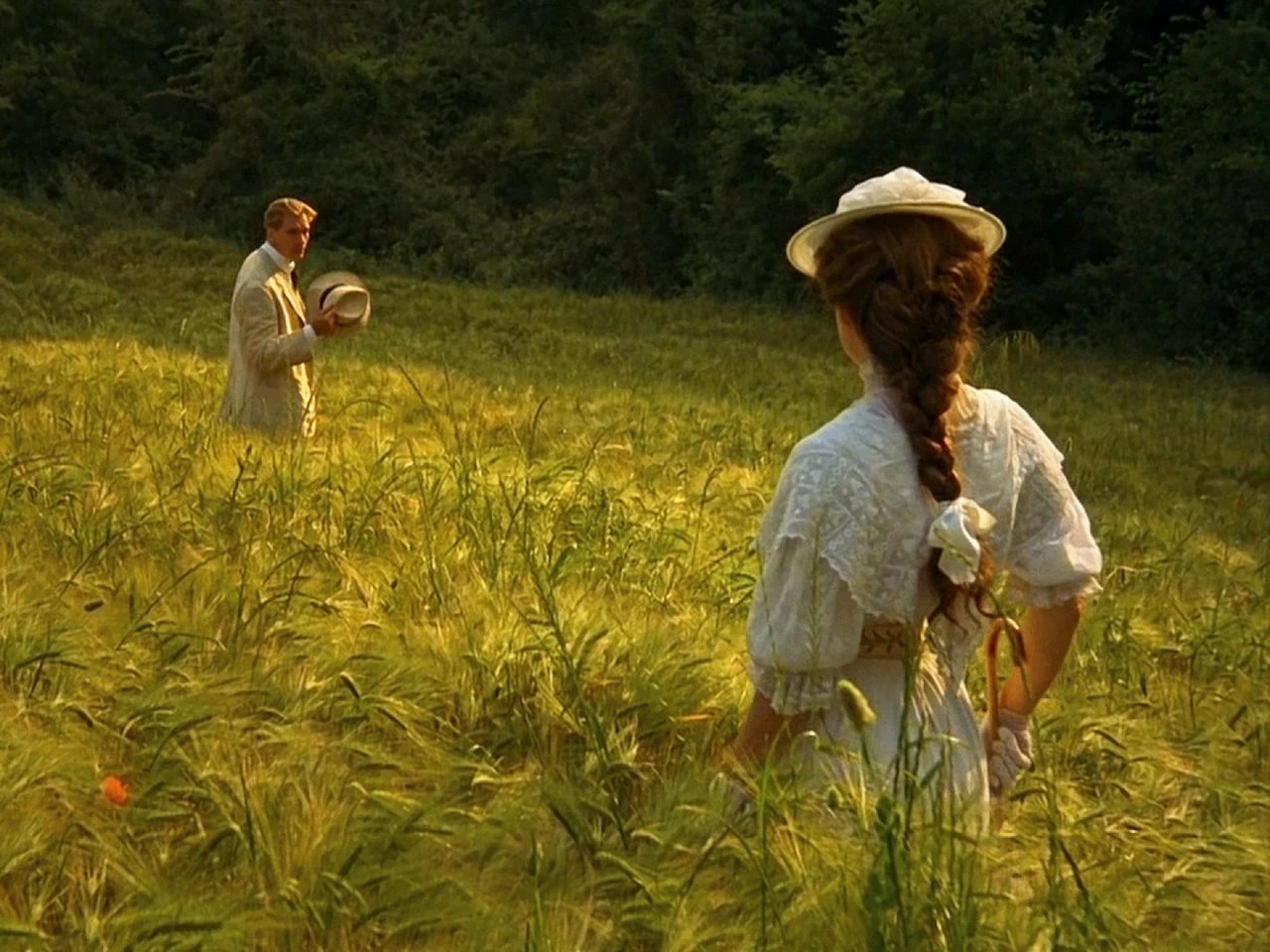
George Emerson is Forster’s attempt at a hero, and the attempt is only partially successful, which is itself interesting. George is a young man in the grip of a philosophical crisis — he sees no meaning in the world and says so, with the bluntness of someone who has not been taught that one’s existential despair is a private matter to be managed discreetly rather than announced at the pension dinner table. He is redeemed, in the novel’s logic, by his capacity for joy: Italy works on him, Lucy works on him, the kiss in the field of violets above Fiesole works on him, and the working produces a person capable of the direct statement — “I love you” — that the social world around him has conspired to make nearly unspeakable.
He is less fully rendered than Lucy, which is a deliberate choice: the novel is Lucy’s story, her education, her gradual and painful and finally achieved self-knowledge, and George is its catalyst rather than its subject. He exists primarily in the effect he has on her — in the field, in the Piazza Signoria where he witnesses a murder and reaches for her in the confusion, in the moment at Summer Street when he kisses her again and she retreats into a panic of propriety — and the effect is always the same: to insist on the reality of the body, on the fact of feeling, on the impossibility of pretending, in the presence of genuine connection, that the connection is not there.
“He had been brave enough to speak. She must be brave enough to listen, even if what she heard disturbed her conception of herself.”
E.M. Forster, A Room with a View, 1908
Charlotte Bartlett and the Wages of Renunciation
Charlotte Bartlett is the novel’s dark mirror and its most complex character, and she has been underestimated by readers who take her at the surface the novel presents. She is, in the obvious reading, the voice of convention, the chaperone whose function is to prevent Lucy from doing anything that would damage the social fabric, and she performs this function with a tirelessness that is both comic and faintly oppressive. But there is another Charlotte, visible in certain moments if you are reading carefully: a woman who has renounced something, long ago, and who has made of that renunciation a vocation, a complete identity, so that what began as a sacrifice has become the only self she knows how to inhabit.
The novel’s final revelation — that it is Charlotte who has, apparently inadvertently, engineered the circumstances that lead to Lucy and George’s reunion — admits of two readings. One is that it is coincidence, the world arranging itself toward the right outcome despite the agents who would prevent it. The other, and more interesting, is that Charlotte has done it deliberately: that some part of her that she cannot acknowledge directly has ensured that Lucy does not make the choice Charlotte once made, that the younger woman escapes the renunciation that has been the older one’s entire adult life. This reading cannot be confirmed from the text, and Forster does not confirm it. But he plants it, precisely, and leaves it there, and the ambiguity is not a failure of resolution but a form of mercy — toward Charlotte, and toward the idea that people whose lives have been shaped by the denial of their own natures sometimes, in the end, cannot help but reach toward the light they themselves were not permitted to enter.
Italy as Argument, Surrey as Consequence
The novel’s division between its Italian first half and its English second is not merely a structural device but a philosophical one. Italy — the light, the heat, the physicality, the violence of the Piazza Signoria murder, the irrepressible fecundity of the countryside above Fiesole — is where the body’s claims assert themselves without apology. England — the villa in Surrey, the social calls, the tennis parties, the carefully managed surfaces of middle-class Edwardian life — is where those claims are managed, deferred, translated into the acceptable language of convention. The novel’s question is whether what was felt in Italy can survive the translation into English, and the answer Forster gives is: only if the person feeling it is willing to be, in the deepest sense, honest.
The Florentine scenes have a quality that the Surrey scenes deliberately lack: an openness of space, a willingness of the light to reveal rather than to flatter. In Florence, people are seen clearly — their motives, their desires, their essential natures. In Surrey, everything is arranged, softened, made presentable. Forster understood this distinction with the precision of someone who had been to Italy and felt it work on him, and he rendered it in the prose itself: the Italian chapters are warmer, more immediate, more willing to let the emotion exist on the surface, while the Surrey chapters are cooler, more ironic, more aware of the gap between what is said and what is felt.
What the Novel Knows That Forster Could Not Say
The Maurice that Forster wrote in 1913 and withheld from publication until after his death in 1970 — the novel in which he allowed himself to write directly about homosexual desire and to give it a happy ending — tells us something important about what A Room with a View is carrying beneath its light surface. The argument about the body, about the cost of renunciation, about the necessity of self-knowledge and the bravery of the direct statement: these are arguments that had, for Forster, a personal urgency that the heterosexual love story of Lucy and George could only partially contain. The novel is, among other things, a message from a man to himself: a demonstration that it is possible, with enough courage, to choose correctly, even if the demonstration had to be conducted through surrogates whose situation was publicly speakable in ways that his own was not.
This does not reduce A Room with a View to autobiography or to allegory. It deepens it: adds a layer of feeling to the comedy that makes the comedy more serious without making it less funny, and makes the argument about self-knowledge and the cost of its denial more urgent and more fully felt than a purely hetero-normative reading of the novel can quite account for. Forster knew, with the precision of personal experience, what renunciation cost. He knew what it meant to live in the room without the view. He gave Lucy the view that he could not, yet, give himself, and the generosity of that gift — the warmth that radiates from the novel’s conclusion, its genuine and unironic happiness at the outcome — is the most intimate thing in it.
The novel ends with Lucy and George in the pension room that started everything, the room that now has the view it was always meant to have, the Arno below and the hills above and the light doing what Italian light does in late afternoon, and the ending is earned — not sentimentally, not by the suppression of everything that has made it difficult, but by the honest working-through of exactly what it cost to get there. Only connect, Forster would write in Howards End, two years later — his most famous instruction, his most compressed statement of what he believed. A Room with a View is the demonstration: what connection requires, what it costs, and what it gives in return to those willing to pay.
This essay draws on E.M. Forster’s A Room with a View (1908), Maurice (written 1913–14, published 1971), and Howards End (1910), as well as P.N. Furbank’s authorised biography E.M. Forster: A Life (1977–78). The Merchant Ivory film adaptation (dir. James Ivory, 1985), with Helena Bonham Carter as Lucy Honeychurch, is referenced in connection with the earlier essay in this series on Bonham Carter’s career. The Pension Bertolini of the novel is thought to be based on the Pensione Simi on the Lungarno delle Grazie, Florence.
Discover more from My World of Interiors
Subscribe to get the latest posts sent to your email.

