
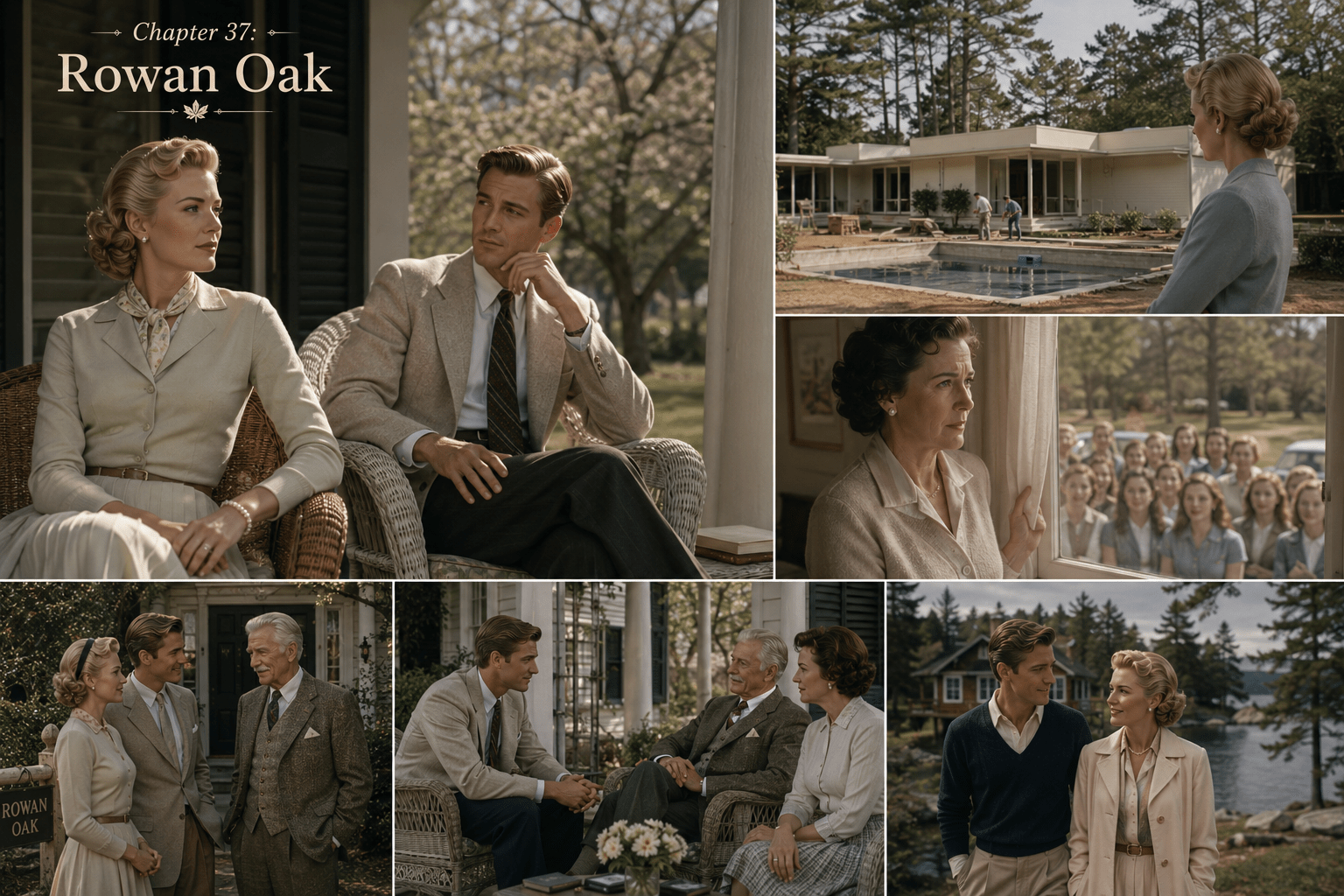
I bring Topper to the South for Easter in 1956. The boy is in Los Angeles, so we don’t see him. It feels strangely empty to be back home without him here.
On Easter Sunday, he’s in San Diego for the Milton Berle Show. I drive over to visit his parents and see their new house on Audubon Drive.
“I love it,” I tell Mrs P. “It’s so modern and sophisticated.” And I mean it. “It’s a pretty impressive place for a house bought by a twenty-one-year-old.”
Mrs P looks proud and agrees. She laughs her little Mrs P laugh, and I realise I’ve missed her too, her funny little ways, her warmth, the way she adores her son.
Out back, they’re putting in a swimming pool. I tell her I think they’ll be happy here.
But she’s already worried about the fans.
“Fans?” I ask.
She tells me there’s a barrage of girls on the front lawn every day and every night.
“Oh,” I say. “I thought there was a street party or some other happening going on nearby when I drove up.”
I look out the window and realise the people everywhere are here for him.
“So they’re here even when he’s out of town?” I ask.
Mrs P shakes her head. “It’s terrifying,” she says, and closes the curtains.
I’ve completely missed the everyday reality of fame.
“I’m so sorry,” I say, hugging her goodbye. “Let me know if you need anything, I’ll be here.”
I wave as I drive back to the house, where Topper and Miss Mary are setting up lunch. I miss the boy. I’m scared he might never come back to me.
I shake it off, lean against Topper, who puts his arm around me, and he takes me to see William Faulkner at Rowan Oak, a drive away in Oxford, Mississippi. Turns out Topper is a friend of Faulkner’s daughter, Jill.
***
Estelle greets us as we park the car, and I wonder why Topper never told me he knows one of the greatest minds of all time, but that’s the way Topper operates: quietly, and full of surprises.
“This is my girlfriend, Birdie,” he says, resting a hand on my back as I reach out to greet everyone.
We sit and talk, and I observe Topper and his ways with the world. He walks a rich but humble path, my Topper. He engages so easily with Faulkner and his wife. There’s a quiet elegance in the way he moves through the world.
And I see him a little more clearly this Easter, not just the sophisticated and anchored suitor from New York. I see him unfold, and I sense a dream in him I haven’t seen before. He might be too good for me. He’s bigger than me somehow, and I don’t quite understand what he hangs around me for, but I’m glad he does.
I smell the spring, soak up the sun, and look around Rowan Oak. I feel like a very lucky girl. A wave of happiness washes over me, and I breathe deeply, taking in the scent of the earth, the sunlight warming my skin.
I glance at Topper, deep in conversation, leaning forward in his wicker chair on the porch, and watch as his dark blond hair falls across his face. I notice the way his elegant hand flicks it back, the glances he gives me, checking that I’m okay, drawing me into the conversation, letting me know I have something to contribute.
I study his face, his clear skin, his poetic features, his blue eyes and clever mouth, and I feel myself moving in a new direction.
***
We visit Topper’s parents in the city, then spend a long weekend at his cabin in Maine.
“To get away from everything.”
And it’s lovely. Topper has a simple approach to his complexity, where the boy has a complex approach to his simplicity. And I’m okay with not having seen the boy this Easter.
Maybe I can live without him, after all?
I shake it off. It feels like a faulty message. Underneath the spring feeling I have for Topper, I still long for the boy like a missing piece of my soul.
I look over at Topper, reading by the fireplace in the Maine house. He looks up from his book, takes off his reading glasses, and smiles.
“Can I help you?” he asks.
“You already are,” I tell him.
“Let’s go for a walk,” he says, rising to his feet. “It’s a beautiful day for it.”
Discover more from My World of Interiors
Subscribe to get the latest posts sent to your email.

