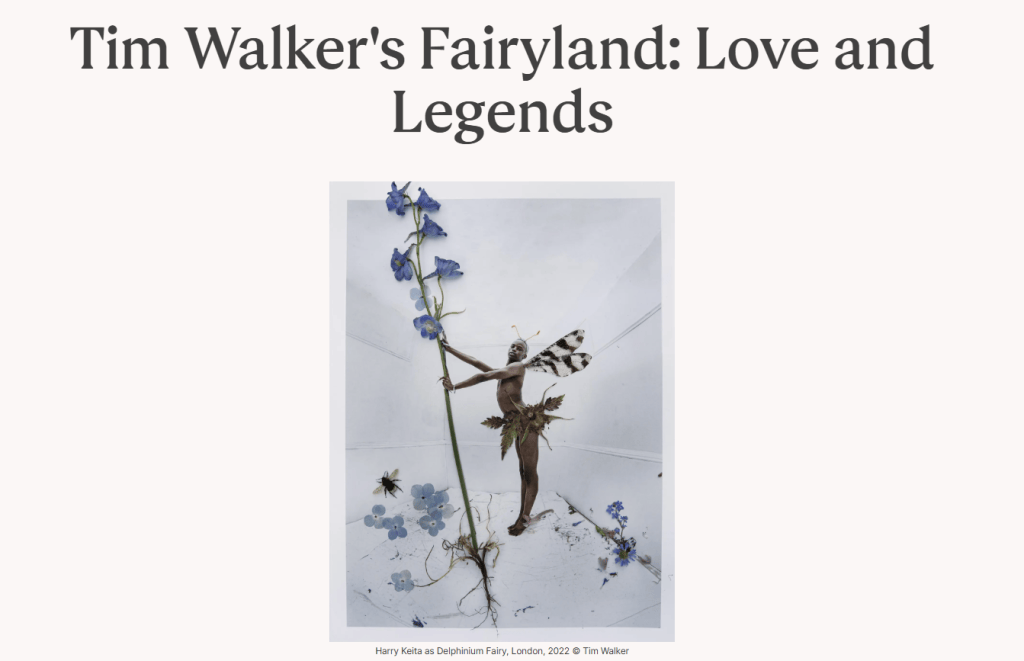
At London’s National Portrait Gallery, the photographer who transformed fashion into elaborate theatre turns his imagination towards queer history. With some 250 portraits spanning activists, artists, performers and cultural pioneers, Tim Walker’s Fairyland: Love and Legends is at once a celebration of difference, an examination of historical visibility and a deeply personal reconsideration of the purpose of portraiture.
National Portrait Gallery, London | 9 October 2026 – 7 February 2027
A Birthday, a Protest and the Beginning of an Idea
On 27 November 1970, a small group of gay liberation campaigners gathered in London’s Highbury Fields to protest against the treatment of a man arrested following police entrapment. The demonstration would become an important early moment in the history of Britain’s modern gay rights movement.
On precisely the same day, Tim Walker was born.
Half a century later, the celebrated British photographer discovered a commemorative plaque marking the demonstration while walking through the area. The coincidence prompted a question that gradually developed into the most personal exhibition of his career: what had become of those people who had marched for freedoms that subsequent generations would come to regard as fundamental?
Who were they? What had their lives become? And why were so many of their faces absent from the institutions responsible for preserving Britain’s cultural memory?
The resulting exhibition, Tim Walker’s Fairyland: Love and Legends, opened at the National Portrait Gallery on 9 October 2026.
Curated by Susanna Brown, it brings together approximately 250 portraits produced through several years of conversations, research and photographic encounters with people who have shaped queer life in Britain and beyond.
Its subjects include Sir Ian McKellen, Isaac Julien, Miriam Margolyes, Chappell Roan, John Waters, Lady Phyll, Peter Tatchell and an extraordinary collection of activists, nurses, social workers, writers and underground performers.
Some are internationally recognised. Others have spent decades working outside the public spotlight.
What unites them is not celebrity but participation in a history of social transformation.
For Walker, whose extraordinary career has been defined by the invention of fantastical worlds, the project represents an important change of emphasis.
For once, the fantasy serves an unusually direct historical purpose.
Tim Walker: The Imagination Behind the Image
Born in 1970, Tim Walker developed his distinctive photographic language through an unlikely combination of historical research, fashion, theatrical construction and childhood fantasy.
An early period working with Cecil Beaton’s archive at the Condé Nast Library introduced him to the possibilities of fashion photography as a form of visual storytelling.
Beaton’s carefully constructed portraits, with their theatrical settings and sophisticated interplay between costume and personality, offered an important precedent.
After studying photography at Exeter College of Art, Walker moved to New York, where he assisted Richard Avedon.
The influence of these two photographers remains visible throughout his work.
From Beaton came the understanding that portraiture could become a form of theatre, its subject transformed through costume, gesture and setting.
From Avedon came something apparently contradictory: an appreciation of the emotional possibilities of simplicity.
The tension between these approaches would eventually become central to Walker’s photography.
Throughout the 1990s and subsequent decades, his images appeared in Vogue, W, i-D, Vanity Fair and other influential publications, developing an unmistakable visual vocabulary.
Enormous flowers, disproportionate furniture, extraordinary costumes and fantastical landscapes transformed fashion photography into something approaching narrative painting.
His subjects appeared to inhabit an alternative universe in which the conventions of scale, chronology and ordinary physical experience had been temporarily suspended.
The influences were extensive: Lewis Carroll, fairy-tale illustration, surrealism, romantic painting and the highly artificial theatricality of early fashion photography.
In 2019, the Victoria and Albert Museum presented Tim Walker: Wonderful Things, an ambitious exhibition inspired by objects from the museum’s collections.
For that project, Walker explored everything from historical costume to decorative art and photography, creating new work in response to the museum’s extraordinary holdings.
The exhibition demonstrated the extent to which his photography functioned as a conversation with art history rather than merely an exercise in fashion illustration.
But Fairyland introduces a different question.
What happens when an artist renowned for transforming reality decides to use those same imaginative powers to examine the world as it actually exists?
The Queer Aristocracy: Portraiture and Historical Authority
The opening section of Fairyland provides one of its most intelligent art-historical propositions.
Walker photographs pioneers of gay liberation through the visual language of Tudor portraiture, borrowing from the traditions established by Hans Holbein the Younger and the Elizabethan miniaturist Nicholas Hilliard.
The choice is particularly appropriate to the National Portrait Gallery.
Founded in 1856, the institution was established to collect portraits of individuals considered important to British history.
Its collections have traditionally reflected the structures through which national significance was recognised: monarchy, aristocracy, political power, military accomplishment and cultural distinction.
Portraiture has never been entirely neutral.
The decision to represent a particular person is itself an acknowledgement of historical importance.
So is the visual language through which that person is presented.
Holbein’s portraits of the Tudor court convey status through exacting detail, controlled posture, clothing and the material symbols of authority.
Hilliard’s miniatures similarly transformed their subjects into carefully constructed expressions of rank, identity and prestige.
Walker appropriates these conventions for individuals whose political work directly challenged established structures of social authority.
Among them are Olivette Cole-Wilson, Andrew Lumsden, Lisa Power and Tom Robinson.
Olivette Cole-Wilson appears holding a blackbird, her hands ornamented with jewellery. The composition invokes the visual language of historical prestige, but its subject represents a very different understanding of public importance.
The effect is more than decorative.
It questions the criteria by which individuals acquire the right to be represented within national institutions.
The traditional portrait of an aristocrat asserts the legitimacy of inherited status. Walker’s portraits of campaigners celebrate authority acquired through resistance.
He effectively constructs an alternative aristocracy: one defined not by birth or wealth but by courage, creativity and contributions to collective freedom.
This reversal is among the exhibition’s most compelling intellectual achievements.
The Meaning of a White Background
Not all Walker’s subjects are dressed in elaborate historical costume.
Many appear against deceptively straightforward white backgrounds, an approach that recalls Avedon’s celebrated portrait practice.
The contrast with Walker’s more familiar visual extravagance is striking.
The photographer who once built monumental dream worlds around fashion models now frequently removes almost everything from the image.
What remains is the encounter between camera and sitter.
Nevertheless, these are not necessarily conventional portraits.
Walker invited his subjects to collaborate in determining how they wished to be represented, often asking them to bring objects of particular personal significance.
The resulting photographs become exercises in self-definition.
Writer and publisher Jane Cholmeley appears with the original sign from Silver Moon Women’s Bookshop, the influential feminist bookshop she helped establish in London in 1984.
Photographer Sunil Gupta holds his camera, the instrument through which he has documented queer communities and examined the intersections of sexuality, race and personal identity.
Filmmaker Isaac Julien holds a conch shell, recalling the imagery of his 1989 film Looking for Langston, a landmark exploration of Black gay identity, desire and the cultural legacy of the Harlem Renaissance.
The objects function as condensed biographies.
They allow the sitters to introduce the histories and experiences they consider central to their identities.
This participatory method complicates the conventional power relationship between photographer and subject.
Rather than simply imposing an aesthetic, Walker creates circumstances in which individuals can participate in constructing their own representations.
One particularly revealing example concerns E-J Scott, founder of the Museum of Transology, an archive devoted to preserving trans, non-binary and intersex people’s personal histories through donated objects.
In discussions with Walker, Scott developed the idea of representing the restrictions imposed upon trans lives through the physical act of wrapping himself in adhesive tape.
The resulting image connects bodily experience with an apparently simple visual metaphor.
Here, photography becomes an instrument through which personal experience is translated into a form that others can encounter.
The visual language may be restrained, but the questions are substantial.
Who determines how an individual is seen? How much control does the sitter possess? And can portraiture provide a corrective to identities imposed from outside?
Remembering the AIDS Crisis
One of the exhibition’s most significant achievements is its recognition that the history of queer liberation cannot be separated from the AIDS crisis.
The epidemic transformed LGBTQ+ communities during the 1980s and 1990s, producing devastating losses alongside extraordinary forms of activism, mutual support and medical innovation.
The period has often been represented through images of illness, fear and death.
Walker does not disregard that history, but broadens the field of remembrance.
His exhibition includes activists, healthcare professionals, researchers, musicians and others whose contributions were essential to the social response to HIV and AIDS.
Among the most poignant portraits is that of Graham McKerrow, co-founder of the newspaper Capital Gay, holding a November 1982 issue that reported the emergence of AIDS in London.
The newspaper becomes a physical connection to a moment when information was uncertain, public hostility was considerable and the full consequences of the epidemic remained unknown.
Another photograph reunites nurse Jane Bruton with former patient Tony Whitehead and medical researcher Jonathan Weber.
Whitehead was among those whose lives were saved by combination antiretroviral treatment in the 1990s.
Their portrait celebrates an extraordinary history of care, scientific progress and survival.
Such images are important because the history of AIDS is also a history of labour that is easily overlooked.
Nurses, community organisers, volunteers, researchers and advocates played essential roles in responding to a public health emergency frequently accompanied by political indifference and social stigma.
Alongside these figures, Walker presents musicians including Marc Almond, Holly Johnson and Jimmy Somerville, whose work formed part of the cultural environment of queer Britain during those years.
The juxtaposition of medical history and popular music is deliberately unconventional.
Yet it makes a powerful argument.
Communities do not survive through political protest alone. They also survive through friendship, music, pleasure, humour and the ordinary practices of caring for one another.
The exhibition asks us to remember the lives that were lived, not exclusively the lives that were lost.
The Rebel Dykes: An Alternative History of British Feminism
A central room is devoted to the Rebel Dykes, the lesbian punk collective associated with London’s alternative culture during the 1980s.
These women occupied a distinctive position within Britain’s developing feminist and queer political movements.
Their activities intersected with anti-nuclear protest, environmental activism, sexual politics and the creation of autonomous lesbian cultural spaces.
They challenged the assumptions of mainstream society while also questioning some of the restrictions they encountered within established feminist movements.
Walker’s large-scale portraits take inspiration from the work of Swiss photographer Karlheinz Weinberger, whose photographs of youthful biker and rock-and-roll subcultures transformed clothing, posture and personal ornament into expressions of social identity.
The reference is particularly well chosen.
Like Weinberger’s subjects, the Rebel Dykes used fashion, bodily presentation and collective affiliation to construct alternatives to conventional respectability.
Their appearance was not merely a style.
It represented a declaration of belonging.
The portraits are accompanied by a short film in which members reflect upon their histories and political commitments.
Placed within Fairyland, their story also challenges the tendency to present queer culture as a succession of glamorous personalities.
Much of its development depended upon collective organisation, shared spaces and political relationships extending well beyond music and nightlife.
The Rebel Dykes demonstrate that identity can become an active cultural force when individuals organise around their common experiences.
Fashion as an Instrument of Transformation
In the exhibition’s second half, Walker returns more explicitly to the territory that made his reputation.
Costume, theatricality, elaborate make-up and visual extravagance become central elements in portraits of designers, performers, actors and musicians.
The subjects include Jean Paul Gaultier, Michaela Stark, David Hoyle, Paul O’Grady, Julian Clary, Hunter Schafer, Ncuti Gatwa, Björk, Lady Gaga and Chappell Roan.
Yet fashion here is not simply a matter of visual pleasure.
It offers a means of reconsidering the relationship between identity and social expectation.
Clothing has always possessed the capacity to communicate status, gender, profession and cultural affiliation.
It can reinforce established conventions or deliberately contradict them.
Within queer culture, fashion and performance have frequently provided spaces in which identities could be explored beyond the restrictions of ordinary social life.
Drag, in particular, transforms familiar conventions of masculinity and femininity into acts of conscious representation.
The theatrical exaggeration reveals how much apparently natural social behaviour is itself constructed through clothing, gesture and performance.
In this context, Walker’s extravagant imagery acquires a political dimension.
His elaborate photographs of Paul O’Grady and Julian Clary as glittering fantasy figures are celebrations of theatrical excess, but they also belong to a tradition in which humour and exaggeration become forms of cultural resistance.
The same can be said of the extraordinary Miriam Margolyes portraits, which reject conventional expectations surrounding age, sexuality and the presentation of the female body.
Walker has always understood that the camera can turn an individual into a character.
In Fairyland, he increasingly asks whether becoming a character might sometimes be a way of asserting one’s most authentic self.
From Fragonard to Fairy Tales: The Erotic Imagination
The exhibition’s final room presents its most explicitly fantastical and provocative imagery.
Drawing upon mythology, nursery rhymes, erotic art and the history of painting, Walker constructs elaborate scenes in which familiar narratives acquire new sexual meanings.
Among the historical references is Jean-Honoré Fragonard’s celebrated painting The Swing, painted in the eighteenth century and now held by London’s Wallace Collection.
Fragonard’s vision of an overgrown garden filled with concealed erotic suggestion offers an illuminating precedent.
The painting transforms landscape into a theatre of desire.
Its apparent innocence is inseparable from its erotic ambiguity.
Walker works within a related tradition, employing theatrical scenery, improbable compositions, decorative excess and the suspension of ordinary reality.
His subjects inhabit settings that recall Renaissance allegory, Rococo painting and illustrated fairy tales, but traditional sexual conventions are deliberately overturned.
The resulting imagery is frequently humorous, extravagant and confrontational.
These photographs also reveal a more complicated dimension of Walker’s long-standing fascination with fantasy.
Fairy tales are often understood as innocent narratives associated with childhood, yet their historical forms frequently contain violence, transformation, sexuality and psychological uncertainty.
The modern distinction between innocent fantasy and adult desire is therefore less stable than it initially appears.
Walker’s imagery exploits precisely this ambiguity.
His constructed world is neither exclusively innocent nor simply provocative.
It is a place in which the familiar rules governing bodies, behaviour and desire have temporarily ceased to apply.
The National Portrait Gallery has designated this final space for adult visitors, reflecting the explicitly sexual content of some works.
Its position at the conclusion of the exhibition is significant.
The visitor’s journey moves from political protest and historical exclusion towards increasingly unrestricted forms of self-expression.
The freedom imagined through fantasy becomes the culmination of freedoms secured through political struggle.
The Politics of Fairyland
The exhibition’s title carries an autobiographical significance.
As a child, Walker was fascinated by imaginary landscapes, woodland creatures and the illustrated worlds of fairy stories.
Yet the word fairy also possessed another meaning.
For generations, it had been used as a derogatory term directed towards gay men.
Walker has spoken about the relationship between his childhood imagination and the experience of growing up in a society where homosexuality was frequently treated with hostility.
The exhibition deliberately reclaims this language.
What had once been used to ridicule difference becomes a declaration of belonging.
This transformation is central to understanding the relationship between Walker’s aesthetic imagination and his personal history.
His elaborate photographic worlds have always offered an alternative to ordinary reality.
Their exaggerated proportions, theatrical costumes and disregard for conventional behaviour suggest places in which established rules no longer possess authority.
Fairyland makes the social implications of that imaginative freedom explicit.
Fantasy becomes more than an escape from reality.
It becomes a way of proposing that reality might be organised differently.
In this respect, the exhibition belongs to a much longer tradition of artistic utopianism.
From Renaissance pastoral imagery to surrealism and twentieth-century experimental performance, artists have repeatedly constructed imaginary worlds through which to question the assumptions of their own societies.
The fantastical is not necessarily opposed to the political.
Sometimes it provides the means through which political possibilities can first be imagined.
Can Spectacle Become Historical Testimony?
There is nevertheless an interesting tension at the centre of Fairyland.
Walker is among the most accomplished image-makers working in contemporary fashion photography, but the methods that produce a memorable fashion editorial do not automatically guarantee an equally compelling historical portrait.
Some critics have questioned whether the exhibition’s extensive collection of comparatively straightforward celebrity portraits possesses the visual invention associated with his strongest work.
It is a reasonable distinction.
A photograph can celebrate an important individual without necessarily becoming an important work of art.
Equally, an elaborate composition can be visually extraordinary without revealing much about its subject.
The exhibition’s achievement therefore cannot be assessed through its visual extravagance alone.
Its more substantial accomplishment lies in the relationship between biography, representation and historical recognition.
The image of an activist holding an object connected to decades of political work may initially appear less spectacular than a fantasy tableau featuring an internationally famous performer.
Yet the quieter image may communicate considerably more.
In its strongest moments, Fairyland demonstrates that photography’s imaginative possibilities do not depend solely upon theatrical construction.
They can also emerge from the careful recognition of another person’s life.
The distinction is especially significant within the National Portrait Gallery, where photography must engage with the institution’s longstanding responsibility to represent individuals of historical consequence.
Walker effectively asks the museum to reconsider the relationship between public visibility and cultural importance.
The resulting exhibition does not always resolve the tension between celebrity, spectacle and historical testimony.
But that tension is itself productive.
It raises questions about why some individuals become celebrated while others, whose contributions may be far more consequential, remain relatively unknown.
A Different Kind of National Portrait Gallery
The exhibition has been designed by Walker’s long-standing collaborator Shona Heath, whose theatrical approach to spatial design creates an environment in which the photographs operate as elements of a larger imaginative narrative.
Heath also collaborated with Walker on the V&A’s Wonderful Things, and the partnership has become integral to the photographer’s ambitious museum presentations.
Yet the significance of Fairyland extends beyond installation design.
The National Portrait Gallery is an institution concerned with the relationship between individual lives and national history.
To place queer activists, underground performers, nurses and social organisers within its exhibition programme is to acknowledge that their experiences belong to the country’s central historical narrative.
The question is no longer simply whether such people deserve recognition.
It is why their contributions were so often excluded from established forms of historical remembrance.
This shift has important implications for the function of the museum itself.
Cultural institutions do not merely preserve history.
Through their decisions about collection, exhibition and interpretation, they actively participate in determining how history is understood.
Fairyland therefore performs two forms of representation simultaneously.
It offers portraits of individuals whose lives have shaped queer culture.
And it proposes a more expansive understanding of the people whose achievements constitute British cultural history.
The exhibition’s accompanying 320-page catalogue extends these ideas through contributions by Travis Alabanza, Russell T Davies, Shon Faye, Lisa Power and Joelle Taylor, together with conversations between Walker and curator Susanna Brown.
The inclusion of these voices is important.
It ensures that the history represented through Walker’s photographs is accompanied by personal reflection, cultural analysis and accounts grounded in the experiences of the communities themselves.
The Right to Exist Within the Picture
Tim Walker has spent much of his career creating images of places that do not exist.
His extraordinary visual landscapes have been inhabited by fashion models, actors, artists and musicians temporarily transformed into creatures of imagination.
In Fairyland, the relationship between fantasy and reality becomes more complicated.
The people are real. Their histories are real. The political struggles, losses, relationships and acts of collective solidarity represented within the exhibition have shaped the lives of generations.
Yet Walker approaches these histories through a visual language traditionally associated with make-believe.
The result is an exhibition in which fantasy becomes an instrument of historical recognition.
Its subjects are not simply documented.
They are granted the space to appear as they wish to be remembered: dignified, playful, extravagant, defiant, vulnerable, ordinary or extraordinary.
There is something particularly moving about the inclusion of older activists whose early lives unfolded in circumstances of legal restriction and intense social hostility.
To portray them through the visual conventions once reserved for royalty and aristocracy is a quietly radical proposition.
Their lives, Walker suggests, deserve the same consideration, complexity and cultural permanence.
The exhibition ultimately returns us to the fundamental purpose of portraiture.
A portrait can record the appearance of an individual.
But it can also affirm that the individual’s life possesses significance beyond the circumstances of its own existence.
For all its theatrical excess, Fairyland is concerned with precisely this distinction.
It is an exhibition about imagination, certainly, but also about the right to occupy public space, to construct one’s own identity and to be included within the histories that societies tell about themselves.
Walker has always known how to make people look extraordinary.
Here, he makes a more important argument: that the freedom to be seen should never have been extraordinary in the first place.
Visit the Exhibition
Tim Walker’s Fairyland: Love and Legends — National Portrait Gallery
Venue: National Portrait Gallery, St Martin’s Place, London WC2H 0HE.
Dates: 9 October 2026 – 7 February 2027.
Opening hours: Daily, 10.30–18.00; Fridays and Saturdays until 21.00.
Admission: £23 Monday–Thursday and £25 Friday–Sunday for standard adult tickets, with optional donation pricing. Reduced-price tickets and Monday Pay What You Can sessions are available, subject to eligibility and availability.
Booking: Official exhibition information and tickets.
Visitor information: The exhibition contains adult themes, nudity and some images of a sexual nature. A designated final room is not recommended for visitors under 18.
Exhibition Events
6 November 2026 — Tim Walker in Conversation
The photographer discusses the ideas, people and experiences behind Fairyland. The event takes place at the National Portrait Gallery, with online attendance available.
29 January 2027 — Russell T Davies in Conversation
A discussion examining the legacy of the HIV and AIDS crisis and the importance of preserving its cultural history.
Programme and exhibition events
Further Reading and Exploration
Explore Walker’s photographic career, including his fashion work, portraits and major museum exhibitions.
Tim Walker: Wonderful Things — Victoria and Albert Museum
The photographer’s landmark 2019–2020 exhibition exploring the relationship between his work, museum collections and the history of visual imagination.
A closer examination of Walker’s artistic process and the historical objects that influenced his photographic installations.
Tim Walker in Conversation — W Magazine
A substantial interview examining the personal origins of Fairyland, his relationships with the sitters and the changing direction of his work.
The community archive founded by E-J Scott, preserving the material culture and personal histories of trans, non-binary and intersex people.
Fragonard’s The Swing — Wallace Collection
An introduction to the Rococo masterpiece whose visual language informs aspects of Walker’s fantastical erotic imagery.
Fairyland: The Exhibition Catalogue
Published by the National Portrait Gallery, the richly illustrated volume includes approximately 280 images and contributions from leading contemporary writers and cultural figures.

