Remembering the Shakespearean actor, lifelong socialist and irreverent friend whose finest lines were often delivered away from the stage.
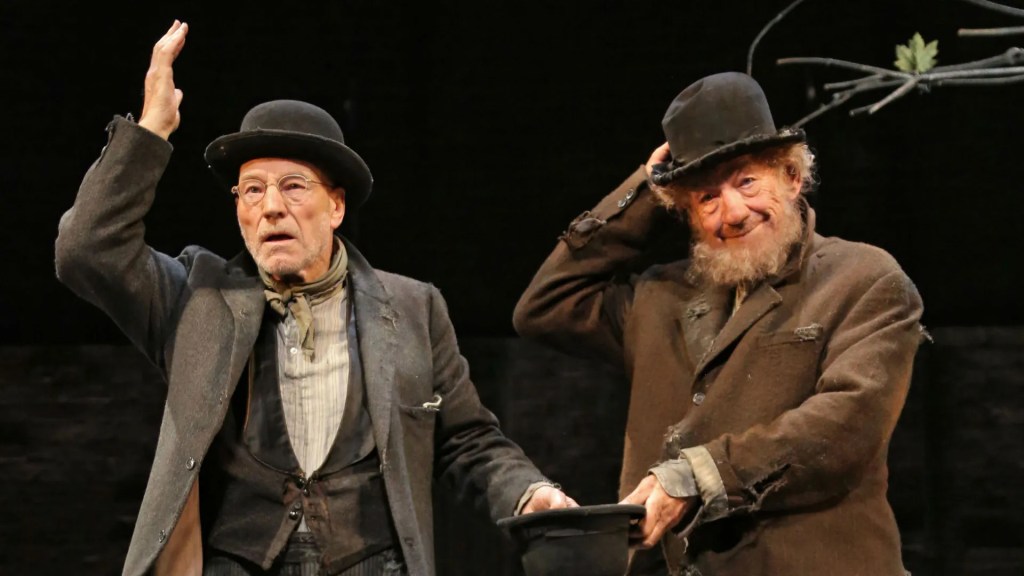
In Sean Mathias’s 2009 production of Samuel Beckett’s Waiting for Godot at the Theatre Royal Haymarket, Patrick Stewart played Vladimir opposite Ian McKellen’s Estragon. When the two characters were reunited, Stewart performed a little shimmy. The gesture caught the attention of The Guardian’s Michael Billington, who admired the actors’ comic timing while questioning whether the production’s easy charm had softened Beckett’s bleakness. Stewart brought a stubborn optimism to Vladimir; McKellen made Estragon gruff, dishevelled and sceptical. Their characters quarrelled incessantly but were frightened of being left alone.
It was an unusually apt pairing. Stewart and McKellen had become close friends relatively late in life, and their mutual affection was as apparent offstage as it was during their performances together.
Sir Patrick Stewart died on 28 October 2026, aged 86, at his Los Angeles home, following an illness involving Alzheimer’s disease and Lewy body dementia. He had been one of Britain’s finest Shakespearean actors, joining the Royal Shakespeare Company in 1966 and appearing in more than forty of its productions. International fame arrived in middle age, when he was cast as Captain Jean-Luc Picard in Star Trek: The Next Generation in 1987. His portrayal of Professor Charles Xavier in the X-Men films later introduced him to another generation of audiences.
Yet Stewart’s public personality was far more playful than the commanding characters for which he became famous. His interviews were full of dry humour, unexpected confessions and an increasingly cheerful willingness to make himself ridiculous. His friendship with McKellen became one of the great pleasures of following either actor’s career.
The two had known each other through the Royal Shakespeare Company in the 1970s, although Stewart admitted to having been intimidated by McKellen, whose work he greatly admired. Their friendship developed during the filming of the first X-Men. Their trailers were next to each other, and the long intervals between scenes provided opportunities for conversation, tea and, as Stewart recalled, occasionally something stronger.
They discovered that they had much in common: a northern English upbringing, a shared devotion to the theatre and similar political sympathies. McKellen came from Lancashire, Stewart from Yorkshire, a historic rivalry that provided endless opportunities for teasing.
During their Broadway engagement in Waiting for Godot and Harold Pinter’s No Man’s Land in 2013–14, the pair wandered around New York wearing matching bowler hats, documenting their excursions on social media. They visited the Empire State Building, played Skee-Ball at Coney Island and photographed themselves holding hands outside the Stonewall Inn. The photographs also served to promote their theatrical productions, although their popularity owed much to the obvious pleasure the actors took in one another’s company.
Their affection was equally uninhibited at premieres and public appearances, where they kissed, embraced and cheerfully declared their love for each other. McKellen, openly gay since 1988, and Stewart, heterosexual and married, appeared entirely comfortable expressing a kind of male friendship that men of their generation had often been discouraged from displaying.
McKellen even officiated Stewart’s marriage to the American singer Sunny Ozell in 2013. As Stewart recounted in a 2019 tribute to his friend, a complication with the wedding paperwork necessitated an improvised ceremony in a California Mexican restaurant before the planned celebrations at Lake Tahoe. McKellen produced a dressing gown, performed the ceremony between interruptions from the waiters and refused to drink until the formalities were complete.
Stewart had not always been so comfortable with companionship. In an interview with AARP in 2014, he acknowledged a lifelong tendency towards solitude and explained how much he had come to value the company of people he loved. His friendship with McKellen was part of a broader change in his willingness to express affection.
His professional seriousness had undergone a similar adjustment. During the early years of Star Trek: The Next Generation, Stewart became frustrated by the joking and horseplay of his younger colleagues. Accustomed to the discipline of classical repertory theatre, he called a meeting to complain that they were failing to take their work seriously enough. His response to their suggestion that acting ought to involve some enjoyment became one of his favourite stories against himself. Eventually, he admitted, his fellow actors taught him how to relax.
The transformation was evident in his later enthusiasm for comedy. Stewart appeared in Ricky Gervais’s Extras, voiced the gloriously disreputable CIA deputy director Avery Bullock in American Dad!, and took considerable pleasure in undermining his dignified public image. Few actors of his generation seemed quite so delighted by the discovery that audiences enjoyed watching them behave absurdly.
His political convictions, however, remained consistent.
Stewart grew up in the working-class Yorkshire town of Mirfield. His father, Alfred, was a committed trade unionist and Labour supporter who introduced his son to socialism at an early age. Stewart remembered standing outside a polling station in Dewsbury at six years old, campaigning for Labour candidate William Paling until a policeman ordered him to move along.
His political inheritance was complicated by a deeply troubled family life. Alfred Stewart, a former soldier, repeatedly subjected his wife Gladys to domestic violence. Patrick witnessed the abuse throughout his childhood and later spoke about his inability to protect his mother.
He was remarkably candid about the contradiction. In a 2009 interview with The Independent, he credited his father with instilling discipline, ambition, storytelling and socialism, while condemning the violence that had marked their family life.
Stewart subsequently became a patron of Refuge, the British charity supporting women and children experiencing domestic abuse. His campaigning was sustained and explicitly political. In an article written for The Guardian in 2012, he criticised government cuts to women’s shelters and argued that inadequate funding placed vulnerable women in direct danger.
His socialism also informed his defence of public arts education. A scholarship had enabled him to attend the Bristol Old Vic Theatre School, an opportunity otherwise beyond his family’s means. He never forgot the importance of the teachers who encouraged him, particularly Cecil Dormand, who introduced him to Shakespeare at Mirfield Secondary Modern School.
In later interviews, Stewart repeatedly criticised reductions in public funding for the arts. He understood that a theatrical education could be inaccessible to talented young people without financial assistance. His objections to Conservative arts policy were grounded in his own experience of what publicly supported opportunity could achieve.
He was equally outspoken in his opposition to Brexit, campaigning for Britain to remain in the European Union and subsequently supporting efforts to secure a second referendum. His political position combined an attachment to his Yorkshire roots with a thoroughly international outlook.
His knighthood, awarded in 2010, did nothing to moderate his convictions or his capacity for irreverence. He was perfectly capable of discussing socialism with absolute seriousness and then wondering aloud whether Queen Elizabeth II might have owned a Klingon sword.
Following Stewart’s death, McKellen paid tribute to his friend’s Yorkshire directness, emotional openness and unfailing honesty. He remembered a man whose affection was freely expressed and whose political and moral convictions made him someone to trust.
Stewart’s own interviews provide a fitting companion to that tribute. He was a marvellous storyteller, particularly when the joke was at his own expense.
Patrick Stewart in His Own Words: Ten Memorable Quotations
1. On taking acting rather too seriously
“We are not here to have fun.”
Stewart’s unforgettable declaration to his Star Trek colleagues, accompanied by a thump on a chair. He eventually conceded that their playful approach had improved his acting.
2. On performing with Ian McKellen
“Sometimes I feel we’re enjoying it too much and the audience don’t quite understand why we’re having so much fun.”
Stewart recalling the pleasure of appearing onstage with his closest friend, in a tribute written for McKellen’s eightieth birthday.
3. On his feelings for McKellen
“I’ll be frank with you, I’m in love with…”
McKellen, naturally. Stewart went on to explain that his wife felt exactly the same way, which made everything perfectly agreeable.
Source: WIRED Autocomplete Interview, 2020.
4. On his brief career in journalism
“I could be Rupert Murdoch now if I’d kept at it. Luckily for everyone, the job lasted a year.”
Stewart spent a year working as a junior reporter on a Yorkshire newspaper before deciding that acting was a more promising occupation.
5. On his political convictions
“An absolute fundamental, emotional socialist.”
Stewart’s description of his lifelong political identity. His socialism originated in his working-class upbringing and remained central to his convictions.
Source: The Independent, 2009.
6. On campaigning against domestic violence
“I accepted for my mother. As a child, there was little I could do to help her.”
Stewart explaining why he agreed to become a patron of Refuge. His campaigning against domestic violence was inseparable from his childhood experiences.
Source: Patrick Stewart, The Guardian, 2012.
7. On Brexit
“The saddest, grimmest thing that has happened to me since I have been involved in politics.”
Stewart speaking at the London premiere of Star Trek: Picard in January 2020, shortly before Britain formally left the European Union.
8. On the scholarship that changed his life
“Here I was, a secondary school boy, getting everything paid for.”
His recollection of the financial support that allowed him to attend drama school. Stewart regarded public access to arts education as a political responsibility.
9. On discovering the pleasure of comedy
“But laughter is glorious.”
Speaking in 2023, Stewart explained that making an audience laugh had become more satisfying to him than making them cry. He wanted to do more comedy.
10. On what Patrick Stewart was best known for
“Being a delightful, good-looking, charming, witty, and generous companion.”
His answer when WIRED asked what he was famous for. Delivered with a laugh, and perhaps a rather better assessment of his character than the question had anticipated.

