
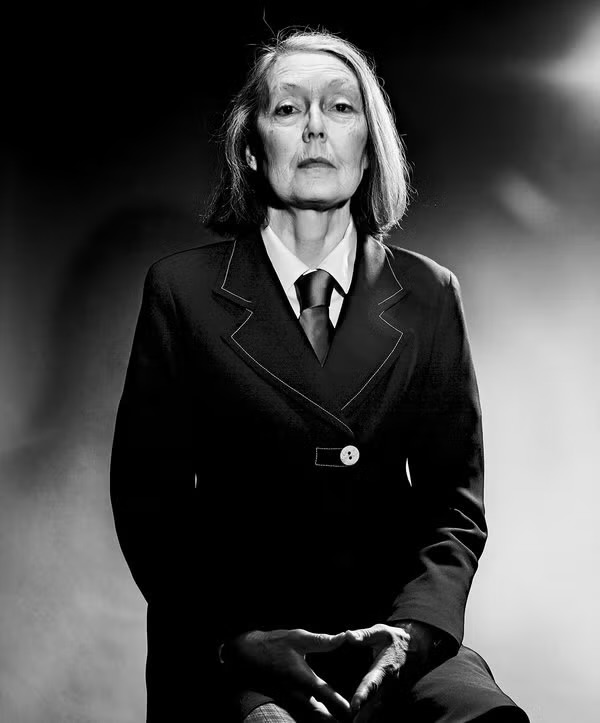
The 2026 Nobel laureate has brought classical scholarship, poetry and the essay into a sustained inquiry into desire, grief and the limits of knowledge. Her achievement changes how we understand the relationship between intellectual life and emotional experience.
The award of the 2026 Nobel Prize in Literature to Anne Carson, announced on 8 October, recognises a writer who has expanded the possibilities of literary form by examining what happens when understanding reaches its limits. Across her work, scholarship encounters experiences it can illuminate without mastering: the persistence of desire, the humiliation of betrayal, the death of someone whose life remained partly unknown. Her books return to the discrepancy between the precision of language and the disorder of living. They ask how a mind trained to analyse can describe what continues to hurt after the analysis is complete.
Carson’s formal inventiveness follows from this problem. A novel becomes a sequence of poems; an essay unfolds through dances; an elegy takes the form of an accordion of photographs, letters and fragments of translation. These arrangements make thought perceptible in ways that conventional exposition sometimes cannot. Reading her involves attending to how meaning emerges between different materials, including the silences separating them. The result is a literature in which intelligence is implicated in the experience it studies, exposed to its pressures and liable to discover its own insufficiency.
Born in Toronto in 1950, Carson encountered ancient Greek through a schoolteacher who offered to teach her alongside Latin. She later studied classics at the University of Toronto, completing her doctorate in 1981, and taught at universities including Princeton, McGill and Michigan. This background matters because her writing grows from sustained engagement with the languages and transmission of ancient texts. Philology, the study of words and their textual histories, teaches the reader to distinguish what survives from what can only be conjectured. That distinction becomes one of the governing principles of her literary imagination.
Her first book, Eros the Bittersweet (1986), establishes the relationship between desire and knowledge that much of her subsequent writing develops. Beginning with Sappho’s description of eros as glukupikron, or sweetbitter, Carson considers an emotion whose pleasure and pain are structurally connected. Desire makes us acutely aware of something we lack. The beloved appears within a distance that the lover longs to overcome, yet that distance also gives longing its shape. Carson’s account unsettles the familiar assumption that desire has a straightforward destination in possession. Reaching itself becomes an essential part of the experience.
Her reading of Sappho’s fragment 31 gives this argument a concrete structure. A speaker observes a beloved woman in the company of a man; the encounter produces bodily disturbance and an intensified awareness of separation. Carson reads the configuration as a triangle of lover, beloved and the impediment between them. The third element can make the desired relationship visible by preventing its completion. This is also a way of thinking about literary attention: language approaches an experience across a distance, and the effort of approach generates perception. In Carson’s work, longing repeatedly becomes a means of discovering how the mind organises the world.
That discovery carries little guarantee of comfort. In “The Glass Essay,” published in Glass, Irony and God (1995), a woman recovering from the end of a relationship visits her mother and reads Emily Brontë. Domestic conversation, landscape, literary criticism and the speaker’s suffering occupy the same field of attention. Brontë becomes a figure through whom the speaker examines her own solitude, although the resemblance also threatens to imprison her within an inherited story. Reading another woman’s life offers recognition; it can also impose a pattern that the reader needs to question.
The poem’s disturbing visions of exposed bodies, which the speaker calls Nudes, give emotional suffering a physical presence that commentary cannot fully explain. Its movement between interpretation and bodily image suggests that intellectual activity is itself part of heartbreak: the mind searches for structures, analogies and explanations because it is experiencing pain. Carson makes that search available for scrutiny. A reader can recognise the familiar wish that sufficient understanding might bring sufficient relief, while seeing how stubbornly experience exceeds the accounts we make of it.
Autobiography of Red (1998), perhaps her most inviting substantial work, transfers these concerns into a narrative of queer desire and artistic formation. Drawing on the fragmentary work of the ancient Greek poet Stesichoros, Carson makes Geryon, the red monster killed by Herakles in the myth, the centre of a contemporary story. Her Geryon is a winged boy who grows up amid abuse, falls in love with Herakles and develops a practice of photography. The change in perspective has considerable ethical force. A figure encountered within a hero’s achievement acquires an interior life, and the inherited designation of monster becomes a problem for the reader to examine.
The book announces its way of thinking with a joke about Stesichoros: “He came after Homer and before Gertrude Stein, a difficult interval for a poet.” The comic scale of this chronology is characteristic of Carson’s wit. Her discussion then turns to the capacity of adjectives to loosen inherited descriptions of the world. A grammatical choice becomes a question about being: what possibilities disappear when language fastens a person or thing to a familiar attribute? Geryon’s story develops this concern by exposing how a designation can organise an entire narrative around somebody else’s interests.
Geryon’s redness and wings give bodily form to the difficulty of inhabiting a difference that others can see before they understand it. His sexuality participates in that difference, alongside vulnerability, imagination and the intensity of his perceptions. Carson allows these qualities to coexist without reducing the character to an explanatory category. The emotional recognisability of his attachment to Herakles anchors the book’s strangeness. The reader understands his exposure to someone whose capacity to attract exceeds his capacity to care.
Photography gives Geryon a way to participate in the making of images, as well as being subjected to other people’s ways of seeing him. This offers a useful account of artistic agency. His creative life develops through the particularity that makes belonging difficult; it allows him to give that particularity form. The novel can consequently be read as a revision of the heroic values its myth inherits. Attention moves towards the vulnerable figure, and survival and perception acquire a significance that the original story assigns to conquest.
The power of beauty over judgement receives a harsher examination in The Beauty of the Husband (2001), subtitled A Fictional Essay in 29 Tangos. Its account of a collapsing marriage tests the proposition associated with Keats that beauty and truth belong together. The husband is beautiful and repeatedly untruthful. The wife’s awareness of his conduct coexists with her susceptibility to his appearance. Carson examines the humiliating interval between knowing that an attachment damages us and ceasing to feel its force.
The tango supplies a form for that interval: partners approach, retreat, repeat and remain involved in movements whose consequences they can foresee. Intellectual recognition and emotional attachment proceed at different speeds. The wife’s intelligence therefore belongs to the tragedy itself. She can interpret the situation and still remain vulnerable to it. Carson’s writing gives this predicament the dignity of sustained examination, allowing the contradictions of desire to stand without making them evidence of stupidity or moral failure.
The question of what knowledge can legitimately claim becomes especially clear in If Not, Winter: Fragments of Sappho (2002). Carson places Greek beside English and uses brackets and spaces to evoke the damage through which many of the poems have reached us. Her introduction carefully explains that the brackets are an aesthetic indication of damaged papyrus, rather than a complete documentary record of every uncertainty. The edition makes the conditions of survival part of the reading experience. We encounter words together with the losses that surround them.
Those spaces have consequences for interpretation. The surviving phrase invites speculation while withholding the evidence that would settle it. Carson gives the reader access to the excitement of encountering an ancient voice under these conditions, with the limits of that access visibly present. This can be understood as an ethics of reading: attention includes an obligation to acknowledge what remains unavailable. The fragment acquires force through the relation between the words we have and the completeness we desire.
Carson’s comparisons across history work through similarly productive distances. In Economy of the Unlost (1999), she reads the ancient Greek poet Simonides alongside Paul Celan, whose German-language poetry bears the pressure of the Holocaust. Questions of verbal economy, exchange and commemoration bring them into relation. The comparison asks what a brief poem can preserve and what forms of absence it makes perceptible. Their different historical situations remain crucial to the inquiry. Ancient epitaphs and Celan’s writing disclose distinct relations between language and the dead; placing them together allows those differences, as well as their affinities, to become more legible.
Nox (2010) brings the problem of commemoration into an explicitly personal work. Made after the death of Carson’s estranged brother Michael, it reproduces a handmade book assembled from photographs, scraps of correspondence, reflections and lexical explorations of Catullus’s poem 101, an elegy for his own brother. The printed object unfolds as an accordion, giving the reader a physical encounter with the work of assembling a record. Evidence is gathered, placed beside other evidence and examined for what it might disclose.
The lexical entries extend that examination to individual Latin words. Translation becomes a form of mourning, an effort to approach another person’s absence through the language of an earlier bereavement. Yet accumulated material leaves Michael partly unknown. Nox gives that incompleteness a material form: the unfolding book permits proximity to traces of a life without producing an authoritative account of it. Its emotional power lies in the continuing labour of attention. It suggests that love can persist where explanation fails, and that an elegy can honour someone while allowing their opacity to remain.
The difficulty of relinquishing possession extends from other people to the self in Decreation (2005). Taking its title from Simone Weil, Carson considers the undoing of the self through encounters with Sappho, the medieval mystic Marguerite Porete and Weil’s religious thought. The subject requires care. These writers emerge from different religious and intellectual worlds, and the desire to surrender the self carries risks as well as spiritual promise. Carson is interested in how someone might attend so completely to what they love that their own centrality becomes an impediment.
For a writer, this produces a particular contradiction. Writing gives a voice distinctness and brings its author into view; the wish to describe self-effacement can become another assertion of self. Carson explores the tension through essays, poems and performance forms, allowing it to generate different kinds of speech. The philosophical question remains tangible: how much of what we call love or attention is occupied by our wish to see ourselves loving and attending? Her work subjects the observing intelligence to the same scrutiny it applies to its objects.
These concerns also have a social dimension. Norma Jeane Baker of Troy, first staged in 2019, brings Marilyn Monroe into relation with Helen of Troy and considers the destructive consequences of becoming an image of female beauty. Their conjunction directs attention towards the demands placed on women who bear other people’s fantasies. The connection with The Beauty of the Husband is revealing: beauty can exercise power over a desiring person, while the person made into an emblem of beauty can suffer under that designation. Carson examines desire from both positions.
Her collaboration with the artist Rosanna Bruno on The Trojan Women (2021) similarly brings classical tragedy into an unfamiliar contemporary form. This graphic adaptation of Euripides follows women living through the consequences of Troy’s destruction. Bruno’s animal figures make vulnerability visible through a disconcerting change of register. The collaboration invites reflection on who remains available for suffering after the heroic narrative has reached its conclusion. Here, as in Autobiography of Red, inherited stories are examined through lives whose significance exceeds the roles assigned to them.
The material form of Carson’s books extends this examination to the reader’s habits. Float (2016) consists of separate chapbooks housed together and available to be read in different orders. Sequence becomes something the reader participates in making. Wrong Norma (2024) gathers prose pieces whose varied subjects resist the expectation of a single organising narrative. Their humour and abrupt changes of direction remind us how much of thinking occurs through apparently incongruous encounters. Carson’s seriousness accommodates deadpan comedy, everyday details and absurdity; her books give intellectual life a range of tones that academic convention often narrows.
Such work belongs within a longer history of literary experiment. Modernist writers, including H.D., had already used classical material to examine gender and remade literary form through juxtaposition and fragmentation. Carson’s achievement develops those possibilities through the habits of a practising classicist and a sustained interest in the relation between scrutiny and vulnerability. She has made that relation available across criticism, translation, narrative, visual objects and performance. Her importance rests partly in the range of literary activity that this permits to count as thinking.
An account of her achievement must also acknowledge the demands and limitations of the work. Rapid movement between references can leave a reader struggling to determine why a connection matters. Compression sometimes allows the force of an assertion to exceed the argument supporting it, and emotional restraint can feel withholding. The fragment offers an especially seductive form: readers and critics can be tempted to treat every omission as evidence of depth. Carson’s books deserve assessment at the level of individual connections, images and formal decisions, where their successes are often extraordinary and their risks remain visible.
Her difficulty is most rewarding when it produces a more exact experience of uncertainty. The bracketed remains of Sappho, Geryon’s uneasy visibility and the assembled traces of Michael’s life each create a situation that a simpler form might resolve too quickly. Reading requires patience because the work asks the reader to sustain relations between materials that never become wholly equivalent. A knowledge of Greek can deepen this experience, but the human problems directing it are widely recognisable: wanting someone, misreading them, surviving them and trying to understand what has happened.
In her 2004 interview with The Paris Review, Carson said, “I write to find out what I think about something.” The remark gives a useful measure of her method. Thought develops through the making of the work, and the resulting form records something of that discovery. Her writing makes room for the educated mind to be surprised by its own responses, and for scholarly exactness to coexist with emotional exposure. It also asks how judgement can remain responsible when the evidence is incomplete and the desire for certainty is strong.
The Nobel Prize recognises a body of work that has given these questions exceptional literary reach. Carson has enlarged the resources of contemporary writing while keeping its attention on experiences that resist orderly representation. Her books allow knowledge to become more discriminating about its own claims, and feeling to receive the sustained examination often reserved for ideas. Their importance lies in this shared discipline of attention: a willingness to look closely, to test the forms through which we understand, and to remain engaged with another life beyond what we can explain.
Sources / Read More
- Swedish Academy: Nobel Prize in Literature 2026; Penguin Random House: award announcement, 8 October 2026.
- Academy of American Poets: Anne Carson’s biography and bibliography.
- Anne Carson, Eros the Bittersweet (Princeton University Press, 1986) and Economy of the Unlost (Princeton University Press, 1999).
- Anne Carson, “The Glass Essay”, from Glass, Irony and God (New Directions, 1995).
- Anne Carson, Autobiography of Red, with the publisher’s excerpt and reading guide.
- Anne Carson, The Beauty of the Husband, with the publisher’s reading guide.
- Sappho, If Not, Winter: Fragments of Sappho, translated by Anne Carson (Knopf, 2002); Carson’s introduction and selected fragments.
- Anne Carson, Nox (New Directions, 2010); Harvard Divinity Bulletin: “Nox, or the Muteness of Things”.
- Anne Carson, Decreation (Knopf, 2005); University of Calgary: bibliography and annotation of the title essay.
- Anne Carson, Norma Jeane Baker of Troy; Anne Carson and Rosanna Bruno, The Trojan Women.
- Anne Carson, Float (2016) and Wrong Norma (2024).
- Anne Carson, “The Art of Poetry No. 88,” interviewed by Will Aitken, The Paris Review, Fall 2004.
- Elizabeth Lowry, “The man who would put to sea on a bathmat,” London Review of Books, 2000.
Discover more from My World of Interiors
Subscribe to get the latest posts sent to your email.

