
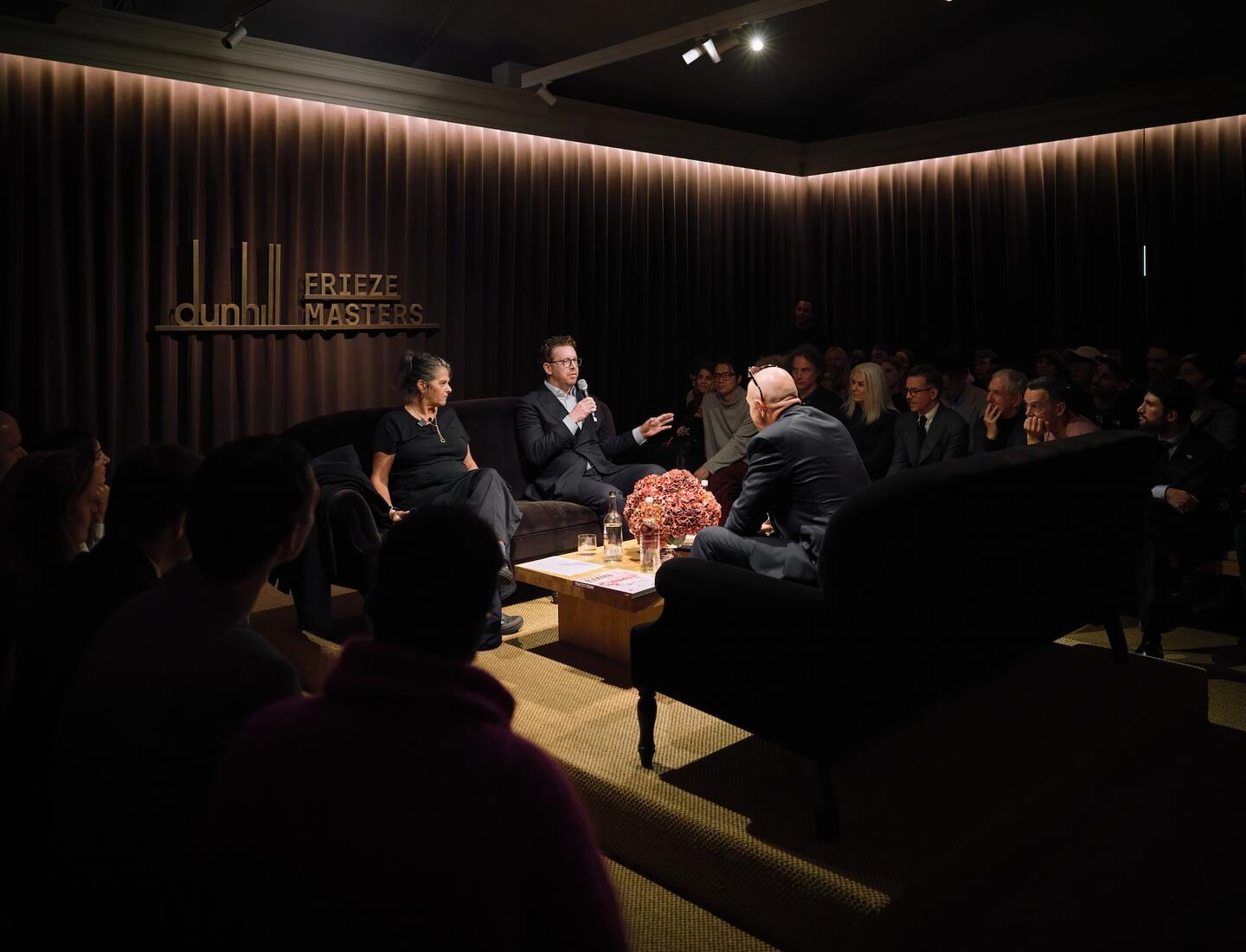
Frieze returns to Regent’s Park from 14–18 October. This year’s programme offers a rewarding route through contemporary painting, the politics of materials, domestic architecture and the changing interpretation of modern art.
Every October, Frieze concentrates a substantial part of the international art world into a few days in London. Galleries arrive with new work and carefully researched historical presentations; museums open exhibitions; the city acquires an unusually dense calendar of encounters. Frieze London and Frieze Masters, taking place together in Regent’s Park, provide the centre of that activity. Their proximity allows visitors to move between contemporary practice and objects with much longer histories, making connections that the divisions of a museum collection can sometimes discourage.
An art fair is also a commercial environment, and its priorities deserve scrutiny. Visibility, price and artistic significance have an imperfect relationship. Yet the announced programme for 2026 contains substantial reasons to visit: artists examining how value is assigned to people and materials, presentations reconsidering whose experiences belong in art history, and a section devoted to the home as a place of architectural experimentation. A selective visit should offer plenty to think about.
Contemporary art and the uses of history
Among the larger gallery presentations, Dalton Paula at Lisson is a compelling starting point. His new works draw on oral histories, biographies and visual records to restore visibility to Black historical figures from the sixteenth to the nineteenth centuries. At Fort Gansevoort, Haitian artist Myrlande Constant develops the drapo tradition of Vodou flags, bringing its spiritual and political histories into the fair. Both presentations invite attention to the means through which histories are preserved: the portrait, the archive, the ceremonial object and the labour involved in making them.
The new section The Code Universe, curated by Carol Yinghua Lu, director of Beijing’s Inside-Out Art Museum, considers the influence of mass culture on artistic production. Selma Selman, presented by acb Gallery, paints on discarded metal and recycled materials; Carolyn Lazard, with Trautwein Herleth, examines expectations of productivity and the social organisation of care and dependency. These are promising presentations to approach together. Materials acquire different values as they pass through economies of work, disposal and collection, while people are themselves assessed according to their capacity to produce. Within an art fair, where objects are assigned exceptional financial worth, this subject has a particular force. The setting becomes part of the discussion.
There is also good reason to spend time in Focus, the section dedicated to younger galleries, and Artist-to-Artist, whose seven solo presentations are nominated by established artists. Caroline Monnet, nominated by Jeffrey Gibson and presented by Blouin Division, works with construction membranes and other industrial materials, using weaving, embroidery and geometric pattern informed by Anishinaabe design. Her presentation offers a point of contact between contemporary art, architectural materials and inherited knowledge. The nomination structure is itself useful: it gives visitors an introduction through an artist’s judgement, adding another perspective to the choices made by galleries and collectors.
The interior as an artistic subject
For readers interested in interiors, Edel Assanti’s presentation merits particular attention. Marcin Dudek has devised an architectural environment that loosely reconstructs his childhood home on a Kraków housing estate. Visitors will enter a compressed domestic interior containing works by the gallery’s artists, arranged around ideas of home, belonging and place. The presentation suggests an unusually productive use of a fair booth. A room carries the memory of how people have lived within it: their proximity to one another, their possessions, their privacy and the limits imposed by its dimensions. Dudek’s installation gives those conditions a physical presence. His accompanying exhibition, PAWILON, opens at Edel Assanti’s Fitzrovia gallery on 16 October.
At Frieze Masters, Reflections returns under the direction of Abby Bangser, founder of Object & Thing. Its six presentations take inspiration from Casa Luis Barragán in Mexico City and The Cosmic House, the London home of Charles and Maggie Jencks. These houses give the section a precise architectural foundation, placing collected objects in relation to the ideas that shape a lived environment. Barragán’s engagement with Mexican vernacular architecture and Jencks’s postmodern thinking offer distinct approaches to colour, symbolism and the organisation of space.
Erskine, Hall & Coe will bring ceramic sculpture by artists including Ken Price and Elizabeth Fritsch; MASA Galería will present historical works by Mexican sculptor and feminist Ana Pellicer. Tristan Hoare’s presentation will include early works by Alev Ebüzziya Siesbye and Ptolemy Mann. This is a section to approach with the relationships between objects in mind. Scale, colour and placement affect how a work is understood, and a domestic collection develops through the accumulated decisions of its inhabitants.
Art history under reconsideration
Frieze Masters is particularly rewarding when its historical range allows familiar categories to be examined afresh. This year’s new curatorial thread, Queering Modernism: Visual Languages of the 20th Century, is conceived by Anke Kempkes and distributed across the fair. Its concern is the role of gender, sexuality and self-representation in shaping modern art. That approach should encourage visitors to consider the relationship between formal invention and the circumstances in which an artist could live, work and become visible.
Alberta Pane Gallery will bring Claude Cahun into dialogue with Judy Chicago, while Victoria Miro and David Zwirner share a presentation of Alice Neel. At Ab-Anbar, Bahman Mohasses’s work will be considered through postwar modernism, queer identity and exile. Seen together, these presentations should offer an account of modernity attentive to experience as well as style. The historical questions are substantial: who could represent themselves publicly, whose work was preserved, and how displacement or social exclusion affected what an artist made.
Spotlight, curated this year by Devika Singh and Sofia Gotti, provides another route through twentieth-century work. Alison Jacques will present Pacita Abad, including Social Realist paintings and her large trapunto work Angkor Wat (1998). The section’s attention to research, migration and material exchange is useful preparation for looking. It encourages an understanding of artistic developments through the movement of people, techniques and ideas across places. A fair can provide access to such work before it reaches a larger exhibition, allowing visitors to follow the process through which an artist’s history becomes more widely understood.
Sculpture in the park
Frieze Sculpture is already open in the English Gardens of Regent’s Park and continues until 1 November. Curated by Fatoş Üstek, the exhibition is free, requires no booking and includes work by eleven international artists. Among them are Angel Otero, Conrad Shawcross, Ivana Bašić and Tarini Sethi. Douglas White’s Black Palm, presented by Leila Heller Gallery, rises approximately seven metres and is constructed from reclaimed tyre rubber and steel. Its materials bring the residues of transport and industrial use into the park’s cultivated landscape.
The outdoor setting gives sculpture a changing context. Weather, light, surrounding vegetation and the movement of visitors all affect an encounter with the work. It also allows the exhibition to enter the routines of people who have come to the park for entirely different reasons. For a visitor planning several hours inside the fairs, the English Gardens are worth treating as a substantial part of the day, with time to walk between works and observe how each occupies its surroundings.
Three exhibitions to build a visit around
At the Courtauld, Salman Toor: Someone Like You runs from 2 October 2026 to 10 January 2027. It brings together nineteen paintings concerned with friendship, desire, solitude and belonging, alongside a separate display of drawings. Toor’s fictional scenes draw on the experiences of queer and immigrant lives, and his engagement with older painting makes the Courtauld a particularly apt setting. The Bar on East 13th (2019) revisits Manet’s A Bar at the Folies-Bergère, held in the museum’s collection. That relationship offers a specific way to consider how an inherited pictorial language can accommodate contemporary experience.
The Barbican’s Robert Ryman: The Real Thing, running from 8 October 2026 to 28 February 2027, brings together more than sixty works made between the mid-1950s and the early 2010s. Ryman’s sustained use of white paint directs attention to differences in surface, support, brushwork, fastening and light. His paintings make physical presence essential to understanding them. During a week in which visitors will encounter an enormous number of images, this exhibition offers a reason to spend longer with a smaller number of decisions: how paint is applied, where an edge falls, and how a work meets the wall.
At Tate Modern, Tarek Atoui’s new Hyundai Commission opens in the Turbine Hall on 13 October and continues until 11 April 2027. Atoui’s practice brings together composition, performance, research and the invention of instruments that are also sculptural objects. The commission offers an opportunity to experience an architectural space through sound. Alongside the fair’s paintings, objects and constructed interiors, it should make a useful addition to a week concerned with the different ways art organises our perception.
Planning a visit
Both fairs run from 14–18 October 2026, but Wednesday 14 October is invitation-only. Public admission begins at 1pm on Thursday 15 October; Frieze London closes at 5pm that day and Frieze Masters at 7pm. Both open from 11am–7pm on Friday and Saturday, and 11am–6pm on Sunday. Tickets are sold online for a specified date and time. General admission does not permit re-entry, and visitors using combined tickets must follow the order printed on them. Frieze London is in the south of Regent’s Park, while Frieze Masters is on Gloucester Green in the northeast; a complimentary shuttle connects them.
For a short London visit, a fair session, a walk through Frieze Sculpture and one museum exhibition would make a satisfying day. The programme is extensive enough to reward a clear choice of interests: painting, materials, domestic space or the rewriting of art history. Allowing time for a work to become interesting, and for one encounter to inform the next, will make the week more memorable than the number of stands visited.
Sources / Read More
- Frieze London and Frieze Masters: 2026 gallery highlights — www.frieze.com.
- Focus and Artist-to-Artist — www.frieze.com.
- The Code Universe — www.frieze.com.
- Reflections: architecture and design — www.frieze.com.
- Queering Modernism — www.frieze.com.
- Spotlight: interview with curators Devika Singh and Sofia Gotti — www.frieze.com.
- Marcin Dudek at Edel Assanti — www.edelassanti.com.
- Frieze Sculpture — www.frieze.com; Douglas White — www.leilahellergallery.com.
- Fair dates, opening hours and tickets — www.frieze.com.
- Salman Toor at the Courtauld — www.courtauld.ac.uk.
- Robert Ryman at the Barbican — www.barbican.org.uk.
- Tarek Atoui: Tate Modern commission announcement — www.hyundai.com.
Discover more from My World of Interiors
Subscribe to get the latest posts sent to your email.

