
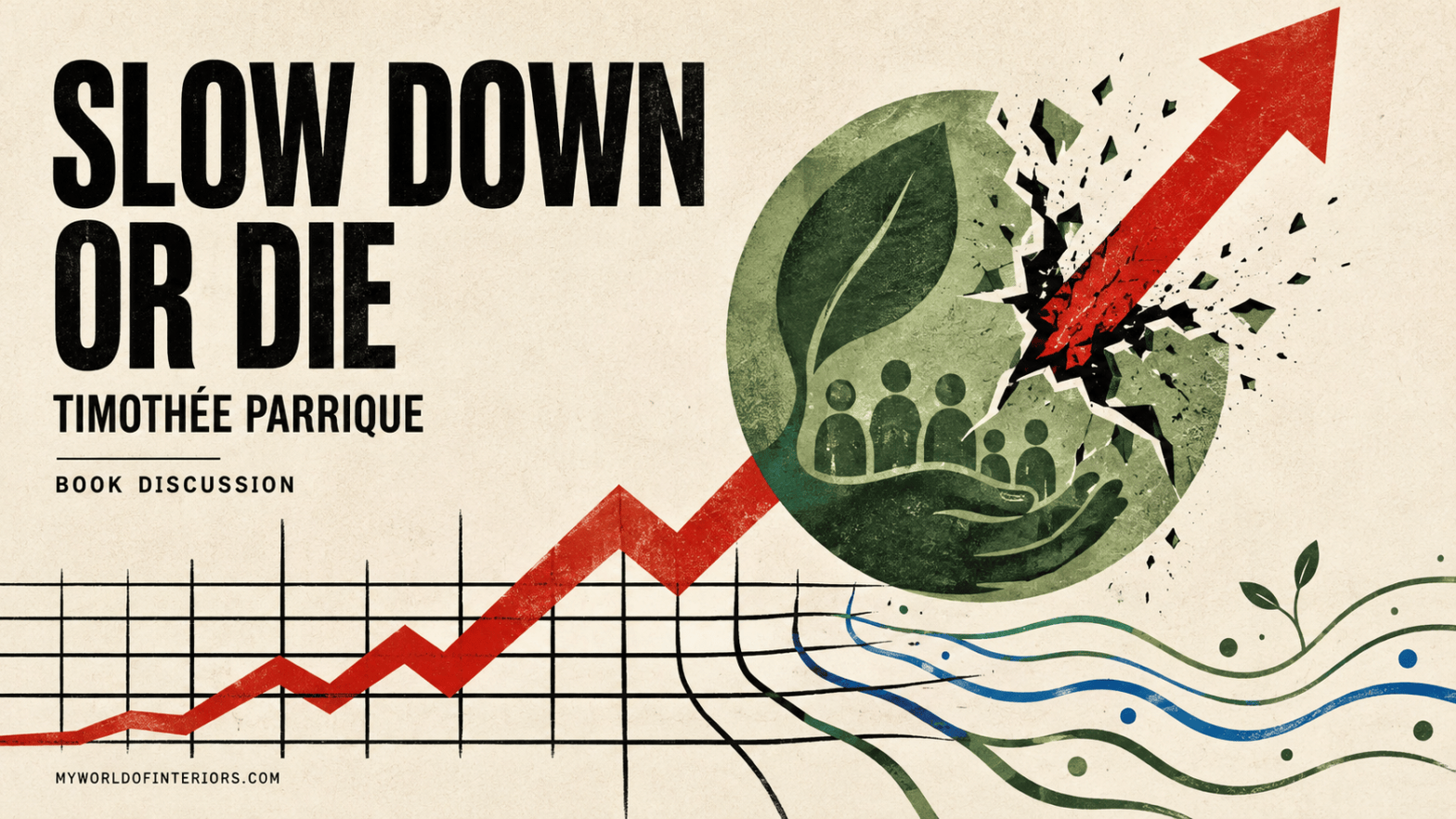
Ideas · Book Discussion
What If the Economy Were Made for Life?
Timothée Parrique’s Slow Down or Die asks us to abandon economic growth as civilisation’s governing purpose—and replace it with sufficiency, equality, care and democratic control.
By Bergotte
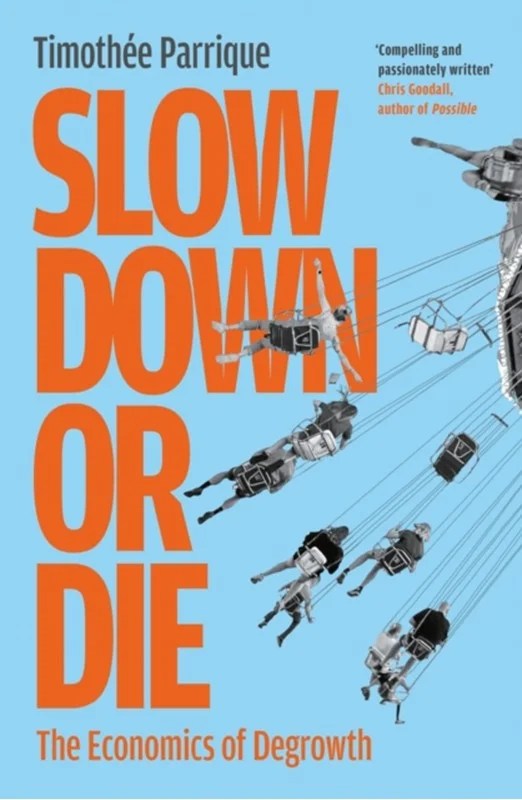
Slow Down or Die: The Economics of Degrowth by Timothée Parrique
Translated by Claire Benoit · Profile Books · 2025
We have been taught to hear the word “growth” as though it were synonymous with life itself. Governments promise it, corporations demand it, markets punish its absence and newspapers report its smallest fluctuations with the solemnity once reserved for harvests, wars and royal deaths. An economy that grows is said to be healthy; one that stops growing is said to be failing. The metaphor is so familiar that it has become almost impossible to see how strange it is.
A child must grow. A mature human being does not. A forest develops, renews and changes, but it cannot expand without limit across a finite landscape. In the body, growth that refuses every boundary is not vitality but disease. Why, then, should an economic system be exempt from the limits that govern every living system upon which it depends?
This is the unsettling question at the centre of Timothée Parrique’s Slow Down or Die. The book is not an invitation to embrace poverty, technological primitivism or joyless self-denial. Nor is it a proposal to place an economy into recession and allow unemployment, debt and insecurity to punish those with the least power. It is a systematic argument that the richest economies must deliberately reduce their use of energy and materials, abandon socially useless and ecologically destructive production, and reorganise economic life around human needs rather than the accumulation of capital.
Parrique’s subject is degrowth, but his deeper subject is emancipation. What would become possible if a society no longer treated the endless multiplication of commodities as its highest achievement? Could productivity give us time rather than simply more products? Could technological progress reduce labour rather than eliminate livelihoods? Could housing, health, education, energy and transport be secured as social rights rather than sold as opportunities for profit? Could we learn to distinguish wealth from possession, comfort from excess and a genuinely rich life from an expensive one?
These are economic questions, but they are also moral and political ones. They concern who works, who owns, who decides, who enjoys abundance and who is required to endure the damage that abundance creates. Parrique’s achievement is to make clear that ecological breakdown cannot be separated from class power, colonial extraction, patriarchal ideas of work or the extraordinary political influence of those who profit from destruction. The climate crisis is not the accidental side effect of an otherwise rational system. It is the predictable consequence of making expansion compulsory on a finite planet.
Degrowth Is Not a Recession
The most important distinction in the book is also the one most frequently distorted. Degrowth does not mean taking the present economy and making it smaller by accident. That is recession: an uncontrolled contraction within institutions that require perpetual expansion. When production falls in a growth-dependent economy, workers lose jobs, public revenues decline, businesses fail and debts become harder to repay. The pain travels downward, while wealth and power are often consolidated at the top.
Degrowth means changing those institutions so that the economy can use less energy and fewer materials without sacrificing human wellbeing. It is a planned and democratic transition, not an economic car crash. It reduces what is harmful or unnecessary while protecting—and often expanding—what people need in order to live well.
That selectivity is essential. Fossil-fuel extraction, private aviation, oversized vehicles, fast fashion, planned obsolescence, manipulative advertising and the continual production of disposable goods must contract. Renewable energy, home insulation, public transport, ecological agriculture, education, healthcare, disability support, childcare, elder care, repair, culture and the arts may need to expand. The issue is not whether every numerical measure must move downward. The issue is whether society can place material limits on private accumulation while creating a far greater abundance of public goods, free time and collective security.
Degrowth is not less life. It is less waste, less domination and less compulsory labour in order to make room for more life.
This is why the slogan “consume less” is inadequate. A tenant in a cold flat, a disabled person waiting for care and a family dependent on a food bank do not need lectures in personal austerity. They need more access to the necessities of life. Degrowth begins not with the deprivation of ordinary people but with the excesses of the wealthy, the industries that manufacture artificial demand and the economic structures that turn sufficiency into insecurity.
GDP and the Moral Illiteracy of the Market
Parrique begins by dismantling the authority of gross domestic product. GDP records the monetary value of goods and services exchanged within an economy. It does not tell us whether those exchanges improve life. Pollution can increase GDP when money is spent cleaning it up. Illness can generate profitable treatment. A long commute, a rent increase or the replacement of a deliberately short-lived appliance may all appear as economic activity. Meanwhile, a stable climate, clean air, friendship, leisure, mutual aid and much of the labour required to sustain human life remain invisible because they have no market price.
This blindness is not gender-neutral. Women still perform a disproportionate share of unpaid childcare, domestic work and care for elderly or ill relatives. Conventional economics benefits from this labour while treating it as though it scarcely exists. The formal economy could not function without the daily work of feeding, cleaning, comforting, teaching and maintaining human beings, yet the work is routinely excluded from the principal measure by which national “success” is judged.
A humanist economics must therefore begin before the market begins. The economy is not simply the place where things are bought and sold; it is the way a society organises the satisfaction of human needs. Markets can be useful instruments within that organisation, but they cannot be allowed to determine its purpose. A market registers effective demand—the wants of those who possess money—not human need. It can produce a luxury apartment for an investor while leaving a nurse homeless, or devote brilliant engineering to advertising algorithms while a public health system deteriorates.
Parrique asks us to replace purchasing power with something closer to living power: the real capacity to be nourished, housed, cared for, educated, mobile, creative, politically heard and free to use one’s finite time. This echoes the human-development tradition in which prosperity is measured by people’s capabilities, not merely by the quantity of commodities passing through the market.
Once that shift is made, the supposed neutrality of GDP disappears. Choosing GDP growth as the overriding objective means choosing to reward whatever can be monetised, whether or not it is socially valuable. It also means placing nature, care and democratic life beneath an accounting system designed to measure transactions rather than flourishing.
The Ecological Case: Efficiency Cannot Defeat Infinity
The conventional answer to ecological crisis is “green growth”: continue expanding the economy while new technologies steadily reduce its environmental effects. Renewable energy, electrification, recycling and greater efficiency are indispensable. But Parrique argues that they cannot bear the impossible burden placed upon them.
Some countries have reduced territorial carbon emissions while their economies have grown. Yet carbon is only one dimension of ecological damage, and territorial statistics can hide the energy, materials and pollution embodied in imported goods. A credible account must consider the total consumption footprint: extraction, shipping, land use, water, biodiversity loss, toxic chemicals and the waste produced across global supply chains.
There is also the rebound effect. When an activity becomes more efficient and therefore cheaper, the savings are often used to consume more of it—or to consume something else. Cars use fuel more efficiently, but become larger and are driven further. Digital devices become more powerful, but proliferate through homes, offices and data centres. Efficiency reduces the resources required for each unit while growth increases the number of units. The ecological gain is swallowed by the expanding scale of production.
The burden of proof matters here. Humanity is being asked to gamble a habitable future on the hope that global GDP can grow indefinitely while every major environmental pressure falls quickly enough to remain within planetary limits. Parrique’s argument is precautionary and rational: use every available green technology, but also reduce the total quantity of energy and materials demanded by affluent economies. A smaller throughput makes decarbonisation faster, less mineral-intensive and more credible.
This is not a war against innovation. It is a refusal to allow innovation to serve as an alibi for delay. Technology must be judged by what it enables human beings and ecosystems to become—not by whether it opens another frontier for accumulation.
The Class Politics of “Enough”
Calls for restraint are rightly distrusted when they come from people who will never experience it. For decades, governments have demanded sacrifice from workers while protecting concentrated wealth. Austerity closed libraries, reduced care, restrained wages and degraded public services, even as private fortunes expanded. Any ecological politics that repeats this pattern will be both unjust and politically doomed.
Degrowth must therefore be radically unequal in its application. Those who consume the least cannot be asked to surrender necessities so that the affluent may preserve luxuries. Private jets, frequent long-distance flights, superyachts, multiple oversized homes and investment-driven consumption are not morally equivalent to heating a flat or travelling to work. The richest people are responsible for a vastly disproportionate share of emissions and possess the greatest capacity to change. The transition must begin with them.
This exposes the real conflict hidden by the language of a universal “human footprint.” Humanity as a species did not collectively choose fossil capitalism, design planned obsolescence or decide that shareholders should command production. Specific institutions and classes acquired the power to make those choices, and specific populations have benefited far more than others. Those who have contributed least to ecological breakdown—poor communities, Indigenous peoples and much of the Global South—are frequently those exposed first to heat, flood, hunger, displacement and conflict.
A democratic-socialist degrowth politics would combine ecological ceilings with social foundations. It would guarantee universal access to the essentials of a dignified life while limiting extreme wealth, inheritance and resource use. It would strengthen trade unions, shorten the working week, tax wealth and pollution progressively, expand public ownership and remove essential goods from speculative markets. It would replace the private abundance of the few and public deprivation of the many with public abundance and private sufficiency.
Time, Work and the Freedom to Live
One of the most humane implications of degrowth concerns time. Under capitalism, improvements in productivity rarely become a shared freedom from labour. Instead, they create more output, greater profits, competitive pressure and, increasingly, anxiety about technological unemployment. Society celebrates labour-saving machines while organising life so that losing paid work may also mean losing housing, healthcare, status and the means to eat.
Parrique invites us to consider a different choice. If a durable phone needs to be replaced half as often, the same workforce need not be divided between the securely employed and the discarded. The available work can be shared through shorter hours. Productivity can be converted into time rather than surplus production.
This is not a minor lifestyle benefit. Time is the substance of a human life. Time permits care, friendship, participation in democracy, study, music, love, rest and the unhurried attention through which the world becomes meaningful. An economy that saves labour but denies people leisure has misunderstood both freedom and progress.
Shorter working hours would also challenge the gendered organisation of care—but only if they were combined with universal public services and an equal redistribution of domestic labour. Degrowth must not romanticise unpaid care or quietly return women to the home. Care work should be recognised, properly paid where appropriate, publicly supported and shared across gender and society. The liberation of time must belong to everyone.
Why Capitalism Cannot Simply Be Asked to Behave
Parrique’s analysis is unavoidably anti-capitalist because capitalism is not merely a collection of greedy personalities. It is a system in which firms must compete, investors demand returns, debts carry interest and economic survival depends upon successful accumulation. Individual executives may be restrained or generous, but the institution rewards expansion. A company that voluntarily produces less while its competitors grow is likely to disappear or be absorbed.
This does not make personal greed irrelevant. On the contrary, contemporary capitalism elevates greed into a civic virtue, protects it with law and gives those who accumulate the most the greatest power to shape the rules. But moral condemnation alone cannot disarm a structure that makes avarice rational and restraint costly. The task is to change ownership, incentives and decision-making power.
A post-growth society would therefore require more than carbon taxes and conscientious consumers. It would need institutions capable of functioning without perpetual expansion: cooperatives, commons, strong public services, democratic planning, social guarantees, alternative forms of ownership and finance, and enterprises whose purpose is to meet needs rather than maximise returns. Essential sectors would be protected from the volatility of markets. Workers and communities would gain a meaningful say in what is produced, how it is produced and for whose benefit.
This is the democratic heart of the argument. If production determines the material conditions of collective life, decisions about production are too important to be left to owners and financial markets. Economic democracy is not an optional ideal attached to ecological policy. It is how a transition can be made legitimate, intelligent and just.
Global Justice and the Right to Develop
Degrowth is principally a demand upon rich economies that have already exceeded a fair share of the planet’s ecological capacity. It cannot mean freezing global inequality in place or denying poorer societies the hospitals, sanitation, homes, energy systems and infrastructure their people need. In many places, material production must increase if basic rights are to be realised.
The contraction of affluent economies can create ecological space for that necessary development. It can also reduce the pressure for extractive projects imposed upon poorer countries to supply wealthy consumers with fuel, minerals, feed, timber and cheap manufactured goods. Yet contraction alone is not enough. A just transition requires debt relief, fairer trade, technology sharing, climate finance and the restoration of political sovereignty to communities treated as sacrifice zones by the global economy.
There is a profound historical obligation here. Industrial wealth was accumulated through colonial conquest, enslaved labour, appropriated land and the disproportionate use of the atmosphere as a dumping ground. Ecological justice cannot be reduced to asking the world’s poor to follow a cleaner version of a path whose benefits the rich have already captured. Degrowth in the Global North must be reparative: a relinquishing of excessive claims upon the world, not a new method of controlling it.
The Political Difficulty—and Necessity—of Degrowth
Growth has long functioned as a substitute for redistribution. Political leaders promise that if the economic pie becomes larger, everyone can receive more without anyone powerful being required to surrender anything. In practice, much of the increase is captured at the top, but the promise permits the question of ownership to be postponed.
A post-growth politics removes that evasion. If the total use of energy and materials must fall, distribution becomes unavoidable. Whose consumption is necessary? Whose is excessive? Which industries serve life, and which exist primarily to generate returns? Who owns the productive system, and who bears the cost of changing it?
These decisions cannot be handed to technocrats, billionaires or an authoritarian state. Ecological emergency may make planning necessary, but emergency does not suspend democracy; it makes democracy more important. Without popular power, rationing will protect privilege, surveillance will replace consent and sacrifice will once again be imposed upon those least able to resist.
Parrique’s framework is persuasive precisely because it defines degrowth through democracy, justice and wellbeing. A contraction that impoverishes workers, excludes the public or strengthens oligarchy is not degrowth in the meaningful sense. It is collapse, austerity or eco-authoritarianism. The transition must be designed with organised labour, feminist movements, climate movements, Indigenous communities, public institutions and those whose lives are most vulnerable to both ecological damage and economic disruption.
Questions the Book Leaves With Us
Slow Down or Die offers a direction rather than a simple administrative programme. That is intellectually honest: no society has yet completed a democratic transition from growth dependence to material sufficiency. Difficult questions remain about pensions and public revenue, sovereign and private debt, international trade, the sequencing of industrial contraction and the political coalition capable of defeating entrenched wealth.
There are democratic dangers too. Who defines a “need”? How can planning remain responsive rather than paternalistic? How can local deliberation coexist with the speed and coordination demanded by global ecological crisis? How can necessary technologies be expanded while mining, energy use and supply chains are rapidly reduced? The answers cannot be supplied by economic theory alone.
But uncertainty is not an argument for preserving a system whose consequences are already visible. Every political economy is experimental; the present one is conducting its experiment upon the atmosphere, oceans and living world. The relevant comparison is not between an imperfect degrowth transition and a stable status quo. It is between democratic transformation and deepening ecological instability managed by increasingly unequal and authoritarian societies.
The word “degrowth” may remain politically difficult. It sounds negative because growth has monopolised the language of hope. Yet its provocation is useful. It prevents governments from repackaging marginal efficiency gains as transformation, and it forces the question that polite environmentalism avoids: can the richest societies continue to demand ever more without making a liveable world impossible?
Eight Chapters: The Essential Takeaways
Chapter 1 — The Secret Life of GDP: Between Phenomenon and Ideology
The argument: GDP is a measure of monetised activity, not a measure of human or ecological wellbeing. It confuses price with value, counts many forms of damage as productive activity and excludes much of what sustains life.
The social significance: What disappears from GDP is politically revealing: unpaid care, domestic work, mutual aid, healthy ecosystems, leisure and social connection. Much of this invisible labour is performed by women. A society governed by GDP subordinates life to whatever can be bought and sold.
What we must recognise now: Economic policy needs a different compass—health, equality, housing, ecological stability, democratic participation, free time and the real capabilities people possess. The economy is a means by which life is supported, not an end before which life must be sacrificed.
Chapter 2 — The Impossible Decoupling: The Ecological Limits to Growth
The argument: Efficiency and cleaner technologies have not demonstrated that limitless global economic growth can be separated, at the required speed and scale, from carbon emissions, extraction, land use, biodiversity destruction and waste. Relative improvement is not enough if the total burden continues to grow.
The social significance: Faith in future decoupling transfers present danger onto people who contributed least to the crisis and onto generations who cannot consent. It allows affluent societies to keep their privileges while describing technological optimism as realism.
What we must do now: Deploy renewable energy and efficient technologies while deliberately reducing the material and energy demands of rich economies. End fossil expansion, luxury emissions and planned obsolescence. The scale of the economy must be brought within ecological limits; technology cannot repeal those limits.
Chapter 3 — Market Versus Society: The Social Limits to Growth
The argument: Beyond a certain point, more production does not reliably produce more wellbeing. Inequality, insecurity, advertising and status competition can ensure that rising wealth generates new anxieties and artificial wants rather than freedom.
The social significance: Markets distribute goods according to purchasing power, not need. They are incapable of deciding what a society owes every person. When care, housing and health are commodities, those without money are treated as though their needs matter less.
What we must do now: Decommodify the foundations of life. Universal basic services, secure housing, accessible transport, public healthcare, education, care and shorter working hours can improve everyday life while requiring less private consumption. Collective provision is both more equal and often more ecologically efficient.
Chapter 4 — False Promises: The Political Limits to Growth
The argument: Growth is presented as the universal remedy for unemployment, poverty, inequality, public debt and political conflict. Yet its benefits depend entirely upon institutions and distribution. An economy can grow while wages stagnate, services decay and wealth concentrates.
The social significance: The promise of future growth defers justice in the present. Workers are told not to challenge ownership because tomorrow’s larger economy will benefit everyone. This political bargain has protected the wealthy far more reliably than it has protected the poor.
What we must do now: Make security independent of growth through job guarantees, shorter hours, strong trade unions, progressive taxation, wealth limits, universal services and reformed systems of debt and public finance. Poverty is not a shortage of aggregate wealth in rich societies; it is a failure of distribution and power.
Chapter 5 — A Brief History of Degrowth: From Objection to Growth to Post-Growth
The argument: Degrowth is not an isolated slogan but the convergence of ecological economics, anti-capitalist thought, feminist analysis, post-colonial critique and traditions of conviviality and voluntary simplicity. It moves from objecting to growth towards imagining institutions that no longer need it.
The social significance: This history matters because it shows that degrowth is about relations between people as much as quantities of resources. It asks who controls work, technology, property and time. Ecofeminist thought is especially important because it reveals how both nature and care have been treated as endlessly available resources.
What we must recognise now: Degrowth means a democratically planned and equitable reduction of ecological pressure in wealthy economies, with wellbeing secured for all. It is not recession, austerity, universal poverty or a romantic return to the past.
Chapter 6 — A Transition Pathway: Degrowing the Economy
The argument: The transition must be selective. Harmful and unnecessary sectors contract; socially necessary and ecologically restorative sectors expand. The objective is not indiscriminate economic decline but a deliberate reduction in total material throughput.
The social significance: Workers cannot be made expendable because the industries employing them must change. A just transition guarantees income, retraining, democratic participation and new work in care, restoration and public infrastructure. Ecological policy without class justice will produce resistance for good reason.
What we must do now: Phase down fossil fuels, wasteful luxury, disposable production and advertising while building public transport, renewable energy, repair systems, insulated housing, healthcare, care work, education and culture. Share necessary labour through a shorter working week and begin with the consumption of the richest.
Chapter 7 — A Societal Project: Toward a Post-Growth Economy
The argument: Degrowth is the transition; a post-growth economy is the destination. That society would maintain a stable level of resource use within ecological boundaries while pursuing qualitative development in knowledge, health, relationships, art, democracy and care.
The social significance: Prosperity is redefined as the power to live well rather than the power to purchase endlessly. Commons, cooperatives, public services and democratic enterprises loosen the control of profit over the necessities of life.
What we must build now: Institutions that can flourish without expansion: universal social guarantees, economic democracy, public and cooperative ownership, limits on extreme wealth, robust common goods and measures of success grounded in human capability and ecological health.
Chapter 8 — Controversies: Twelve Critiques of Degrowth
The argument: Objections concerning jobs, innovation, public finance, democracy, poverty and the Global South often rely upon confusing degrowth with recession or assuming that present institutions can never change. Parrique treats these objections as serious political problems rather than dismissing them.
The social significance: The safeguards are part of the definition. If contraction is imposed from above, deepens poverty, removes rights or protects elite consumption, it is not a just degrowth transition. Democracy and equality are not benefits to be added later; they are the conditions of legitimacy.
What we must confront now: The greatest obstacle is not a lack of policy ideas but concentrated power. Fossil corporations, financial interests and wealthy owners benefit from the present order and possess enormous influence over states and media. Ecological transition therefore requires organised democratic power capable of overcoming oligarchic resistance.
Conclusion: Slowing Down Is a Decision to Live
Slow Down or Die asks us to surrender a superstition: that an economy must expand forever in order for human beings to flourish. What must end is not aspiration, invention, comfort or joy. It is the belief that every increase in extraction and consumption represents progress, regardless of what is produced, who receives it or what is destroyed.
For most people, the promise of degrowth is not a smaller life. It is freedom from insecurity manufactured in the midst of abundance: freedom from rents that devour wages, from jobs that consume our waking hours, from advertisements engineered to make contentment impossible, and from public services starved so that private wealth may grow.
The book’s deepest proposition is beautifully simple. We can produce less because we can share more. We can work less because productivity should liberate time. We can own fewer disposable objects because durable goods and excellent public services can provide greater security. We can abandon the fantasy of mastery over nature because dependence upon the living world is not a humiliation; it is the condition of our existence.
The choice is not between growth and stagnation. It is between an economy organised around accumulation and a society organised around life. The opposite of endless growth is not death. In a civilisation that has confused accumulation with vitality, the refusal to grow without limit may be the most life-affirming decision available to us.
Further reading: Profile Books: Slow Down or Die · Timothée Parrique: clarifications on degrowth
Discover more from My World of Interiors
Subscribe to get the latest posts sent to your email.

