
The Passenger is a weekly dispatch on travel — places, hotels, restaurants, the strange logistics of being elsewhere.
See Something
Irving Penn is everywhere in 2026. Three cities, three exhibitions, and the case for making a trip specifically to see him
Irving Penn directed his models with two words. Not an expression — he was not interested in expressions. He wanted a presence, something interior and irreducible that the camera could locate if given time and silence and the right quality of northern light. “See something,” he would say, with a small gesture of the hand that the hair artist Julien d’Ys, who worked with Penn for many years, described as resembling a benediction. Then he would watch the model, sometimes for a very long time, before he raised the camera. Some sessions ended without a single photograph. Penn would look at the model, the whole team holding its collective breath, and say simply: “Je ne vois rien.” He did not photograph things because they were pretty. He photographed what he could see.
What he saw, across a career at Vogue that spanned sixty years — from his first cover in 1943 to his last work in the 2000s — has been reassembled this year in three significant exhibitions across Europe, each one approaching Penn from a different angle and each one worth travelling to see. The largest and most important opens in Paris in September. A smaller, more focused exhibition ran in London through June. The Centro della Fotografia in Rome has been showing masterworks from the Maison Européenne de la Photographie’s collection since January. Taken together, they constitute one of the richest years for Penn since the centenary retrospective at the Grand Palais and the Metropolitan Museum in 2017.
This is not an art piece. The art is the subject of a separate column. This is a travel piece — about the specific and entirely justifiable decision to build a trip around a great exhibition, and about what Paris, London, and Rome offer the visitor who arrives with Penn in mind and stays for everything else.
Paris: Penn & Fashion, Maison Européenne de la Photographie
30 September 2026 — 17 January 2027
The Maison Européenne de la Photographie is the institution whose relationship with Penn runs deepest. The MEP has been collecting his work since the 1980s, when its founder Jean-Luc Monterosso first acquired photographs that the major European museums were still regarding with the condescension that institutions tend to reserve for things they have not yet decided are serious. Pascal Hoël, the exhibition’s curator, notes that the MEP “considered early on that he had made commissioned photography a genuine auteur work” — at a moment when that argument required making, and the making of it required courage.
Penn & Fashion is the culmination of that relationship: a chronological survey of Penn’s fashion work from 1947 to 2008, drawn primarily from the MEP’s own holdings and from the exceptional private collection of Nicola Erni, the Swiss collector whose holdings in fashion photography constitute one of the most significant in private hands anywhere. The Erni loans are the revelation of the exhibition — photographs that have rarely been seen outside Condé Nast’s archive, including images of Balenciaga and Dior from the 1950s made with the Leica that Penn carried through the Paris ateliers and that carry the specific quality of his earliest major work: the grey backdrop, the frontal light, the model as architecture.
The exhibition also benefits from loans from the Irving Penn Foundation and the Miyake Issey Foundation — the latter reflecting one of the great artistic collaborations of the twentieth century. Penn was, as the Vogue Paris article that has been much discussed since the exhibition’s opening describes it, fascinated by Miyake’s architectural clothing from the moment he first encountered it. For thirteen years, Miyake sent his collections directly to Penn’s Manhattan studio rather than presenting them in Paris. The photographs returned to Japan, where the designer Ikkō Tanaka made them into posters of their own. “Miyake said he rediscovered his own work through Penn’s images,” Hoël has noted. The Miyake section of Penn & Fashion is the most historically significant part of an exhibition full of historically significant material.
The MEP itself sits in the Marais, in the 4th arrondissement — a neighbourhood that rewards walking in every direction. The building is a converted 18th-century hôtel particulier whose courtyards and exhibition spaces handle Penn’s large platinum palladium prints with the intelligence of a space that has been thinking about photography seriously for forty years. All the photographs in the exhibition were printed by Penn himself — a fact the curator emphasises because it is what separates these from reproductions. The depth of the blacks, the subtlety of the greys, the extraordinary rendering of surface and material: these are qualities that belong to the physical object and cannot be adequately understood on a screen.
The season at the MEP continues alongside Penn in the Studio spaces with pays des merveilles by Nanténé Traoré — her first museum exhibition, built from expired film — and David Gilbert’s Apparitions, fragile paper-and-light constructions that feel, in their quiet way, like Penn’s inheritors. Both are worth the time.
Maison Européenne de la Photographie — 5-7 rue de Fourcy, 75004 Paris. Wednesday and Friday 11am–8pm; Thursday until 10pm; Saturday and Sunday 10am–8pm. Closed Monday and Tuesday. Admission €13, reduced €8.
http://www.mep-fr.org
Staying in Paris for Penn: The Marais neighbourhood means the hotel choice is straightforward. The Hôtel du Petit Moulin, designed by Christian Lacroix in a 17th-century bakery on the rue du Poitou, puts you ten minutes from the MEP on foot and deep in the neighbourhood that Penn himself came to understand in the 1950 Paris trip that crystallised his entire visual language. The Hôtel Lacroix connection is appropriate: Penn photographed Lacroix’s work for Vogue, and the designer’s sensibility — the layering of colour and period and reference — is as present in the hotel’s interior as in the couture Penn placed against his grey backdrops.
http://www.hoteldupetitmoulin.com
After the exhibition: Walk north from the MEP to the Place des Vosges, which is ten minutes and is the most beautiful square in Paris. Then into the Marais proper — the galleries on the rue de Bretagne, the covered market at the Marché des Enfants Rouges (open Tuesday through Sunday, the oldest covered market in the city), and the cafés that concentrate around the rue de Bretagne and the rue de Turenne in the late afternoon. Penn’s Paris of 1950 — the Paris where he found the theatre curtain that became his backdrop, photographed Balenciaga and Dior and Jacques Fath, encountered the artisans that became his Petits Métiers series — is overlaid on this neighbourhood in a way that makes walking through it with his images in mind a specific and rewarding kind of time travel.
London: Up Close, Hamiltons Gallery
1 May — 30 June 2026 (now closed, but Hamiltons’ Penn holdings are available year-round by appointment)
Hamiltons Gallery in Mayfair has been Penn’s London home since the 1970s — the gallery that has shown his work more consistently and with more intelligence than any other commercial space in Britain. The Up Close exhibition that ran through June was timed to coincide with Photo London at Kensington Olympia, and its curatorial proposition — examining proximity, the charged space between lens and subject — produced one of the year’s more precisely conceived Penn presentations. The highlight: a platinum palladium print of Penn’s Cottage Tulip, one of only two flower images Penn ever produced in the process, with the velvety tonal depth that the platinum palladium technique produces and that no reproduction — including this one — can adequately convey.
The exhibition is closed, but Hamiltons is the address to know for Penn in London: the gallery holds significant stock of his work, the staff understand it with the intelligence of people who have been living with it for decades, and the experience of viewing photographs in a space of this scale and seriousness — the gallery on Carlos Place in Mayfair handles Penn’s prints as though they are what they are, which is among the finest photographs ever made — is worth a visit in any season.
http://www.hamiltonsgallery.com
Photo London — which Penn’s work appeared within through the Hamiltons presentation — has moved to its new permanent home at Kensington Olympia. For those planning a London visit around photography: Photo London 2027 will take place in May, and Hamiltons will present again.
http://www.photolondon.org
While in London for Penn: The National Portrait Gallery, fifteen minutes from Hamiltons by foot, holds Penn portraits in its permanent collection — the series of photographs of artists and writers that he made for Vogue in the 1940s and 1950s, the same period when the NPG’s own portraiture archive was being built. The V&A, twenty minutes by tube, holds fashion photographs in its collection and its archive that touch Penn’s work directly — the couture he photographed is often the same couture that the V&A acquired in the same period.
Rome: Irving Penn Photographs 1939–2007, Centro della Fotografia
30 January — 29 June 2026 (now closed)
The Rome exhibition — masterworks from the MEP collection, presented at the Centro della Fotografia — has closed, but it established something worth noting: that the appetite for Penn outside the traditional photography capitals is serious and growing. The Centro della Fotografia, which opened in Rome in 2022 as a dedicated photography museum, has been building a programme of historical and contemporary photography that positions Rome as a serious destination for the medium — a city whose relationship with the image is ancient and specific and whose institutions have been slow to acknowledge photography as deserving of the same attention as painting and sculpture.
For the visitor arriving in Rome now: the Centro della Fotografia is worth knowing regardless of what is currently on its walls.
http://www.centrodellafotografia.roma.it
What Penn asks of the traveller
There is a specific argument for travelling to see Penn rather than looking at reproductions, and it is the argument that Penn himself made in every decision about his printing process. He was dissatisfied with the quality of reproductions from the beginning of his career — the gap between the photograph he had made and the version of it that appeared on the printed page was, for him, an ongoing grievance that drove him to take control of every aspect of the printing process himself. He perfected the platinum palladium technique over decades, producing prints of a tonal depth and surface quality that are categorically different from silver gelatin prints of the same images. At the end of his life, he destroyed the photographs he considered unworthy of surviving him. What remains was made to be seen in the room, in the correct light, at the correct distance.
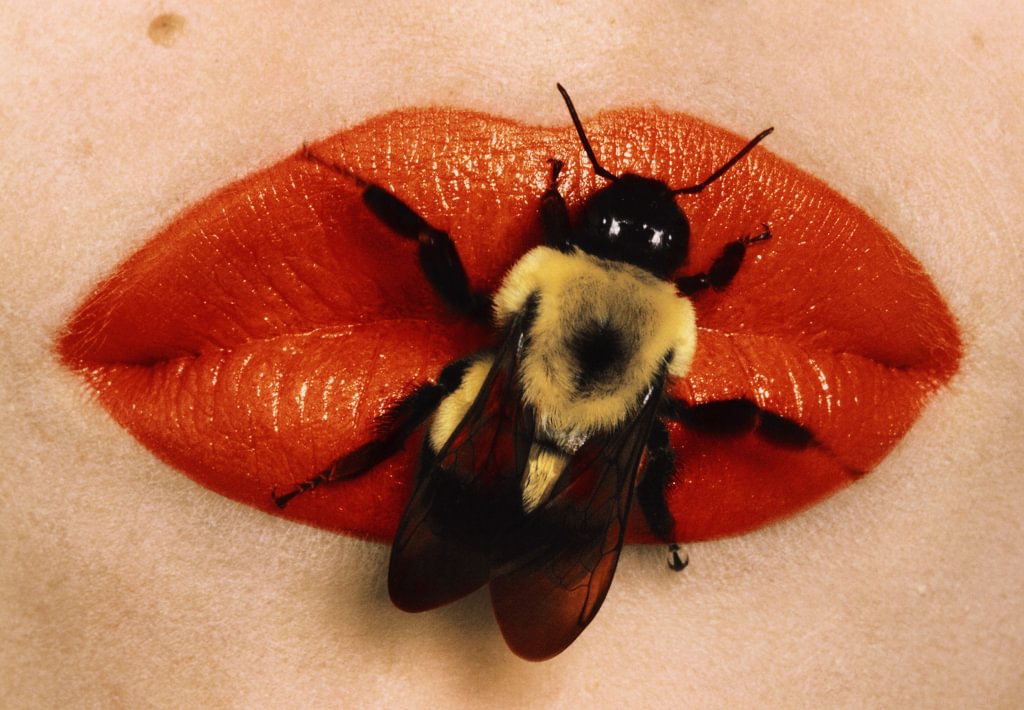
The Vogue Paris essay on Penn & Fashion opens with a description of his beauty pages — a model smoking a cigarette, a bloodshot eye rimmed in mascara, a bumblebee on a scarlet mouth — and notes that photographs made more than half a century ago seem to belong to the present moment. This is what the platinum palladium process does: it preserves. The depth of the blacks does not fade. The surface does not deteriorate. The prints at the MEP this autumn will look, in fifty years, exactly as they look today. Penn understood this, which is why he made them.
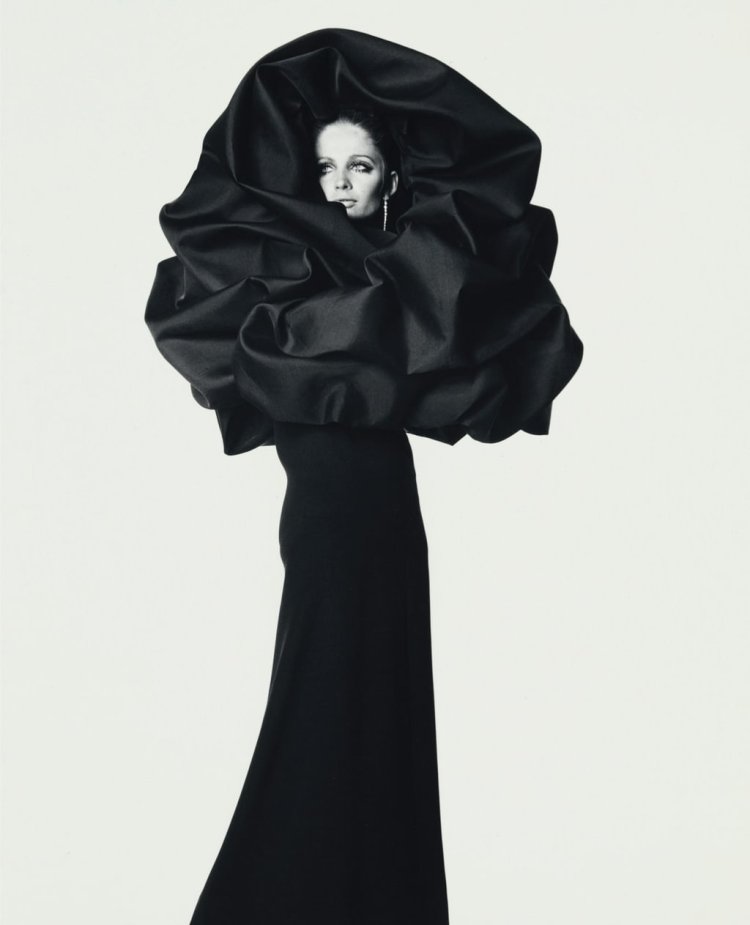
What the room also provides, beyond the physical object, is the scale. Penn’s prints are often large — not the monumental scale of contemporary photography but the specific scale of a photograph that has been made to be stood in front of rather than looked at from across a gallery. At the correct distance, the Balenciaga Rose Dress of 1967 — one of the Nicola Erni loans in the MEP exhibition — resolves in a way that no reproduction prepares you for. The black of the background, the sculpted form of the dress, the model’s absolute stillness: Penn was not photographing a dress. He was making a painting with a camera, and he knew the difference, and the difference is visible in the room in a way that it is not visible anywhere else.
The essentials
Penn & Fashion
Maison Européenne de la Photographie, 5-7 rue de Fourcy, 75004 Paris
30 September 2026 — 17 January 2027
Wed, Fri 11am–8pm; Thu until 10pm; Sat, Sun 10am–8pm. Closed Mon, Tue.
Admission €13, reduced €8.
http://www.mep-fr.org/en/event/penn-fashion-2
Hamiltons Gallery, London
13 Carlos Place, Mayfair, London W1K 2EU
Mon–Fri 10am–6pm. Admission free.
Penn works available year-round; consult the gallery for current and upcoming exhibitions.
http://www.hamiltonsgallery.com
Centro della Fotografia, Rome
http://www.centrodellafotografia.roma.it
The Irving Penn Foundation — for the full exhibition history and current loan exhibitions:
http://www.irvingpenn.org
The Passenger publishes every Friday.
Discover more from My World of Interiors
Subscribe to get the latest posts sent to your email.

