
Book Review
They Told Us What They Wanted
Gil Durán exposes a Silicon Valley oligarchy that does not merely want to govern without us, but has begun to imagine most human beings as obstacles, dependants or waste
By Bergotte
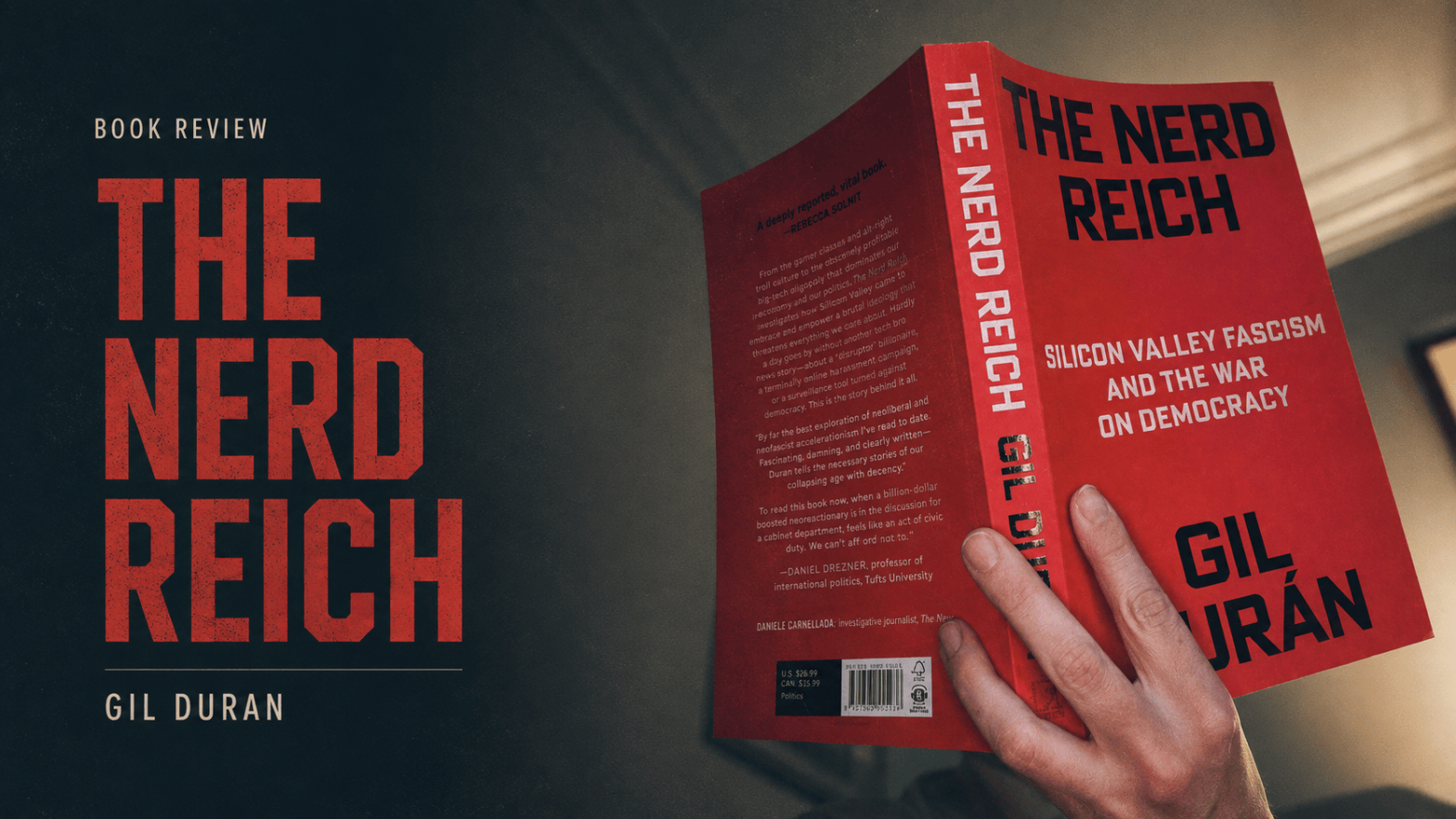
Gil Durán, The Nerd Reich: Silicon Valley Fascism and the War on Democracy
Avid Reader Press / Simon & Schuster · 352 pages · 2026
Rating: ★★★★★
Synopsis
Part intellectual history, part political investigation and part warning, The Nerd Reich traces the anti-democratic ideas now circulating through Silicon Valley from their origins in The Sovereign Individual and Curtis Yarvin’s neo-reactionary writing to Peter Thiel’s patronage, Balaji Srinivasan’s “network state,” the political manufacture of JD Vance and the convergence of tech money with Donald Trump’s second administration. Durán’s argument is that cryptocurrency, artificial intelligence, private cities, mass surveillance and the dismantling of the administrative state are not a collection of unrelated excesses. They are components of a post-democratic order in which wealth becomes sovereignty, corporate owners replace citizens and a technological caste claims the right to decide which human beings remain valuable.
For years, the most powerful men in Silicon Valley were granted a peculiar critical indulgence: no matter how plainly they spoke, no one was expected to take them literally. When they proposed floating states, privately governed cities, CEO-kings, mass administrative purges, immortality or the replacement of democratic government by software, their words were treated as provocation, branding or the harmless eccentricity of men whom money had relieved of the need to sound sane.
Gil Durán’s The Nerd Reich removes that indulgence. Its governing method is simple and devastating: listen to what these men say, read what they read, follow whom they fund, and then compare the fantasy with what has actually happened.
The result is one of the most frightening and necessary political books of the present moment. This is not because Durán uncovers a single secret conspiracy. Something more dangerous is at work: a public ideology protected from scrutiny by its own grotesqueness and by a press that has mistaken the vocabulary of innovation for political neutrality. The evidence was never concealed. It was published in books, blogs, manifestos, podcasts, conference speeches and investment prospectuses. We preferred to hear it as theatre because the alternative was to admit that some of the richest men alive were openly discussing the abolition of the political world the rest of us depend upon.
The Nerd Reich is not, finally, a book about technology. It is a book about the value of a human being. Democracy begins from an imperfect but revolutionary proposition: that no person is born to rule another, that each life possesses equal moral worth and that power must answer to the people over whom it is exercised. The oligarchs in Durán’s book reject that proposition. Their world is divided between superior creators and dependent masses, between those entitled to shape the future and those expected to endure it. Their decisive political movement is from the libertarian demand that government leave billionaires alone to the authoritarian demand that billionaires should become the government.
This is why the book must be read from a humanist perspective rather than merely as a study of eccentric right-wing thought. What is being threatened is not an abstract constitutional arrangement. It is the shared moral world in which a child, a disabled person, an elderly person, a refugee, a low-paid worker and someone unable to produce economic value remain fully human. The ideology Durán documents replaces that unconditional dignity with a brutal calculation of intelligence, productivity, wealth and proximity to power. It does not ask how technology might serve human beings. It asks which human beings deserve to survive the future technology creates.
Women’s rights are not incidental to this story. The expansion of women’s political, economic and bodily autonomy is one of democracy’s great redistributions of power, and therefore an affront to men who understand freedom as their own exemption from other people’s claims. Thiel’s writing has connected his loss of faith in capitalist democracy to women’s enfranchisement; the wider tech right’s radicalisation has repeatedly fed upon resentment of feminism and #MeToo. Its alliance with Christian reaction places reproductive freedom, sexual equality and the right of women to exist outside patriarchal family roles in immediate danger. A technological aristocracy requires a social hierarchy beneath it, and the restoration of male authority is part of that design.
The intellectual source code is James Dale Davidson and William Rees-Mogg’s 1997 book The Sovereign Individual. It imagined digital technology weakening nation-states, private currency defeating public authority and a mobile “cognitive elite” escaping taxation, regulation and democratic obligation. Its sovereign individual is not a liberated human being but a rich man released from reciprocity. He takes the education, infrastructure, law, labour and stability that made his fortune possible, then declares himself too exceptional to owe anything in return. Peter Thiel did not merely admire this prophecy. In Durán’s account, he became its great transmission mechanism, converting a fringe worldview into companies, fortunes, institutions, protégés and political influence.
It is important not to intellectualise what is also personal greed. Beneath the manifestos, theology and talk of civilisational destiny lies an appetite of almost infantile simplicity: they want more. More money than could be spent across many lifetimes; more land, data, contracts and political access; fewer taxes, duties and restraints; greater control over workers and governments; even more years of life in which to possess it all. The ideology exists partly to make this avarice appear noble. It transforms hoarding into genius, selfishness into freedom and the billionaire’s terror of limitation into humanity’s collective mission.
Curtis Yarvin then supplies the administrative fantasy. His “Cathedral”—an allegedly self-perpetuating alliance of universities, journalism, foundations and the civil service—is conspiracy theory made strategically unfalsifiable: every objection becomes further proof that the system controls its critics. His proposed alternative is stripped of any libertarian romance. Democracy gives way to a sovereign chief executive; citizens become customers; political voice is reduced to the right to leave. Yarvin has joked about turning “unproductive” people into biodiesel and has imagined permanent virtual confinement as a supposedly humane answer to genocide. These are not detachable provocations. They reveal the category upon which his political order depends: human beings whose continued presence is treated as a problem to be managed.
Once citizens become users, tenants or data points, they no longer possess rights that power must respect. They have terms and conditions. They may remain while useful, solvent and compliant. A company can close an account; a sovereign company can close a life. The old authoritarian dream returns wearing the language of software architecture, but its contempt for the weak is ancient.
These men resemble medieval kings more closely than modern entrepreneurs: surrounded by flatterers, convinced that fortune signifies divine or natural election, enraged by limits and accustomed to having private desire reorganise other people’s lives. But their potential dominion is more invasive than anything available to a feudal monarch. A medieval king could not record the speech of an entire population, map its relationships, predict its behaviour, control its channels of communication or make automated decisions about work, welfare, movement and punishment. What is being constructed is feudal brutality equipped with surveillance, artificial intelligence, private weaponry and capital that can cross the planet in seconds.
Balaji Srinivasan makes this ugliness presentable. Yarvin’s patchwork of corporate autocracies becomes the “network state,” a start-up nation sold with the frictionless optimism of a pitch deck. What sounds at first like a digital community ultimately requires territory, borders, legal exemptions and people over whom authority can be exercised. It is colonialism reformulated as entrepreneurship: powerful investors acquire jurisdiction in places where democratic institutions can be pressured, bypassed or bought. The journey from Yarvin to Srinivasan is not one from extremism to moderation. It is one from manifesto to product design.
One of Durán’s sharpest insights is that venture capital provides more than money. It provides the movement’s governing logic. The power law—the belief that one spectacular success will repay a portfolio of failures—can be applied to politicians as readily as to companies. The chapter on JD Vance is therefore aptly called “The Unicorn.” Durán reconstructs the money, employment, introductions and cultural credential that helped turn the author of Hillbilly Elegy into a senator and then a vice president. Vance appears not simply as a politician who attracted wealthy supporters, but as the political return on a long investment.
This is also where Durán’s argument becomes larger than personality. Donald Trump may be the vehicle, but he is not the intellectual centre of the story. Around him stands a coalition of monarchists, Christian reactionaries, accelerationists, cryptocurrency speculators, defence contractors, venture capitalists and corporate opportunists. What binds them is more than a shared hostility to regulation, taxation, labour, expertise and any public institution capable of saying no. They share a revolt against human limitation itself: against dependence, vulnerability, slowness, ageing, compromise, mutual obligation and the inconvenient fact that other people have claims upon the world.
Humanism understands these apparent weaknesses differently. A society is not degraded because it cares for those who cannot compete. That care is the evidence that a society exists. We are dependent upon one another at birth, in illness, in disability, in disaster and in old age. Public institutions are the form that solidarity takes among strangers. To destroy them in the name of efficiency is not to eliminate waste. It is to withdraw food, medicine, education, safety and dignity from people whose need offends the oligarchic fantasy of total self-sufficiency.
The title is deliberately polemical, and Durán earns it. Fascism is not present here merely as an insult or historical costume. It appears as a moral structure: the belief that human beings belong in a permanent hierarchy; that the superior few may rule without consent; that weakness deserves punishment; that minorities and critics may be converted into contaminating enemies; and that violence becomes cleansing when committed in the name of rebirth. Some figures in the book are zealots, some are opportunists and some are profiteers. Fascism has always required all three. The corporate version may prefer biometric gates, algorithms and private security to uniforms, but the decisive question remains the same: which lives are protected, and which are made disposable?
The chapter on Peter Thiel’s fascination with the Antichrist is the logical culmination of the book. The tech right does not present its ambitions as an ordinary contest between economic interests. It offers a counterfeit religion: artificial intelligence as deliverance, technological acceleration as destiny, immortality as salvation, regulation as sin and critics as enemies of humanity’s future. The promise of rescuing trillions of hypothetical people tomorrow becomes permission to sacrifice actual people today. Once politics is recast as apocalypse, cruelty can be renamed necessity, compromise becomes betrayal and democratic deliberation becomes an intolerable obstruction to the chosen few.
There is something profoundly anti-human in billionaires dreaming of defeating death while supporting systems that make ordinary lives shorter, harsher and more precarious. They imagine escape to bunkers, private territories, virtual worlds or other planets rather than responsibility for the world they have helped to damage. Their futurism is not hope. It is abandonment with excellent branding.
And the machinery is not metaphorical. Artificial intelligence is being joined to surveillance platforms, border systems, military contracting and weapons capable of accelerating the identification and killing of human beings. War is redescribed as a problem of data, precision and optimisation; a person becomes a coordinate, a probability or a target selected at machine speed. Automation does not make violence clean. It increases the distance between the decision-maker and the body destroyed, weakens the moments in which conscience or refusal might intervene and allows private companies to profit from making lethal force more scalable. A civilisation building machines to kill more efficiently while its owners lecture the world about human progress is not advancing. It is perfecting barbarism.
Durán writes with the speed of a journalist and the anger of someone who understands that euphemism has become complicity. His great achievement is demystification. He refuses the aura of profundity that enormous wealth confers upon moral stupidity. These men are routinely described as visionaries because they can finance their visions, but money is not wisdom and technical intelligence is not ethical intelligence. Again and again, supposedly futuristic ideas are revealed as ancient fantasies of caste, empire, eugenics and domination—with an app attached.
The final chapter makes the book’s inescapable claim: extreme concentrations of wealth are not merely an economic unfairness but a form of political violence. A billionaire can purchase media, candidates, platforms, expertise, access, weapons, data and—increasingly—the practical powers of government itself. The existence of such fortunes means that one private individual can acquire more political agency than millions of citizens combined. Under those conditions, equality survives only as ceremony.
Durán is therefore right to refuse the comforting fantasy that a code of conduct, a little more taxation or kinder billionaires will be enough. The problem is not that these men have forgotten their responsibilities. It is that no human being should possess the power to decide the conditions of life for entire populations without democratic consent. Benevolent oligarchy would still be oligarchy. Human dignity cannot depend upon the character of an owner.
The Nerd Reich deserves five stars because it restores the human consequences to a political language designed to conceal them. A government agency “streamlined” means a person loses medicine. A public service “disrupted” means a child goes hungry. A job “automated” means a family loses security while an owner accumulates more power. A city made “free” for capital becomes unfree for the people who live there. A surveillance platform sold as efficiency becomes the machinery by which human beings can be tracked, excluded, detained or killed.
Read this book not chiefly to learn what might happen, but to understand what has already been made thinkable—and what is already being built. The darkest revelation is not that these oligarchs expect technology to make many people economically unnecessary. It is that they have constructed a moral philosophy in which unnecessary people may be denied political power, public care and eventually any claim upon the future at all.
Against this stands the unfashionable, indispensable conviction at the heart of humanism: nobody is unnecessary. A human being is not a failed entrepreneur, an inefficient worker, an obsolete unit or a problem awaiting technological management. We do not earn our humanity through productivity, intelligence or wealth. We possess it together, equally, or the word has no meaning.
The Nerd Reich is less a prophecy than an inventory of a war already under way: not technology against government, but concentrated power against the equal value of human life. After this book, the alibi of surprise is gone. They told us what they wanted. Gil Durán has made it impossible to pretend that we did not hear them.
The Eight Chapters: What Everyone Needs to Know
The introduction establishes the stakes; the book itself then proceeds through eight chapters. What follows is not a neutral digest. Each chapter describes a stage in the conversion of concentrated wealth into unaccountable rule. Read together, they demand an urgent humanist and democratic-socialist response: the defence of equal human worth, the restoration of collective power and the removal of essential technologies, institutions and territories from oligarchic control.
1. The Sovereign Individual: Peter Thiel and the Politics of Apocalypse
- The doctrine: The Sovereign Individual predicts the disintegration of democratic states and celebrates the emergence of a technologically armed “cognitive elite” able to escape taxation, regulation and social obligation. This is class secession presented as historical destiny. Thiel’s later hostility to the extension of democratic power—including women’s enfranchisement—makes the underlying logic unmistakable: democracy becomes unacceptable when people outside the propertied male elite acquire an effective voice.
- The human danger: If capital can withdraw from democratic authority while workers, families, disabled people and the elderly remain territorially bound, the welfare state becomes impossible. Schools, hospitals, housing, environmental protection and public infrastructure are deprived of resources while the people most dependent upon them are blamed for their dependence. The oligarch’s freedom is purchased through everyone else’s abandonment.
- The urgent conclusion: Tax avoidance and regulatory flight must be understood as attacks upon democratic solidarity, not clever financial behaviour. Personal greed does not become socially useful merely because it is practised on a gigantic scale. Wealth is collectively produced; no fortune exists without workers, publicly funded knowledge, infrastructure and law. A democratic society must reclaim the wealth and strategic systems that private capital now uses to make itself sovereign.
2. The Acid Story: Curtis Yarvin and the “Cathedral”
- The doctrine: Yarvin’s “Cathedral” converts every institution capable of producing independent knowledge or limiting executive power—universities, journalism, courts, foundations and the civil service—into a single imaginary enemy. Because the theory treats contradiction as confirmation, it abolishes the possibility of shared fact before it abolishes democracy itself.
- The human danger: Yarvin’s corporate monarchy reduces citizens to customers and divides the population into useful and surplus lives. His fantasies about “unproductive” people expose the endpoint of government organised as a company: anyone who cannot generate profit becomes a cost to be contained. This is medieval kingship without even the fiction of reciprocal obligation—the owner claims the monarch’s command while treating the population as disposable inventory. The disabled, poor, sick and dissenting are liabilities on his balance sheet.
- The urgent conclusion: The attack on the “administrative state” must be named as an attack on the institutional memory and collective capacity of democracy. Civil servants are not a disposable obstacle between a leader and his will. They administer food safety, pensions, medicine, labour protections and clean water. Purging them replaces public duty with personal loyalty and exposes millions of lives to deliberate neglect.
3. Exit: Balaji Srinivasan and the Network State
- The doctrine: Srinivasan sanitises Yarvin’s corporate autocracy as the “network state”: a venture-backed community that accumulates capital and followers online before acquiring territory, legal recognition and coercive authority. Sovereignty becomes an asset class, and the state becomes a start-up whose investors—not its inhabitants—hold the decisive shares.
- The human danger: Network states, charter zones and “freedom cities” threaten a new digital colonialism. Wealthy outsiders seek land, exemptions and political power in places whose populations may have the least ability to resist. Labour rights, environmental standards, taxation and democratic consent become optional “frictions.” Residents may technically leave, but people bound by family, poverty, work or birthplace do not possess the oligarch’s mobility.
- The urgent conclusion: Land, law and citizenship must never be sold as venture products. Any territorial project demanding immunity from national labour, tax, environmental or human-rights law should be treated as a direct threat to popular sovereignty. Freedom means collective power to shape the conditions under which we live—not the consumer’s permission to depart from a city owned by somebody else.
4. The New Reality: The Tech Right Rises
- The doctrine: During the pandemic, sections of Silicon Valley ceased pretending that their interests coincided naturally with liberal democracy. Public-health obligations, racial justice, labour power, taxation and criticism were reinterpreted as persecution of a superior entrepreneurial class. Private digital spaces helped convert wounded entitlement into class consciousness.
- The human danger: “Acceleration” demands that societies accept displacement, precarity, ecological damage and preventable suffering as the price of a future chosen by investors. Its revolt against feminism and #MeToo also reveals a demand to restore impunity: women who name abuse or insist upon equality become enemies of the supposedly brilliant men entitled to act without restraint. Workers are deskilled or discarded; women are pushed back towards dependence; communities inherit data centres, pollution and housing pressure; capital remains answerable to nobody.
- The urgent conclusion: We must stop allowing innovation, abundance and optimism to function as exemptions from politics. Technology is neither autonomous nor inevitable. Its direction is determined by ownership. Worker power, women’s equality, reproductive freedom, public investment and democratic planning belong to the same struggle: preventing a male oligarchy from privatising both the economy and the conditions of human life.
5. The Unicorn: JD Vance and the Road to the White House
- The doctrine: The venture-capital “power law” becomes a model for capturing the state: finance many candidates and institutions, tolerate failures and wait for the investment that yields extraordinary political control. Vance is Durán’s “unicorn,” the moment private patronage reaches one heartbeat from the presidency.
- The human danger: This is not democratic representation but political asset management. A manufactured populist can speak in the name of workers while remaining structurally indebted to the billionaire network that built his career. Legitimate anger created by deindustrialisation, addiction and abandonment is redirected away from capital and towards migrants, minorities, women, queer people, intellectuals and public servants.
- The urgent conclusion: We must follow political capital as rigorously as political language. Candidate funding, venture networks, media promotion and institutional patronage should be treated as part of the architecture of rule. A socialist politics must answer manufactured populism by returning power to workers themselves—not by offering a more polished administration of the same donor-controlled economy.
6. Apokálypsis: Tech Fascism Unveiled
- The doctrine: The apocalypse is an unveiling: ideas once dismissed as fringe reappear as government. Cryptocurrency wealth buys political influence; artificial-intelligence firms penetrate the state; corporate territorial projects return as “Freedom Cities”; and the destruction of public capacity is marketed as efficiency.
- The human danger: When agencies responsible for aid, health, safety and social provision are dismantled, the result is not an abstract reduction in government. It is hunger, untreated illness, unsafe work, environmental exposure and preventable death. This is brutality administered at a distance: the oligarch never sees the person whose medicine disappears, whose food is withdrawn or whose workplace becomes lethal. Private wealth insulates the decision-maker from every consequence while the poor absorb the experiment with their bodies.
- The urgent conclusion: Euphemism must be broken immediately. DOGE, Stargate, “AI leadership” and “Freedom Cities” must be analysed together as transfers of capacity from the public to an oligarchic technology bloc. The democratic answer cannot be better branding or voluntary safeguards; it requires enforceable limits, public control of critical infrastructure and the removal of profit from decisions governing basic human survival.
7. Antichrist: Silicon Valley’s New Religion
- The doctrine: Thiel’s Antichrist fixation converges with transhumanism, longtermism and faith in artificial intelligence to create an apocalyptic political religion. A technological elite casts itself as humanity’s chosen guardian, uniquely entitled to accelerate history, overcome death and determine the fate of generations not yet born.
- The human danger: Hypothetical future lives become a moral weapon against living people. If trillions of imagined descendants matter more than the worker, woman, refugee or child alive now, almost any present cruelty can be justified as investment in salvation. Meanwhile, surveillance firms, military technologies and AI-assisted weapons give this theology material force: the capacity to classify, track and kill at unprecedented speed. Human beings become data objects inside systems optimised by companies that profit from conflict.
- The urgent conclusion: Humanism must reject every calculus that makes actual persons expendable to an abstract future. Mortality, embodiment and mutual dependence are not engineering defects. No self-appointed caste has the authority to gamble with humanity or delegate life-and-death decisions to machines. AI and weapons systems require binding democratic control, meaningful human accountability and enforceable prohibitions—not corporate promises written by the companies selling them.
8. The Future: Billionaires or Democracy
- The doctrine exposed: Billionaire wealth is incompatible with political equality because it gives private individuals the power to purchase media, elections, land, infrastructure, knowledge and coercion. The oligarch begins to possess the powers of a medieval sovereign while remaining beyond even the monarch’s supposed duties to a realm. His personal greed acquires institutional form, and millions of people are forced to live inside the consequences of appetites they never consented to serve.
- The humanist-socialist response: Resistance must move beyond regulation at the margins. Break up monopolies; bring essential digital infrastructure and data systems under democratic public control; strengthen unions and worker ownership; defend universal public services, reproductive freedom and women’s full political and economic equality; close tax havens; remove private money from elections; prohibit automated killing; prosecute corruption and attacks upon constitutional order; and prevent wealth from accumulating into sovereignty again.
- The urgent conclusion: There is no safe return to the pre-crisis consensus, because that consensus produced the oligarchs and taught society to confuse accumulation with merit. The choice is not between innovative capitalism and excessive government. It is between a future organised around universal human need and one organised around the property rights of a technological aristocracy. Democracy will survive only if ordinary people recover collective ownership of the world their labour created.
The one lesson that connects all eight chapters: Do not confuse absurdity with powerlessness, and do not confuse technical achievement with the right to rule. The oligarchic project is urgent because it has moved beyond speculation: its money funds governments, its platforms organise public reality, its software enters welfare systems and battlefields, and its ideology determines which lives are treated as investments and which as costs. The democratic-socialist task is not to persuade this class to become kinder. It is to deprive it of the private power to decide humanity’s future. Nobody is unnecessary. Nothing essential to human freedom should be owned by a sovereign few.
Discover more from My World of Interiors
Subscribe to get the latest posts sent to your email.

