
Makers & Rooms — Essay III
The Woman Who Broke Fashion in Half
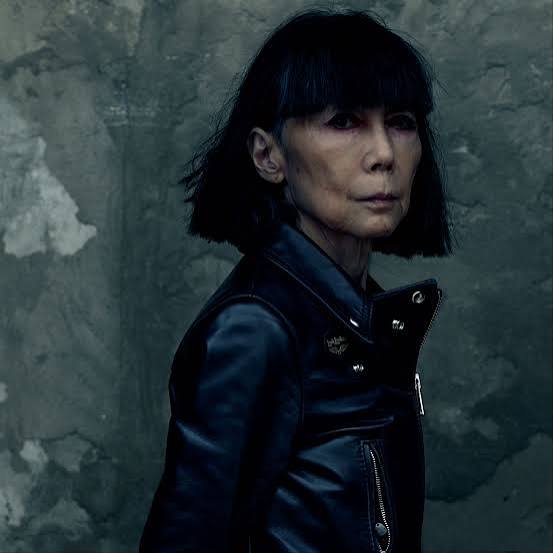
Rei Kawakubo did not arrive in Paris in 1981 to show clothes. She arrived to make an argument — about the body, about beauty, about what a woman was and was not obliged to be. The argument has not stopped since.
By Bergotte
In the spring of 1981, in a small showroom in Paris, a Japanese designer showed a collection that the French fashion press did not have adequate language to describe. The clothes were black, predominantly. They were asymmetrical, many of them. They had holes, or what appeared to be holes — openings that occurred where openings were not expected, that seemed less like design decisions than like evidence of damage, of something having gone wrong in the making. The silhouettes were large and shapeless in ways that bore no relationship to the silhouettes large and shapeless clothes had previously taken — they did not drape or flow or suggest the body beneath so much as contradict it, argue with it, propose a different understanding of what a body wearing clothes was doing in the world. The women who wore them on the runway looked serious and slightly dangerous. The invitation had been printed with no images. The name of the label, Comme des Garçons, meant nothing to most of the people in the room.
The reviews were not uniformly kind. Hiroshima chic, someone wrote — a phrase that has become so famous in the telling of this story that it risks obscuring how genuinely hostile it was intended to be, how much contempt was packed into the conjunction of a city associated with annihilation and a word associated with effortless French elegance. The collection was called poverty fashion, post-nuclear, anti-woman. It was called ugly, which was perhaps the most accurate of the criticisms, in the sense that Rei Kawakubo had worked very hard indeed to make it so, and ugly was precisely what she meant. The disagreement, which was real and is still not entirely resolved, was about whether ugly, in this context, was a failure or an achievement.
Kawakubo herself said nothing, or almost nothing. She has always said almost nothing. In the four decades since that first Paris show, she has given interviews rarely and explained her work essentially never, in the sense that the explanations she occasionally offers are more like encrypted messages than clarifications. She has said that she is always searching for something new, something that has never existed before. She has said that she is not interested in beauty as it is conventionally understood. She has said that she hopes her clothes will make people think. These statements are not false but they are not, exactly, illuminating. They are the statements of a person who has decided, with great deliberateness, that her work should not be explained by the person who made it, that the relationship between the object and the person encountering it should not be mediated by authorial intention. This is a philosophical position. It is also, one suspects, a form of protection: if you do not explain your work, no one can tell you that you have explained it wrongly.
Tokyo, 1969
Rei Kawakubo was born in Tokyo in 1942, the daughter of an administrator at Keio University. She grew up in the years of Japan’s reconstruction — a childhood conducted in the shadow of defeat and the strangeness of the American occupation, in a country that was simultaneously dismantling one understanding of itself and constructing another at a speed that had no historical precedent. The Japan she grew up in was undergoing, in concentrated and sometimes violent form, exactly the kind of collision between tradition and modernity, between indigenous culture and Western imposition, that the twentieth century inflicted on most of the world but that few countries experienced with quite such dramatic intensity.
She studied aesthetics at Keio — a choice that her subsequent career makes seem almost overdetermined, though she has suggested that she arrived at fashion sideways, through frustration with the options available rather than through a formed ambition. After graduating in 1964 she worked in the advertising department of a textile company, Asahi Kasei, which gave her a working knowledge of fabric and production without placing her inside the hierarchical world of Japanese fashion, which was, in the 1960s, even more rigidly structured than its Western counterparts. She began doing freelance styling, then designing, and in 1969, without formal training as a designer and without the institutional backing that was normally considered prerequisite, she founded Comme des Garçons.
The name was chosen, she has said, for its sound rather than its meaning — she was not a French speaker and did not particularly care what the words meant, only that they had the right quality of distance, of foreignness, of not-quite-belonging to any obvious category. This is as good an origin story for the label’s sensibility as any: Comme des Garçons was, from its inception, a thing that occupied the spaces between categories, that refused the identities available to it, that found in foreignness not a problem to be overcome but a productive condition to be inhabited. Like boys. Not boys. Like.
Through the 1970s she built a business in Tokyo, showing collections that were already unusual by the standards of Japanese fashion — dark, severe, structured in ways that owed little to either the prevailing Western silhouette or the traditions of Japanese dress — and developing a following among the kind of Japanese women who were looking for clothes that took their intelligence seriously. The Japanese shops and the Japanese press were not always comfortable with what she was doing, but the discomfort was productive: it generated the kind of conversation about what clothes were for that Kawakubo has always seemed to find more interesting than simple admiration.
What Happened in Paris
The decision to show in Paris in 1981 — made jointly with Yohji Yamamoto, who showed his own first Paris collection at the same time and whose sensibility, while distinct from Kawakubo’s, shared enough with it that the two collections seemed to the press like a coordinated assault — was not primarily a commercial decision. The commercial calculation was there, of course: Paris was the centre of the fashion world, and showing there was a prerequisite for the kind of international visibility that a business needed to grow. But the scale of the provocation suggests that something else was going on, that Kawakubo arrived in Paris not merely to introduce her work to a new market but to conduct an argument with Paris itself — with the entire system of values that Paris, as the capital of fashion, represented and enforced.
That system was, at its core, a system organised around beauty as consensus. Parisian haute couture, and the prêt-à-porter that had grown up in its shadow, were both committed to the proposition that fashion’s function was the enhancement of the female body as Western culture understood it: the lengthening of the leg, the definition of the waist, the movement of fabric in ways that implied ease and desirability. The vocabulary was large and the variations were endless, but the underlying commitment was stable. Beautiful clothes made beautiful women. Beautiful women were the social ideal. The designer’s job was to serve this ideal with skill and invention.
Kawakubo’s collection did not serve this ideal. It did not even acknowledge it. The clothes did not lengthen or define or imply ease. They interrupted. They complicated. They placed fabric in relation to the body in ways that raised questions rather than answering them — questions about where the body ended and the garment began, about what it meant for a woman to be dressed, about whether the purpose of clothing was to reveal the body or to create a different kind of body entirely. The holes were not accidents. The asymmetry was not carelessness. The blackness was not mourning, exactly, though it carried mourning’s weight. Everything was deliberate, and the deliberateness was itself part of the argument: these things did not happen to the clothes. They were chosen.
The press’s discomfort was, in this light, entirely appropriate. They were not wrong that the clothes were ugly by the standards they had available. They were wrong to think that this disqualified them from serious consideration. The fashion press of 1981 was, like most institutional criticism, equipped to evaluate variations within a known vocabulary and poorly equipped to evaluate challenges to the vocabulary itself. What Kawakubo was doing was the latter. It took critics several years to develop the tools to discuss it with any adequacy, and some never managed it at all.
The Body as Site
To understand what Comme des Garçons has been doing for the past four decades, it is necessary to understand that Kawakubo thinks of the body not as a given but as a material — as something that clothing does not merely cover or enhance but actually constitutes, in the sense that the way a garment sits on or around or away from the body produces, in the viewer’s perception, a body. The body we see when we see a dressed person is not the naked body plus clothes. It is something created by the relationship between fabric and flesh and space, something that has no existence apart from that relationship.
This sounds, stated baldly, like theory. In practice it produces objects of remarkable physical immediacy. The 1997 collection, formally titled Body Meets Dress, Dress Meets Body and instantly nicknamed by the press the lumps and bumps collection, is the most extreme example: padded, quilted fabric forms attached to close-fitting base garments in positions that produced protrusions and swellings on the body that had no anatomical basis, that created a human silhouette unlike any that had previously been produced by clothing or by bodies. The model walking down the runway was neither normally proportioned nor deformed — she was something else, a third thing that neither the language of fashion nor the language of the body had words for.
The press was, again, not uniformly enthusiastic. The collection was described as grotesque, as freakish, as a provocation without purpose. It was also, by any serious measure, one of the most original things that had been done in fashion since the invention of the modern silhouette, an entirely genuine reinvention of the relationship between the clothed human form and space. The V&A acquired pieces from it. The Metropolitan Museum included it in the 2017 retrospective. History has been, on the whole, kinder to the lumps and bumps than the 1997 press was, which is not unusual but is worth noting, since it says something about what fashion criticism is actually capable of in the moment of encounter, as opposed to the retrospective comfort of the established canon.
Other collections have approached the question of the body from different angles. There have been collections that explored the relationship between clothing and armour, between the dressed body and the defended body. Collections that investigated flatness — clothing reduced to two dimensions, the body flattened into a kind of walking silhouette. Collections that explored the junction between clothing and architecture, garments that stood away from the body like buildings stand away from their sites. Collections that seemed to be about nothing so much as the process of becoming — garments half-made, or half-unmade, or in a state of transformation that could not be resolved into either origin or destination. Taken together, they constitute not a body of work in the conventional fashion-historical sense — a series of seasonal responses to the prevailing aesthetic conversation — but something more like a sustained philosophical investigation, conducted in fabric and form, into what a clothed human being is.
The Empire of Refusal
Comme des Garçons is, at this point, a substantial commercial enterprise. The label operates multiple lines at multiple price points: the main collection, which is shown in Paris and which constitutes the philosophical core of the project; Comme des Garçons Homme and its variations; Comme des Garçons Shirt; Junya Watanabe, the line run by Kawakubo’s most significant protégé; Noir Kei Ninomiya; and, most visibly to the general public, Comme des Garçons Play — the line with the small heart logo designed by Filip Pagowski, whose striped T-shirts and Converse collaborations have achieved the kind of mass-market visibility that is about as far from the 1981 Paris collection as it is possible to get while remaining nominally within the same organisation. There are fragrances, many of them, including some of the most genuinely radical objects in the history of perfumery: Odeur 53, from 1998, was composed entirely of synthetic industrial notes — metal, plastic, a freshly photocopied page, the inside of a new car — and declined to smell like anything that had previously been considered appropriate for a scent. It was, typically, described variously as a masterpiece and an affront.
The retail operation is organised around Dover Street Market, the concept store that Kawakubo and her husband and business partner Adrian Joffe developed from a single London location — on Dover Street in Mayfair, now relocated to Haymarket — into a network of spaces in New York, Tokyo, Los Angeles, Beijing, and Singapore. Dover Street Market is not exactly a department store, though it sells things. It is not exactly a gallery, though it shows things. It is a total environment: a space in which the selection and arrangement of objects, garments, furniture, and art constitutes an argument about how these categories relate to each other, what they share, what they ask of the person moving through the space. Each location is redesigned entirely twice a year, which means that the space itself is understood as a seasonal creation rather than a permanent installation — a built collection, subject to the same logic of reinvention that governs the clothes.
The tension between this commercial reality and the philosophical radicalism of the main collection is real and is not resolved by simply observing that one funds the other, though one does fund the other. Kawakubo built an empire, and empires have their own logic. The heart logo T-shirt subsidises the lumps and bumps; the Converse collaboration builds the brand awareness that makes the Dover Street Market viable; the perfume licensing revenues allow the Paris show to remain what it has always been: a space for pure research, answerable to nothing but the question of what has not yet existed. This is a more sophisticated version of the tension that appears in the Derian essay — the relationship between the handmade singular and the commercially reproducible — but in Kawakubo’s case the poles are further apart and the electricity between them correspondingly higher.
She has never pretended that the tension does not exist. She has never offered the kind of explanation — that commercial success allows artistic freedom, that the mainstream work does not compromise the avant-garde work — that most designers in her position offer, partly because she does not explain things and partly, one suspects, because she does not find the explanation entirely satisfying. The empire is what it is. The work is what it is. They coexist in a state of productive and unresolved contradiction that is, in its way, as honest as the holes in the 1981 collection.
Silence as Method
The silence deserves more attention than it usually receives, because it is not mere reticence. It is a considered position about the relationship between making and saying, between the object and its explanation, between the designer and the public who encounters her work.
Most designers talk. They talk in interviews, in shows notes, in the kinds of artist statements that accompany exhibitions and retrospectives. They provide context, explain references, situate their work within historical and personal narratives. This talking is not dishonest, exactly — it is a form of engagement, a way of meeting the audience — but it does something specific to the work: it closes off certain readings, forecloses certain interpretations, makes the work smaller in the sense that the stated meaning crowds out the unstated ones. The designer who explains their collection determines, to a significant degree, how the collection will be understood. They also, by explaining, make themselves available for the particular kind of accountability that explanation invites: if you say what you mean, you can be told that you have not achieved what you meant.
Kawakubo has declined this transaction. Her show notes, when they exist, are brief almost to the point of inscrutability — single phrases or short sentences that gesture toward a territory without mapping it. For a show whose forms seemed to investigate the relationship between clothing and armour she offered, as a title, Not Making Clothing. For a collection of extraordinary structural complexity she offered, simply, the word Infinity. These are not explanations. They are invitations to look, and an implicit insistence that looking is sufficient — that the person who looks carefully enough will find what is there without needing to be told what to find.
This places an unusual demand on the audience, and it is a demand that not everyone is willing to meet. Fashion criticism, in particular, struggles with work that will not explain itself, because criticism requires something to engage with beyond the purely visual, and a designer who withholds context makes the critic’s job considerably harder. The response to this difficulty has often been to fill the silence with projection — to read into Kawakubo’s work meanings that say more about the reader than the work, to construct a Kawakubo who is a feminist icon, or a nihilist, or a Japanese nationalist, or a pure formalist, depending on what the particular critic’s framework requires. She has never corrected these readings, which may be because they are all partially true, or because she finds the spectacle of them interesting, or because correction would require speaking, which she has decided not to do.
What Fashion Is
There is a question that Kawakubo’s work raises insistently and that the fashion world has never quite settled: what is fashion for? The dominant answer, in commercial terms, is obvious enough — fashion is for selling clothes, and clothes are for dressing bodies, and dressing bodies is a social and economic activity governed by desire, aspiration, and the seasonal renewal of both. This answer is not wrong. It describes, accurately, what most fashion is and what most of the fashion industry does.
But there has always been another answer, present in the work of a small number of designers at the outer edge of the industry — that fashion is a medium, as painting is a medium or sculpture is a medium, and that the most serious work done in that medium is not primarily about selling or dressing but about thinking: about the body, about gender, about time and beauty and mortality and the strange fact of being a person who wears clothes. This answer is also not wrong. It describes, accurately, what the best of Kawakubo’s work does.
The difficulty is that fashion, unlike painting or sculpture, cannot separate its serious ambitions from its commercial ones. A painting that no one buys still exists as a painting. A fashion collection that no one buys is a financial catastrophe and a practical impossibility — clothes must be produced, and production requires money, and money requires sales. Kawakubo has navigated this constraint for fifty years by building a commercial operation large and various enough to fund a design practice that operates, at its most ambitious, almost entirely outside commercial logic. Whether this constitutes a solution to the problem or merely a very expensive way of deferring it is a question that the next generation of designers — working in a climate of accelerating fast fashion, tightening sustainability pressures, and the atomisation of the fashion audience across digital platforms — will have to answer in conditions considerably less hospitable than the ones in which she worked.
The Retrospective Problem
In 2017, the Metropolitan Museum of Art mounted a retrospective of Kawakubo’s work — the first time the Met had dedicated a Costume Institute exhibition to a living designer since Yves Saint Laurent in 1983. The exhibition was called Art of the In-Between, a title taken from a phrase Kawakubo had used to describe her practice: the space between categories, the zone that is neither one thing nor the other, where definition is resisted and identity remains perpetually negotiable. It was, by most accounts, a spectacular installation — the garments displayed with an architectural ambition that matched their own, in environments designed to serve the clothes rather than domesticate them.
It was also, inevitably, a canonisation. The museum’s retrospective is the cultural machinery by which the living avant-garde becomes the historical record, by which the challenging becomes the established, by which the work that was once described as an affront is reclassified as a masterpiece. Kawakubo attended the Met Gala that accompanied the exhibition in a garment of her own design that was, characteristically, unlike anything else in the room. She said very little. She did not seem to find the canonisation comfortable, though she accepted it with the equanimity of someone who has understood for a long time that the institutions of culture will eventually catch up with whatever they initially rejected, and that this catching up changes the work less than one might expect.
Because the work does not change. The 1981 collection is not easier to look at now than it was then — the holes are still holes, the asymmetry is still asymmetrical, the blackness is still itself. What has changed is the frame around it, the discourse that surrounds it, the willingness of the people who encounter it to find in it something worth sustained attention. This willingness is not a gift from the institutions that have validated it. It was always available. It required only the kind of looking that Kawakubo has always insisted, without ever quite saying so, is the only thing she has ever asked for.
She is still designing. She is in her early eighties and she is still showing collections in Paris, still searching for the thing that has never existed before, still declining to explain herself. The silence continues. The work continues. They are, at this point, inseparable: the woman who will not speak and the clothes that say everything she has decided not to.
Discover more from My World of Interiors
Subscribe to get the latest posts sent to your email.

