
Director: Sasha Waters
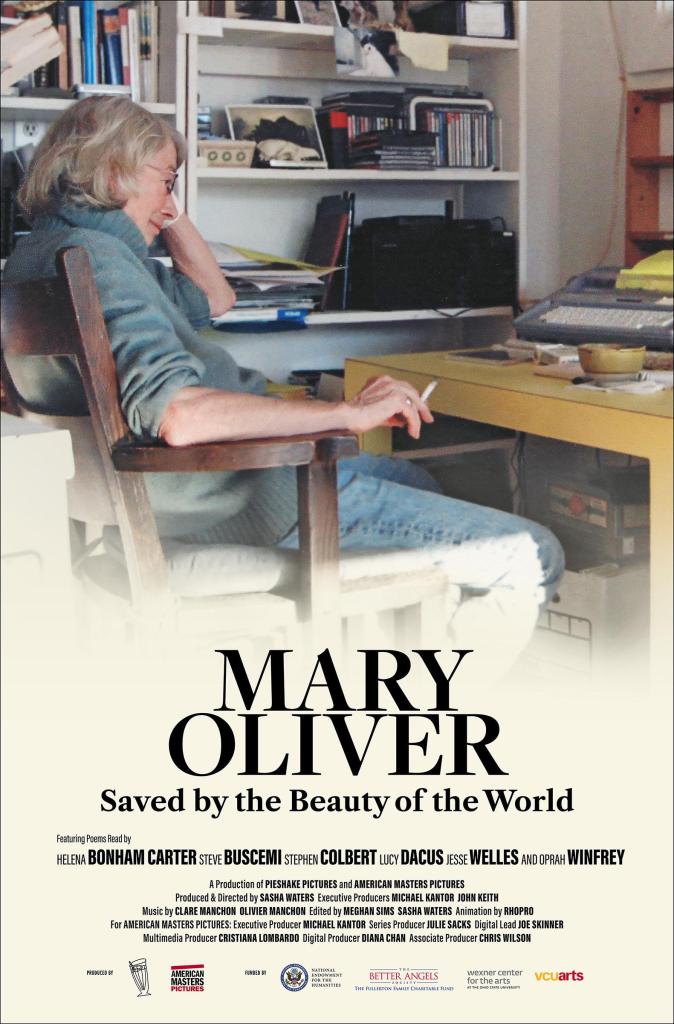
Title: Mary Oliver: Saved by the Beauty of the World
Year: 2026
Country: United States
Genre: Documentary / Biography
Running time: 91 minutes
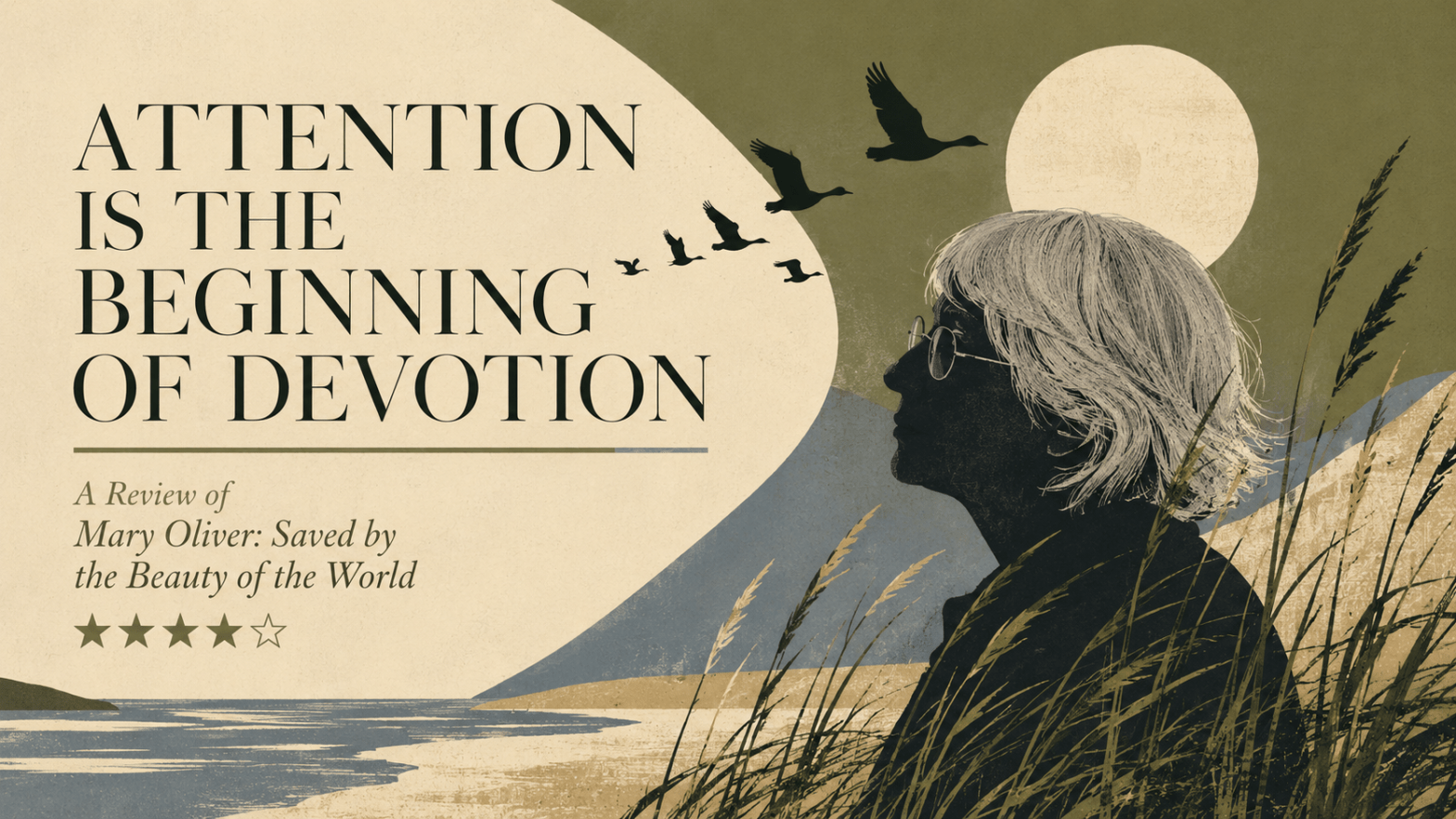
Rating: ★★★★☆
What It Is
Mary Oliver: Saved by the Beauty of the World is Sasha Waters’s documentary portrait of the Pulitzer Prize-winning American poet Mary Oliver, whose deceptively simple poems about nature, solitude, mortality, love and attention made her one of the most widely read poets in modern America.
Drawing on archival photographs, film, notebooks and correspondence, as well as Oliver’s own recorded words, the documentary traces her life from a difficult and solitary childhood in Ohio to the decades she spent in Provincetown with her longtime partner, the photographer Molly Malone Cook, and finally to the extraordinary popular recognition she achieved later in life. Alongside those who knew her personally, the film brings together a striking group of admirers—including Stephen Colbert, Oprah Winfrey, Steve Buscemi, Lucy Dacus and John Waters—to read her poems and consider what her work has meant to them.
The Review
I came to Mary Oliver: Saved by the Beauty of the World knowing almost nothing about its subject.
Mary Oliver belongs to American cultural life in a way she never quite made it into the European. I had encountered her only secondhand: in poetry anthologies, in quotations passed between readers and, increasingly, in the peculiarly diluted afterlife of poetry on Instagram, where a line detached from the poem that produced it becomes inspirational content.
That turned out to be almost the ideal way into Sasha Waters’s documentary, because the film is, among other things, an argument for paying attention to someone before deciding that you already know them.
And Mary Oliver knew something about attention.
The film opens beautifully with Stephen Colbert attempting to read “The Summer Day,” a poem he has said he sends to his children on the first day of summer each year. He scarcely begins before becoming overwhelmed. The poem’s famous final question about what we intend to do with our “one wild and precious life” is probably familiar even to people who could not name its author.
This could easily have been sentimental.
Instead, it establishes one of the documentary’s central subjects: not simply Oliver’s poetry, but the peculiar intensity of the relationship people have formed with it.
Colbert is not alone. Oprah Winfrey, Steve Buscemi, Lucy Dacus and others appear reading Oliver or speaking about what her work has meant to them. What might in another documentary feel like celebrity garnish has a more interesting function here. These readers constitute evidence. Through them, Waters demonstrates the extraordinary distance Oliver’s poems have travelled beyond the relatively narrow institutional world of poetry.
The interviews are therefore not merely decorative. They form part of the film’s argument about Oliver’s cultural importance.
And then there is John Waters.
I have to admit a personal weakness here: I am always delighted when John Waters appears in anything. My favourite punk personified, rebel with a cause, turning up in a documentary about a poet conventionally associated with wild geese, ponds, grasshoppers and morning walks produces a small and rather wonderful collision of worlds.
Yet it also tells us something useful about Oliver.
Her popular image can make her seem almost impossibly wholesome: the solitary poet wandering through Cape Cod with a notebook, returning with small revelations about birds and sunlight. The breadth of her admirers reminds us that this image, while not false, is incomplete. Oliver was a much stranger and more complicated figure than the inspirational quotations extracted from her work might suggest.
This is one of the film’s greatest accomplishments.
It rescues Mary Oliver from Mary Oliver quotations.
The distinction matters because exceptional accessibility can become a peculiar liability for a poet. The more easily a line can be detached from its poem and circulated as wisdom, the easier it becomes to mistake accessibility for simplicity. Oliver has suffered from precisely this problem. Her work is enormously quotable; consequently, it can be encountered everywhere without actually being read.
Waters patiently puts the poems back around the quotations.
Once that happens, the familiar Oliver themes—nature, solitude, gratitude, mortality, spiritual attention—begin to acquire greater weight.
Nature, particularly, is not presented simply as scenery. It was fundamental to the architecture of Oliver’s imagination. The woods, ponds, birds, dogs and shorelines to which she returned were not picturesque accessories to an otherwise human drama. They were the means through which she attempted to understand what it meant to be alive.
That distinction is essential.
Oliver’s writing asks us to reconsider the hierarchy by which human experience is treated as significant and the nonhuman world as backdrop. The act of noticing becomes almost ethical. To look carefully at another living thing is to concede that it possesses a reality independent of ourselves.
Her famous observation that “attention is the beginning of devotion” consequently becomes the most useful key to both her poetry and Waters’s film. Oliver explained elsewhere that attention without feeling is merely reporting: what matters is the empathy that follows observation.
The documentary itself is constructed according to something similar.
It pays attention.
Waters does not rush Oliver’s landscape. Images are given room to breathe; photographs and archival footage sit alongside poems rather than merely illustrating them. The pace belongs to the subject. A more frenetic documentary style would have been almost philosophically incompatible with the woman being portrayed.
There is also discipline behind the apparent gentleness.
Oliver developed three rules against which she tested her poetry: a poem should possess a genuine body, sincere energy and spiritual purpose. The film invokes those principles, and they provide an unexpectedly useful description of Waters’s own approach.
The spiritual purpose is obvious.
The sincere energy is there too.
And the body comes from the archives: photographs, handwriting, notebooks, voices, faces, places—the physical evidence of a life that could otherwise disappear behind the extraordinary ubiquity of the words.
That material becomes especially important when the film approaches Oliver’s childhood.
One of the most affecting archival passages comes from a rare interview late in her life in which Oliver spoke publicly about having been sexually abused when she was very young. She described the damage it caused, her desire to become invisible and the difficulty she subsequently experienced in learning to trust. She said at the time that it was the first occasion on which she had ever spoken about the abuse aloud.
Suddenly, the solitude running through Oliver’s life assumes another dimension.
The child escaping into woods and books is no longer simply the origin story of a nature poet. Attention to the natural world becomes connected with survival.
The title of the documentary comes from Oliver herself: she said that she had been “saved by the beauty of the world.”
That sentence could sound unbearably sentimental if separated from the life behind it.
Here it does not.
Knowing something of what required saving changes the meaning of beauty.
This is perhaps where the documentary is at its strongest. It allows the darkness to alter our understanding of the light without turning the darkness into a crude psychological explanation for the poetry. Oliver is not reduced to her childhood, and nature is not presented merely as therapy. The relationship is more mysterious than that.
The film is also careful to place love beside solitude.
Oliver spent decades in Provincetown with Molly Malone Cook, the photographer who became her life partner. Cook’s death in 2005 profoundly altered Oliver’s life; Oliver subsequently left Provincetown and eventually settled in Florida, where she lived until her death in 2019.
The portrait that emerges is therefore not simply of a recluse disappearing into nature, but of someone whose work continually negotiated the distance between solitude and attachment: how to belong to another person without losing oneself; how to belong to the world without possessing it; how to look closely without turning what is seen into property.
These are much larger questions than the inspirational version of Mary Oliver generally allows.
The documentary also places her extraordinary popularity in useful tension with her critical reputation. Oliver won the Pulitzer Prize for American Primitive in 1984 and the National Book Award for New and Selected Poems in 1992, yet her accessibility and enormous readership have sometimes worked against her in more rarefied literary circles.
This is hardly a new phenomenon. Art that ordinary people love with unusual intensity is often treated with a degree of suspicion by institutions invested in difficulty as a measure of seriousness.
Oliver presents an interesting problem for that hierarchy.
Her language can be lucid without being intellectually empty. Her poems frequently ask enormous questions using apparently modest materials. A grasshopper, a wild goose or a dog becomes a way of asking how one ought to live.
It is not difficult to see why the poems escaped poetry and became part of everyday American language.
Nor is it difficult to see why this produced scepticism.
To its credit, Saved by the Beauty of the World does permit some of that scepticism into the room. The film acknowledges criticism of Oliver’s reluctance to engage explicitly with some of the political realities surrounding her, including questions about why a lesbian poet of her generation did not address the AIDS crisis more directly. Poet Nick Flynn also raises the question of whether Oliver’s work sufficiently confronted the darker, shadowed portions of a life.
I would have liked more of this.
That is ultimately why this is a four-star documentary for me rather than a five-star one.
Waters is not entirely uncritical, but her film is fundamentally an act of admiration. When disagreement appears, it tends to be acknowledged rather than investigated. The harder questions—about Oliver’s enormous popular appeal, the politics of retreat, the relationship between spirituality and avoidance, or the transformation of difficult poetry into wellness culture—are opened and then relatively quickly closed again.
A little more resistance might have produced an even richer portrait.
Particularly interesting, for instance, would have been a deeper exploration of the strange cultural fate of Oliver’s work: how a private, queer, fiercely disciplined poet became one of the great suppliers of inspirational language to twenty-first-century popular culture. There is something fascinating in the journey from Provincetown notebooks to Pulitzer Prize to Instagram typography.
The documentary gestures towards that phenomenon without quite anatomising it.
But perhaps severity would also have violated something essential about the film Waters wanted to make.
This is not an interrogation of Mary Oliver.
It is an attempt to understand why people love her.
And on those terms it succeeds extraordinarily well.
There is a broader argument threaded through the documentary: that poetry and nature perform surprisingly similar functions in human life. We often remember that we require them most urgently when something has gone wrong. Grief, illness, loneliness and fear return us to things that ordinary life teaches us to overlook.
A tree.
A bird.
A poem.
Someone we love.
Attention.
In that respect, Mary Oliver: Saved by the Beauty of the World is an excellent place to begin. It introduces not only the life and work, but the particular kind of attention Oliver asked of the world around her.
I may not have known much about Mary Oliver before watching this tribute to her, but she certainly has my attention now, and I have a feeling it could also lead to my devotion.
★★★★☆
Discover more from My World of Interiors
Subscribe to get the latest posts sent to your email.

