
Essay · Literature & Ideas
Beauty Will Save Us, or It Will Destroy Us First
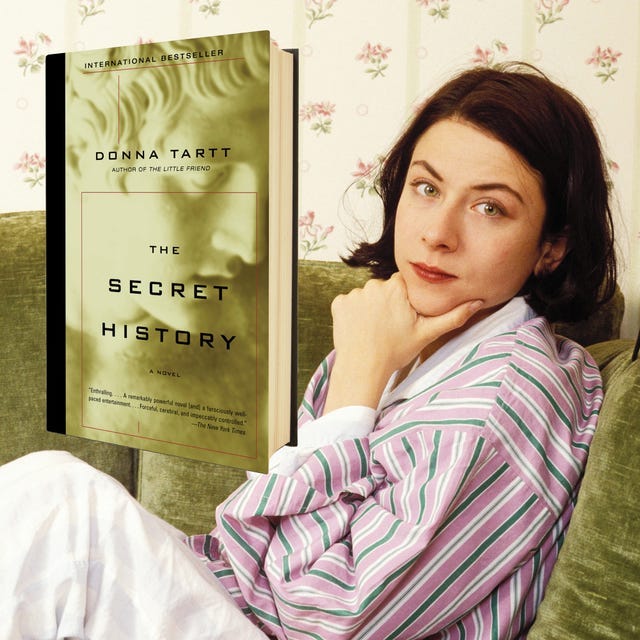
Donna Tartt published The Secret History in 1991, at twenty-eight, and it arrived as something the literary culture had not quite seen before: a novel that was simultaneously a page-turner and a meditation on moral philosophy, that took seriously both the pleasure of the thriller and the claims of beauty, and that understood — with a precision that its undergraduate setting made easier rather than harder to achieve — that the desire to transcend the ordinary is one of the most dangerous desires available to the human animal.
By Bergotte · Vermont & New York · Literature & Ideas
The novel tells you who dies on the first page. This is not a spoiler embedded in a review but a structural decision of considerable consequence, the first and most important of Tartt’s formal choices: we know, before the story begins, that the narrator’s friend Bunny Corcoran is dead, that the narrator was involved in the death, and that what follows will be an explanation rather than a mystery in the conventional sense. The Secret History is an inverted detective story — not whodunit but why, not the revelation of a hidden crime but the slow, detailed, morally precise account of how a group of intelligent, aesthetically serious young people arrived at the point of killing one of their own.
The why, as the novel develops it, is more interesting than any how could have been, because it is not simple. It is not the why of the thriller — greed, jealousy, the elimination of a rival — but the why of moral philosophy: the why of people who have convinced themselves, through a process of argument and aesthetic seduction that the novel traces with great care, that the ordinary moral rules do not apply to them, that beauty and knowledge and the intensity of experience confer a kind of exemption, that they are, in some sense that the novel examines and ultimately refuses to endorse, special.
Hampden and the World That Made the Murder Possible
The setting is Hampden College in Vermont — a thinly fictionalised version of Bennington, where Tartt herself studied, where Bret Easton Ellis was a contemporary, where the combination of progressive pedagogy, rural isolation, and a student body of unusual wealth and unusual eccentricity produced an atmosphere in which the normal social pressures of American undergraduate life were suspended and replaced by something more intense and more dangerous. Hampden is a place where it is possible, the novel argues, to live almost entirely inside a self-constructed reality — inside the aesthetic and intellectual world that Julian Morrow’s Greek seminar creates — and to lose, gradually and without noticing, the connection to the ordinary moral world that makes such constructions possible in the first place.
Richard Papen, the narrator, arrives at Hampden from Plano, California, from a working-class background whose mediocrity he has spent his adolescence trying to escape, and his susceptibility to the world Julian’s students inhabit is the susceptibility of someone who has always believed, with the intensity of the self-made, that somewhere there is a life of greater beauty and significance than the one he has been assigned. He finds it, or thinks he finds it, in the Greek seminar, and the finding is described with a detail and a warmth that makes the reader understand the seduction from the inside: the beauty of the language, the beauty of the ideas, the beauty of the five students who seem to inhabit a world of greater intensity and greater meaning than the one most people occupy.
Henry Winter, Francis Abernathy, Charles and Camilla Macaulay, Edmund “Bunny” Corcoran: the five are drawn with a precision and a consistency that is one of the novel’s greatest technical achievements. They are not types — not the cold intellectual, the decadent aesthete, the doomed romantic, the vulgar pragmatist — though they have elements of all of these. They are people, fully realised, whose qualities are in each case both genuinely admirable and fatally excessive, whose virtues and whose vices are the same qualities expressed in different keys.
“Does it seem to you that beauty is the rarest thing in the world? That things must be earned? That beauty is a kind of grace — undeserved, unearned, terrible in its power over us?” — Donna Tartt, The Secret History, 1991
The Bacchanal and the Philosophy of Transcendence
The novel’s central philosophical argument — the argument that Julian has taught his students and that they have taken further than he intended — is that the Apollonian world of reason and order, the world of ordinary modern consciousness, is incomplete, and that the Dionysian experience of ekstasis, of the loss of self in something larger, is not merely a historical curiosity but an available and perhaps necessary complement to the rational life. The argument is drawn from Nietzsche’s The Birth of Tragedy, from the pre-Socratics, from the Greeks whose language and thought the seminar has been inhabiting all year, and it is made by Julian with the seductive authority of a teacher who believes, or appears to believe, every word of what he is saying.
The students take him seriously, which is what students are supposed to do, and the taking-seriously produces, at some point in the Vermont autumn, an actual bacchanal — an attempt to recreate the Dionysian ritual, to genuinely lose themselves in the experience rather than merely study it. What happens at the bacchanal is not fully described — Tartt withholds it with considerable narrative intelligence — but its consequence is a local farmer dead and a group of students who have crossed a line they cannot uncross, who have done in earnest what they had rehearsed in theory, and who discover, on the other side of the line, that the experience of transcendence and the experience of having caused a death are not as clearly separable as the philosophy had suggested.
The murder of Bunny — which follows from the bacchanal’s consequence in a logic that the novel traces with careful moral precision — is not the act of monsters. It is the act of people who have been persuaded by a system of ideas to believe that their experience of beauty and knowledge places them outside the ordinary obligations of human community, and who discover, too late, that no such placement is available. The philosophy was real. The murder was real. The gap between the two is where the novel lives.
1991 and the World the Novel Arrived Into
The Secret History was published on September 16, 1991, and the world it arrived into was a specific one, whose specificity shaped its reception and whose conditions the novel was, in some sense, responding to. 1991 was the year of the Gulf War and the dissolution of the Soviet Union, the year of Nirvana’s Nevermind and the beginning of the grunge era, the year that the long boom of the 1980s was definitively over and the cultural mood was shifting from the confident acquisitiveness of Reagan’s decade toward something more uncertain and more introspective. The yuppie, that defining figure of the 1980s, had been satirised and anatomised and was now being quietly retired, and the question of what came after — what values, what aesthetics, what relationship between the individual and the culture — was genuinely open.
Into this moment arrived a novel whose subject was, precisely, the consequences of placing aesthetic experience above moral obligation — of deciding that beauty and knowledge and the intensity of feeling were sufficient guides to a life, that the conventional moral framework was for people of less refinement and less seriousness. The Secret History is, among other things, a critique of the aesthetic ideology of the 1980s — of the decade’s elevation of surface and style and the experience of beauty as ends in themselves — conducted through the medium of a narrative whose own surfaces are extraordinarily beautiful, whose own style is seductive in exactly the way that the ideology it is critiquing was seductive. The novel enacts its own argument: it is impossible to resist the world it creates, and the impossibility of resistance is part of what the novel is saying.
The literary context of 1991 is equally important. The decade had produced, in Ellis’s American Psycho, a novel that examined the aesthetic ideology of the 1980s from the inside, with a narrator who is simultaneously its fullest expression and its reductio ad absurdum. The Secret History examines the same ideology from a different angle — not through the Manhattan investment banker but through the Vermont undergraduate, not through the consumer of luxury goods but through the consumer of ancient languages and classical philosophy — and arrives at a similar destination: the revelation that the elevation of aesthetic experience above moral obligation produces, at its logical extreme, violence. Patrick Bateman kills because sensation has replaced ethics as his primary orientation. Henry Winter and his friends kill for the same reason, dressed in different and considerably more elegant clothes.
The Campus Novel and Its Discontents
The campus novel is one of the more durable minor genres in English and American fiction, and The Secret History belongs to it while simultaneously transcending it in ways worth examining. The genre’s conventions — the enclosed community, the heightened social dynamics, the combination of intellectual ambition and personal drama, the sense of a world apart — are all present in Tartt’s novel, but she uses them not to produce the social comedy or the Bildungsroman that the campus novel conventionally produces but something darker and more philosophically ambitious.
The obvious comparisons within the genre are instructive. Mary McCarthy’s The Groves of Academe (1952) and Randall Jarrell’s Pictures from an Institution (1954) use the campus setting for social satire, the enclosed world as a lens for examining the hypocrisies and vanities of intellectual life in America. David Lodge’s campus novels — Changing Places (1975), Small World (1984) — apply the same satirical intelligence to the British and transatlantic academic world. These are novels that find the campus comic, that use its conventions for exposure and amusement. Tartt’s campus is not comic. It is beautiful and it is dangerous, and the beauty and the danger are the same thing.
The closer comparison, within the American tradition, is with John Irving’s work — specifically with The World According to Garp and The Hotel New Hampshire, novels that also use enclosed or semi-enclosed communities to explore the relationship between violence and beauty, between the life of the imagination and the life of consequence, between the story one tells about oneself and the story one is actually living. Irving’s violence is random, the Under Toad arriving without preparation or logic. Tartt’s violence is willed and philosophical, the product of deliberate choices made within a coherent, if ultimately corrupt, system of belief, and this makes it, in some ways, more disturbing: the Under Toad can be survived, but a system of ideas that justifies murder by appealing to the beautiful is harder to resist because the appeal is real.
The Gothic Tradition and the American Inheritance
The Secret History belongs as much to the Gothic tradition as to the campus novel, and the Gothic inheritance is worth tracing because it illuminates what Tartt is doing that the campus novel frame alone cannot explain. The Gothic novel — from Horace Walpole through Ann Radcliffe and Matthew Lewis to Poe and Hawthorne and, in the twentieth century, Shirley Jackson and Flannery O’Connor — is a literature of enclosed spaces and dark secrets and the return of the repressed, of beautiful surfaces that conceal terrible things, of the past that will not stay past. All of these elements are present in The Secret History: the Hampden campus as the Gothic castle, the Greek seminar as the sealed room within the castle, the bacchanal and its consequences as the buried secret that will inevitably surface, the whole Vermont winter as the Gothic landscape in which the repressed returns with the force of the seasons.
The specific American Gothic tradition — Poe’s narrators consumed by their own aestheticism, Hawthorne’s characters destroyed by their refusal to accept the moral claims of community, Fitzgerald’s Gatsby undone by the beauty of a dream that cannot survive contact with reality — is the tradition that The Secret History is most directly in conversation with. Henry Winter is a Gatsby figure: a person who has constructed a self of extraordinary beauty and sophistication on foundations that will not hold, who has mistaken the intensity of the aesthetic experience for a moral licence it was never equipped to provide. The green light at the end of Daisy’s dock is, in Tartt’s novel, the bacchanal on the Vermont hillside — the moment of genuine transcendence that the novel’s characters reach for and that destroys them precisely because it was real, because transcendence is not a metaphor but an experience, and the experience carries consequences.
Tartt and Her Contemporaries
The obvious comparison — pressed most forcefully at the time of publication and since — is with Bret Easton Ellis, whose Less Than Zero (1985) and American Psycho (1991) were the most discussed literary explorations of the same aesthetic terrain that The Secret History was working. Tartt and Ellis were contemporaries at Bennington, and the Bennington of their years — a campus of unusual intellectual intensity and unusual personal freedom, of money and drugs and genuine artistic ambition in unstable combination — is the real-world original of both Ellis’s fictional Los Angeles and Tartt’s fictional Vermont. The connection is not incidental.
The difference between their approaches is the difference between the prosecutor and the poet. Ellis presents the aesthetic ideology from the inside, with a narrator who embodies it completely and whose narrative voice enacts the very numbness it is describing, making the reader complicit in the numbness before offering any critical distance from it. Tartt presents the aesthetic ideology from slightly outside — through Richard, who is seduced by it but never quite of it, who retains enough connection to the ordinary moral world to feel guilt in a way that Henry does not — and the slight outside-ness gives the reader a position from which to see what is happening without being fully consumed by it. This is a moral choice as well as a formal one, and it is the choice that makes The Secret History more conventionally readable than American Psycho and, in some respects, more honest about the seductiveness of what it is critiquing: if the world the novel describes were not genuinely beautiful and genuinely compelling, the critique would be too easy.
The comparison with Tartt’s close friend and early reader Bret Easton Ellis tends to obscure the comparison with writers she has cited as more direct influences: Dostoevsky above all, whose Crime and Punishment is the most obvious precursor to The Secret History‘s central concern — the psychology of the intellectual who has convinced himself that his superiority exempts him from the ordinary moral law — and whose The Brothers Karamazov is the model for the kind of novel that takes ideas seriously without turning characters into vehicles for ideas. Like Dostoevsky, Tartt is interested in the experience of guilt — in what it feels like, from the inside, to have done something that cannot be undone, and in the various strategies the self deploys to manage the unmanageable. Like Dostoevsky, she finds in that experience not a simple moral lesson but a profound psychological complexity.
Julian and the Failure of the Mentor
Julian Morrow is the novel’s most elusive figure and its most important argument. He is the teacher who has taught his students everything they know and who, when the consequences of their education arrive, is entirely absent — who removes himself from the situation with the smoothness of a man who has always known, at some level, that his position was untenable, that the world he constructed in the seminar room could not survive contact with the world outside it. He is beautiful, learned, charming, and morally weightless: a person of extraordinary aesthetic cultivation and essentially no ethical substance, a teacher who offered his students the keys to the kingdom without mentioning that the kingdom had a price.
The critique of Julian is the critique of a certain kind of humanist education — the education that treats aesthetic and intellectual cultivation as ends in themselves, that produces people of great refinement and great learning and no corresponding moral development, that mistakes the love of beauty for the love of the good. This critique was particularly resonant in 1991, at the end of a decade in which a certain kind of education — the expensive, the elite, the richly furnished with Western canonical culture — had produced a generation of people of considerable aesthetic sophistication and, in some documented cases, conspicuous ethical bankruptcy. Julian’s students are the product of that education taken to its extreme, and Julian’s departure, when the extreme is reached, is the novel’s most damning judgment on the tradition he represents.
The Novel’s Lasting Argument
The Secret History has remained in print and in active cultural circulation for thirty years, which is not the fate of most first novels, and the reasons for its durability are worth examining because they are also the reasons for its importance. It is not merely a good thriller, though it is a good thriller. It is not merely a portrait of a specific milieu, though the portrait is precise and memorable. It is a novel whose central argument — that beauty is not a moral guide, that the intensity of aesthetic experience does not confer ethical license, that the desire to transcend the ordinary is as likely to lead to destruction as to liberation — has not dated, because the desire it describes has not dated.
The world continues to produce people who believe, with varying degrees of sophistication and self-awareness, that their aesthetic or intellectual superiority exempts them from the ordinary obligations of human community. The world continues to produce institutions — some of them resembling Hampden, some of them resembling rather different environments — in which that belief is cultivated and rewarded. The world continues to discover, at intervals, that the belief is wrong and the consequences of acting on it are real.
Richard Papen survives, which is not the same thing as escaping. The guilt is permanent. The beauty is permanent. The gap between them is where he lives for the rest of his life, which is also where the novel lives, and where its readers live while they are inside it — held between the seduction of the world Tartt has created and the knowledge, provided on the first page, of what that world costs. It is an uncomfortable position, and it is a precise one, and it is the most honest thing the novel says: that beauty and destruction are not opposites but companions, and that knowing this does not make the beauty less beautiful, and that the only honest response to this knowledge is to keep living, with full awareness of everything it implies, in the world it describes.
This essay draws on Donna Tartt’s The Secret History (1991, Alfred A. Knopf), Nietzsche’s The Birth of Tragedy (1872), Dostoevsky’s Crime and Punishment (1866) and The Brothers Karamazov (1880), Fitzgerald’s The Great Gatsby (1925), and the critical literature on the campus novel tradition including works by Mary McCarthy, Randall Jarrell, and David Lodge. Bret Easton Ellis’s Less Than Zero (1985) and American Psycho (1991) are discussed as contemporary comparators. Donna Tartt was born on December 23, 1963, in Greenwood, Mississippi. She and Ellis were contemporaries at Bennington College in the early 1980s.
Discover more from My World of Interiors
Subscribe to get the latest posts sent to your email.


Interesting essay. One slight correction, The Secret History was published in 1992.
LikeLiked by 1 person
You are right. Thank you for the editorial note
LikeLiked by 1 person