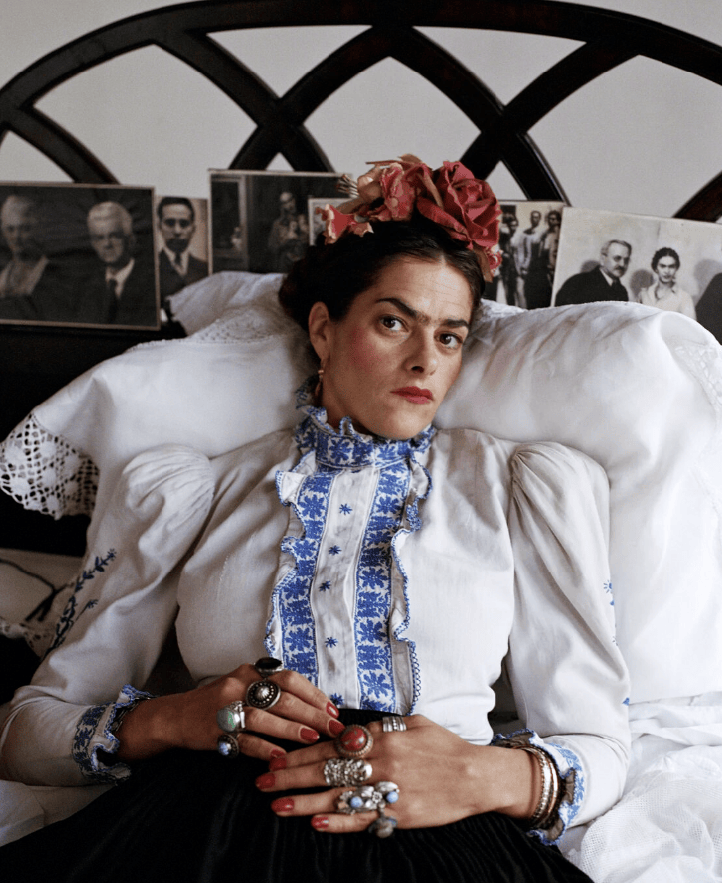
From the delicate bird drawings of the 1990s to the monumental paintings of her later career, Tracey Emin has developed one of the most recognisable visual languages in contemporary British art. Her work belongs to a long tradition of artists who have understood drawing as a means of examining the most difficult aspects of human experience.
Among Tracey Emin’s most affecting works are a series of small drawings of birds. Their forms are suggested through a few hurried lines: a rounded body, an extended beak, the slight movement of a wing. Sometimes the creatures appear uncertain of their surroundings, perched precariously upon branches or occupying large expanses of empty paper. There is very little to distract from the fragility of the image.
These drawings, developed throughout the 1990s and early 2000s, reveal something fundamental about Emin’s artistic temperament. They possess the same emotional directness as her better-known autobiographical works, but communicate it through an extraordinarily economical visual language.
In a 2018 interview with The Guardian, Emin explained that she had begun drawing birds at a time when the British art world was particularly suspicious of overt emotional expression. In the conceptual atmosphere of the late 1980s and early 1990s, she found that the bird allowed her to communicate feelings she could not easily express through conventional self-portraiture.
The drawings were, in her words, another language.
There is something revealing in that explanation. Emin’s reputation developed around her willingness to expose the intimate details of her life, yet some of her most affecting images emerged from the decision to communicate indirectly.
The relationship between disclosure and concealment has remained central to her work. Even when the subject is explicitly autobiographical, the artwork is constructed through choices about what to reveal, how to represent it and what must remain outside the image.
An Artist Formed in the 1980s
Born in London in 1963 and raised in Margate, Emin studied at Medway College of Design, Maidstone College of Art and eventually the Royal College of Art, where she completed a master’s degree in painting in 1989.
Her early artistic education coincided with an important period in British art. Painting, particularly expressive figurative painting, was increasingly challenged by conceptual practices that favoured photography, installation, appropriation and the manipulation of existing cultural imagery.
The emergence of the Young British Artists in the late 1980s and early 1990s intensified this interest in the idea of the artwork as an intellectual proposition.
Emin was closely associated with that generation, yet her sensibility remained distinctly her own. Her work drew upon personal histories, remembered conversations, ordinary objects and emotional circumstances that many artists of the period might have regarded as excessively private.
Her first solo exhibition, My Major Retrospective 1963–1993, opened at White Cube in November 1993.
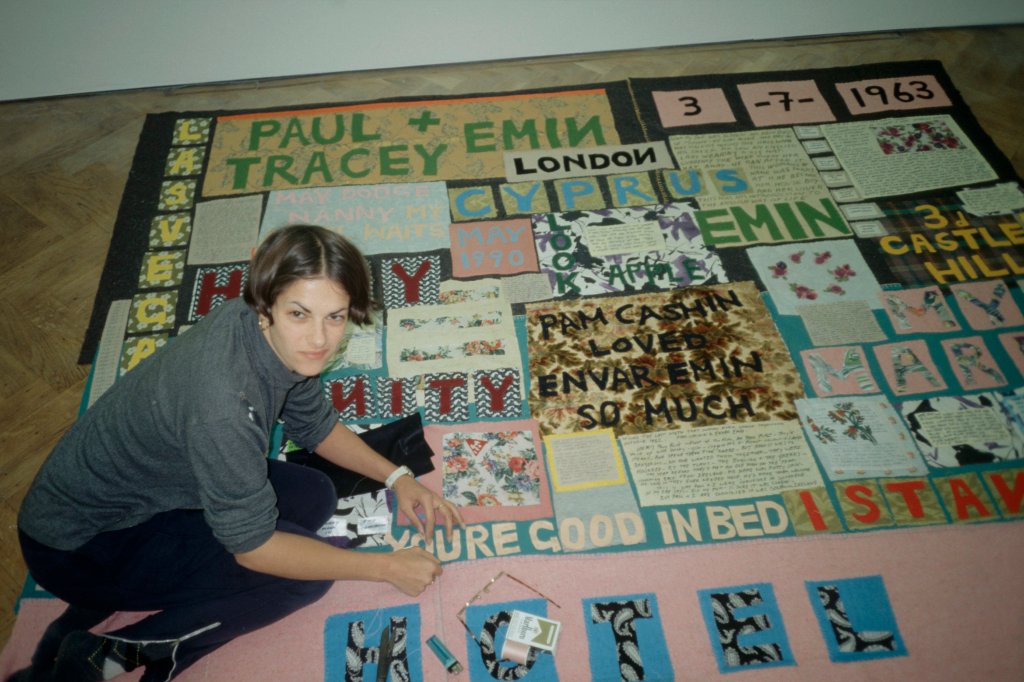
The title contained a considerable amount of humour. A relatively young artist was presenting her life as though it already constituted an established historical career. Yet the exhibition also addressed a difficult episode in her development: the destruction of many of her earlier paintings.
Emin reconstructed their existence through tiny photographic records, placing the absence of the original objects within the artistic narrative.
This understanding of absence became a recurring characteristic of her work. Lost relationships, vanished places, damaged memories and the impossibility of recovering certain experiences would all become subjects through which she investigated the relationship between past and present.
In 1995, she produced Everyone I Have Ever Slept With 1963–1995, the small appliquéd tent containing the names of people with whom she had shared a bed.
The distinction between physical intimacy and sexual intimacy, frequently overlooked in contemporary accounts, was essential to the work. Its embroidered names included family members and childhood companions alongside lovers.
A tent is a temporary shelter, associated with privacy, protection and the circumstances of sleeping away from home. Emin transformed it into a repository of human relationships, inviting visitors to enter a space that was simultaneously intimate and public.
The work’s destruction in the 2004 Momart warehouse fire introduced an additional layer of loss to an object already concerned with the preservation of memory.
The Quiet World of the Birds
The birds deserve a far more substantial place within Emin’s artistic history than they have generally received.
Her interest in them began early; she studied ornithology at school and became fascinated by the relationship between their physical vulnerability and their capacity for flight.
In the late 1980s and early 1990s, following a difficult period in her life, drawing birds offered an alternative to the human figure. Their small bodies could carry feelings of isolation, longing and apprehension without requiring the explicit representation of the artist herself.
The Bird Drawings of 2001, a group of fourteen monoprints, demonstrate the sensitivity of her approach. In Mum I’m Stuck (2001), the pale, delicate marks give the impression of an image emerging almost accidentally from the paper.
The technique is particularly appropriate. A monoprint is made through the transfer of an image from one surface to another, producing a unique impression that cannot be repeated in precisely the same way.
The process introduces uncertainty into the final result. Pressure, the quantity of ink and the movement of the hand determine the appearance of the image, sometimes preserving marks that would disappear in a more controlled drawing.
Emin uses these irregularities with considerable skill. The birds possess an extraordinary immediacy, their vulnerability suggested through the tentative quality of the line.
In Self-Portrait as a Small Bird (2002), the relationship between the animal and the artist becomes explicit. The small creature, perched upon a flowering branch, suggests an identity expressed through delicacy and watchfulness.
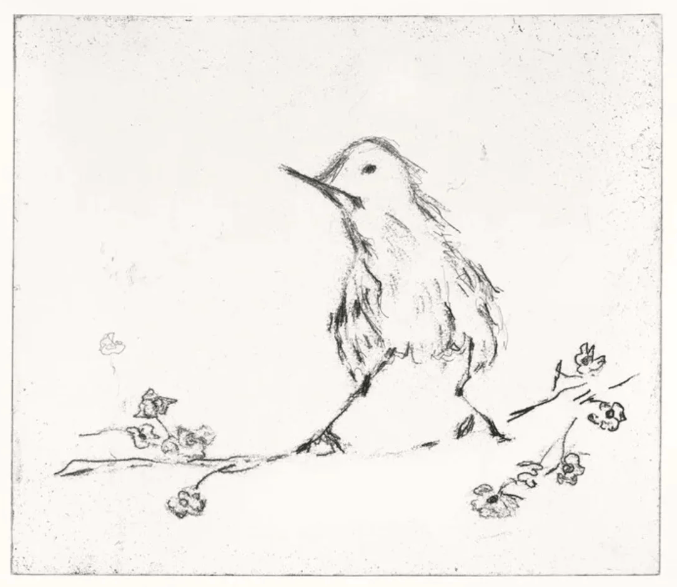
Birds also offered her a language of freedom. Emin has spoken about childhood dreams of flying and the peculiar consolation she found in watching birds move through the air. Their freedom from the physical limitations of the human body acquired a personal significance.
The motif eventually entered her sculptural practice.
In 2005, Emin created Roman Standard, a tiny bronze bird perched upon a pole approximately four metres high, originally installed outside the Oratory beside Liverpool Cathedral.
The title refers to the monumental military standards carried by Roman legions, symbols of power, conquest and political authority.
Emin replaced the expected imperial eagle with an almost absurdly modest creature. Its diminutive scale requires the viewer to search for it, transforming an emblem of public authority into something tender and unexpectedly private.
The work is particularly accomplished because of this subtle inversion. Monumentality is established through height and position, while emotional significance emerges from the tiny figure itself.
In 2018, she returned to the idea with The Distance of Your Heart, a public artwork comprising sixty-eight small bronze birds installed around central Sydney.
The sculptures occupied ordinary urban locations, including benches, awnings and lampposts. Their placement encouraged the possibility of unexpected encounters, allowing the work to be discovered during the course of everyday life.
Emin described her intention as one of gentleness. She wanted to create something that might offer people a moment of pleasure without imposing itself upon the surrounding environment.
The birds introduce tenderness into an artistic vocabulary more frequently discussed through pain, sexuality and emotional exposure. They also demonstrate her ability to use considerable technical restraint.
Their omission from accounts of Emin’s career has produced an unnecessarily narrow understanding of her work.
Drawing the Human Body
Emin’s treatment of the human figure belongs to a tradition of expressive drawing in which psychological experience determines the appearance of the body.
Her particular affinities with Egon Schiele and Edvard Munch have been explored through major exhibitions bringing their works into direct conversation.
Schiele’s figures are distinguished by angular contours, exaggerated proportions and an almost uncomfortable sense of physical exposure. Their bodies frequently appear strained or unstable, reflecting an interest in sexuality, mortality and psychological disturbance.
Emin shares his willingness to abandon idealised anatomical representation in pursuit of emotional expression.
But the relationship also invites consideration of the position of women within the history of figurative art.
The female nude has been among the most persistent subjects of European painting, although its representation has overwhelmingly been shaped by male artists and their patrons.
Emin approaches the female body from the experience of inhabiting it. Pregnancy, sexuality, ageing, physical vulnerability and the changing appearance of the body become subjects for investigation through drawing.
Her figures frequently emerge from tangled or interrupted lines. A shoulder may be suggested by a single movement of the hand; a torso might dissolve into several overlapping marks.
These apparently unfinished forms reveal a highly developed understanding of how little information is necessary for a drawing to communicate a physical presence.
Emin’s Family Suite (1994), a series of twenty monoprints now held by the National Galleries of Scotland, already demonstrates this capacity.
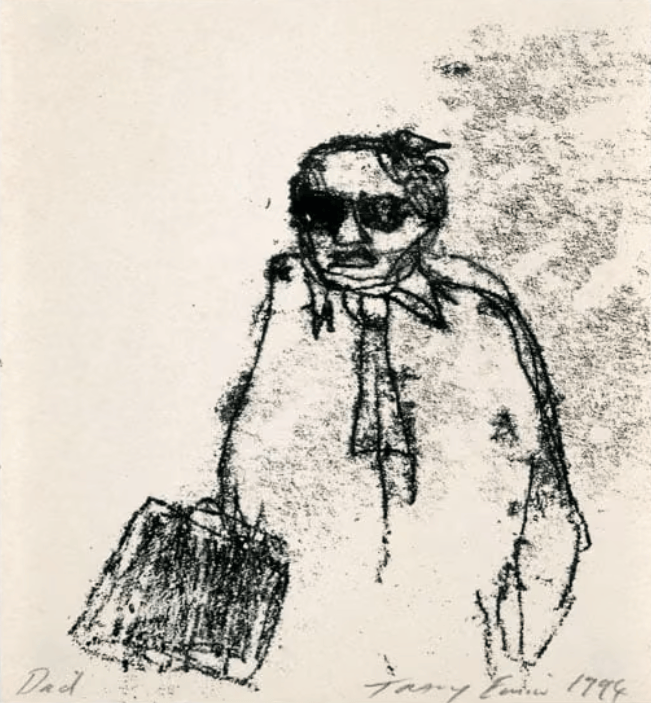
The images return to the circumstances of her childhood, including portraits of family members and remembered domestic scenes. Their immediacy derives partly from the way the printing process records the movement and hesitation of the artist’s hand.
The drawings are often small, but their emotional concentration gives them considerable force.
Emin has described drawing as a process through which remembered experiences pass into physical form. In a 2009 essay for The Guardian, she examined the way certain memories repeatedly return to her work, demanding new attempts at representation.
There is an important distinction between drawing something remembered and drawing from direct observation. Memory alters the significance of visual details, allowing certain gestures or forms to acquire disproportionate emotional importance.
Emin’s line follows these changes in perception. The drawing becomes a record of how an experience has been retained rather than an attempt to reconstruct its precise outward appearance.
Munch, Bourgeois and Artistic Kinship
Emin’s relationship with Edvard Munch extends beyond their shared interest in emotional experience.
Both artists use repetition as a way of returning to particular psychological states. Munch repeatedly revisited subjects such as jealousy, separation and illness, producing different versions of images whose emotional significance remained unresolved.
Emin’s work displays a comparable persistence. Beds, reclining figures, embracing bodies and isolated female forms recur throughout her practice.
The image changes as the artist changes, acquiring different meanings across successive periods of her life.
Their artistic relationship was explored in The Loneliness of the Soul, which brought their works together at the Royal Academy in London and the MUNCH museum in Oslo.
An equally significant encounter occurred through Emin’s collaboration with Louise Bourgeois.
Between 2009 and 2010, the two artists worked together on Do Not Abandon Me, a series of sixteen images concerned with sexuality, the body and emotional attachment.
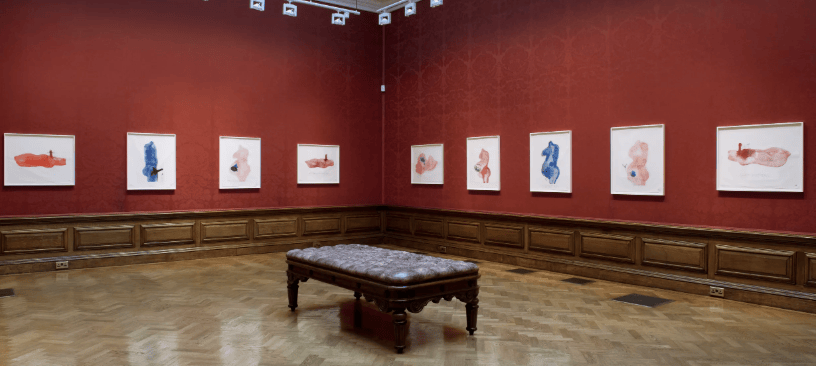
Bourgeois initiated the works through fluid gouache paintings of male and female torsos. Emin subsequently added drawings and handwritten texts, creating miniature narratives around the older artist’s forms.
The resulting images reveal a remarkable artistic sympathy.
Bourgeois’s rounded figures possess a sensual, almost biological presence, while Emin’s smaller marks introduce movement, narrative and psychological specificity.
The collaboration was among the final projects of Bourgeois’s life. It remains a particularly moving example of artistic dialogue between generations, founded upon shared interests in the body, memory and the physical expression of emotion.
Painting and the Question of Form
Emin’s relationship with painting has been continuous, although it has also been complicated.
After completing her training at the Royal College of Art, she struggled with the medium, eventually destroying much of her student work.
Her 1996 performance Exorcism of the Last Painting I Ever Made attempted to confront that difficulty by turning the act of painting into a public event.
For three weeks, she occupied a studio constructed inside a Stockholm gallery, making work while visitors observed her through viewing apertures.
The performance revealed the anxiety surrounding artistic production itself: the difficulty of beginning, the frustration of imperfect results and the persistent desire to recover a language that had previously seemed possible.
Her later return to painting developed gradually, drawing upon the expressive possibilities already established through her monoprints.
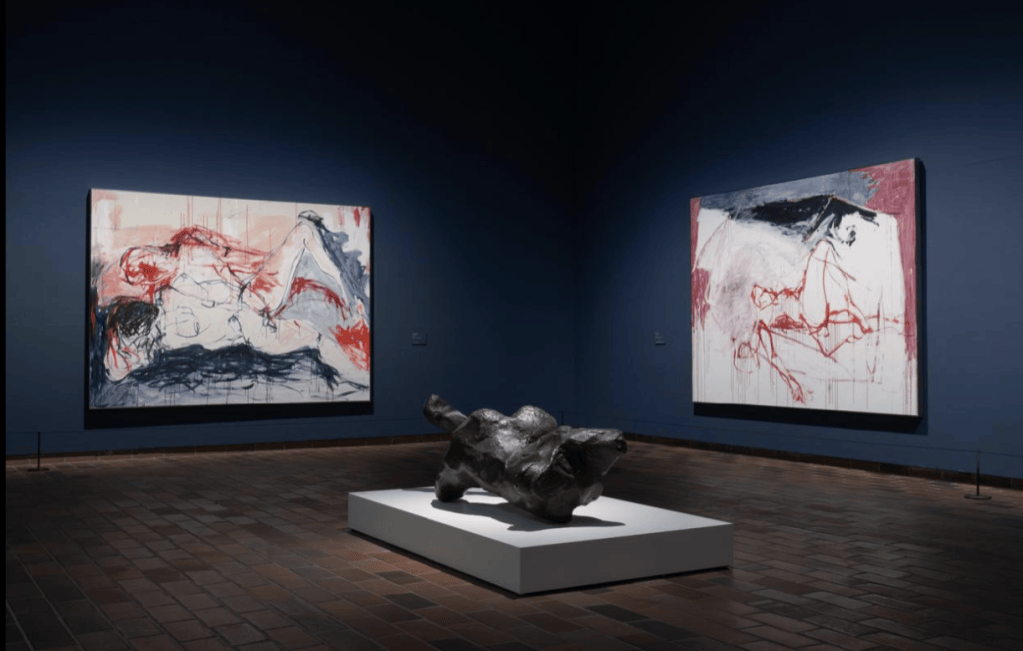
The paintings of the past decade demonstrate considerable formal confidence. Human figures emerge from energetic passages of colour, their outlines frequently interrupted by drips, stains and areas of erasure.
In The End of Love (2024), the bodies appear to merge with their surroundings, their forms partially concealed within a field of restless brushwork.
The composition possesses a quality of continual movement. Lines suggest physical contact, then dissolve into passages of colour whose precise relationship to the figures remains uncertain.
The tension between presence and disappearance recalls Munch, although Emin’s treatment of paint is more fluid and less dependent upon established contours.
Her palette has become particularly distinctive. Reds, pinks, pale blues and dark, almost black passages frequently establish the emotional character of a painting before its subject becomes recognisable.
The red can suggest physical injury or intense desire, but its pictorial function extends beyond symbolism. It establishes weight, rhythm and movement across the surface.
The paintings reward sustained attention because their emotional intensity is supported by genuine compositional intelligence.
Emin understands when an image needs another mark and when the preservation of empty space will communicate more effectively.
This is particularly apparent in works where the body is reduced to a few isolated gestures. The surrounding canvas acquires an active presence, suggesting the physical and psychological space in which the figure exists.
The relationship between drawing and painting has become increasingly fluid. Even her largest canvases retain the immediacy of works on paper, with the movement of the hand remaining visible beneath the accumulated paint.
The Body and Its Alterations
Emin’s diagnosis of bladder cancer in 2020 introduced profound changes into her personal life and artistic practice.
Following extensive surgery, she began producing works that addressed the altered body with an immediacy informed by the experience of serious illness.
Her recent paintings and bronze sculptures explore physical vulnerability, mortality and the continuing possibility of intimacy.
The body frequently appears fragmented or exposed, its familiar anatomical relationships interrupted by the demands of the image.
In sculpture, these concerns acquire a different material character.
Bronze offers permanence and substantial physical weight, qualities that contrast with the instability of the forms being represented.
Emin often preserves the marks of modelling within the finished sculpture, allowing the surface to retain something of the fragility of its original construction.
The resulting figures recall aspects of Auguste Rodin and Alberto Giacometti, particularly their interest in the relationship between the sculptural object and the physical experience of the human body.
Yet Emin’s recent work also returns to a concern evident throughout her career: the difficulty of representing the body as something simultaneously familiar and subject to continual change.
The experience of illness has intensified that investigation, but its artistic foundations were established decades earlier.
A Continuing Commitment to Art
Emin’s influence extends beyond her exhibitions and the considerable international recognition she has received.
Her appointment as Professor of Drawing at the Royal Academy of Arts in 2011 reflected the seriousness of her engagement with artistic education, particularly the importance of practical knowledge and sustained work.
More recently, she has developed the Tracey Emin Foundation and TKE Studios in Margate, creating opportunities for artists to work within a community committed to painting, drawing and artistic experimentation.
The foundation’s residency programme, TEARS, emphasises individual development through studio practice, discussion and intensive artistic engagement.
This commitment to education belongs naturally within an account of Emin’s artistic philosophy.
Her work has consistently demonstrated the value of developing an individual visual language, even when that language conflicts with prevailing artistic conventions.
Across the different periods of her career, she has remained closely engaged with the physical processes of making. Drawing, painting, embroidery, sculpture and installation have provided different means of investigating subjects that continue to interest her.
It is perhaps through the drawings that the consistency of her work becomes clearest.
The small birds of the 1990s and early 2000s, the intimate monoprints, the gestural figures and the monumental paintings all reveal a sustained interest in the relationship between physical marks and emotional experience.
Emin’s artistic language has become more expansive with time, but the sensitivity of the earliest works remains visible.
A fragile bird balanced upon a branch can communicate something that would be diminished by a more elaborate image. Its significance emerges through the delicate economy of the drawing and the space left around it.
It is an image worth remembering when considering the extraordinary scale and emotional force of her recent paintings. The same intelligence that gives those canvases their intensity was already present in the slight movement of a line across a small sheet of paper.

