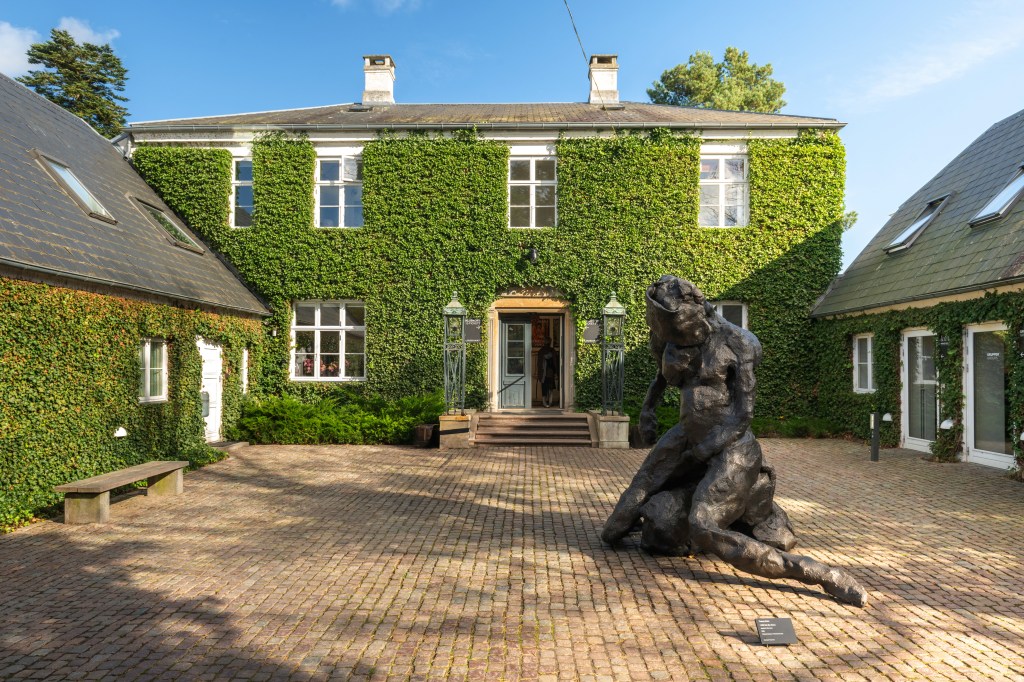
At Louisiana Museum of Modern Art, Tracey Emin’s retrospective brings nearly four decades of work together, revealing the remarkable continuity between her early installations and the increasingly assured paintings of recent years.
Almost thirty years after My Bed (1998) became one of the most controversial works in British contemporary art, it is fascinating to encounter it within the context of Emin’s entire career. The stained sheets, underwear, cigarette packets and personal debris remain familiar. What has changed is our understanding of the artist who made it.
At the Louisiana Museum of Modern Art, Tracey Emin: A Second Life brings together painting, sculpture, film, textiles and installation, including previously unseen works and a substantial selection of recent paintings.
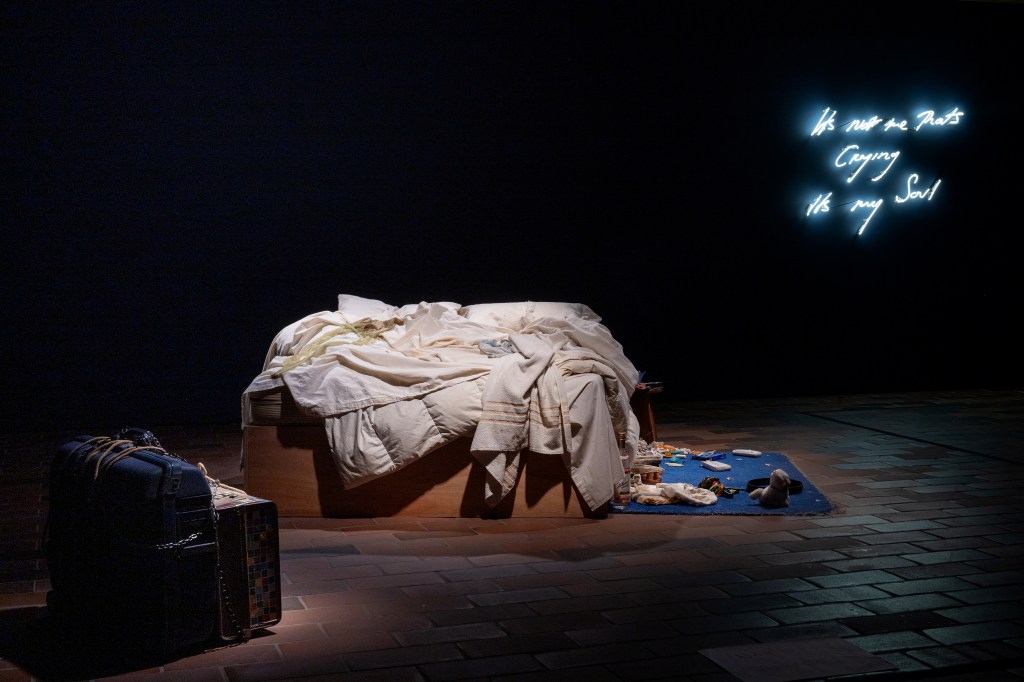
Organised by Tate Modern in collaboration with Louisiana, the exhibition runs until 18 April 2027. It offers a particularly rewarding experience for those familiar with the British art world of the 1990s, when Emin’s public reputation often threatened to overshadow serious consideration of her work.
The exhibition’s title refers in part to Emin’s survival of bladder cancer, diagnosed in 2020. Yet the works suggest a more interesting interpretation of a second life: the possibility of looking back across an artistic career and recognising qualities that were present long before they received their due attention.
The Works We Thought We Knew
The early works remain enormously affecting, particularly the film Why I Never Became a Dancer (1995). Emin recounts her adolescence in Margate, including the sexual humiliation she experienced during a local dancing competition.
The film is deceptively simple. Her narration accompanies images of the seaside town until, in its final sequence, Emin dances alone to Sylvester’s You Make Me Feel (Mighty Real). The moment is funny, defiant and unexpectedly moving. Her response to humiliation is to reclaim the pleasure of dancing.
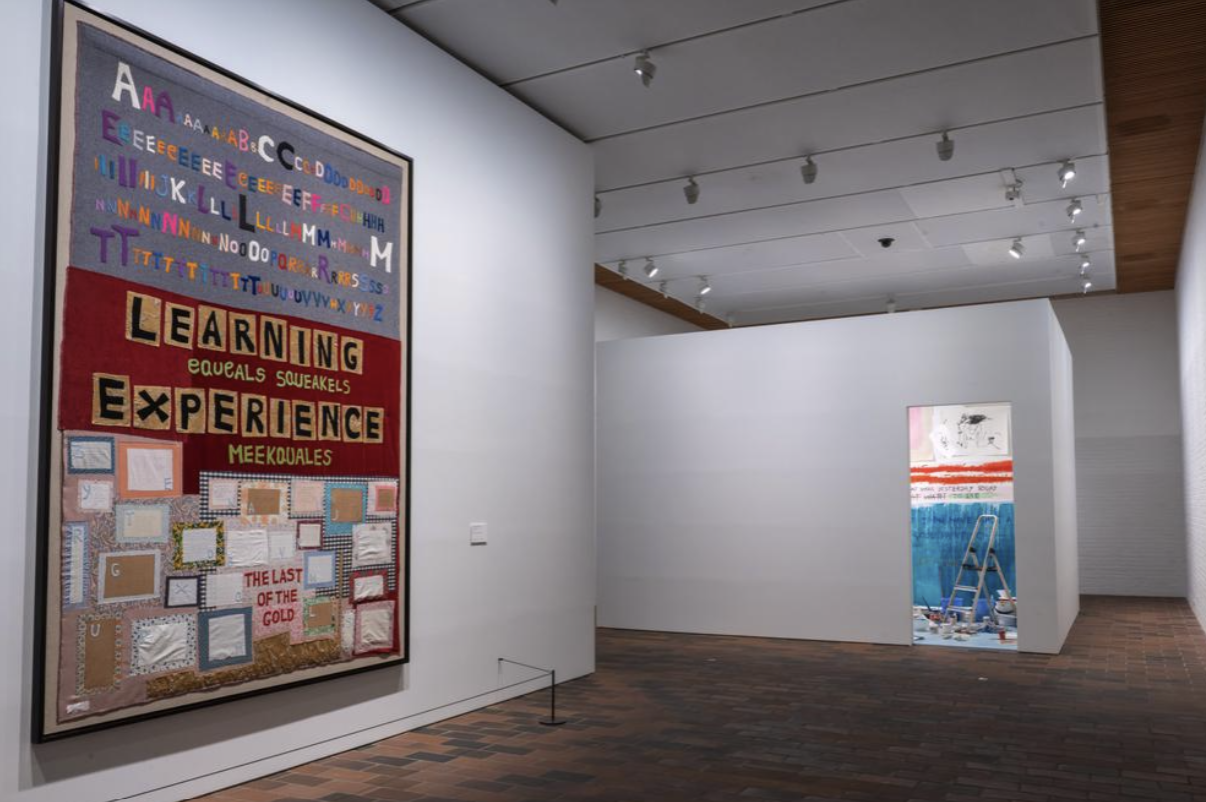
Nearby, Exorcism of the Last Painting I Ever Made (1996) provides an important reminder that painting was central to Emin’s ambitions long before her recent canvases brought her widespread recognition in the medium.
The original performance involved Emin living and painting inside a Stockholm gallery for several weeks, observed through viewing apertures. Having destroyed earlier paintings during a difficult period of her life, she was attempting to recover her confidence in the practice.
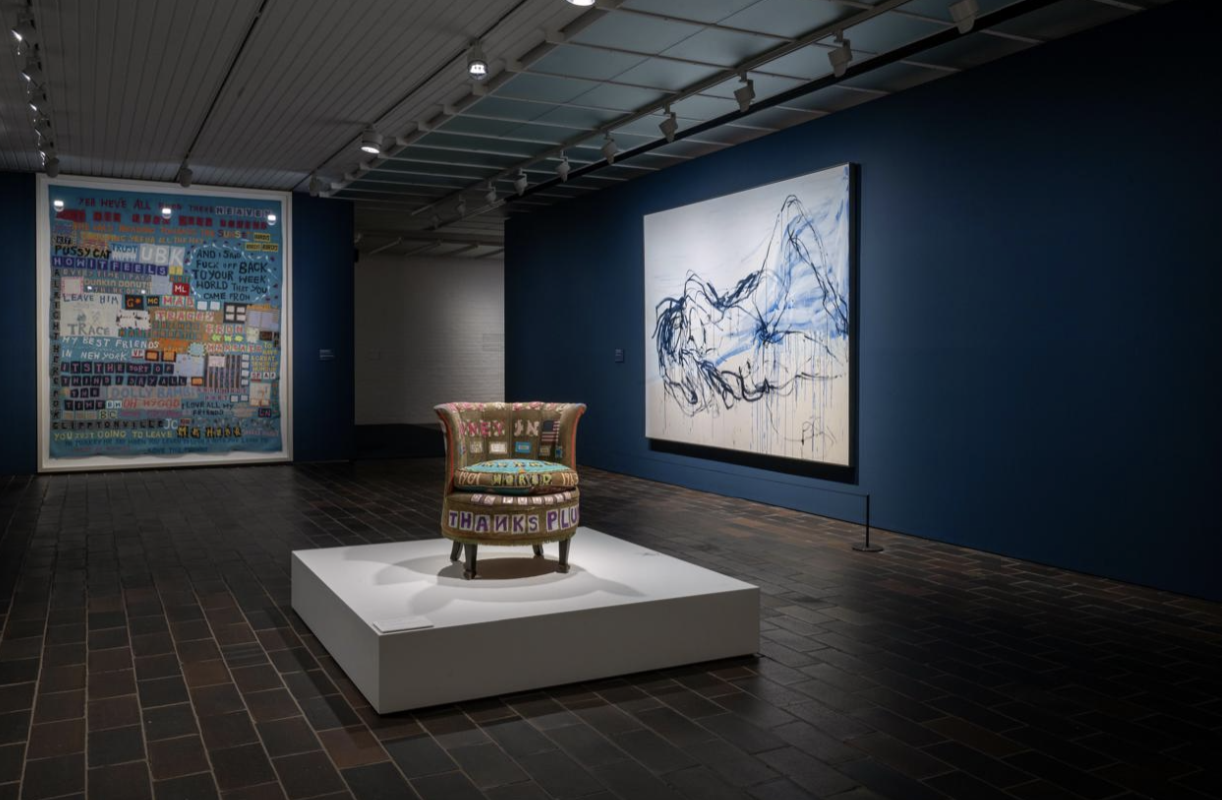
The appliqué blankets offer another example of her ability to bring together apparently incompatible traditions. In Mad Tracey from Margate. Everyone’s Been There (1997), the domestic associations of sewing and embroidery meet language that is angry, direct and deliberately confrontational.
These works belong within a longer history of feminist art, although Emin’s particular achievement lies in the ease with which she moves between tenderness, humour, anger and vulnerability. Even her quieter bird drawings, less prominent in the familiar accounts of her career, reveal an artist whose emotional vocabulary has always extended well beyond confrontation.
The Body Becomes Painting
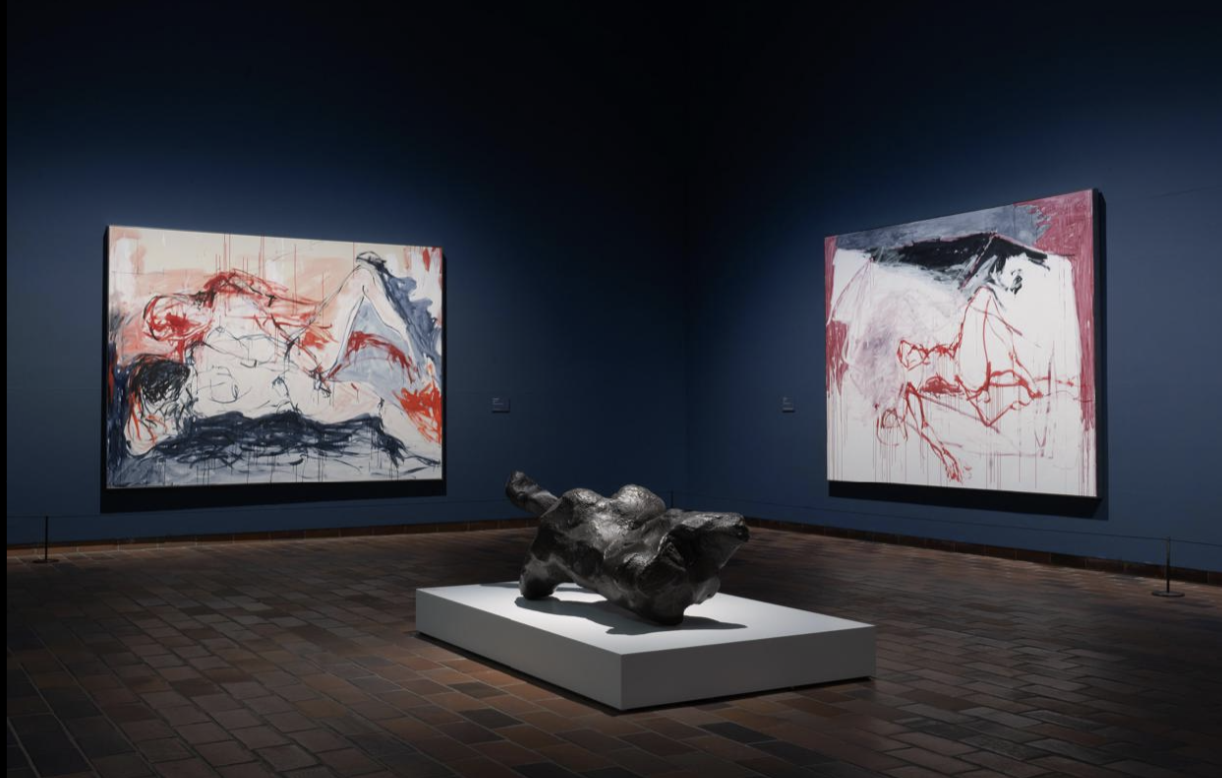
The exhibition’s most convincing achievement is its presentation of Emin’s paintings.
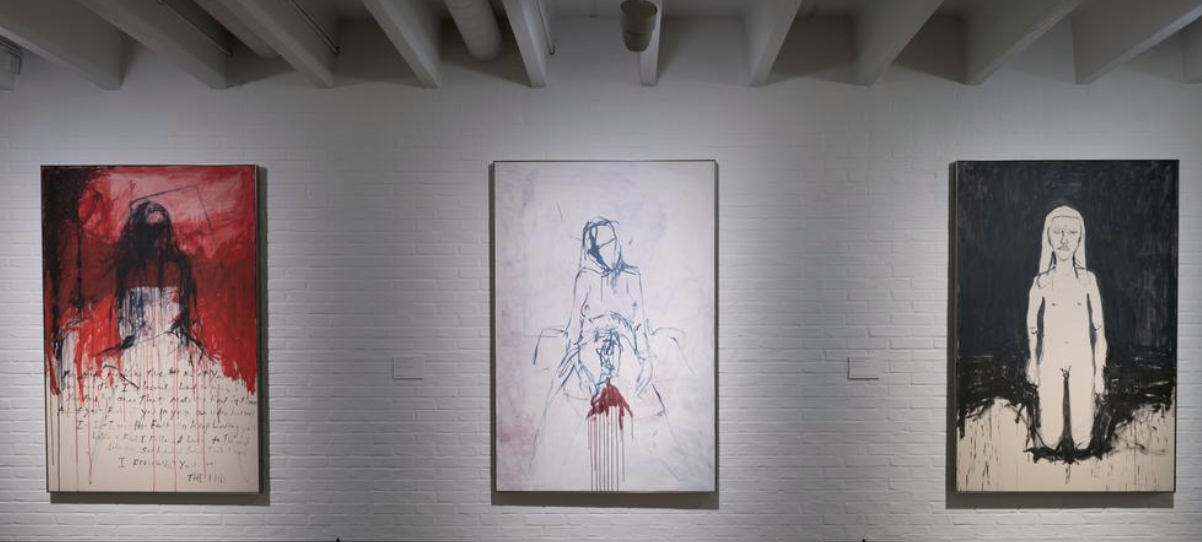
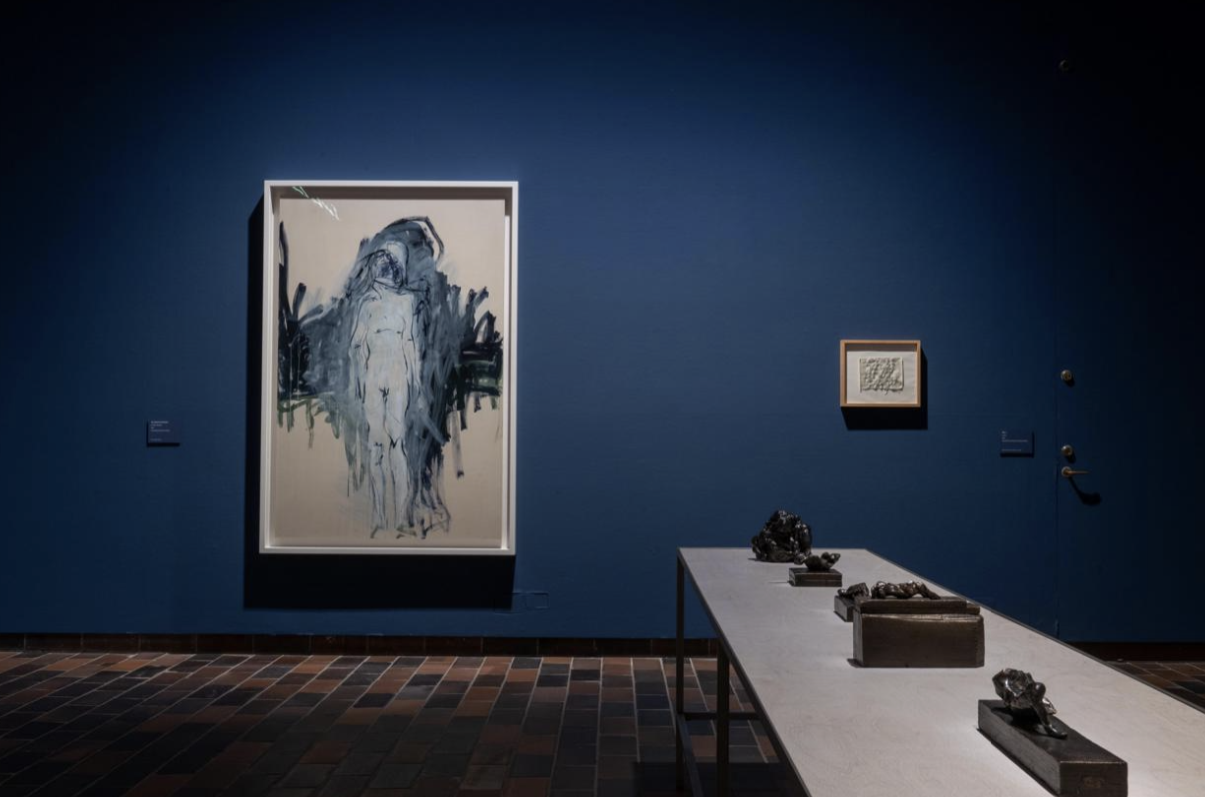
In recent years, the human figure has become increasingly central to her work. Bodies emerge through hurried lines, diluted acrylic, broad gestures and areas of exposed canvas. They are often difficult to distinguish from the spaces surrounding them, appearing to lose their solidity as we look.
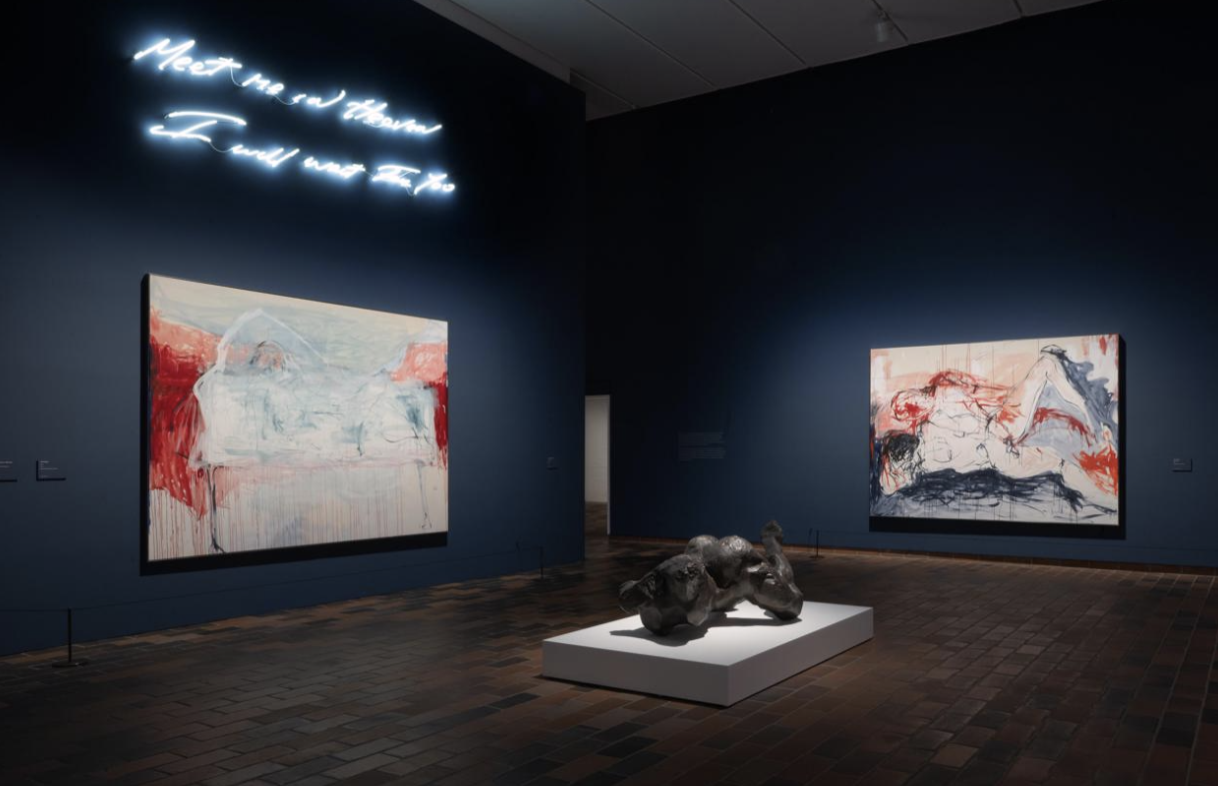
In The End of Love (2024), a figure collapses against a bed, its body articulated through forceful passages of colour. The physical handling of paint carries much of the work’s emotional intensity.
I Followed You to the End (2024) combines a solitary female figure with handwritten reflections on love and abandonment. The words are painfully direct, yet the painting’s force comes equally from the unstable outline of the body, suspended amid areas of red and black.
Emin’s admiration for Edvard Munch and Egon Schiele is well documented, and their influence is evident in her treatment of the figure. Like them, she uses the body as a means of exploring emotional states that cannot be adequately expressed through conventional portraiture.
Yet the paintings are unmistakably her own. Their exposed drawing, liquid surfaces and abrupt changes of scale give them an urgency that becomes particularly apparent when encountered in person.
The strongest works no longer require the viewer to know every detail of the artist’s biography. They possess a visual authority independent of the experiences from which they emerged. This is perhaps the clearest indication of Emin’s increasing confidence as a painter.
The Meaning of a Second Life
Emin’s serious illness forms an important part of the exhibition, although it would be misleading to interpret her recent work solely through the experience of surviving cancer.
Following extensive surgery in 2020, her relationship with her body changed profoundly. The vulnerability of physical existence, long present in her work, acquired an immediate and unavoidable significance.
The recent paintings and sculptures confront this altered body without attempting to make it heroic. It can appear damaged, exhausted or exposed, but it remains capable of desire and pleasure.
There is continuity here with her earliest work. Emin has always explored the physical and emotional consequences of being alive, and illness has intensified concerns that were already fundamental to her practice.
Outside the museum, the bronze sculpture I Will Not Be Alone (2025) stands near one of Henry Moore’s reclining figures. The juxtaposition is fascinating. Moore’s sculpture transforms the human body into an arrangement of monumental, organic forms, while Emin’s seated figure retains an insistent sense of individual psychological experience.
Her sculptural work is less consistently persuasive than her painting, although certain pieces possess a formidable physical presence. The familiar neon texts are similarly uneven: the handwritten statements remain unmistakably Emin’s, but their immediacy can occasionally limit their complexity.
Such distinctions are worth making. A major retrospective should allow us to recognise differences in artistic achievement rather than treating every work as equally important because of the life behind it.
Beyond the Autobiography
Tracey Emin has discussed her experiences of sexual violence, abortion, grief, difficult relationships and serious illness with unusual openness. The familiarity of these stories can, however, make it difficult to look at the work without first thinking about the life.
Louisiana’s retrospective is particularly successful when it allows the art to lead.
The relationship between the early installations and recent paintings becomes clearer through the exhibition’s thematic presentation. Across different media, Emin has explored the possibilities of giving material form to private experience. Her achievement lies as much in her choices of colour, composition, gesture and material as in the subjects she has been willing to confront.
Louisiana’s galleries provide a particularly sympathetic setting. The paintings have sufficient space to command attention, while the juxtaposition of works from different periods encourages a less chronological understanding of her development.
There is also something satisfying about seeing My Bed almost thirty years after the arguments surrounding its original appearance. The work no longer needs the controversy that made it famous. Within this exhibition, it can be understood as one contribution to a much larger body of work.
Emin’s career has contained changes of direction, periods of uncertainty and considerable personal upheaval, but the artistic concerns have remained strikingly consistent.
A Second Life makes that continuity visible. Above all, it demonstrates how an artist initially celebrated and criticised for her willingness to expose her private life has developed an increasingly accomplished visual language through which to express it.
Tracey Emin: The Life of a Line
Tracey Emin: From Cool Britannia to Enduring Voice
Exhibition information
Tracey Emin: A Second Life
8 October 2026 – 18 April 2027
Louisiana Museum of Modern Art
Gl. Strandvej 13, 3050 Humlebæk, Denmark
Official exhibition information
Tracey Emin in conversation with Louisiana Channel: I Am Doing What I Think Is Right

