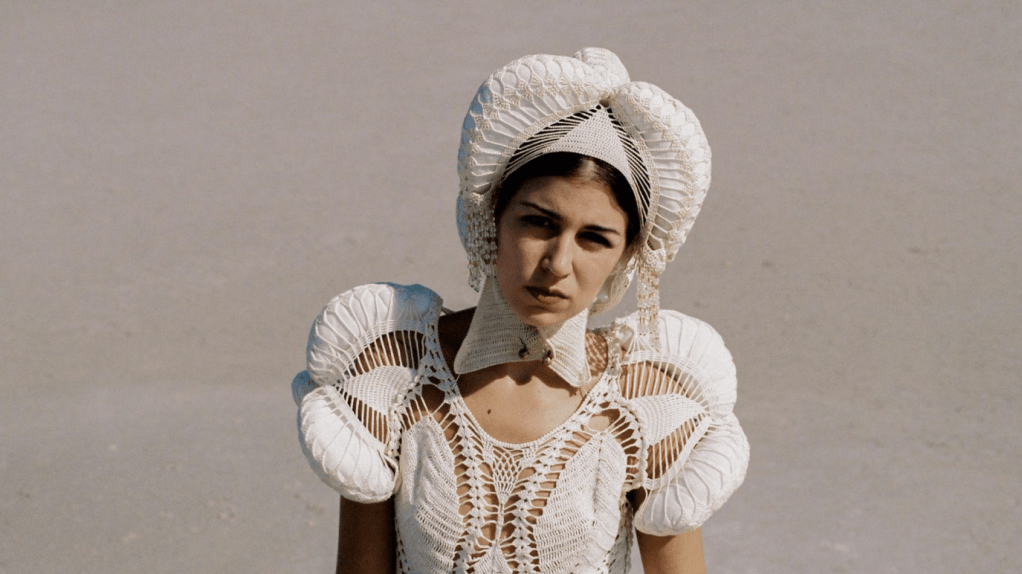
With Dja Dja, released on 9 October 2026, Catalan composer Marina Herlop has produced one of the year’s most adventurous albums: a dazzling, occasionally bewildering collision of classical composition, experimental electronics, invented languages and Balinese gamelan. Three years in the making, it arrives with an unusually pointed argument about the state of contemporary music. At a time when artists are increasingly expected to produce images, personalities and a continuous supply of promotional material, Herlop has devoted herself to something rather unfashionable: the painstaking business of making music.
Three Years and a Piece of Cardboard
For much of the past three years, a large piece of cardboard lay across the floor of Marina Herlop’s Barcelona studio. Covered in coloured notes, musical instructions and diagrams, it mapped the structure of an album that had gradually grown into an extraordinarily complicated undertaking.
Herlop had decided that her fifth record would be conceived as a single composition, rather than a collection of independent songs. Every musical idea would have consequences for the others. A melody established early in the album might reappear much later in altered form; changes in instrumentation, harmony or tempo would affect the larger architecture.
She compared the undertaking to a giant Sudoku puzzle, in which every individual solution influences the rest.
The resulting album, Dja Dja, is a remarkable achievement. Spanning fifteen tracks and just over fifty-two minutes, it moves between delicately constructed piano passages, intricate vocal arrangements, orchestral brass, electronic percussion and recordings of Balinese gamelan musicians. Its musical language is unmistakably contemporary, yet much of its formal ambition belongs to a considerably older understanding of composition.
Herlop wanted to create something that demanded time, concentration and a degree of patience, not only from the listener but from herself.
That ambition has become unusually significant in 2026.
The contemporary music industry increasingly rewards visibility and frequency. Streaming platforms encourage regular releases, while social media places constant demands upon musicians to maintain an audience through videos, images, interviews and personal disclosures. The creation of music has become entangled with the continuous production of material designed to promote it.
Herlop has been unusually candid about her dissatisfaction with this arrangement.
In an illuminating October interview with El País, she questioned an industry in which music has increasingly become subordinate to visual presentation. She also explained her decision to release Dja Dja independently: the work required a schedule that conventional recording and promotional cycles could not comfortably accommodate.
Her argument was not that musicians should withdraw from contemporary culture, but that artistic development requires time which may produce no immediately marketable result.
There is something wonderfully contrary about spending three years constructing an album in an industry that increasingly treats three weeks without new content as an absence requiring explanation.
From the Piano to an Imaginary Language
Born Marina Hernández López in Piera, Catalonia, in 1992, Herlop received a classical musical education and developed an early fascination with the expressive possibilities of the piano.
Her first two albums, Nanook (2016) and Babasha (2018), were relatively restrained recordings built around piano and voice. Their harmonic language reflected her familiarity with classical composition, particularly the impressionistic textures associated with composers such as Debussy and Ravel.
But Herlop was already interested in disrupting conventional expectations.
Her breakthrough came with Pripyat (2022), released through the Berlin-based experimental label PAN. Having immersed herself in electronic production, she began constructing compositions in which acoustic instruments, manipulated voices and digital sounds moved through rapidly changing rhythmic structures.
Herlop’s engagement with South Indian Carnatic vocal techniques proved particularly influential. She became fascinated by the possibilities of using the voice rhythmically, treating syllables as musical material rather than vehicles for conventional lyrical meaning.
The resulting vocal arrangements were unlike much contemporary pop. Voices appeared in overlapping patterns, producing combinations of familiar human expression and unfamiliar phonetic sounds.
Her subsequent album, Nekkuja (2023), developed this language further, incorporating elaborate harmonies, abrupt changes in texture and melodies that seemed to emerge from an imaginary musical tradition.
Critics have understandably compared Herlop with Björk, whose recordings similarly combine technological experimentation with a distinctive vocal language.
But the comparison only takes us so far.
Herlop’s music frequently appears less interested in autobiography than in the physical properties of sound. Her vocal arrangements do not necessarily invite us to interpret a particular emotional experience. They encourage us to encounter the voice as an instrument capable of creating its own structures and relationships.
This is one reason her invented or phonetic language is so effective. Without the familiar narrative cues of conventional lyrics, the listener must pay greater attention to rhythm, timbre and the interaction between musical elements.
Meaning emerges through sound rather than being delivered through words.
It is an approach that can be initially disorientating, but it also offers extraordinary imaginative freedom.
(129) Marina Herlop – Emne – YouTube
The Hero’s Journey, Without the Hero
For Dja Dja, Herlop chose an unusual structural foundation: the hero’s journey, the narrative model associated with mythologist Joseph Campbell’s 1949 book The Hero with a Thousand Faces.
Campbell proposed that myths and traditional stories frequently follow a recognisable pattern in which an individual leaves an ordinary world, encounters extraordinary challenges and eventually returns transformed by the experience.
The model has exercised enormous influence upon contemporary popular culture, particularly cinema. George Lucas famously drew upon Campbell’s ideas during the development of Star Wars, and variations of the structure appear throughout mainstream storytelling.
For a musician whose work largely rejects conventional narrative, the decision might initially seem strange.
But Herlop was not interested in illustrating a familiar story. She used the structure as a compositional framework, organising changes in harmony, rhythm and instrumentation around the emotional progression of an imagined journey.
The distinction matters.
The album does not require a listener to identify a particular hero, villain or sequence of fictional events. Its narrative exists principally through musical transformation.
The opening track, Flor de los precipicios (Flower of the Precipices), establishes a relatively delicate environment of flute-like textures and carefully arranged melodic fragments. Heladas (Frosts) introduces a more reflective piano passage before the six-minute As meigas (The Witches) moves into far stranger territory.
Here, the vocal language becomes particularly adventurous. Voices chatter, chant, overlap and shift between melodic beauty and deliberately unsettling textures.
The effect resembles entering a world governed by unfamiliar rules. Musical phrases seem to invite interpretation, only to escape before their meaning can be established.
Elsewhere, Herlop introduces unexpected elements of funk, orchestral composition and electronic dance music.
Vas volant (You Go Flying), featuring her close collaborator Adri Goor, possesses a rhythmic suppleness that contrasts with the more elaborate vocal passages, while Los dos lobos (The Two Wolves) introduces muscular brass arrangements and an almost confrontational sense of momentum.
One of the most striking transitions occurs between You’ve Lost Your Muchness and Hay ángeles (There Are Angels). The former introduces dissonance and instability into an apparently ethereal vocal environment, before the latter offers a more recognisable melodic release.
The sequence communicates a sense of collapse and recovery without needing to explain either experience through language.
By the time Bliss arrives, the album has acquired a celebratory quality. Brass, percussion and voices accumulate into an exuberant musical climax.
The closing Muy heladas (Very Frosty) returns to harmonic material established near the beginning, but presents it through a changed instrumental perspective.
The musical world has altered, even though recognisable elements of the opening remain.
Herlop’s use of the hero’s journey ultimately serves an interesting purpose. The familiar narrative framework provides discipline, but the music is free to develop its own meanings.
The structure becomes a means of encouraging invention rather than restricting it.
Why Complexity Can Be Pleasurable
One of the unfortunate habits of contemporary music criticism is the tendency to equate complexity with seriousness.
Difficult music is praised for its intellectual ambition, while accessible music is treated as though immediate pleasure necessarily implies artistic simplicity.
Herlop’s work makes this distinction increasingly difficult to defend.
Dja Dja is undoubtedly complicated. Its rhythms can be irregular, its instrumentation unpredictable and its vocal arrangements startlingly elaborate.
Yet the music is frequently exuberant.
There are passages that invite dancing, melodies of extraordinary sweetness and sudden changes in musical character that possess an unmistakable sense of humour.
The album’s formal ambition does not prevent it from being playful.
Indeed, the pleasure often emerges directly from the complexity.
A familiar rhythmic pattern may be disrupted by an unexpected instrumental entrance. A delicate melody may suddenly acquire a percussive force that changes its entire character. Voices can move from apparent innocence towards something unsettling and return again within a few moments.
These changes reward attention because the listener gradually begins recognising relationships that were not immediately apparent.
The album becomes more intelligible through familiarity.
This is an important distinction from music that depends upon difficulty as a form of cultural prestige.
Herlop is not asking listeners to admire how hard her compositions are to understand. She is creating environments in which close attention produces increasingly rich experiences.
The ambition is closer to that of a complicated novel or an elaborate piece of architecture, where individual details acquire meaning through their relationship with the larger whole.
There is, however, a legitimate question about whether the album occasionally becomes too elaborate.
Herlop is an avowed maximalist, and her compositions sometimes threaten to overwhelm themselves through the sheer quantity of musical ideas. The listener can struggle to identify which elements deserve attention, while moments of exceptional beauty may disappear before they have been given sufficient space.
Adri Goor, who acted as a production adviser, helped her reduce and refine the material.
The resulting tension between abundance and restraint is part of what makes the record interesting. Dja Dja is not a celebration of complexity for its own sake. It is the work of an artist attempting to discover how much invention a musical structure can accommodate without losing its coherence.

The Music Industry’s Visual Obsession
The most provocative aspect of Dja Dja may lie in the circumstances of its release.
Herlop has described her growing discomfort with the expectation that musicians must construct elaborate visual identities around their work. Music videos, promotional photographs, stylised performances and continuous social-media production now occupy an increasingly large portion of an artist’s professional life.
These activities can be artistically rewarding. Some of the most important figures in popular music, from David Bowie to Grace Jones and Björk, have treated visual presentation as an essential element of their work.
There is nothing inherently inferior about an artist who thinks visually.
The difficulty arises when visual production becomes an obligation rather than a creative choice.
Herlop’s concern is that musicians may find themselves devoting enormous quantities of time, money and energy to activities only indirectly connected with the development of their music.
In her October interview with El País, translated here as The Pop Industry Has Made Music Subordinate to Visual Presentation, she argued that studying, learning and absorbing new ideas should take precedence over the constant production of content.
The distinction is important because it addresses something larger than social media.
It concerns the relationship between artistic development and commercial productivity.
An artist may need months to understand a particular technique or develop a new musical language. Such work may produce nothing immediately suitable for publication, yet it can become essential to everything that follows.
In the contemporary digital economy, periods of apparent inactivity can be commercially difficult to justify.
The musician is encouraged to remain visible even when the most valuable work is happening privately.
Herlop’s decision to self-release Dja Dja reflects her desire to protect that private process.
Independence is not absolute, of course. The record still depends upon collaborators, distributors, streaming services and the audience Herlop has built through earlier releases. Self-releasing is also considerably easier for an artist who already possesses an established international reputation.
Nor has she abandoned visual culture altogether. The album’s striking red cover features Naomi and Ruth: The Weight of a Curse, a painting by American artist Brittney Leeanne Williams, and Herlop’s stage presentation has often been carefully considered.
Her objection is therefore not to imagery itself.
It is to the assumption that imagery must continually accompany and justify the existence of music.
She is defending the artist’s right to decide where her creative attention belongs.
The Luxury of Taking Time
There is a broader cultural argument within Herlop’s decision to spend three years making a single album.
Contemporary digital technology has made the production and distribution of music easier in certain respects, but it has also encouraged an extraordinary acceleration of creative life.
Artists can record at home, distribute their work internationally and communicate directly with audiences. These are substantial achievements.
Yet the same systems generate constant pressure to remain productive and visible.
The professional musician must increasingly function as composer, performer, producer, publicist, visual strategist and social-media personality.
The result can be an uncomfortable contradiction. The technologies that promise creative independence may also introduce new demands upon the artist’s time.
Herlop has responded by imposing restrictions of a different kind.
Her creative process is not organised around maximum speed or output. It is governed by the demands of the work itself.
She has spoken about long days spent attempting to solve compositional problems without arriving at a satisfactory result, and about the frustration involved in accepting that such apparently unproductive periods remain necessary.
That experience will be familiar to anyone involved in serious creative work.
An artist does not necessarily discover something valuable by producing more. Sometimes the most significant development occurs through sustained attention to a problem that resists resolution.
The point is not that slow work is automatically better. Nor is it that all musicians should spend years making albums.
Rather, Herlop’s example demonstrates the importance of allowing different forms of creativity to develop according to their own requirements.
A culture that recognises only the value of continuous production risks losing the conditions necessary for more demanding forms of invention.
Dja Dja is interesting not merely because it took three years to make, but because its musical ambition helps explain why that time was required.
An Album That Asks Us to Listen Differently
The decision to structure Dja Dja as a complete work also challenges the increasingly fragmented ways music is consumed.
Streaming platforms encourage listeners to move between tracks, playlists and recommendations with remarkable speed. Individual songs circulate independently of the albums from which they emerged, while short excerpts can achieve enormous popularity through social media.
There is nothing inherently objectionable about these developments. Popular music has always existed through singles, radio broadcasts and other forms of relatively brief listening.
But the album remains an important artistic form precisely because it allows musicians to establish relationships across extended periods.
Herlop takes those possibilities seriously.
The opening and closing passages of Dja Dja are connected, musical ideas develop through successive transformations and the album’s emotional progression depends upon the relationship between its different sections.
To encounter only individual tracks is therefore to experience part of the work.
The complete recording asks for something that has become increasingly precious: uninterrupted attention.
This does not mean that listeners must decode every compositional decision to appreciate it. Herlop’s use of invented language and unusual musical forms actively encourages subjective interpretation.
The album can be experienced as an elaborate journey, an unusual collection of sonic landscapes or simply an astonishing succession of musical sensations.
Its complexity does not prescribe a single correct response.
Instead, it creates possibilities for different kinds of listening.
That openness is one of its most attractive qualities.
The Right to Be Difficult
There is something refreshing about an artist who refuses to confuse accessibility with simplicity.
Herlop’s music can be playful, beautiful, confusing, exhilarating and occasionally excessive. She is willing to pursue an idea beyond the point at which a more commercially cautious musician might have simplified it.
This willingness does not guarantee success, but it creates the conditions in which genuinely unfamiliar music can emerge.
Her achievements also suggest an interesting future for experimental pop.
The increasingly familiar distinction between high and popular culture has become less convincing as musicians develop sophisticated relationships with electronic production, classical composition and global musical traditions.
But the disappearance of stylistic boundaries does not automatically produce originality.
Musical invention still depends upon choices, discipline and an individual understanding of form.
What distinguishes Herlop is not simply the number of traditions she incorporates, but the degree to which she transforms their materials into a recognisable personal language.
Her treatment of the voice, in particular, is extraordinary. It becomes an instrument of rhythm, texture and emotional suggestion, capable of communicating experiences that resist conventional verbal description.
Her approach to structure is similarly distinctive. She combines a composer’s concern for the relationship between parts with a producer’s willingness to explore the unpredictable behaviour of sound.
The results are sometimes bewildering, but they are rarely anonymous.
In an industry that places enormous emphasis upon recognisable personalities, Herlop has achieved something more interesting: recognisable music.
Beyond the Content Economy
Perhaps the most significant quality of Dja Dja is its confidence in the possibilities of musical experience.
The album does not depend upon an elaborate fictional mythology, a continuous stream of promotional images or an intimate knowledge of its creator’s private life.
Its artistic identity emerges principally through the composition itself.
The choice seems almost radical in the present cultural environment, although it would once have been regarded as entirely ordinary.
Musicians made records. Audiences listened to them. The relationship between the work and the listener was not necessarily mediated through a continuous presentation of the artist’s personality.
That older arrangement was hardly perfect, but it permitted a greater degree of separation between creative activity and personal publicity.
Herlop is not proposing a nostalgic return to the past. Her music is too technologically adventurous and too deeply involved with contemporary experimental culture for that.
Instead, she is asking whether some of the freedoms associated with artistic independence might be worth recovering.
The freedom to work slowly. To study without immediately producing. To create something difficult without apologising for its complexity. To allow music to generate its own images within the listener’s imagination.
Dja Dja offers a persuasive example of what those freedoms can produce.
It is a record full of strange beauty, extravagant musical invention and an almost contagious enthusiasm for the possibilities of sound. Its elaborate structures occasionally threaten to overwhelm the listener, but its ambition is sustained by a remarkable sense of pleasure in the act of composition.
More importantly, it suggests that experimental music need not retreat into intellectual isolation to preserve its independence.
It can be humorous, physical, emotionally generous and frequently exhilarating.
Herlop has made a record that asks a great deal of itself and rewards the attention of those prepared to follow it.
In a culture increasingly organised around making things instantly legible, that is a valuable achievement.
She has not made music to accompany the content.
She has made music worth paying attention to.
The Listening Guide
Listen to the complete album — Marina Herlop on Bandcamp
Dja Dja is best experienced from beginning to end, but these five tracks offer a useful introduction to its musical language.
1. As meigas (The Witches)
An extraordinary example of Herlop’s vocal experimentation. Overlapping voices, unexpected rhythmic patterns and rapidly shifting textures create a musical environment that seems to possess its own unfamiliar language.
2. Vas volant (You Go Flying), featuring Adri Goor
A more rhythmically approachable composition that reveals Herlop’s ability to bring elements of pop, electronic production and sophisticated musical structure into a coherent whole.
3. Los dos lobos (The Two Wolves)
A thrilling introduction to the album’s orchestral ambitions. Brass, percussion and shifting rhythmic patterns create a sense of extraordinary momentum.
4. Average evil
One of the album’s most adventurous combinations of musical traditions, incorporating gamelan recorded in Bali with electronic rhythms and elaborate vocal production.
5. Bliss
A joyous, theatrical climax in which brass, percussion and voices combine to create something approaching collective celebration.
Album Information
Marina Herlop — Dja Dja
Release date: 9 October 2026
Fifth studio album; first self-released album
15 tracks | Approximately 52 minutes
Composition, production and recording: Marina Herlop
Production adviser: Adri González (Adri Goor)
Mixing: Joker, James Ginzburg and Marina Herlop
Mastering: Alex Ferrer
Cover artwork: Naomi and Ruth: The Weight of a Curse by Brittney Leeanne Williams
Distribution: Lapsus Records via !K7 Music
Official album, streaming and physical editions
Marina Herlop — Official Website
Further Reading and Listening
An excellent interview, originally published in Catalan, examining the album’s construction, Herlop’s approach to artistic independence and her concerns about the contemporary industry’s demands upon musicians.
Marina Herlop: Dja Dja — Pitchfork
Matthew Blackwell’s enthusiastic assessment explores the album’s relationship with the hero’s journey and the extraordinary range of its musical arrangements.
Marina Herlop: Dja Dja — Bandcamp Daily
April Clare Welsh examines Herlop’s developing musical language, from her early piano compositions to the electronic and vocal experimentation of Dja Dja.
Marina Herlop Is Classically Trained and Totally Chaotic — Pitchfork
An entertaining and revealing 2022 interview with Philip Sherburne about Herlop’s creative methods, musical influences and the development of Pripyat.
Musician Marina Herlop on When to Divert from the Plan — The Creative Independent
A thoughtful discussion of artistic uncertainty, improvisation, creative pleasure and the relationship between musical structure and discovery.
Ben Cardew’s review explores the album’s rhythmic complexity, theatrical intensity and relationship with contemporary electronic music.
The breakthrough album that established Herlop’s distinctive combination of electronic experimentation, unconventional vocal technique and intricate composition.
An essential companion to Dja Dja, demonstrating the development of her increasingly elaborate musical language.
