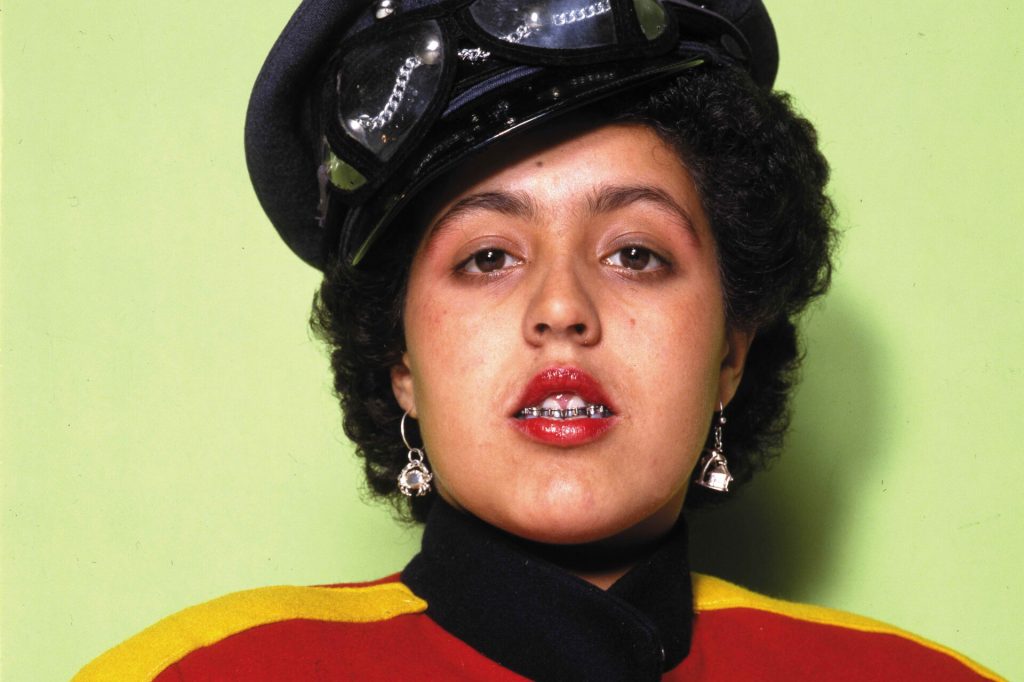
Fifty years after punk erupted into British cultural life, a landmark exhibition at London’s Museum of Youth Culture challenges one of popular music’s most persistent historical distortions. Through previously unseen archives, photography, fashion and fine art, God Save the Queens restores the women who shaped punk to their rightful place: not at the margins of the movement, but at its centre.
Museum of Youth Culture, London | 23 October – 22 November 2026
The Revolution Was Never Exclusively Male
Punk has always possessed an unusually precise mythology. London, 1976. The Sex Pistols, the Clash, Malcolm McLaren, ripped T-shirts, safety pins and the deliberate destruction of everything respectable. Its familiar narrative has become so thoroughly embedded in British cultural history that its protagonists are almost impossible to separate from the movement itself.
Yet this account, for all its apparent rebelliousness, reproduces a remarkably conventional distribution of cultural authority.
The men become revolutionaries. The women become icons, girlfriends, muses or decorative evidence of a particularly exciting period.
It is an extraordinary historical contradiction for a movement that purported to reject established hierarchies.
At the Museum of Youth Culture in Camden, Up Yours! God Save the Queens offers a necessary corrective. Presented by the Up Yours! Collective, the exhibition commemorates fifty years of women in punk, bringing together original artworks, previously unseen photography, clothing, films, drawings and intimate archival material.
The exhibition is not simply concerned with identifying neglected female performers. Its more substantial argument is that women participated in constructing punk’s entire cultural language: the way it looked, the way it sounded, the subjects it addressed, and the possibilities it opened for subsequent generations.
From Poly Styrene and Ari Up to Gina Birch, Linder, Vivien Goldman and Caroline Coon, these were not peripheral participants in someone else’s revolution.
They were among its authors.
1976: Britain at the Point of Rupture
Punk emerged during a period of profound British economic, social and political uncertainty.
By the middle of the 1970s, the optimism associated with the previous decade had largely dissipated. Inflation, industrial conflict, unemployment and declining confidence in traditional institutions contributed to an atmosphere of national exhaustion.
For many young people, the established promises of education, employment and social advancement appeared increasingly hollow.
Punk offered an alternative not because it presented a coherent political programme, but because it rejected the assumption that cultural production required institutional permission.
A person without formal musical training could form a band. An amateur photographer could document a movement. A young designer could turn discarded clothing into a political statement. A bedroom could become a recording studio, an editorial office or an artistic workshop.
The importance of this democratisation is difficult to overstate.
For women, whose participation in professional music and the cultural industries remained constrained by entrenched expectations, punk’s do-it-yourself philosophy created particularly significant possibilities.
But these opportunities were not distributed equally.
Female performers still encountered sexism, objectification and professional exclusion. Punk’s hostility towards authority did not automatically eliminate the prejudices of the society from which it emerged.
Indeed, one of the exhibition’s most interesting propositions is that women were often required to challenge two sets of conventions simultaneously: those of mainstream society and those developing within punk itself.
The freedom to participate was not necessarily the freedom to be taken seriously.
Poly Styrene: The Intellectual Radical at Punk’s Centre
At the heart of God Save the Queens is the remarkable legacy of Poly Styrene, born Marianne Joan Elliott-Said in 1957.
The daughter of a Scottish-Irish mother and a Somali father, Styrene occupied a distinctive position within a British music scene in which race, class, gender and appearance were rarely separable from public perceptions of artistic legitimacy.
As the frontwoman and principal songwriter of X-Ray Spex, she challenged almost every established expectation of female performance.
She was neither interested in conventional sexual glamour nor prepared to adopt the aggressive masculinity frequently associated with rock music.
Instead, she appeared in brightly coloured, often deliberately unflattering clothing, wearing dental braces and producing extraordinary vocal performances that moved between theatrical exaggeration, urgency and barely controlled exhilaration.
But the real sophistication lay in her writing.
X-Ray Spex’s 1977 single Oh Bondage Up Yours! is routinely understood as an expression of youthful rebellion. It is considerably more interesting than that.
Beneath its anarchic surface is a sustained critique of imposed identities, social conformity and the restrictions placed upon women.
The band’s 1978 album Germfree Adolescents developed these concerns into a remarkably coherent exploration of consumer capitalism.
Plastic, synthetic materials, artificial identities, technological intervention and commercial manipulation repeatedly appear in Styrene’s lyrics.
Her imagined world is one in which people increasingly resemble the products they consume.
What distinguishes this work from much of punk’s immediate political anger is its almost philosophical quality.
Styrene was not merely protesting against the existing order. She was attempting to understand the mechanisms through which modern society manufactured desire, identity and behaviour.
Her concerns now seem strikingly contemporary.
In an age of algorithmic identities, artificial intelligence, consumer surveillance and relentless commercial self-presentation, her observations about authenticity and commodification have acquired renewed relevance.
Styrene died in 2011, but her cultural legacy has been carefully preserved and reconsidered by her daughter, filmmaker and writer Celeste Bell.
Bell co-directed the acclaimed 2021 documentary Poly Styrene: I Am a Cliché with Paul Sng, using personal archives to explore both her mother’s artistic achievements and the complicated realities of her private life.
That archival work now informs the Camden exhibition.
Among the material brought together are Styrene’s draft artwork for Oh Bondage Up Yours!, the original poster for X-Ray Spex’s 14 May 1978 performance at the Roundhouse, and further examples of her visual creativity.
These objects make an important point.
Styrene was not simply a musician whose image was constructed by other people. She helped design the identity through which her music was presented.
The visual and intellectual dimensions of her work were inseparable.
The Slits, The Raincoats and the Destruction of Musical Convention
If X-Ray Spex challenged society through satire and sharply articulated criticism, other female-led groups began dismantling the musical conventions of rock itself.
The Slits, formed in London in 1976, approached music with an extraordinary disregard for accepted ideas of proficiency, structure and feminine respectability.
Ari Up, Viv Albertine, Tessa Pollitt and Palmolive, among the band’s early members, created a sound shaped by punk, reggae and a willingness to experiment.
Their performances were physically expressive, confrontational and frequently chaotic.
But beneath the apparent disorder lay an understanding of the possibilities opened by rejecting conventional musicianship.
The Slits’ 1979 album Cut, produced by Dennis Bovell, remains an important record of this transformation.
The band’s relationship with reggae and dub helped move British punk beyond the narrow boundaries of guitar-driven rock, while songs such as Typical Girls subjected accepted constructions of femininity to sustained ridicule.
Their work also revealed the tensions within punk’s supposed emancipation.
Women were encouraged to abandon conventional femininity, but could still be punished or trivialised for doing so.
Similarly, The Raincoats, formed by Ana da Silva and Gina Birch in 1977, developed an experimental musical language in which fragility, dissonance, irregular rhythms and unconventional arrangements became artistic strengths.
Where rock music traditionally valued technical accomplishment and masculine virtuosity, The Raincoats proposed a different understanding of creativity.
An uncertain voice could be expressive. A deliberately awkward rhythm could be compelling. Apparent musical imperfections could communicate experiences that polished performances concealed.
Their significance extends beyond musical history.
They challenged the assumption that artistic legitimacy depended upon adherence to pre-existing standards, many of which had been established within male-dominated institutions.
These experiments anticipated aspects of independent music, alternative rock and the feminist riot grrrl movement of the 1990s.
The exhibition brings such musical histories into conversation with the objects, photographs and artworks that surrounded them.
It becomes possible to understand punk not simply as a collection of recordings, but as an interconnected cultural environment.
The Art of Refusal: Fashion, Photography and the Female Gaze
One of the exhibition’s great strengths is its insistence that punk’s visual culture deserves to be considered alongside its music.
The conventional history of punk fashion begins with Malcolm McLaren and Vivienne Westwood’s King’s Road boutique, and understandably so.
Westwood’s transformation of clothing into a language of provocation remains one of the most consequential developments in twentieth-century fashion.
Yet the visual culture of punk was considerably broader than the designs associated with a single shop.
Women used clothing, cosmetics, photography, performance and graphic design to challenge the social expectations attached to the female body.
Designer Dame Zandra Rhodes approached punk through the possibilities of textile construction, turning deliberate damage, exposure and apparent imperfection into sophisticated fashion statements.
The exhibition brings together a punk-era Rhodes dress, original sketches and photographic documentation, including Sheila Rock’s image of Debbie Harry wearing the designer’s work.
This relationship between the object, its design and its representation is particularly revealing.
It demonstrates how punk aesthetics moved between the street, the stage and high fashion, often complicating the distinctions between spontaneous rebellion and carefully considered artistic production.
The exhibition also includes material from the late designer Pam Hogg’s estate, alongside personal clothing belonging to musicians.
Pauline Murray of Penetration has contributed shirts she painted herself, displayed in relation to photographs of her performances.
Such garments are important because they resist the tendency to reduce punk fashion to a commercially reproducible style.
These were working objects, created by individuals constructing their own public identities.
The distinction matters.
Fashion in punk was not merely about what people wore. It was about who possessed the authority to determine how a person should appear.
Linder and the Violence of the Image
Among the exhibition’s most intellectually significant contributors is Linder, whose work emerged from Manchester’s punk and post-punk culture.
Linder’s photomontages use images drawn from advertising, pornography, domestic magazines and commercial photography to expose the contradictions underlying representations of women.
Her technique is deceptively simple.
By cutting and recombining familiar imagery, she reveals the social violence concealed within apparently ordinary visual conventions.
The female body becomes fragmented, commodified, fetishised or transformed into a mechanism of consumption.
Her work draws upon a tradition of photomontage associated with Dada and the political avant-garde, but directs its critical attention towards the modern production of gender.
The act of cutting is both artistic method and political intervention.
Images that previously appeared natural or harmless become grotesque when removed from their commercial context.
Linder’s contribution also demonstrates why punk cannot adequately be understood as a purely musical phenomenon.
Its most radical ideas frequently took shape in photography, graphic design, performance and independent publishing.
The same principle informs the exhibition’s inclusion of artworks by Caroline Coon, Lora Logic and Gina Birch.
Birch, whose artistic practice has developed alongside her musical career, contributes portraits of Poly Styrene and Ari Up.
Sue Webster, meanwhile, has produced painted jackets paying tribute to Siouxsie Sioux, alongside a film documenting her imaginative reworking of the singer’s distinctive appearance.
These works connect punk’s original visual experiments with its continuing influence on contemporary art.
They also complicate the distinction between participant, artist and historical subject.
The women who lived through punk are not simply being represented by subsequent generations.
Many are still making art, interpreting their experiences and participating in the construction of their own histories.
The Importance of Ordinary Things
Some of the exhibition’s most revealing material is not monumental.
Gaye Black of The Adverts has contributed the suitcase she took on tour with The Damned, together with postcards and personal keepsakes.
Other material includes handwritten notes, personal photographs and objects preserved by musicians and participants whose contributions were rarely recorded in official cultural histories.
These apparently modest possessions are particularly valuable historical evidence.
A suitcase tells us something about travel, working conditions and the everyday experience of performing musicians.
A handmade shirt records decisions about identity and self-presentation.
A poster reveals the practical networks through which bands organised performances and reached audiences.
An annotated photograph offers evidence of the relationship between the person behind the camera and the subject being photographed.
Such objects challenge the familiar hierarchy of historical importance.
They ask whether the evidence of a cultural revolution is necessarily found in its most famous recordings and public performances, or whether it survives equally in the material traces of ordinary participation.
This approach is especially appropriate to the Museum of Youth Culture.
The institution is dedicated to preserving the lived experiences of young people: not only the celebrated innovators of particular movements, but also the audiences, communities and friendships through which those movements became socially meaningful.
Its collections encompass photographs, clothing, music, ephemera and personal recollections.
In this context, God Save the Queens becomes something more than a commemorative exhibition.
It becomes an investigation into how cultural history is constructed.
Who Gets Remembered?
The historical marginalisation of women in punk cannot be explained solely through deliberate exclusion.
It also reflects the uneven processes through which cultural material is preserved, collected, published and subsequently interpreted.
Record companies, journalists, photographers, publishers and museums all play a role in determining which figures become historically significant.
Commercial success creates documentation. Documentation facilitates recognition. Recognition attracts further scholarship and institutional attention.
Those without access to the same professional structures are more easily omitted from the historical record.
Women in punk frequently operated in precisely these less secure circumstances.
They created artwork for bands, documented performances, organised events, wrote fanzines, developed independent musical practices and established informal networks of support.
Much of this activity took place outside the institutions traditionally responsible for preserving cultural history.
The resulting archival imbalance is not simply a failure of memory.
It is also a reflection of how cultural authority operates.
The exhibition’s curatorial team is therefore significant.
Alongside Celeste Bell is Lauren Estelle Jones, whose work includes the preservation of music-related archives, and Vivien Goldman, the musician, journalist and scholar who has spent decades examining the relationship between punk and feminist cultural production.
Goldman’s 2019 book, Revenge of the She-Punks: A Feminist Music History from Poly Styrene to Pussy Riot, provides an important intellectual framework for understanding the exhibition.
Rather than treating women as a neglected appendix to a predominantly male history, Goldman investigates how questions of identity, economics, sexuality and political resistance informed the development of punk across different countries and generations.
Her work also makes clear that feminist punk cannot be reduced to a single aesthetic or ideology.
Punk offered a language of liberation, but its practitioners disagreed about the meaning of that freedom.
These disagreements were themselves part of the movement’s cultural vitality.
Race, Class and the Limits of Punk’s Utopia
Any serious reconsideration of punk must also address the relationship between gender, race and class.
British punk developed in a society experiencing profound tensions over immigration, national identity and the political mobilisation of racism.
The emergence of Rock Against Racism in 1976 demonstrated that music could provide a practical space for political organisation and cross-cultural solidarity.
The exchange between punk and reggae was particularly influential.
Yet punk’s relationship with racial politics was neither uniform nor free from contradiction.
Its anti-establishment language could coexist with forms of exclusion, while its supposedly universal ideals of rebellion were experienced differently by individuals occupying different social positions.
Poly Styrene’s background is central to this history.
As a woman of mixed heritage, she confronted expectations that differed from those imposed upon many of her white male contemporaries.
Her refusal to conform to conventional ideas of femininity therefore carried additional social significance.
The contributions of musicians such as Rhoda Dakar, Pauline Black and Neneh Cherry further demonstrate the diversity of the musical culture developing around and beyond punk.
Their work crossed the boundaries between punk, ska, reggae and post-punk, complicating any narrowly defined account of the period.
Such intersections matter because they reveal that the cultural transformations of the late 1970s were not created by isolated musical tribes.
They developed through encounters between different communities, traditions and political experiences.
Seen from this perspective, punk becomes part of a broader history of British multiculturalism, feminism and the struggle over who could participate in public cultural life.
From Punk to the Museum: The Paradox of Preservation
There is a certain irony in seeing punk, a movement that rejected established cultural authority, carefully preserved within a museum.
What was once disposable becomes archival material.
What was once considered offensive or amateurish becomes an object of historical significance.
What was created in opposition to cultural institutions is eventually welcomed by them.
Yet this transformation need not represent the domestication of rebellion.
Museums can preserve more than aesthetic objects. They can preserve evidence of dissent, alternative social organisation and the experiences of people historically excluded from official narratives.
The newly established Museum of Youth Culture is especially well positioned to address these questions.
Its permanent Camden home, opened in 2026, is devoted to documenting youth culture across generations, from fashion and music to friendship, protest and informal communities.
Rather than treating youth movements as colourful episodes in an otherwise stable national history, the museum approaches them as forces that actively shape social change.
This is an important distinction.
Youth culture is not merely a reflection of society. It is frequently one of the places in which society’s future is imagined.
The exhibition also belongs to a wider reassessment of feminist cultural history.
Tate Britain’s major exhibition Women in Revolt! Art and Activism in the UK 1970–1990, subsequently presented in Edinburgh and Manchester, similarly examined how women used art, music, film and political organising to transform British cultural life.
Taken together, these projects indicate a growing institutional recognition that conventional narratives of postwar British creativity remain incomplete.
The challenge is not simply to acknowledge previously neglected figures, but to reconsider the historical frameworks that made their neglect possible.
Fifty Years Later: The Revolution Continues
The exhibition arrives at a particularly appropriate moment.
In 2026, the fiftieth anniversary of punk’s emergence provides an opportunity to reconsider a movement that has sometimes become trapped within its own nostalgia.
Its familiar imagery has been endlessly reproduced.
Ripped clothing, safety pins, leather jackets and confrontational typography have long since entered the commercial vocabulary of international fashion.
The visual language of rebellion can now be purchased as luxury merchandise.
But punk’s deeper significance was never reducible to a particular style of clothing or music.
Its revolutionary proposition was that cultural authority could be challenged, that creativity did not require permission, and that individuals excluded from established systems could develop alternatives of their own.
Women were central to transforming those possibilities into practice.
Their influence can be traced through independent music, feminist art, alternative publishing and subsequent movements including riot grrrl.
Contemporary groups such as Big Joanie continue to extend punk’s political and musical vocabulary, addressing questions of race, gender, community and cultural ownership.
The wider God Save the Queens programme has brought different generations into direct conversation through performances, discussions and screenings.
Among its events was a special concert at Electric Brixton on 16 October, billed to reunite original X-Ray Spex musicians Lora Logic and Paul Dean as part of an intergenerational celebration of female punk.
The programme continues during the exhibition with documentary screenings, discussions and events devoted to the original pioneers.
This intergenerational dimension is perhaps its most consequential feature.
It resists the temptation to treat punk as a historically completed phenomenon.
Instead, it presents cultural rebellion as something continually reinterpreted by successive generations confronting different versions of familiar inequalities.
Rewriting the History of Rebellion
Ultimately, God Save the Queens raises a question that extends well beyond punk.
What happens to our understanding of cultural history when we reconsider who has been allowed to occupy its centre?
The answer is not simply that additional names are inserted into an established account.
The account itself begins to change.
Punk becomes less exclusively concerned with spectacular confrontation and more attentive to the quieter structures of cultural transformation: collaboration, experimentation, informal education, collective creativity and the construction of independent spaces.
Its history expands beyond famous bands and commercial recordings into photography, fashion, graphic design, personal archives and the lives of those who participated without achieving celebrity.
The women of punk did not merely adopt a rebellious style.
They challenged the conventions governing how women could look, speak, perform, create and occupy public space.
In doing so, they helped change the possibilities available to those who followed.
Fifty years later, their contribution should no longer require recovery as though it were a historical footnote.
It belongs within the principal narrative of twentieth-century cultural change.
Perhaps that is the real achievement of God Save the Queens.
It reminds us that the history of rebellion is not necessarily the history we have been taught.
And that sometimes the most radical act a museum can perform is simply to change who occupies the centre of the picture.
Visit the Exhibition
Venue: Museum of Youth Culture, 51 St Pancras Way, Camden, London NW1.
Dates: 23 October – 22 November 2026.
Admission: Free. Walk-in visitors are welcome, although advance booking is recommended.
Opening hours: The organisers list Wednesday–Sunday, 12.00–18.00. Check the museum’s website for the latest visiting arrangements.
Exhibition information and booking: Museum of Youth Culture – God Save the Queens
Organisers and accompanying programme: Up Yours! Collective | Events and screenings
Related Events
1 November 2026 — Stories From the She-Punks
A screening of Gina Birch and Helen Reddington’s documentary, followed by a discussion with the filmmakers and DJ sets.
13 November 2026 — An Evening with The Slits
A screening of Here to Be Heard: The Story of The Slits, followed by a discussion with original drummer Palmolive and writer Zoë Howe, plus a DJ set by Tessa Pollitt.
Both events take place at the Museum of Youth Culture. Further information and tickets are available through the Up Yours! Collective’s events programme.
Further Reading and Viewing
Poly Styrene: I Am a Cliché — The 2021 documentary directed by Celeste Bell and Paul Sng, exploring Poly Styrene’s life and work through personal testimony and previously unseen archives.
Revenge of the She-Punks — Vivien Goldman’s important feminist history of punk, examining the movement’s relationship with identity, money, love and protest.
Women in Revolt! Art and Activism in the UK 1970–1990 — The major museum survey placing punk within the broader history of feminist art and political activism in Britain.
Linder: Danger Came Smiling — A retrospective exploration of the artist’s radical feminist practice, from early punk photomontages to contemporary work.
The Poly Styrene Archive and X-Ray Spex — Further information on the musician’s artistic legacy, recordings and documentary film.
