
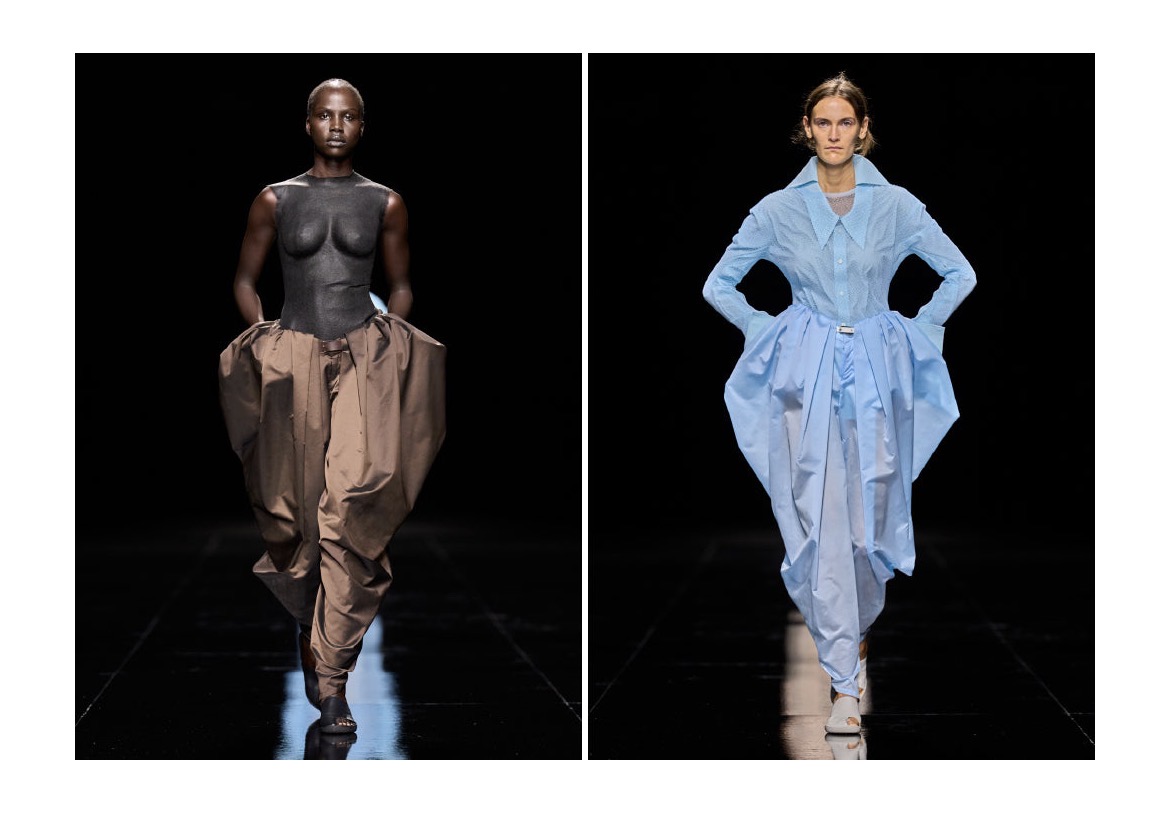
With Figure of Ma, Satoshi Kondo gives the space between body and cloth an eloquent, exuberant form.
A fashion collection becomes especially compelling when its ideas can be understood through the clothes themselves. Satoshi Kondo’s Spring/Summer 2027 collection for Issey Miyake, presented at the Dojo de Paris on 2 October 2026, has precisely that quality. Titled Figure of Ma, it considers the space between the body and the fabric surrounding it. This apparently modest starting point produces an exceptionally beautiful collection, full of swelling volumes, intricate surfaces and colour that makes the construction of a garment a pleasure to look at.
Its appeal lies in the confidence with which thought becomes form. A fold changes the apparent proportions of the body; a generous opening makes the skin part of the composition; a rounded sleeve gives air a visible presence. There is a lovely generosity to this approach. The wearer enters a structure whose appearance can change with every gesture, contributing to its design through the ordinary act of moving.
The Space We Inhabit
The Japanese concept of ma can describe an interval in space or time. Writing for Japan House London, the designer Kenya Hara places it within a wider understanding of emptiness as something capable of inviting imagination and participation. A space left open can hold possibilities. This gives Kondo’s subject a resonance that reaches beyond dress, into architecture, painting and the experience of inhabiting a room.
Applied to clothing, the idea directs attention towards something we rarely examine: the small, shifting environment between a garment and the person wearing it. That environment changes when we lift an arm, sit down or turn. Fabric can follow the body, fall away from it or establish an outline of its own. In this reading, Kondo’s collection treats that relationship as a field of invention. The resulting silhouettes invite us to notice how much of clothing’s character comes from what happens inside its boundaries.
For anyone interested in interiors, the analogy is particularly appealing. The quality of a room depends on the relationships between its surfaces, its openings and the people moving through it. Clothing operates at a more intimate scale, but it also organises the experience of space. Kondo makes that organisation unusually expressive.
The Intelligence of the Fabric
The violet and ice-blue knits are among the collection’s loveliest passages. Their rippling ridges travel across the torso and around the legs, while asymmetric openings interrupt the surface. In the FLUIGLYPH series, variations in yarn and stitch create an irregular, fluid relief. The eye follows these lines almost as it would follow the contours of a landscape. Colour intensifies the effect, giving the fabric a presence that feels both graphic and sensuous.
Elsewhere, the surface becomes more exuberant. BALLOON TWIST uses fabric twisted and bound around spherical moulds, producing rounded protrusions and fine creases. The white and blue ensembles have an almost fantastical appearance: hoods frame the face, sleeves swell and the texture holds the light in innumerable small folds. Their proportions are wonderfully audacious. The pleasure comes from seeing a familiar material assume an unfamiliar behaviour, with the processes of making still perceptible in its surface.
Kondo is equally assured with larger expanses of cloth. A pale pink ballooning coat opens into immense sleeves; a lavender-blue version gives the upper body a broad, floating circumference. Against the dark runway, these shapes acquire considerable clarity. The volume has direction and balance, so that even the most expansive forms remain visually coherent.
The collection also offers more intimate kinds of discovery. TEMPO PLEATS places its pleats horizontally, allowing them to respond with a bounce, while BUBBLE’s translucent organza carries marbled patterns made by Kyoto artisans using pigment on water. Across these approaches, texture, movement and image become closely connected. The craftsmanship rewards attention because it changes the experience of the garment: how light passes through it, how its outline behaves and how a surface can appear to hold motion even in a photograph.
A Body Reimagined
The COCOON BODY collaboration with Wacoal introduces a fascinating change of scale and emphasis. Using Wacoal’s Melooop technology, originally applied to bra components, the project creates forms by depositing fine fibres onto a torso mould attached to a robotic arm. It proposes a way of making clothing directly in three dimensions, with the body providing the starting point for construction.
The resulting tops suggest casts or small sculptures of the torso. In violet, pale yellow and charcoal, they give the body a sharply articulated presence beside the generous folds of trousers and skirts. The relationship between these elements is particularly effective. A compact, moulded upper body makes the surrounding cloth seem more expansive; the drapery, in turn, draws attention to the precision of the torso.
This is an absorbing contribution to the collection’s central inquiry. The distance between body and garment can be explored through close correspondence as well as spaciousness. Here, the body becomes both the inhabitant of clothing and a form that clothing can represent. The sculptural reference gains its interest from that double role, bringing questions of likeness and physical presence into the practical language of dress.
Movement, Music and a Living Legacy
Pianist Koki Nakano joined Kondo and the design team in a dialogue between musical composition and clothes-making. The collaboration is entirely apt for a collection concerned with intervals and changing forms. Music unfolds through time, and a garment also reveals itself in sequence: a sleeve extends, a hem shifts, a fold opens. Thinking about these clothes through music helps make sense of their rhythm, the relationship between repetition and variation, and the way a coherent structure can accommodate surprise.
That interest in movement belongs to the deeper history of Issey Miyake. The founder’s investigation of the relationship between cloth and body, and his work with William Forsythe and the Frankfurt Ballet, helped establish clothing as something to be explored through physical activity. Pleating brought technical research into contact with the demands and possibilities of a moving body. This remains one of the house’s most fertile ideas: the finished garment acquires another dimension through use.
Kondo’s first collection for the house, Spring/Summer 2020’s A Sense of Joy, already placed movement and the pleasure of wearing at the centre of his work. Figure of Ma gives that commitment a particularly rich expression. Its experimentation has a clear purpose, and its intellectual framework is sustained by clothes with real visual authority.
What makes this collection so persuasive is the generosity of its imagination. It gives the wearer room to become part of the work, while offering the viewer a succession of beautiful, surprising forms. Kondo carries forward Miyake’s curiosity through an assured understanding of material, proportion and the body. The result is fashion with an unusually expansive sense of what clothing can offer: the pleasure of colour and texture, the fascination of invention, and a heightened awareness of the space we occupy.
Sources / Read More
- ISSEY MIYAKE — Spring/Summer 2027: Figure of Ma. Official collection notes and explanations of the textiles and techniques.
- ISSEY MIYAKE — Spring/Summer 2027 collection images. The collection’s official runway presentation.
- Kenya Hara — “Looking behind Japanese concepts of ‘empty space’,” Japan House London.
- Wacoal — COCOON BODY collaboration announcement. Wacoal’s press release, published on 7 October 2026, describing the project and Melooop technology.
- The Museum of Modern Art — Issey Miyake. Background on Miyake’s work across fashion, design, technology and dance.
- ISSEY MIYAKE KYOTO | KURA — “A Sense of Joy”. An account of Satoshi Kondo’s debut collection for Spring/Summer 2020.
Discover more from My World of Interiors
Subscribe to get the latest posts sent to your email.

