
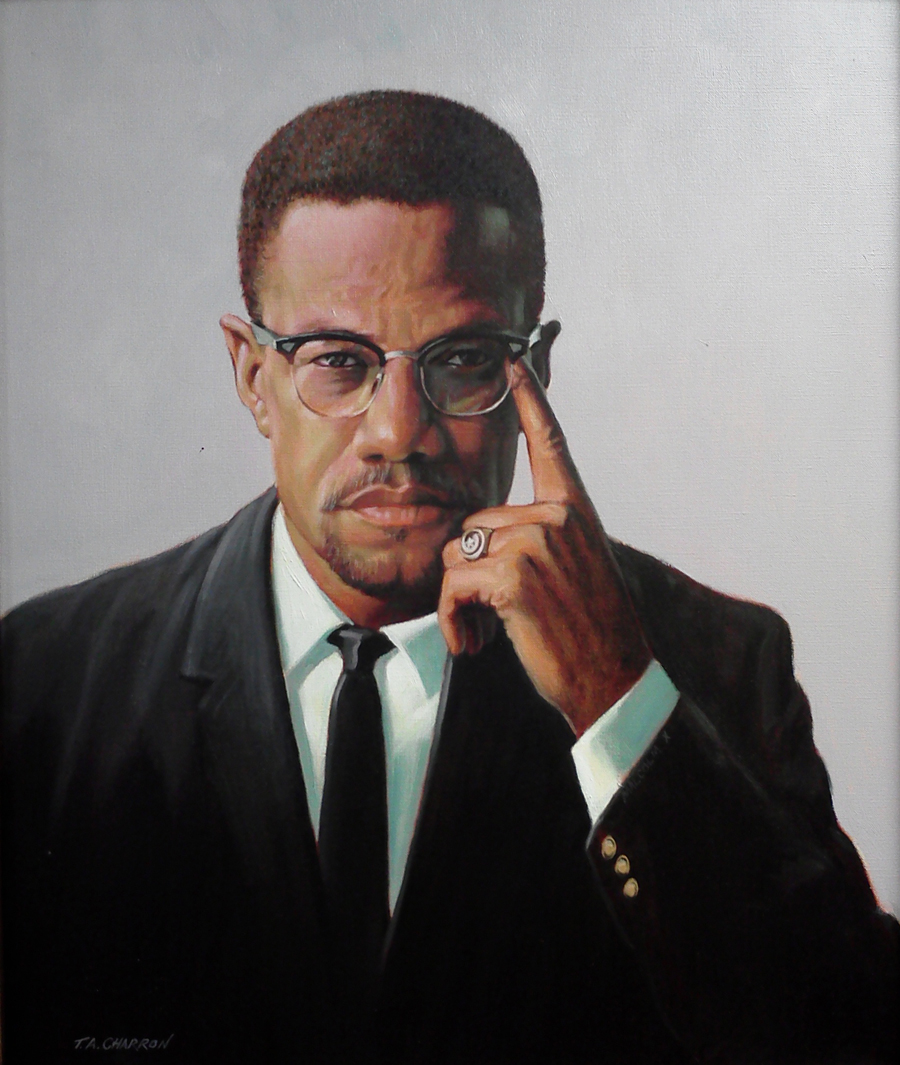
Essay · History & Lives
The Man Who Kept Becoming Someone Else
Malcolm X is one of the most difficult subjects in American history to write about honestly, because the honest account requires holding simultaneously several versions of the same person — the street hustler, the Nation of Islam minister, the Black nationalist icon, the man who changed his mind — and refusing the temptation to choose one of these versions as the real one and treat the others as prologue or error. They were all real. The capacity to keep becoming someone else, to revise the self completely in the face of new evidence, was not a weakness of character but its most distinctive strength, and it is what makes him, sixty years after his assassination, still the most challenging figure in the history of American Black political thought.
By Bergotte · Harlem & Mecca · History & Lives
He was born Malcolm Little in Omaha, Nebraska, on May 19, 1925, the fourth of eight children of Earl Little, a Baptist preacher and organiser for Marcus Garvey’s Universal Negro Improvement Association, and Louise Norton Little, a woman of mixed Black and white heritage from Grenada who was lighter-skinned than her husband and who passed that lightness, unevenly, to her children. The family moved repeatedly — to Milwaukee, to Lansing, Michigan — fleeing threats from white supremacist groups who objected to Earl Little’s Garveyite politics, and in Lansing, when Malcolm was six, his father died in circumstances that the family believed were murder, the official verdict of accidental death being, in 1931, the standard official verdict in such cases in Michigan.
The death of Earl Little set in motion a sequence of events that the autobiography traces with unsparing precision: the family’s poverty, Louise Little’s deteriorating mental health under the combined pressure of grief and destitution and the intrusions of white welfare officials who regarded her child-rearing with the confident condescension of people who have been given authority over other people’s lives, her eventual commitment to a state mental institution when Malcolm was twelve, the dispersal of the children to foster families and relatives. Malcolm went to a foster family, then to a detention home, then to a school in Mason, Michigan, where he was an excellent student, elected class president, told by a white teacher he respected that his ambition to become a lawyer was “no realistic goal for a nigger” and that he should consider carpentry instead. He was thirteen. He left Michigan for Boston, and then for Harlem, and by the early 1940s he was Malcolm Little the street hustler — the zoot-suited, conked-haired, numbers-running, drug-dealing young man who inhabited the street economy of wartime Harlem with the intelligence and the adaptability that had always been there and was now being applied, with full commitment, to survival.
The Prison and the Conversion
He was arrested in 1946, at twenty, for burglary, and sentenced to ten years in the Massachusetts state prison system. The sentence was, by the standards of the crime, severe — a reflection, his supporters argued, of the fact that two of his accomplices were white women — and the prison years produced, through a combination of circumstance and choice that the autobiography renders with extraordinary vividness, the most consequential transformation of his life.
His brother Philbert wrote to him about the Nation of Islam. Malcolm was initially resistant and then, through a process of reading and argument and the particular receptivity of a very intelligent young man who has been given, by the enforced stillness of imprisonment, the time to think that the street had never allowed, he was converted. The Nation of Islam — Elijah Muhammad’s organisation, which taught that the white man was a devil created by a mad scientist named Yacub, that Black Americans were the original people of the earth, that integration was a trap and separation the only honest solution — gave Malcolm something that nothing in his previous life had given him: a framework for the rage that his history had produced, an explanation of the condition he and his family and his people were in, and a discipline that transformed the street hustler into something he had always, beneath the hustling, wanted to be: a serious man.
He educated himself in the prison library with the ferocity of someone who understands that he is making up for time that was taken from him by a system that had no interest in his education. He read everything — history, philosophy, linguistics, the Bible, the Quran, the works of the scholars whose names he had never encountered in the Mason, Michigan school system. He developed the debating skills that would eventually make him the most effective public speaker in American political life — practising arguments in his cell, honing the rhetorical precision that derived from his father’s preaching tradition and from his own natural intelligence and from the discipline that the Nation of Islam imposed on everything he did.
He was released in 1952, at twenty-seven, and within a year was working as a minister for the Nation of Islam in Detroit, and within three years was the organisation’s national minister, the most prominent voice in an organisation that was becoming, under his advocacy, the most significant expression of Black nationalist politics in America.
“We didn’t land on Plymouth Rock. Plymouth Rock landed on us.” — Malcolm X, speech, 1962
The Minister and the Message
What Malcolm X gave Black Americans in the late 1950s and early 1960s was something that the dominant civil rights discourse of the period, for all its moral clarity and its genuine courage, was not giving them: permission to be angry. The civil rights movement, in its strategic wisdom, had adopted the philosophy of nonviolent direct action — the sit-ins, the marches, the dignified acceptance of violence from those who opposed integration — as both a moral position and a tactical calculation, and it was right to do so, and the strategy worked, and the work it did was of enormous historical importance. But the strategy required, from its participants, a suppression of the rage that the history of Black American life had produced, a channelling of that rage into disciplined action rather than its expression as fury, and for many Black Americans — particularly those who were not middle-class, not in the South, not participants in the organised movement — the suppression was both psychologically costly and politically insufficient.
Malcolm offered a different position. Not nonviolence but self-defence: the right of Black people to protect themselves from the violence of white supremacy by any means necessary, which was both a political position and, for many of his listeners, a profound psychological relief. Not integration but separation: the rejection of the white-dominated society’s permission to participate, the insistence on Black self-determination and Black pride and Black economic independence, which was both a political programme and a declaration that the aspiration to whiteness was itself a form of self-degradation. Not respectability but rage: the unmediated expression of what the history had produced, delivered from a podium in a voice of extraordinary clarity and intelligence and without the softening that the white gaze required.
The effect on his audiences was electrifying and was documented, with considerable alarm, by the FBI, which maintained extensive surveillance of Malcolm and of the Nation of Islam throughout the late 1950s and 1960s. The alarm was, from the FBI’s perspective, understandable: here was a man who was speaking to the Black Americans who had been left out of the civil rights discourse — the urban poor, the Northern working class, the people for whom the Southern movement’s victories were geographically and economically remote — and telling them that the system was not capable of reform, that the problem was structural and total, that accommodation was not dignity but submission. This was a message with a significantly larger potential audience than the movement’s existing leadership cared to acknowledge.
The Rivalry and the Relationship With King
The relationship between Malcolm X and Martin Luther King Jr. has been framed, since both men were alive, as an opposition — nonviolence versus self-defence, integration versus separation, the beloved community versus Black nationalism — and the framing is not without basis but obscures as much as it reveals. The two men met once, briefly, in Washington in 1964, at a Senate hearing on the Civil Rights Bill, shaking hands for the photographers with the wariness of people who understood that they were being photographed making history. The photograph is one of the more resonant images of the era: two men who needed each other, who served as each other’s counterweight in the larger argument they were both making, who disagreed about means and shared more about ends than either’s supporters were always willing to acknowledge.
King needed Malcolm because Malcolm’s presence — the implication, never far from any discussion of the civil rights movement, that the alternative to negotiation was the kind of radicalism that Malcolm represented — gave the movement’s demands an urgency that the white establishment might otherwise have found comfortable to defer. Malcolm needed King because King’s moral authority and King’s victories demonstrated that change was possible, that the system had pressure points, that the struggle was not simply futile. Each man’s existence altered the political conditions in which the other operated, and the combination of the two — the moral insistence of King’s movement and the political urgency of Malcolm’s nationalism — was more effective, in aggregate, than either would have been alone.
Malcolm was not unaware of this, and in his final years, as his thinking evolved, the distance between his position and King’s was narrowing in ways that neither man lived long enough to fully explore. The meeting of 1964 was the only time they spoke at any length. King was assassinated in April 1968. Malcolm was assassinated in February 1965. The conversation between them remains, permanently and painfully, incomplete.
The Break with Elijah Muhammad
In November 1963, four days after the assassination of John F. Kennedy, Malcolm gave an interview in which he described the assassination as a case of “the chickens coming home to roost” — the violence that America had exported to the world returning to its source. The remark was widely reported, widely condemned, and used by Elijah Muhammad as the pretext for a ninety-day suspension that was, in retrospect, the beginning of the end of Malcolm’s relationship with the Nation of Islam.
The suspension was the pretext; the cause was more complex and more personal. Malcolm had become, in the preceding years, the Nation’s most prominent and most effective spokesman, and his prominence had produced a tension with Elijah Muhammad — who was simultaneously the organisation’s spiritual leader, its patriarch, and the subject of allegations, which Malcolm had by this point confirmed to his own satisfaction, of sexual relationships with a series of young women in the organisation. The discovery of these relationships — and the discovery that the organisation’s senior members had known and concealed them — was a personal catastrophe for Malcolm, who had organised his faith and his identity around the figure of Elijah Muhammad and who was now required to confront the gap between the man and the mythology.
He left the Nation of Islam in March 1964 and founded two organisations — the Muslim Mosque, Inc., and the Organisation of Afro-American Unity — that represented an attempt to develop a politics beyond the Nation’s theological framework. The break was painful and the consequences were immediate and lethal: members of the Nation of Islam publicly threatened his life, his house was firebombed, the FBI’s surveillance intensified, and the last year of his life was conducted under conditions of genuine personal danger that he acknowledged without allowing to deflect him from the work.
Mecca and the Third Transformation
In April 1964, Malcolm made the Hajj — the pilgrimage to Mecca required of all Muslims who are able — and the experience produced the final and most radical revision of his thinking. The letter he wrote from Mecca to his associates in New York is one of the more remarkable documents in the history of American political thought: a public announcement, from a man who had built his public identity on the doctrine of white devilry, that what he had seen in Mecca — the full diversity of the Muslim world, people of every complexion praying together, treating each other as brothers without the racial hierarchy that American society had taught him to regard as natural and permanent — had forced him to reconsider everything he thought he knew about race.
He wrote: “During the past eleven days here in the Muslim world, I have eaten from the same plate, drunk from the same glass and slept in the same bed (or on the same rug) — while praying to the same God — with fellow Muslims whose eyes were the bluest of blue, whose hair was the blondest of blond, and whose skin was the whitest of white. And in the words and in the actions and in the deeds of the ‘white’ Muslims, I felt the same sincerity that I felt among the black African Muslims of Nigeria, Sudan and Ghana. We were truly all the same — because their belief in one God had removed the ‘white’ from their minds, the ‘white’ from their behaviour, and the ‘white’ from their attitude.”
The revision was not complete, and it was not simple, and he did not abandon his analysis of American racism — if anything, the Mecca experience deepened his understanding of racism as a specifically American pathology rather than a universal human condition. But the theological framework of the Nation of Islam — the white man as devil by nature, the biological basis of racial difference — was abandoned, and in its place he articulated, in the last months of his life, a position that was both more sophisticated and more dangerous to the American establishment than anything he had previously said: an international human rights framework that connected the condition of Black Americans to the condition of colonised people everywhere, that took the struggle out of the domestic civil rights framework and into the arena of international law and global solidarity.
It was this Malcolm — the Malcolm of the final year, the Malcolm who had revised his theology and expanded his politics and was constructing a framework for Black liberation that could not be contained within the terms that either the civil rights movement or the Black nationalist tradition had established — who was shot to death at the Audubon Ballroom in Harlem on February 21, 1965, at thirty-nine years old.
The Autobiography and Its Author
The Autobiography of Malcolm X, assembled by Alex Haley from a series of recorded conversations and published later in 1965, is one of the great American autobiographies — in the company of Benjamin Franklin and Frederick Douglass and Henry Adams, the tradition of the self-made American mind examining its own formation and finding, in the examination, something that transcends the personal. It is also a complicated document, written under the pressure of Malcolm’s final months, revised repeatedly as his thinking evolved, and shaped by Haley’s own craft and sensibilities in ways that Malcolm might or might not have endorsed had he lived to see the final text.
The narrative arc the Autobiography presents — the street life, the prison, the Nation of Islam, the break, the Hajj, the final wisdom — is a conversion narrative in the oldest American tradition, the story of a soul in progress, moving from darkness toward light, each stage a preparation for the next. The arc is not false, but it imposes a tidiness on a life that was, in its living, considerably messier and more provisional and more genuinely open-ended than the retrospective account can fully render. The Malcolm of the final months was not a finished man who had arrived at his final position. He was a man in the middle of something, thinking hard and fast under conditions of danger, whose final position cannot be known because he was not given the time to develop it.
The book has sold millions of copies and has been read by generations of young people — Black Americans above all, but far beyond that community — as the account of a man who refused to accept the definition of himself that the world had imposed, who kept insisting on his own capacity for revision, who understood that the most important thing about a self was not what it was but what it was capable of becoming. This is not a comfortable message. It requires the reader to apply the same standard to themselves, to ask what they have accepted about their own condition that they might, with sufficient courage and sufficient honesty, revise.
The Assassination and What It Meant
Three members of the Nation of Islam were convicted of Malcolm’s murder. The full account of who ordered the assassination — the Nation’s involvement, the FBI’s surveillance and its possible facilitation, the question of whether law enforcement had prior knowledge and declined to act — has not been fully established, and a 2021 reinvestigation exonerated two of the three convicted men and acknowledged the withholding of evidence by the FBI and the New York Police Department at the time of the original investigation. The reinvestigation confirmed what Malcolm’s family and supporters had long maintained: that the official account of the assassination was incomplete, and that the agencies responsible for investigating it had interests in its incompleteness.
The incompleteness is itself a form of violence, added to the original, and it is the form of violence that the American state has most consistently applied to its most threatening dissenters: not only to kill them but to obscure the killing, to deny the survivors the clear account of what happened that grief requires and that justice demands.
He was buried in Hartsdale, New York, at a funeral attended by thousands. Ossie Davis gave the eulogy, and it contains the most precise account of what Malcolm X meant to the people who mourned him: “However we may have differed with him — or with each other about him and his value as a man — let his going from us serve only to bring us together, now. Consigning these mortal remains to earth, the common mother of all, secure in the knowledge that what we place in the ground is no longer Malcolm’s — and so can be taken from him. He was our shining black prince, the manhood of our people.”
What He Leaves
The difficulty of Malcolm X’s legacy is the difficulty of a man who outgrew every category his contemporaries tried to place him in — Nation of Islam minister, Black nationalist demagogue, anti-white racist, international human rights advocate — and who died before the process of outgrowing was complete. The categories still compete. The Black nationalist tradition claims him as its founding father. The Islamic tradition claims him as a martyr and a model. The human rights tradition claims the final Malcolm, the one who was constructing a framework that could have been, had he lived, one of the most powerful arguments in twentieth-century political thought. The street tradition, in a different register, claims the young Malcolm — the zoot suit, the conk, the cool — as its own.
All of these claims are legitimate and none is sufficient, which is the condition of a figure whose significance exceeds any single framework and who was, in any case, constitutionally resistant to being contained. The most useful thing his life demonstrates is also the most uncomfortable: that the capacity to be wrong, to recognise the wrongness, and to change completely in response to the recognition, is not a failure of conviction but the highest form of it. He had been wrong about the white devil theology. He said so, publicly, at enormous personal cost. He had been wrong about the separability of Black American liberation from the liberation of oppressed people elsewhere. He said so, and began the work of revision, and was killed before the work was done.
The work is not done. It is the nature of work of that kind to be perpetually unfinished, because the conditions that generate it are perpetually present and the understanding required to address them is perpetually incomplete. What Malcolm X left behind is not a finished argument but a standard: the standard of someone who kept revising the argument in the face of what the evidence required, who put the truth of his own experience above the comfort of his established positions, and who understood that the final measure of a life was not the position it arrived at but the honesty with which it pursued the journey.
This essay draws on The Autobiography of Malcolm X, as told to Alex Haley (1965), Manning Marable’s Malcolm X: A Life of Reinvention (2011), which won the Pulitzer Prize for Biography, and the documentary I Am Not Your Negro (dir. Raoul Peck, 2016), which addresses the connected legacies of Malcolm X, Martin Luther King Jr., and James Baldwin. The 2021 reinvestigation of Malcolm X’s assassination was conducted by the Manhattan District Attorney’s office. Malcolm X was born Malcolm Little on May 19, 1925, in Omaha, Nebraska, and died February 21, 1965, in New York City. The Autobiography of Malcolm X remains one of the most widely read political memoirs in the English language.
Discover more from My World of Interiors
Subscribe to get the latest posts sent to your email.

