Essay · Comedy & Lives
Can We Talk?
Joan Rivers was the funniest woman in the history of American comedy, and the qualifications embedded in that sentence — the word woman, the word history — are themselves part of the argument she spent sixty years making: that the comedy establishment’s willingness to tolerate her existed in permanent tension with its unwillingness to fully accommodate her, and that the tension was the source of everything.
By Bergotte · New York · Comedy & Lives
She worked. This is the first and most important thing about Joan Rivers, the fact from which everything else follows, the fact that her admirers invoke as a form of tribute and that her critics, had they been paying attention, would have recognised as a rebuke. She worked with a consistency and a volume and a ferocity that had no precedent among comedians of her generation and very few among comedians of any generation: six nights a week in the clubs when she was starting out, the same jokes refined across hundreds of performances until each word was in its right place, notebooks filled with material, a filing system for jokes that grew, over decades, into thousands of cards organised by subject, a discipline so total that it looked, from the outside, like something other than discipline — like compulsion, like desperation, like the behaviour of a person for whom stopping was not an option. It was not an option. She knew, with the precision of someone who has understood the terms of their own situation very clearly, that the moment she stopped working was the moment the industry she had fought her way into would stop pretending to have a place for her.
Joan Alexandra Molinsky was born in Brooklyn in 1933, the daughter of Russian Jewish immigrants — her father a doctor, her family comfortably middle-class, her childhood marked by the particular pressures of a world in which being funny was not considered a viable ambition for a woman and being Jewish was a complication to be managed rather than an identity to be celebrated. She was both of these things fully and simultaneously, and she made her comedy from the intersection, which is the place where the best comedy has always been made: the place where two forms of not-quite-belonging meet and produce, from their friction, something that illuminates both.
The Clubs, the Craft, and the Years Nobody Noticed
The years between Rivers’s first attempts at stand-up in the late 1950s and her breakthrough on The Tonight Show in 1965 were a decade of failure so sustained and so thoroughgoing that they would have ended most careers, and the fact that they did not end hers is itself instructive. She was told, repeatedly and by people with the authority to make the judgment stick, that she was not funny, that women were not funny, that audiences would not pay to watch a woman be funny about the things she was being funny about — her looks, her romantic failures, her anxiety, her ambition, the gap between what she wanted and what the world was prepared to give her. The content was too personal, too female, too nakedly about the experience of being a particular kind of woman in a particular kind of world. It was, in short, too true, and the comedy establishment of the early 1960s had a well-developed instinct for the kind of truth it found uncomfortable.
She kept working. She refined the material. She developed the voice — the rapid, associative, self-interrupting style that became her signature, that mimicked the speed of a mind moving faster than the available social forms could accommodate, that created the impression of someone who could not stop thinking and could not stop talking and had decided, after considerable reflection, that this was not a problem to be solved but a gift to be deployed. The persona she constructed in those years — the Jewish girl from Brooklyn who was too much, too loud, too needy, too honest about wanting things that women were not supposed to want as openly as she wanted them — was not a mask but an amplification: the most vivid, most public, most formally useful version of a self that was genuinely there.
“I succeeded by saying what everyone else is thinking.” — Joan Rivers, Enter Talking, 1986
Carson, the Tonight Show, and What a Breakthrough Actually Costs
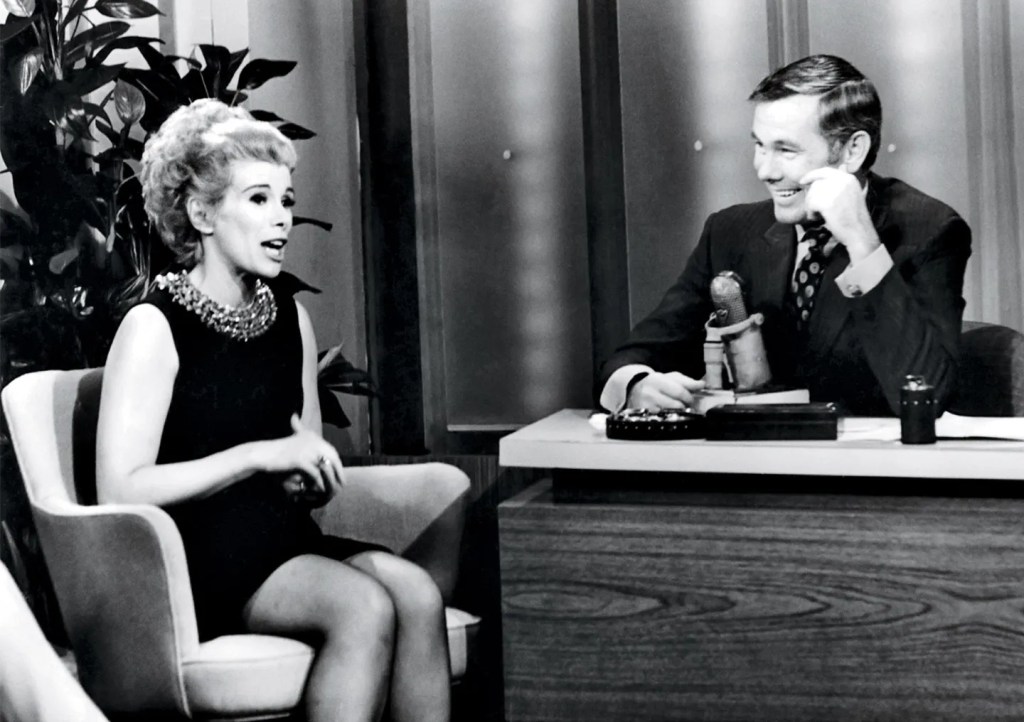
Johnny Carson introduced her on The Tonight Show on February 17, 1965, with words that have been quoted so often they have acquired the quality of mythology: “This girl is going to be a star.” He was right, and his rightness was — as the relationship between them would eventually demonstrate — conditional in ways that neither of them fully understood at the time. Rivers became a regular guest, then a permanent guest host, the first woman to occupy that position, and the years of her association with Carson and with The Tonight Show were the years in which she became, by any reasonable measure, the most successful female comedian in America. She was also, in those years, still operating within a framework whose terms Carson set and whose limits she had not yet tested.
The testing came in 1986, when Fox offered her her own late-night show — The Late Show Starring Joan Rivers — in direct competition with Carson. She accepted without telling him. He never forgave her and never spoke to her again, and his refusal to forgive her was, among other things, a very clear statement about the nature of the accommodation that had always been on offer: she was welcome on his stage, on his terms, in the position he assigned her. The moment she decided that her own terms were worth pursuing, the accommodation ended. She knew this would happen. She went ahead anyway. This is not a small thing.
The Fox show was cancelled after one season, and the months that followed — her husband Edgar Rosenberg’s suicide in 1987, the industry’s collective decision that she was now a cautionary tale rather than a success story, the years of reduced bookings and casino residencies and the slow, grinding process of rebuilding a career that the establishment had decided was over — constitute one of the more remarkable second acts in the history of American entertainment, and they are remarkable precisely because Rivers refused the narrative. She did not accept that it was over. She went back to the clubs. She worked.
The Joke and How It Works
The mechanics of a Rivers joke reward attention because they are doing more than they appear to be doing. The surface structure is simple — a set-up, a punchline, the punchline usually involving a self-deprecating observation about her appearance or her age or her romantic history — but the emotional structure is considerably more complex. The self-deprecation is not genuine self-loathing, or not only that; it is a pre-emptive strike, a way of saying the worst thing about herself before anyone else can say it, of disarming the cruelty of the world by getting to it first and making it funny. This is a survival strategy as much as a comedy strategy, and the two things are, in Rivers’s work, inseparable.
The jokes about her looks — relentless, escalating, delivered with the timing of someone who has done them ten thousand times and found, in each repetition, a new angle — are not evidence of low self-esteem. They are evidence of a precise and ruthless understanding of how the world values women, and of a decision, made very early and maintained throughout sixty years of professional life, to take that understanding and turn it into currency. The joke about her face is a joke about a culture that judges women by their faces, and the laugh it produces is a laugh at the culture as much as at the comedian. This double movement — the joke that appears to be at her own expense and is actually at the expense of everyone who has ever made her feel she needed to apologise for her face — is the structural principle of her comedy, and it is a more sophisticated principle than most comedy operates on.
“The first time I see a jogger smiling, I’ll consider it.” — Joan Rivers
The Darkness, the Edge, and Why the Joke Had to Hurt
Rivers went further than her contemporaries were comfortable going, and she went there deliberately, and the discomfort she caused was the point rather than an unfortunate side effect. The jokes about the Holocaust — told by a Jewish woman whose parents’ generation had lived inside its shadow — were not casual offensiveness but a very specific act: the use of humour as a way of approaching the unapproachable, of insisting on the comedian’s right to take the darkest material and find in it, if not redemption, then at least the small fierce victory of the laugh. She said, when challenged: “When you can laugh at the horror, the horror loses some of its power over you.” This is a position with a long history in Jewish comedy, and Rivers held it with a consistency that her critics mistook for callousness and that was in fact the opposite — a form of engagement so intense that it required the comedian to enter the darkness fully rather than gesturing at it from a safe distance.
The celebrity jokes — the red carpet commentary, the Fashion Police years, the sustained and sometimes devastating assessments of other women’s appearance — are the part of her legacy that sits least comfortably with contemporary sensibilities, and the discomfort is legitimate. The jokes about women’s bodies, including the bodies of women who had done nothing to invite the commentary, operated within the same value system they were ostensibly mocking, and the defence that she included herself in the attack does not entirely resolve the tension. Rivers knew this, or knew something like it, and made her own position on the matter characteristically clear: she was doing what the culture was doing, only louder and faster and funnier, and if the loudness and the speed and the funniness made it uncomfortable, that was the intention, and the discomfort was worth examining rather than simply directing back at the comedian.
The Last Decade and the Question of Hunger
In the final decade of her life Rivers was, by any external measure, a success: the QVC jewellery line, the Fashion Police franchise, the awards and the tributes and the documentary — Ricki Stern and Annie Sundberg’s Joan Rivers: A Piece of Work (2010) — that gave the broadest audience the clearest view of what the working life actually looked like from the inside. The documentary opens with a shot of her calendar for the coming year, every week filled with bookings, and her response to it — not satisfaction, not relief, but the faint anxiety of someone who sees gaps and needs to fill them — is one of the more honest portraits of professional hunger ever put on film. She was seventy-six. The hunger had not diminished. It had, if anything, sharpened, as hunger tends to in people who have spent their lives aware of how quickly the table can be cleared.
She died on September 4, 2014, following complications from a routine endoscopic procedure she had undergone at a clinic in Manhattan. She was eighty-one. She had performed stand-up six days before the procedure. The eulogies were warm and numerous and almost universally noted the working, the hunger, the refusal to stop, with the mixture of admiration and slight bewilderment that these qualities tend to produce in people who have not felt them from the inside. What the eulogies were slower to note was that the hunger was not a personality quirk or a workaholic tendency but the logical response to a career spent in an industry that had made clear, repeatedly and at considerable personal cost to her, that her place in it was contingent on her continued willingness to fight for it.
The Genius, Properly Understood
The word genius is used loosely in comedy, as in most fields, and it is worth being precise about what it means in Rivers’s case. It does not mean that she was the funniest person who ever lived, though she was extraordinarily funny. It does not mean that every joke she told was brilliant, because she told so many jokes that the law of averages alone would have produced some duds, and her willingness to work new material in front of live audiences meant that the duds were as public as the triumphs. It means, rather, that she understood comedy — its mechanics, its purposes, its relationship to truth and to pain and to the social structures it appears to be merely entertaining — with a depth and a precision that most comedians do not achieve and that produced, across six decades, a body of work whose formal intelligence is only now beginning to receive the critical attention it deserves.
She understood that the joke is always about something — that the laugh is never innocent, never purely aesthetic, always in some relation to the thing the joke is about and to the world that produced the thing. She understood that the comedian’s job is not to comfort the audience but to show them something true, and that the showing requires a willingness to go somewhere the audience would prefer not to go and to make them laugh when they get there, which is a more demanding act than it looks. She understood that the self on stage — the needy, loud, surgically altered, relentlessly self-deprecating persona — was both an instrument of comedy and a critique of the world that had produced the need for the instrument, and she played both registers simultaneously, without sacrificing either, for sixty years.
This is genius. It is not comfortable genius, and it was not a comfortable life, and the discomfort was the price of the precision, and the precision is what lasts. Can we talk? She always could. She always did. The talking is still there, in the recordings and the specials and the documentary, and it is still, when you sit with it properly, the funniest and the most honest account available of what it cost to be that woman in that industry in that century, and what it was worth, and what it left behind.
This essay draws on Joan Rivers’s memoirs Enter Talking (1986) and Still Talking (1991), the documentary Joan Rivers: A Piece of Work (dir. Ricki Stern and Annie Sundberg, 2010), and Leslie Bennetts’s biography Last Girl Before Freeway (2016). Joan Rivers was born Joan Alexandra Molinsky on June 8, 1933, in Brooklyn, New York, and died September 4, 2014, in New York City.

Leave a Reply