
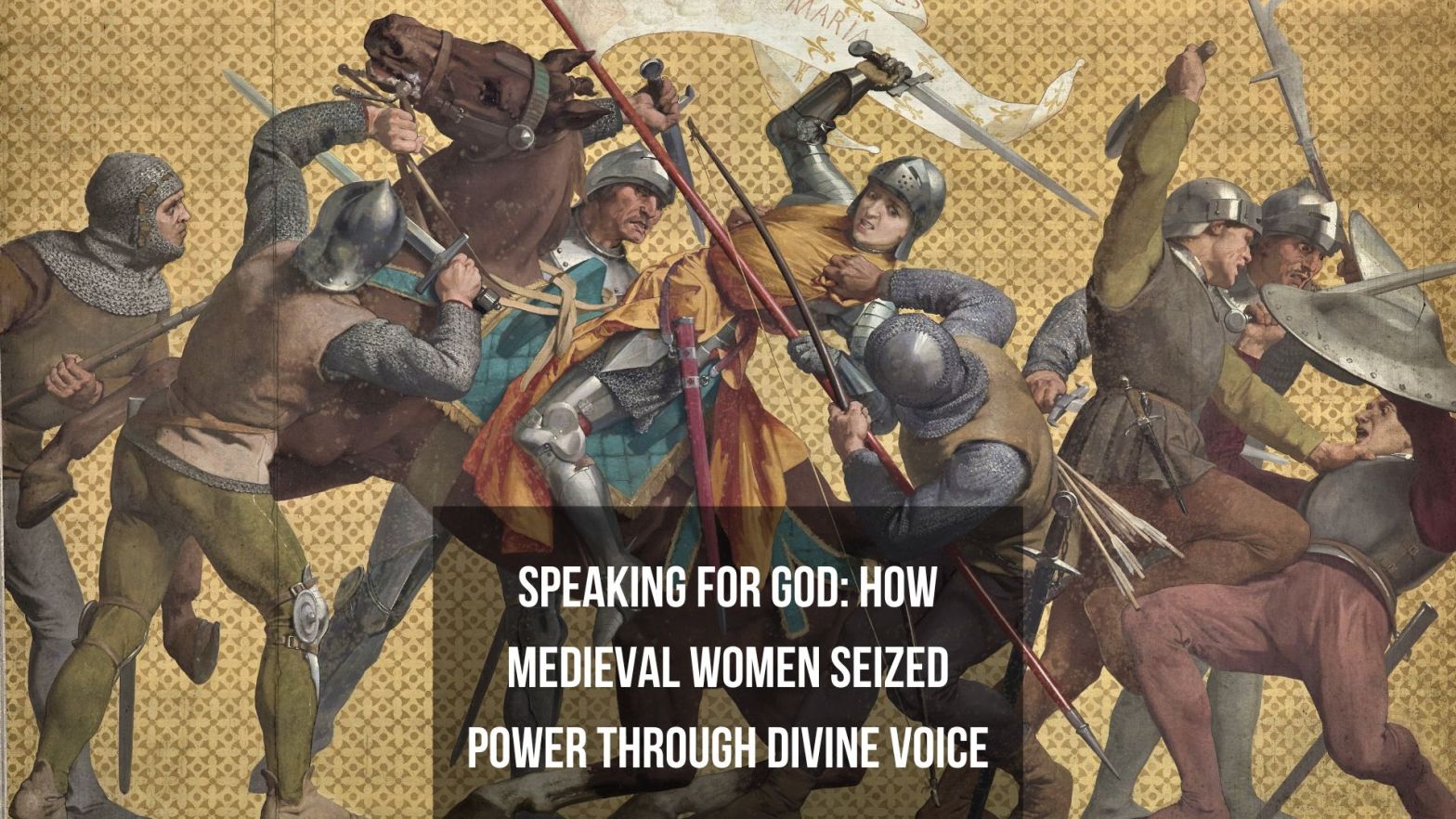
They had no pulpit, no vote, no university, no legal standing, and no legitimate path to public authority in any institution their world recognised. So they found the one loophole the medieval Church could not easily close — the direct line to God — and they used it to address popes, command armies, reshape theology, and write some of the most extraordinary literature in the European tradition. Whether they believed every word of it is, finally, the wrong question.
By Bergotte
Begin with the problem, because the problem is everything. In medieval Christian Europe — across roughly a thousand years, from the fragmentation of the Roman world to the convulsions of the Reformation — women were formally excluded from almost every category of public authority that the culture recognised as legitimate. They could not be ordained priests. They could not preach from a pulpit. They could not teach in universities, which did not admit them. They could not hold political office in any of the senses that office was understood. They could not appear in court as witnesses whose testimony carried full legal weight. They could not, in most circumstances and most places, own property independently of a father or husband. The intellectual and spiritual traditions they had inherited — the Church, the scholastic philosophy, the Roman law that was slowly being recovered and codified — were unanimous in their assessment: the female mind was weaker, the female will less reliable, the female body a site of temptation and instability that required management rather than autonomy.
This is not a description of a conspiracy. It is a description of a worldview so thoroughly internalised, by women as much as by men, that it presented itself not as ideology but as nature — as the simple, God-given order of things, confirmed by scripture and philosophy and the accumulated authority of the Church Fathers and the daily evidence of a social organisation that seemed to have always been this way. To challenge it frontally was not merely dangerous; it was, within the intellectual categories available, barely thinkable.
And yet women wielded power. They wielded it in ways that were, given the constraints, of extraordinary ingenuity and extraordinary force — force enough, in some cases, to direct the policies of popes, to end schisms that had split the Church for decades, to command armies, to produce theological writing of lasting significance, to correspond as equals with the most powerful men in Europe. The mechanism by which they did this was, in retrospect, elegant in its simplicity. It exploited the one genuine vulnerability in the architecture of patriarchal authority: the claim to direct communication with God.
The Church taught — had always taught, could not stop teaching without abandoning something essential to its own self-understanding — that God spoke to human souls directly, that the Holy Spirit moved where it willed, that prophets and mystics and visionaries were not anomalies in the Christian tradition but central to it. The Old Testament was full of them; so was the New; so was the history of the Church from the Desert Fathers onward. And if God could speak to anyone — if the divine voice could, in principle, choose any vessel — then the formal barriers erected by human institutions could not, in principle, be applied to the recipients of divine revelation. To deny a woman’s claim to divine communication was to risk something far worse than the disruption of the social order: it was to risk denying God.
This was the loophole. It was narrow, and it was monitored with intense suspicion by the very institution that could not quite close it, and women who attempted to pass through it risked outcomes ranging from institutional containment to execution. It was also, in the hands of the right women — women who combined genuine visionary experience with the political intelligence to deploy it — the most powerful tool available in medieval Europe to anyone without a sword or a throne.
The Question of Sincerity
Before proceeding to the women themselves, the central question must be faced, because it organises everything else: did they believe it?
The modern reader — secular, psychologically sophisticated, accustomed to reading religious experience through the lenses of neurology and social construction and historical context — instinctively wants to resolve this question in one of two directions. Either the women were sincere, in which case we are dealing with a form of experience that we must understand on its own terms even if we cannot share it. Or they were strategic, in which case we are dealing with something closer to performance — a conscious deployment of available cultural resources for the achievement of otherwise unavailable ends.
The difficulty is that this binary dissolves under examination, and it dissolves in ways that are more interesting than either of its terms. Consider what it would mean for a woman born into thirteenth-century Italy or fourteenth-century Sweden to be “strategic” about a claim to divine communication. Strategy implies a subject who stands outside the available frameworks and chooses among them — who sees the game and plays it. But the women in question were born into a world in which divine communication was not a metaphor but a literal possibility, in which the boundary between the natural and the supernatural was not where we would draw it, in which fasting produced physiological states that were interpreted, by the person experiencing them and by everyone around her, not as altered consciousness but as proximity to God. The interpretive framework was not separate from the experience; it was constitutive of it.
What is more: the category of “strategy” implies a cynicism — a knowingness, a separation of the inner conviction from the outward claim — that the evidence consistently fails to support. The women who most successfully used divine authority to wield power were, in almost every case, women who appear to have been in the grip of something they could not control and did not choose. The visions came unbidden. The voices were not requested. The physical consequences — the fasting, the illness, the ecstatic states, the stigmata — were not comfortable experiences that a calculating person would elect. They were, by every account including the accounts of the women themselves, overwhelming, frightening, and frequently destructive of the ordinary conditions of life.
And yet. To say that the experience was genuine is not to say that the framing of the experience was innocent. The women who achieved the greatest influence were also women of considerable intelligence who understood the system they were operating within, who knew how to present their revelations for maximum effect, who chose their interlocutors carefully and their moments precisely, who understood that a vision reported to the wrong person at the wrong time was not liberation but imprisonment. The sincerity and the strategy were not alternatives. They were simultaneous, interpenetrating, probably inseparable even to the women themselves. This is not a contradiction to be resolved. It is the condition of what it meant to be a powerful woman in medieval Europe.
Hildegard of Bingen: The Feather on the Breath of God
The career of Hildegard of Bingen (1098-1179) is, by any measure — including measures that have nothing to do with the conditions of medieval female life — one of the most extraordinary in the history of European culture. She was a theologian, a composer, a botanist, a physician, a poet, a playwright, a prophet, a preacher, and a political correspondent of formidable effectiveness. She founded two monasteries. She conducted four preaching tours — travelling the Rhineland, the Main, the Moselle, addressing clergy and laity at a time when women were formally prohibited from preaching — that were received, by contemporary accounts, with the reverence due to a living saint. She corresponded with Bernard of Clairvaux, with Frederick Barbarossa, with Pope Eugenius III, with Pope Anastasius IV, and with Pope Adrian IV, and she corresponded with them not as a suppliant but as an equal — sometimes as a superior, correcting their errors and demanding their attention with a directness that would have been remarkable coming from a bishop.
She began receiving visions at the age of three, by her own account, and spent decades not speaking publicly about them — waiting, she said, for divine permission to disclose what she had been shown. The permission came, she reported, in 1141, when she was forty-three: a voice from heaven commanded her to write what she saw and heard, and she obeyed, with the assistance of a monk named Volmar who served as secretary and, in the early years, as a kind of institutional cover. The relationship with Volmar mattered: having a male ecclesiastical collaborator was not merely practical but legitimising, a way of inserting her work into the channels of institutional approval rather than presenting it as the unmediated production of a female mind.
The resulting work — Scivias (Know the Ways), completed around 1151, followed by Liber Vitae Meritorum and Liber Divinorum Operum — is unlike anything else in the medieval tradition. The visions it records are cosmological, theological, and allegorical: vast, intricate, populated by figures of extraordinary strangeness, saturated with colour and sound and a kind of intellectual intensity that makes the reading of them, even in translation, a physically demanding experience. They are not comfortable visions. They are not the warm consolations of a devout mind resting in God’s love. They are confrontational, strange, filled with an urgency that reads, across eight hundred years, as entirely genuine.
But they are also — and this is where the question of strategy becomes unavoidable — extremely well-deployed. Hildegard understood the institutional landscape with precision. She sought and obtained the approval of Bernard of Clairvaux, the most influential churchman of his generation, for her work before publishing it — a strategic move that insulated her from the charge of unsanctioned female teaching. She presented her authority as entirely passive: she was a feather, she wrote, on the breath of God; she was merely the vessel; the intelligence was not hers but divine. This self-presentation was both, very probably, sincere — her descriptions of the visionary experience are those of someone overwhelmed by something external rather than generating something internal — and extremely effective, because it placed the burden of denial on anyone who challenged her. To say that Hildegard was wrong was to say that God was wrong. Few were willing to go that far.
Her music — the seventy-seven surviving compositions that make up the Symphonia, settings of her own liturgical poetry — is the dimension of her work that has most recently recovered widespread attention, partly through recordings that have brought it to audiences with no particular interest in medieval theology. The music is immediately and strikingly unlike the mainstream Gregorian tradition: wider in range, more melismatic, more harmonically adventurous, more interested in the ecstatic prolongation of the single syllable than in the measured progress of the text. It sounds, to modern ears attuned to non-Western music and to contemporary minimalism, less archaic than much medieval composition. Whether this is because it was, in its own moment, radical, or because certain kinds of musical feeling transcend their period, is a question the music does not resolve.
What the music makes clear is the degree to which Hildegard’s various forms of expression were unified by a single, powerful sensibility — a sensibility that was simultaneously mystical and intellectual, that understood beauty as a theological category rather than an aesthetic one, that treated the composition of music and the writing of theology and the management of a monastery and the dispatch of letters to emperors as aspects of the same divinely mandated project. The project was not, at its core, strategic. But the intelligence that pursued it was of a quality that knew exactly how to navigate the available channels, and the navigation was as important as the vision.
Birgitta of Vadstena: The Diplomat of Heaven
Birgitta of Sweden (1303-1373) — known in English as Bridget of Sweden, and in the records of her own order as Birgitta of Vadstena, after the monastery she founded on the shores of Lake Vättern — is a figure who forces the belief-versus-strategy question most acutely, because the scale of her political ambitions was so large and her deployment of divine authority so systematic that the question of where the vision ended and the policy began becomes genuinely difficult to answer.
She was born into the Swedish aristocracy, married young, bore eight children, moved in the highest circles of the Swedish court, and began receiving visions of considerable intensity in the 1340s following the death of her husband. She dictated the visions — in Swedish, to confessors who translated them into Latin — over the following three decades, accumulating a body of revelations that was eventually collected as the Revelaciones, running to eight books and constituting one of the most extensive visionary texts of the medieval period.
The revelations addressed, with a specificity unusual in the genre, the major political questions of the age. Birgitta received divine instructions concerning the Hundred Years War — she was told, and reported, that God wanted a peace between England and France. She received divine instructions concerning the Avignon papacy — she was told, emphatically and repeatedly, that the papacy must return to Rome from its French captivity, a position she communicated to successive popes with a directness that ranged from urgent request to something resembling divine ultimatum. She received divine instructions concerning the reform of the Church, the conduct of crusades, the behaviour of specific monarchs, and the validity of specific political marriages.
The instructions are, read with a cold eye, almost perfectly aligned with the political positions that a woman of Birgitta’s background and connections would have held independent of any divine intervention. She was Swedish, and the Swedish church and aristocracy wanted a papacy less dominated by French interests. She was pious in the tradition of fourteenth-century affective mysticism, and that tradition was genuinely concerned with Church reform. She had personal connections — through pilgrimage, through the networks of aristocratic female piety — to the reforming currents in Italian religious life. Her visions were not fabricated to match her politics. But her visions and her politics were produced by the same mind, shaped by the same formation, responsive to the same pressures. The question of which caused which is, finally, unanswerable.
What is answerable is the question of effectiveness. Birgitta lobbied, petitioned, cajoled, and threatened popes over the course of decades. Pope Gregory XI returned the papacy to Rome in 1377, four years after Birgitta’s death — an event she had predicted and demanded and prayed for across the entirety of her adult life. That the return happened for multiple reasons, of which her campaign was only one, does not diminish the fact of the campaign or the seriousness with which it was taken. Popes read her letters. They received her in audience. They treated her not as a troublesome mystic to be managed but as a correspondent whose communications required careful response — because to dismiss her was to dismiss what she claimed to be transmitting, and to dismiss that required a confidence in one’s own divine standing that few thirteenth-century popes were willing to assume.
She is also the foundress of the Bridgettine Order — a double monastery housing both nuns and monks under the authority of the abbess, a structural arrangement that placed women at the institutional head of a mixed religious community, the theological justification for which was, naturally, divine command. God had told Birgitta exactly how the order was to be organised. The organisation happened to place women in charge.
Catherine of Siena: The Mystic Who Ran a Diplomatic Operation
Catherine of Siena (1347-1380) died at thirty-three, having lived long enough to conduct one of the most remarkable political careers of the fourteenth century — a career conducted entirely through letters, and through the authority of a visionary reputation so thoroughly established that she could address sitting popes with the tenderness and directness of a parent addressing a wayward child.
She was the twenty-fourth of twenty-five children of a Sienese dyer, and she grew up in the dense, intensely pious atmosphere of late medieval Italian urban life, in which the performance of lay piety was deeply integrated with the social fabric of the city. From childhood she exhibited the behaviours that the tradition associated with extreme sanctity — severe fasting, extended prayer, mortification of the flesh, mystical experiences including the reception, eventually, of the stigmata. By her early twenties she had gathered around her a group of disciples — men and women, some of considerable social standing — who called themselves the Bella Brigata, the beautiful brigade, and who functioned, effectively, as a secretariat and a network of correspondents.
The letters Catherine dictated — she learned to write, it is believed, late in her short life, and most of the approximately three hundred and eighty surviving letters were dictated to members of the Bella Brigata — are among the most extraordinary documents of the medieval period. They are addressed to popes, to cardinals, to the leaders of the great Italian city-states, to mercenary captains, to queens, to prisoners awaiting execution, to men and women in spiritual difficulty. They cover matters of high politics and matters of intimate pastoral care, often in the same letter, with a voice that is simultaneously maternal and prophetic, tender and demanding, suffused with the specific imagery of her visionary experience — the blood of Christ, the cell of self-knowledge, the sea of divine peace — and utterly unafraid of the power of those she is addressing.
The letter she wrote to Pope Gregory XI urging him to return the papacy to Rome is the most famous, and it is worth quoting at some length not for the argument but for the tone: “I tell you, sweet Christ on earth,” she addressed him — sweet Christ on earth, to the Pope — “on behalf of Christ in heaven, that you come and resist the foes of Holy Church… Be manly in my sight, and not timid.” The audacity of this — the directness, the command, addressed to the vicar of Christ himself — was possible only because Catherine had established, beyond serious challenge, that the commands were not hers. She was transmitting. The words were God’s. She was merely the vessel.
Whether she believed this — whether, in the moments of dictation, she experienced the words as genuinely coming from somewhere outside herself — is a question her writings return to repeatedly and never quite resolve. She describes the experience of vision with great precision: the withdrawal of the senses, the filling of the interior with light, the reception of what she insists she could not have produced herself. The insistence is, paradoxically, itself evidence of a mind acutely aware of the accusation of self-fabrication, carefully building the institutional case for the authenticity of the experience. Authentic visionaries were careful about this. They knew the dangers of the charge of illusion, and they knew that the defence against it required not merely sincerity but a certain forensic self-awareness — an ability to describe the phenomenology of vision in terms that the tradition recognised and approved.
She was canonised in 1461. She was declared a Doctor of the Church — one of only four women ever to receive this designation, the others being Teresa of Ávila, Thérèse of Lisieux, and Hildegard of Bingen — in 1970. The designation of Doctor means, within Catholic teaching, that her writings are authoritative guides to Christian truth. It means, in other words, that the Church eventually endorsed, at the highest level of doctrinal significance, the theological authority of a woman who had no formal theological education, whose authority rested entirely on the claim that she had received it from God, and who spent the last years of her life eating almost nothing and collapsing with increasing frequency, dying at thirty-three of what modern medicine would probably identify as the consequences of severe malnutrition.
Julian of Norwich: The Interior Architecture of Power
Julian of Norwich (1342-c.1416) is the most interiority-focused of the great medieval visionaries, and in some ways the most intellectually radical — which is perhaps why she is also the most carefully self-effacing, the most insistent on her own unworthiness, and the most thoroughly protected by the institutional structure of the anchorite’s cell from the charges that a more publicly active woman would have faced.
She received her visions — the Showings, or Revelations of Divine Love — during a severe illness in May 1373, in which she believed she was dying. The visions lasted approximately five hours. She then spent, by her own account, the next twenty years thinking about what she had been shown, revising and extending and deepening her account of the experience into the work that exists in its long form: one of the most theologically sophisticated documents of the medieval English tradition, and one of the first works of theology in the English language by a woman whose name we know.
The anchorite’s cell was, in the social geography of medieval England, a particular kind of institution. The anchorite — usually a woman, though not exclusively — was enclosed in a small room attached to a church, sealed in by a ceremony that resembled the funeral rite, committed to a life of prayer and contemplation that was formally and permanently separated from the social world. She could speak to visitors through a window; she had a servant to provide food and carry messages; she was, in principle, permanently retired from the world. In practice, the anchorite’s cell was a site of considerable social and spiritual influence — people came for counsel, for prayer, for the wisdom of a person who had removed herself from the competitions of the world and could therefore be trusted. Julian received Margery Kempe in her cell, and the account of their meeting in Kempe’s own memoir suggests a woman of great psychological sophistication and genuine warmth.
The Revelations contain the passage for which Julian is most universally known — “All shall be well, and all shall be well, and all manner of thing shall be well” — which has been extracted and distributed across mugs and greetings cards and inspirational Instagram accounts in ways that strip it of the context that makes it radical rather than merely consoling. The context is a theological problem so serious that Julian returns to it repeatedly across the long text without entirely resolving it: if God is all-good and all-powerful, and if sin exists, and if the consequence of sin is damnation, how can all be well? She cannot deny sin; she cannot deny damnation; she has been shown, in the visions, a God whose love is so comprehensive and so tender that the existence of damnation seems to contradict it. She does not resolve the contradiction. She holds it, with extraordinary intellectual honesty, and reports that she was told — by the voice in the vision — that all shall be well, without being told how. The trust is the point. The not-knowing is the point.
This is not a comfortable theology. It is a theology that is willing to leave the hardest question open rather than closing it with a formula that is inadequate to the experience. That a woman in a cell in fourteenth-century Norwich arrived at this position — that she refused the available resolutions and stayed with the difficulty — is a remarkable fact about both Julian and the tradition of female mysticism that her cell represented. The cell was not a retreat from thinking. It was the condition that made thinking possible.
Margery Kempe: The Mystic Who Would Not Be Quiet
If Julian represents divine authority deployed with maximum discretion, Margery Kempe (c.1373-c.1438) represents it deployed with maximum noise — and the contrast between the two women, who met at least once and who represent opposite ends of a spectrum of visionary self-presentation, illuminates what was possible within the tradition and what was not.
Kempe was a Norfolk businesswoman — she ran a brewery, then a milling operation, both unsuccessfully — who experienced a conversion following a mental breakdown after the birth of her first child, and who subsequently embarked on a career as a travelling mystic that brought her into conflict with ecclesiastical authority in England, on pilgrimage to Jerusalem and Rome and Santiago de Compostela, into the presence of the Archbishop of Canterbury, and eventually to the peculiar distinction of having produced what is generally considered the first autobiography in the English language.
The Book of Margery Kempe was dictated — she was probably illiterate — to two scribes in sequence, and it records a life of remarkable eventfulness and remarkable difficulty. Kempe wore white, the colour of virginity, as a married woman and the mother of fourteen children, claiming divine authorisation for this sartorial declaration. She wept — loudly, publicly, almost continuously — at any reminder of the Passion of Christ, which meant at nearly every church service she attended, a habit that made her enormously disruptive in the environments of communal religious life and that she showed no inclination to moderate despite repeated requests and occasional threats. She talked back to priests who criticised her. She negotiated, with her husband, a formal arrangement of celibacy within her marriage, which she likewise attributed to divine instruction. She travelled alone, or in groups that repeatedly abandoned her as too much trouble, to holy sites across Europe and to Jerusalem.
She was accused of Lollardy — the heretical movement associated with John Wycliffe — on multiple occasions, and she was examined by bishops and archbishops who found her, repeatedly, theologically orthodox if personally insufferable. The distinction mattered: heresy was a capital charge; being insufferable was merely a social problem. She exploited the distinction with a skill that suggests, whatever her theological sincerity, a very clear understanding of the legal and institutional landscape she was navigating.
The question of sincerity in Kempe’s case is particularly acute because she is so thoroughly, so constantly, so unapologetically self-centred in the Book — so entirely focused on her own spiritual condition, her own visions, her own relationship with Christ, which she describes in the extravagant terms of bridal mysticism, Christ as husband and lover and intimate companion. The modern reader finds it difficult, at moments, to distinguish between genuine religious experience and a very determined form of attention-seeking. But this difficulty may be the wrong difficulty — may reflect a modern psychology of sincerity that does not quite apply to the late medieval context. In a world where the self was understood as the site of divine action, where the most important thing that could happen to a person happened in the interior of the soul, the intense focus on the interior was not narcissism in the modern sense. It was the condition of the vocation.
What is beyond dispute is the effectiveness of the claim. Margery Kempe was questioned by the most powerful churchmen in England and released. She travelled through territories at war, without male protection, and survived. She was arrested and threatened and insulted and abandoned and she kept going — kept making the claim, kept performing the visions, kept presenting herself as the vehicle of divine instruction and demanding that the world treat her accordingly. Whether God was on her side is not a question history can answer. That she behaved, throughout, as though God was on her side, and that this behaviour gave her a freedom of movement and a public presence that no woman of her social class would otherwise have had, is not in doubt.
Joan of Arc: The Vision as Military Command
Joan of Arc (c.1412-1431) is the figure in whom the mechanics of visionary authority and the risks of that authority are most nakedly visible — because in Joan’s case the authority was tested by the most demanding conceivable examination, deployed in the most public conceivable theatre, and ultimately destroyed by the same institutional framework that had, initially, validated it.
She was a peasant girl from Domrémy, in the contested borderlands of northeastern France, who began hearing voices — she identified them eventually as Saint Michael, Saint Catherine, and Saint Margaret — in childhood and who received, from these voices, a military commission: to go to the Dauphin Charles, the uncrowned heir to the French throne, to help him recover his kingdom from the English and their Burgundian allies. The commission was, by any rational assessment, absurd. She was a girl of no military experience, no social standing, no connections, no resources. The kingdom she was being asked to save had been losing the war for decades. The Dauphin she was being asked to approach was surrounded by advisors who had every reason to reject her.
She went. She obtained an audience. She was examined — by theologians, by women who confirmed her virginity, by courtiers who assessed her claim — and she was approved. She was given troops. She led them to Orléans, which had been under English siege, and the siege was lifted within a week of her arrival. She led the Dauphin to Reims, where he was crowned King Charles VII of France. These are not legends. They are documented historical events, attested by contemporary records on both sides of the conflict.
The mechanism was the visionary claim, deployed in the specific institutional context of a Church that could neither definitively confirm nor definitively deny the claim and that therefore, in the political emergency of the moment, chose to provisionally credit it. Charles had reason to accept the claim beyond faith: he needed a miracle, and Joan, arriving at the precise moment of maximum crisis, looked enough like one that the political calculation aligned with the theological concession. Whether he believed in her visions is a secondary question. Whether he believed she was useful was the primary one.
The examination she faced before being given her command was not cursory. The Church’s tradition of discernment — the systematic process for distinguishing genuine divine communication from diabolical deception or simple madness — was sophisticated and demanding, and Joan was subjected to it in an unusually thorough form. The questions asked and the answers she gave are recorded in the trial transcripts, which are among the most detailed documents of the period: a sustained interrogation of a person’s claim to supernatural authority conducted over weeks, probing the content of the visions, the behaviour of the recipient, the consistency of the claim, the theological orthodoxy of the instructions received. Joan passed. The theologians at Poitiers concluded that there was more good than evil in her.
The trial at Rouen, two years later, which ended with her burning for heresy and witchcraft, was a different kind of examination — politically motivated, conducted by English-allied clerics who had every interest in a conviction, lacking the procedural fairness that the Poitiers examination had possessed. But it was also, in its theological substance, a genuine confrontation with the inherent instability of visionary authority as a basis for political action. The judges at Rouen asked a question that the judges at Poitiers had not pressed: was Joan certain that the voices were from God? She said yes. They asked: but how can you be certain, given that the deceiving spirit can take the form of an angel of light? She could not answer this — could not answer it because no one can answer it, because the claimed certainty of visionary experience is precisely what cannot be externally verified.
This was the trap at the heart of the loophole. The authority derived from divine communication was the most powerful available, but it was also the most vulnerable, because it rested on a claim that the institution had the power to invalidate — and that the institution would, when political circumstances required it, exercise that power. The Church gave visionary authority; the Church could take it back. Joan had used the gift perfectly. She could not protect herself from the revocation.
She was nineteen years old when they burned her. She had been in the field for approximately a year. In that year she had turned a war that France was losing into a war that France would eventually win. She was rehabilitated by the Church in 1456, twenty-five years after her execution, when the political circumstances had changed and the heresy verdict was annulled. She was canonised in 1920. She is now a saint. The women who burned her are not.
The Body as Credential
Across all these cases — and across the wider medieval visionary tradition that they represent and partially define — the body appears as the primary site of credentialing: the place where the claim to divine communication was made material, made visible, made verifiable by the standards of the community. The body in question was almost always a female body, and the specific things done to that body — the extreme fasting, the mortification, the illness, the ecstatic states, the stigmata — were not incidental to the visionary career but central to it.
Catherine of Siena ate almost nothing for the last years of her life. Birgitta of Vadstena undertook pilgrimage journeys of extreme physical difficulty. Hildegard of Bingen was incapacitated by physical illness at precisely the moments when she was also receiving her most intense visions. Julian received her showings during what she believed was her deathbed. Joan of Arc, when she was wounded at Orléans by an arrow to the neck — a wound she had predicted — was back in the field the same evening, and her recovery was received as miraculous.
The logic of this is not arbitrary. In a theological tradition that had always been somewhat suspicious of claims to divine communication — because the tradition knew that such claims could be false, could be demonic, could be the product of an unstable mind — the suffering body provided a form of evidence that was harder to dismiss than verbal testimony. The person who was visibly destroying herself, who was not gaining comfort or ease or social advancement from the experience but was paying a high physical cost for it, was less easily dismissed as a fraud or a self-promoter. Suffering was the credential. The more extreme the suffering, the more convincing the claim.
This logic was not invented by the visionary women; it was a structural feature of the tradition they inherited. But the women who navigated it most successfully were women who understood, at some level — consciously or not — that the body was performing an argument. The argument was: look what this is costing me. No one would pay this price for a fiction. The suffering is the proof.
Whether the suffering was chosen or compelled, whether it reflected genuine ascetic commitment or a physiological response to the conditions of the visionary life, or whether the distinction is meaningful, are questions that cannot be answered from the outside. What can be said is that the suffering was real — the malnourishment was real, the illness was real, the physical extremity was real — and that the reality of it was the condition of the authority. The women could not have the authority without the cost. In this, as in other respects, the loophole was narrow.
The Institution and Its Ambivalence
The Church’s relationship to the visionary women is one of the most revealing things about the medieval Church — revealing precisely because it was not simply repressive. It was ambivalent in ways that the institution’s own theology required it to be, and the ambivalence created the space in which the women operated.
The Church could not simply close the loophole, because the loophole was not a legal error but a theological necessity. A Church that categorically denied the possibility of divine communication to women would have had to deny a significant portion of its own history, including some of its most venerated saints. It was instead required to maintain the theoretical possibility of female vision while subjecting every specific claim to examination — examination that was intended to validate the genuine and expose the fraudulent but that could not, in practice, be applied with anything like consistency, because the criteria for distinguishing genuine from false divine communication were not actually clear, and because the examiners were not neutral, and because the political stakes of validation and invalidation were very high and changed with circumstances.
The result was an institution that simultaneously produced and persecuted visionary women — that elevated Hildegard and burned Joan, that canonised Catherine and imprisoned Margery, that provided the theological framework within which female authority was possible and the institutional mechanism by which it was controlled. The control was not absolute. The women found ways to work within and around it, to accumulate institutional sanction in the form of confessor approval and papal correspondence and the endorsement of theologians, to insulate themselves from the charge of unsanctioned autonomy by embedding themselves, carefully, in the structures of clerical oversight. The ones who were most successful were the ones who most thoroughly understood the institution’s needs — who gave it what it needed (genuine devotion, theological orthodoxy, the prestige of visible sanctity) while extracting what they needed (the authority to speak, to travel, to address the powerful, to shape events).
This was not, finally, a battle between women who wanted freedom and an institution that wanted control. It was a negotiation between parties whose interests partially overlapped and partially conflicted, conducted in a common language — the language of divine communication, visionary experience, and the discernment of spirits — that both sides had strong reasons to maintain. The women needed the institution to validate their authority. The institution needed the women to demonstrate that the Holy Spirit had not abandoned it. The negotiation produced, over several centuries, some of the most remarkable figures in the history of European culture.
What They Knew and What We Miss
The modern tendency — the tendency this essay has been carefully trying to resist — is to read the medieval visionary women as proto-feminists: as women who saw clearly the system that oppressed them and found a clever way around it, who were, in some meaningful sense, on our side. This is a seductive reading and a distorting one. They were not on our side. They were on their own side, which was the side of a specifically medieval, specifically Christian understanding of the world in which divine communication was the most important thing that could happen and in which the question of whether it was happening to you was the most consequential question you could face.
What they knew — what they understood with an intimacy and a precision that most of their male contemporaries did not — was the inside of the system from the position of those who were systematically excluded from it. They knew what it cost, and they knew what was possible if you were willing to pay the cost, and they paid it. The sincerity and the strategy were not alternatives; they were the same thing, seen from different angles. The belief was real and the deployment of the belief was calculated, and both of these things were true simultaneously, and the truth of both is what makes the lives, considered honestly, more interesting than either hagiography or revisionism allows.
Joan burned. Margery was ignored into survivable obscurity. Hildegard became so thoroughly institutionalised that the institution eventually claimed her entirely. Catherine spent herself into death at thirty-three. Birgitta achieved, posthumously, approximately what she had asked for. Julian sat in her cell and wrote, and what she wrote survived, and what she wrote may be the most permanently valuable thing produced by any of them — the most honest, the most willing to sit with what could not be resolved, the most trusting that all shall be well without any certainty about how.
The loophole is still there. It is not, in most of the world, the same loophole — divine communication is no longer the only legitimate basis for a claim to authority that overrides institutional exclusion. But the structure persists: the way that those who are excluded from the established channels of power find the gap in the system, the place where the institution’s own commitments exceed its capacity to control them, and move through that gap with everything they have. The specifics change. The intelligence required does not.
The standard scholarly edition of Hildegard of Bingen’s works is published by Brepols. Barbara Newman’s Sister of Wisdom: St Hildegard’s Theology of the Feminine is published by University of California Press. Caroline Walker Bynum’s Holy Feast and Holy Fast: The Religious Significance of Food to Medieval Women is published by University of California Press and is essential reading for the body and fasting material. Julian of Norwich’s Revelations of Divine Love is published in multiple translations, the most useful of which is Barry Windeatt’s Penguin Classics edition. The Book of Margery Kempe is published by Penguin Classics, translated by Anthony Bale. Régine Pernoud’s Joan of Arc: By Herself and Her Witnesses is published by Scarborough House.
Discover more from My World of Interiors
Subscribe to get the latest posts sent to your email.

