
Essay · Architecture & History
The Man Who Demolished Paris to Save It
Georges-Eugène Haussmann did not build Paris. He destroyed it, systematically and at enormous speed and with the full authority of an emperor behind him, and what he built in its place was something that had not previously existed: the modern city, with all of its grandeur and all of its violence and all of its capacity for both the beautiful and the brutal, which turned out to be, in his hands, the same capacity expressed in different registers.
By Bergotte · Paris · Architecture & History
He was not an architect. This is the first and most important thing to understand about Georges-Eugène Haussmann, the Prefect of the Seine who between 1853 and 1870 oversaw the most radical transformation of a major European city in the history of urban planning. He was a bureaucrat — a civil servant of extraordinary administrative ability, a man who understood power and money and logistics and the machinery of the state with the thoroughness of someone who had spent his entire professional life operating within it and had learned, through three decades of provincial posting, exactly how much could be accomplished by a sufficiently determined official with the right political backing. He did not design the buildings of Paris. He designed the conditions in which the buildings could be built and the system through which they would be financed and the framework within which every individual decision about every individual street and every individual façade would be made. He was, in the most precise sense, an urban planner — a term that did not yet exist and whose invention he more or less necessitated.
The Paris he inherited in 1853, when Napoleon III appointed him Prefect, was a medieval city that had accumulated, over centuries, the consequences of its own growth without the benefit of anything resembling a coherent plan. The streets were narrow, dark, and impossibly congested — not merely inconvenient but dangerous, both to public health and to public order. The cholera epidemic of 1832 had killed eighteen thousand Parisians, and the epidemic of 1848 had killed nearly as many, and the connection between the overcrowded, underventilated, sewage-contaminated conditions of the city’s medieval core and the spread of disease was, by 1853, understood well enough to constitute a public health emergency. The barricades of 1848 — the revolutionary uprising that had nearly toppled Louis-Napoleon’s predecessor and that had demonstrated, to anyone paying attention, that the narrow streets of old Paris were as useful to insurrection as to disease — had demonstrated equally clearly that the city’s medieval geography was a political problem as well as a sanitary one.
Napoleon III had been paying attention. He had a plan for Paris that predated Haussmann’s appointment — a map of the city annotated in his own hand with proposed new boulevards, a vision of what the capital of his empire should look like — and what he needed was not a visionary but an executor, not an architect but a machine. He found his machine in Haussmann, and the machine ran for seventeen years and demolished sixty per cent of the existing city and created, in its place, something that has been called, variously, the most beautiful city in the world and one of the great acts of urban violence in European history, and both descriptions are accurate, and neither is sufficient.
The Prefect and the Emperor
The relationship between Haussmann and Napoleon III is one of the more interesting partnerships in the history of power and its exercise. Napoleon III was the nephew of Napoleon Bonaparte and had spent years in exile and in prison before the revolution of 1848 gave him his opportunity; he was elected President of the Second Republic and in 1851 staged a coup that made him Emperor, and the new Paris was to be his monument, the physical demonstration that the Second Empire was a civilisational achievement rather than merely a political one. He was genuinely interested in urban planning — more interested, arguably, than Haussmann himself — and the vision he brought to the project was informed by his time in London, where he had observed the way that a modern city could be organised to facilitate commerce and movement and the display of power without the medieval accretions that made Paris simultaneously picturesque and unliveable.
Haussmann was forty-four when he was appointed and had spent his career in the provinces, managing the administrative machinery of departments whose names — Var, Yonne, Gironde — suggest the distance from Paris in which his abilities had been applied. He was large, physically imposing, possessed of a confidence in his own judgment that contemporaries consistently described as amounting to arrogance, and he combined this confidence with an administrative intelligence of the first order: the ability to manage simultaneously the financial, legal, technical, and political dimensions of projects of enormous complexity, to move faster than the opposition could organise itself, and to treat obstacles — legal, financial, human — as problems to be solved rather than limits to be respected.
The combination of the emperor’s vision and the prefect’s executive force produced an administrative partnership of unusual effectiveness and unusual ruthlessness, and the ruthlessness was not incidental. Haussmann understood, and Napoleon III understood, that the transformation they intended could not be achieved through negotiation or consensus. It required compulsion: the legal power of expropriation, the financial power of the state, and the political will to use both in the face of opposition from property owners, from preservationists, from the thousands of Parisians who were displaced from their homes to make way for the boulevards. The opposition was real and sustained, and Haussmann defeated it, consistently and comprehensively, because he had the emperor’s authority and because he moved faster than any opposition could effectively organise against him.
“I was given a task. The task was to make Paris a capital worthy of France. I accomplished it. The means I employed were the means available to me, and I employed them without hesitation.” — Baron Haussmann, Mémoires, 1890
The Boulevard and Its Logic
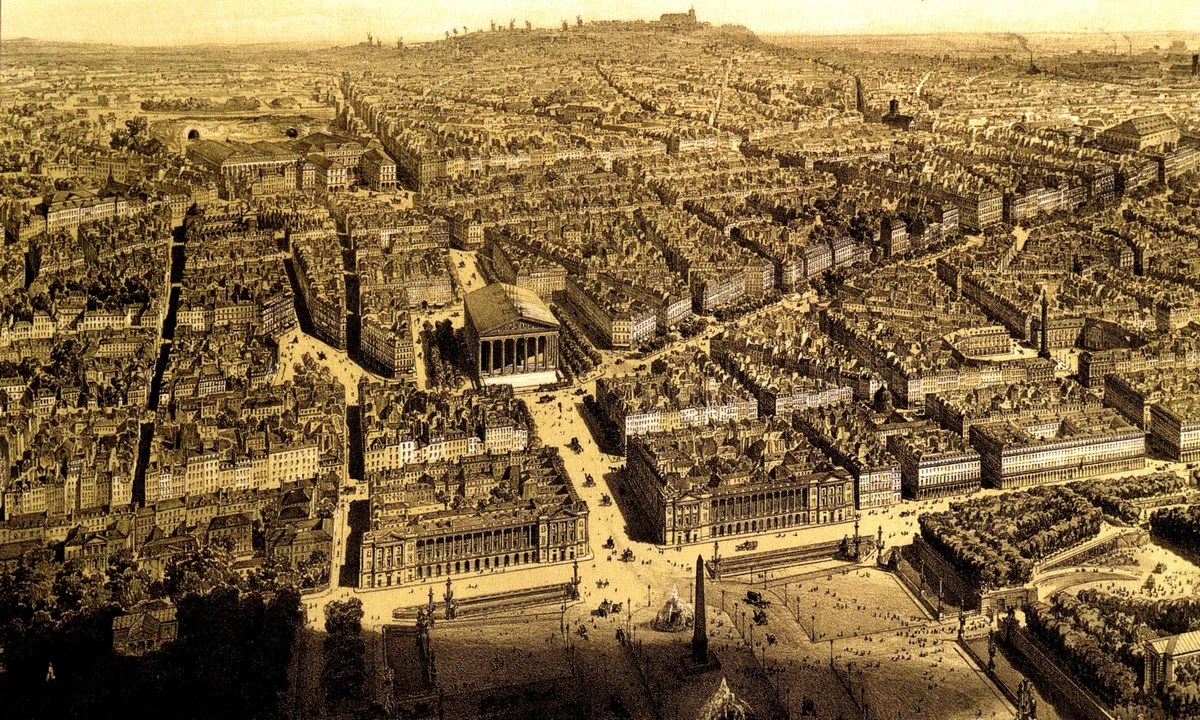
The boulevard is Haussmann’s primary instrument and his primary legacy, and its logic is worth understanding in full because the logic is more complex than it appears. The broad, straight avenue cutting through the medieval city fabric — lined with uniform stone buildings of regulated height and regulated façade, with wide pavements and rows of trees and the infrastructure of gas lighting and underground sewers running beneath it — is not merely an aesthetic statement, though it is that. It is a system, and the system has several functions operating simultaneously, not all of them publicly acknowledged.
The public functions were real and important: the new boulevards allowed the movement of goods and people through a city that had been strangled by its own congestion, connected the railway stations to the centre and to each other, provided the infrastructure — the water mains, the sewers, the gas lines — that the public health of a modern city required. The sewer system Haussmann built beneath the new Paris was, by itself, one of the great engineering achievements of the nineteenth century: three hundred and fifty miles of underground galleries that transformed the city’s relationship to its own waste and that the engineer Belgrand designed with a comprehensiveness that the surface boulevards above them both required and concealed.
The military function was also real, and Haussmann was not entirely candid about it, though he did not entirely deny it. The broad straight boulevards that connected the major monuments of Paris — the Arc de Triomphe to the Opera, the Opera to the Louvre, the Louvre to the Hotel de Ville — were designed in part to allow the rapid movement of troops from the barracks to the flash points of potential insurrection, and to deny the revolutionaries the narrow streets and the blind alleys that had made the barricades of 1830 and 1848 so effective. A city of broad boulevards is a city in which cavalry can charge and artillery can be deployed, and Haussmann’s Paris was designed with this knowledge as one of its operating principles.
The aesthetic function was the one most publicly celebrated: the boulevard as the stage for modern urban life, the space in which the flâneur — that figure of Baudelairean modernity, the observer of the spectacle of the city — could move and watch and be watched, in which the café and the shop window and the theatre hoarding created a continuous surface of commercial and cultural stimulation that was itself a form of politics, an argument for the proposition that the Second Empire had produced a civilisation worth inhabiting. Haussmann understood the aesthetics of power as well as its mechanics, and the uniformity of the building façades along his boulevards — the regulated heights, the aligned balconies, the creamy Lutetian limestone that gives Paris its particular golden tone in certain lights — was the aesthetic expression of an administrative intelligence that valued order and coherence and the demonstration of the state’s capacity to impose both.
The Human Cost
The displacement was enormous, and it was not evenly distributed, and its unevenness was not accidental. The slums that Haussmann demolished were predominantly working-class neighborhoods — the îlots insalubres, the insalubrious blocks of the city’s medieval core, the densely populated districts of Montmartre and Belleville and the Marais — and the populations displaced from them were not rehoused within the new boulevards, whose rents were calibrated for the bourgeoisie that the new Paris was designed to serve. The working class of Paris was pushed outward, to the periphery, to the new arrondissements that Haussmann incorporated into the city’s administrative boundaries precisely because the expansion of the boundary allowed him to manage the displacement more efficiently.
This sorting of the city by class — the centre for the comfortable, the periphery for the poor — was not new in European urban history, but Haussmann accelerated and systematised it with an efficiency that transformed the social geography of Paris in ways that have not been fully reversed. The Paris of the grands boulevards and the Haussmann apartment buildings and the Second Empire cafés is the Paris of the bourgeoisie made permanent: a city whose centre is beautiful and expensive and from which the working class has been, with greater or lesser efficiency, excluded for a hundred and fifty years. The banlieues of the twenty-first century — the peripheral housing estates where the city’s poor and its immigrant populations are concentrated — are, in this sense, a consequence of Haussmann’s logic as much as of any subsequent policy decision.
Walter Benjamin, whose Arcades Project is the most sustained meditation on Haussmann’s Paris that the twentieth century produced, understood this clearly. Benjamin saw in Haussmann’s boulevards the physical expression of the commodity economy — the wide streets as channels for the circulation of capital as well as of people, the uniform façades as the architectural equivalent of the commodity’s suppression of use value by exchange value, the spectacle of the boulevard as the prototype of the spectacle of consumer capitalism that the twentieth century would develop to its full extent. The connection between Haussmann’s Paris and the society of the spectacle that Guy Debord would theorise a century later is not metaphorical. It is structural.
The Financing and the Fall
Haussmann financed the transformation of Paris through methods that were, by any conventional accounting standard, fraudulent — or if not fraudulent, then so creative in their interpretation of the legal and financial constraints under which he was operating that the distinction between creativity and fraud becomes difficult to maintain. The expropriation payments, the construction costs, the infrastructure investment: the sums involved were far beyond what the city’s ordinary budget could accommodate, and Haussmann covered the gap through a system of borrowing against future revenues that his opponents, when they finally assembled the political force to examine it, found impossible to fully account for.
The opposition had been building for years — from property owners who resented the expropriations, from conservatives who deplored the destruction of old Paris, from republicans who saw in the transformation an exercise of authoritarian power dressed in the clothes of public improvement, from the writer Victor Hugo who mourned the Paris that was being demolished, from the poet Charles Baudelaire who understood, with the ambivalence of someone who both loved and hated the new city, that modernity had arrived and that its arrival was irreversible. “The old Paris is no more,” Baudelaire wrote, “the form of a city changes faster, alas, than the heart of a mortal” — one of the most precise descriptions of the feeling of living inside Haussmann’s transformation that the period produced.
The financial exposure was revealed to the Legislative Corps in 1869 by Jules Ferry, whose pamphlet Les Comptes fantastiques d’Haussmann — the fantastic accounts of Haussmann, a pun on Offenbach’s then-running opera Les Contes d’Hoffmann — was the document that ended Haussmann’s tenure. Napoleon III, whose own political position was weakening under the pressures that would eventually produce the disastrous Franco-Prussian War of 1870, could no longer protect his prefect against the financial scandal, and Haussmann was dismissed in January 1870. The Franco-Prussian War followed. The Paris Commune — the revolutionary uprising of 1871, which destroyed several of the buildings Haussmann had created and demonstrated that the broad boulevards had not, in the end, solved the problem of insurrection — followed that. The Second Empire was over. The new Paris remained.
The Legacy and Its Complications
Haussmann was made a baron by Napoleon III in 1853, the year of his appointment, and the title has stuck to him in the way that titles stick to people who have done something large enough to require a name: Haussmann’s Paris, Haussmannisation, the Haussmann apartment — the six-storey limestone building with the wrought-iron balconies and the zinc roof and the regular rhythm of windows that is the defining domestic architecture of the city — as a type and a concept that has spread far beyond Paris itself, adopted and imitated in cities across Europe and beyond as the model of what a modern urban apartment building should look like.
The assessment of his legacy has shifted across the century and a half since his dismissal. The immediate response of the architectural and cultural establishment was largely negative: the destruction of old Paris, the displacement of the poor, the financial scandal, the military logic of the boulevards — these were the terms in which his critics framed the transformation, and the terms were not entirely wrong. The preservationist tradition that emerged in his wake — the tradition that would eventually produce UNESCO’s World Heritage designations and the conservation frameworks that now protect the old centres of European cities — was partly a reaction to what Haussmann had done to Paris.
The rehabilitation came gradually, as the public health benefits of the transformation became undeniable — the cholera epidemics stopped, the infant mortality rates fell, the city became, by measurable indices, a less lethal place to live — and as the aesthetic achievement of the new Paris accumulated the patina of history that made it, by the mid-twentieth century, the thing that tourists came to see rather than the thing that reformers complained about. The Haussmann apartment, despised by the modernists of the early twentieth century for its bourgeois historicism and its decorative excess, has become the most desired form of housing in the city, its high ceilings and its stone walls and its wrought-iron balconies now carrying a premium that would have astonished the working-class families displaced to the periphery to make room for it.
What He Actually Built
What Haussmann built — and the word is more accurate than it might seem, because even if he was not an architect he was the author of the system that produced the buildings — was the modern city as a concept and as a physical reality. Not merely Paris, though Paris was his laboratory and his monument, but the idea of the city as a planned system rather than an accumulated organism, as something that could be designed from above rather than merely grown from below, as an expression of administrative intelligence rather than historical accident.
The consequences of this idea have been both magnificent and terrible, and often simultaneously, which is the condition of all genuinely powerful ideas applied to the world. The magnificent: the Paris that is one of the great human achievements in the organisation of urban life, whose boulevards and public spaces and unified architectural language create a city of extraordinary beauty and extraordinary livability for those who can afford to live in it. The terrible: the displacement, the destruction, the class sorting, the authoritarian logic that treats the city as an administrative problem to be solved rather than a community of people to be consulted, and that has served as the model for urban transformations from Robert Moses’s New York to the wholesale demolitions of Chinese cities in the twenty-first century.
Haussmann died in 1891, having outlived the empire that made him and the city he had known and the reputation that had briefly destroyed him. He had written his memoirs, defended his methods, maintained to the end that what he had done was necessary and that the necessity justified the means, which is the position of every transformative official who has ever operated at the intersection of vision and power and found, in the intersection, both the capacity to change the world and the capacity to do so at other people’s expense. The boulevard outside the window catches the light in the way that the Lutetian limestone always catches the light in Paris in certain hours of the afternoon, and the trees are in their rows, and the café is full, and somewhere beneath all of it the sewers are running, and none of this existed before him, and none of it would have been possible without the displacement and the destruction and the authoritarian certainty of a man who was given a task and accomplished it without hesitation, and who was right about the city and wrong about the people, which is perhaps the defining condition of the great urban planner, and perhaps of power itself.
This essay draws on Haussmann’s own Mémoires (1890–93), David Harvey’s Paris: Capital of Modernity (2003), Patrice de Moncan’s Le Paris d’Haussmann (2002), Walter Benjamin’s The Arcades Project (written 1927–1940, published posthumously), and Jules Ferry’s Les Comptes fantastiques d’Haussmann (1868). Charles Baudelaire’s lines are from “Le Cygne” (1861). Georges-Eugène Haussmann was born on March 27, 1809, in Paris, and died on January 11, 1891. He served as Prefect of the Seine from 1853 to 1870.
Discover more from My World of Interiors
Subscribe to get the latest posts sent to your email.

