
Essay · Music & Ideas
Four Men and the Thing They Were Saying
The Beatles did not set out to have a message. They set out to make girls scream, to get out of Liverpool, to be bigger than Elvis, and they achieved all three with a speed and a completeness that left them, by 1965, with nowhere obvious to go except inward. What they found there — in the music they made between the screaming and the silence, between “Love Me Do” and “A Day in the Life” — constitutes one of the more sustained and more coherent arguments about what it means to be alive in the modern world that popular music has produced, and the argument is more interesting and more durable than the mythology that has accumulated around it.
By Bergotte · Liverpool & Abbey Road · Music & Ideas
Begin with the love songs, because that is where they began, and because the love songs are not as simple as they look. The early Beatles — 1962 to 1964, the Hamburg years and the first flush of British fame, the period that ends roughly with the American invasion of February 1964 — made music whose surface is entirely conventional: boy meets girl, boy loses girl, boy wants girl back. The chord sequences are borrowed from American rhythm and blues and from the Brill Building pop that Lennon and McCartney had absorbed as teenagers, and the subjects — desire, rejection, longing, the small catastrophes of adolescent romantic life — had been the subjects of popular song for as long as popular song had existed. There is nothing, on the surface, that distinguishes “She Loves You” from a hundred contemporaneous records except that it is better, which is a distinction of degree rather than of kind.
But even in the early work, something is happening beneath the surface that distinguishes it from the contemporaneous records not just in degree but in kind. The voice — Lennon’s specifically, in the recordings where he takes the lead — has a quality of directness and of wit that popular music of the era was not producing in that combination: not the wit of the entertainer performing for an audience, but the wit of a person genuinely thinking, genuinely finding the situation funny and sad simultaneously, genuinely more interested in the complexity of the experience than in the reassurance of the resolution. The early Lennon songs are not love songs in the conventional sense. They are observations about love — slightly incredulous, slightly amused, alive to the absurdity of the whole enterprise in a way that the genre’s conventions were not designed to accommodate and that Lennon accommodated anyway, bending the form until it could carry more than it had been built to carry.
This — the bending of available forms to carry more than they were designed to carry — is the central technique and the central achievement of the Beatles’ career, and it applies not just to the love songs but to everything that followed them.
Liverpool and the Education of Outsiders
The Beatles were from Liverpool, which matters more than it is usually made to matter. Liverpool in the 1950s was a city of considerable cultural richness and considerable economic depression, a port city with deep connections to America through the sailors who brought back records that were not yet available in Britain — rhythm and blues, country, the early rock and roll of Chuck Berry and Little Richard and Buddy Holly — and a city with the particular social texture of a place that is not London and knows it and has a complicated relationship with that knowledge. The Liverpool sensibility — sceptical, funny, quick to deflate pretension, fiercely loyal to its own and suspicious of everything that comes from elsewhere — is present in the Beatles’ work from the beginning and never entirely leaves it, even in the most psychedelic and the most experimental of the later records. There is always, somewhere in the music, the Liverpudlian refusal to take itself too seriously, the quick joke that arrives just when the thing is in danger of becoming portentous.
Lennon and McCartney were, in addition to being Liverpudlian, working-class and lower-middle-class respectively, which is to say they were people who had not been given the cultural permission to consider themselves artists and who became artists anyway, which produced in both of them a relationship to their own ambition that was slightly combative, slightly defensive, and enormously productive. The art schools that both attended — Lennon at Liverpool College of Art, McCartney less formally — gave them exposure to modernism and to the avant-garde without giving them the institutional framework that might have contained and regularised those influences. They absorbed what was useful and left the rest, which is the best education available.
Harrison and Starr came from different backgrounds and brought different things. Harrison’s guitar playing — always more melodically sophisticated than the rock and roll template required, always reaching toward something stranger and more interesting than the obvious note — was the band’s most consistently innovative instrumental voice, and his spiritual seriousness, which became explicit in the later years, was a genuine counterweight to Lennon’s scepticism and McCartney’s pragmatic warmth. Starr’s drumming is the most underassessed element of the Beatles’ sound: the steadiness, the rightness, the quality of restraint in a drummer who understood that his job was to make the music work rather than to demonstrate his own skill, is a formal intelligence of considerable sophistication and produced the rhythmic foundation on which everything else rested.
1964 to 1966: The Acceleration
The period between the first American visit in February 1964 and the last concert in San Francisco in August 1966 is the period of the acceleration — the compression of development that took the Beatles, in thirty months of touring and recording and the daily pressure of being the most famous people on earth, from “I Want to Hold Your Hand” to “Tomorrow Never Knows,” which is a distance that no other act in popular music has covered in comparable time.
A Hard Day’s Night (1964) and Help! (1965) are the bridge — the albums and the films of a band that is still working within the pop conventions but beginning to push against them, beginning to find the conventions insufficient for what they are actually trying to say. The Lennon songs of this period are becoming stranger: “I’m a Loser” and “Help!” and “You’ve Got to Hide Your Love Away” are not love songs in any useful sense; they are confessions, self-examinations, records of a mental state rather than a narrative situation, and the directness of the confession — the willingness to say, in a pop song, that one is unhappy, uncertain, frightened, that the image one projects does not match the experience one is having — was new. Pop music was not supposed to be confessional. Pop music was supposed to be aspirational, or entertaining, or both. Lennon’s middle-period songs are neither, and they changed what pop music thought it was allowed to be.
Rubber Soul (1965) is where the argument becomes fully articulate. The album sounds, still, like nothing before it and like everything after it: folk influences and rhythm and blues and something harder to name that is simply the Beatles thinking, on record, about the world they inhabit and the people they are and the gap between the two. “In My Life” — perhaps the finest song Lennon wrote — is a meditation on memory and loss and the specific quality of the feeling of having lived, and it is written with a formal control and an emotional precision that places it in the company of the best lyric poetry of the century. “Norwegian Wood” is a short story in three minutes, told from the perspective of an unreliable narrator with something to hide, which no pop song had previously attempted. “The Word” and “Think for Yourself” and “The Nowhere Man” — Lennon’s most explicit statement of the problem that will preoccupy him for the rest of his career, the problem of the person who exists in a comfortable life without any apparent purpose or conviction — are the earliest signs of the social criticism that Revolver would make explicit.
“We’re more popular than Jesus now. I don’t know which will go first — rock and roll or Christianity.” — John Lennon, in interview with the London Evening Standard, 1966
The remark was not, in the context in which it was made — a candid conversation with a sympathetic journalist — particularly inflammatory. It was an observation, probably accurate, certainly meant as one, and it was made by a man who had been thinking seriously about the relationship between celebrity and religion, about the quasi-religious function that the Beatles had begun to serve for their audiences, about the difference between the thing being worshipped and the thing that deserved worship. The American South took it as blasphemy. What it actually was, was the first fully public statement of a theme that runs through the later work: the critique of false gods, of empty systems of meaning, of the things that people give their devotion to in the absence of anything better.
Revolver and the Argument Made Explicit
Revolver (1966) is the first Beatles album in which the message — if we are going to use that word — is fully visible in every song, in which every track is doing something beyond entertainment and doing it consciously, with the confidence of a band that has understood what it is capable of and is no longer interested in concealing it.
“Taxman” is social criticism — sharp, funny, slightly crude, exactly as sharp and funny and crude as social criticism in a pop song needs to be to work. “Eleanor Rigby” is a miniature novel about loneliness, specifically the loneliness of people who are not interesting enough to appear in the stories the culture tells about itself — the priest, the spinster, the background figures of ordinary life — and it is written with a compassion and a formal severity that make it, still, one of the most remarkable things in the pop canon. “Here, There and Everywhere” is a perfect love song. “Yellow Submarine” is a children’s song. “She Said She Said” is an account of an acid experience that is also a theological argument. “Love You To” — Harrison’s first serious engagement with Indian music — is the opening of the spiritual inquiry that will occupy the band’s last three years. “Tomorrow Never Knows” is a direct transcription of Timothy Leary’s version of the Tibetan Book of the Dead, made into a sound that no one had previously imagined, built on a drone and a series of tape loops that anticipate ambient music by a decade and electronic music by two.
The album’s message, if it has a single one, is: pay attention. Pay attention to the people around you — the Eleanor Rigbys, the invisible people, the ones who die and leave no trace. Pay attention to the limits of the society you inhabit — the taxman, the politician, the machinery of power. Pay attention to consciousness itself — what it is, what it could be, what the ordinary waking state conceals from you. This is not a political programme or a philosophical system. It is a disposition, a quality of attentiveness, and the music is its demonstration: Revolver sounds like a band that is paying attention, that is interested in everything, that has no use for the comfortable and the conventional except as a baseline from which to depart.
Sgt. Pepper and the Limits of the Dream
Sgt. Pepper’s Lonely Hearts Club Band (1967) is the album that the culture has designated as the Beatles’ masterpiece, and it is not quite. It is the album that sounds most like a masterpiece — most unified in its conception, most ambitious in its scope, most self-consciously significant in its ambitions — and the gap between the sound of a masterpiece and the thing itself is where its limitations live. The conceit of the alter-ego band — the fictional Sgt. Pepper’s, within which the Beatles could perform without the pressure of being the Beatles — was a good idea that the album follows intermittently and then abandons, and several of its most celebrated songs are celebrated for reasons that have more to do with their cultural moment than with their intrinsic quality.
But “A Day in the Life” is as close to a perfect artefact as rock music has produced: a song that moves between McCartney’s cheerful morning routine and Lennon’s bleak newsreel consciousness, that connects the private and the public in a structure of devastating simplicity, that ends in an orchestral crescendo that resolves into a single sustained piano chord, and that says, in four and a half minutes, something about the relationship between the individual life and the collective reality that no other song has said as fully or as precisely. The message of “A Day in the Life,” if it must be reduced to a message, is: the world is terrible and ordinary and funny and the people in it are sleepwalking through it and the sleepwalking is both understandable and a catastrophe. This is not a comfortable message. It is a true one.
The Summer of Love that Sgt. Pepper was taken to announce was not, in fact, what the Beatles were announcing. The summer of love was an interpretation — a wish, a projection, a desire for the music to mean something more optimistic than it actually meant. “All You Need Is Love,” broadcast to a global television audience of 400 million in June 1967, was taken as a statement of utopian faith, and it was also, if you listened to it carefully, a tautology: a statement that is true in the way that all tautologies are true, which is completely and without content. Lennon knew this. The lyric is almost deliberately thin, a gesture toward an idea rather than an articulation of one, and the gesture was what the moment required, and Lennon provided it, and felt, presumably, the slight embarrassment of a serious man who has been asked to be a symbol.
The White Album and the Dissolution
The Beatles (1968) — the White Album — is where the message fractures, which is itself a message. The album is the sound of four people who have been, for a decade, the most unified creative enterprise in the history of popular music, discovering that they are not, in fact, unified — that they are four separate people with four separate visions and four separate desires, and that the project of being the Beatles has become, for each of them, a constraint rather than a liberation.
The fracturing produces music of extraordinary range and extraordinary unevenness: “Blackbird” and “While My Guitar Gently Weeps” and “Julia” and “Happiness Is a Warm Gun” alongside “Ob-La-Di, Ob-La-Da” and “Wild Honey Pie” and “Rocky Raccoon,” and the disparity is the point, the deliberate refusal of the coherence that Sgt. Pepper had imposed, the insistence on the variety and the messiness of actual creative life rather than the tidiness of the concept album. The White Album contains multitudes because the Beatles, by 1968, were multitudes — no longer a band in the original sense but a collective of individuals whose individual visions were no longer fully compatible with one another.
The message of the White Album, if it has one, is that the dream has limits — that the utopian moment of 1967 was a moment and not a destination, that the love and the music and the possibility they represented were real but not sufficient, that the world was more complicated and more resistant than the summer of love had been prepared to acknowledge. This is a harder and a more honest message than anything Sgt. Pepper delivered, and it is delivered without the comfort of a unified artistic vision to contain it.
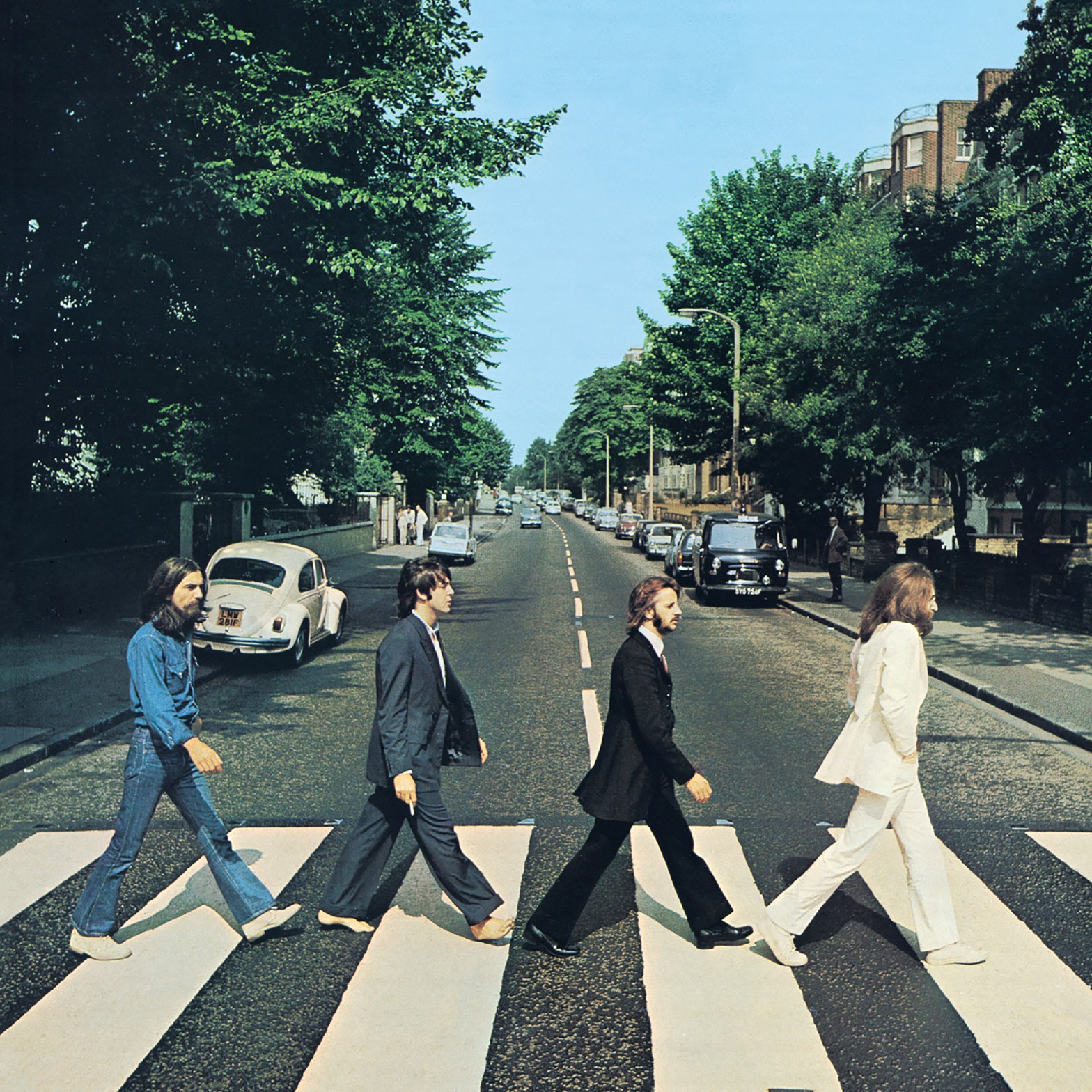
Abbey Road and the Valediction
Abbey Road (1969) is the farewell, made by four people who knew they were saying goodbye even as they were making it, and the knowledge gives the album a quality that the others do not quite have: the quality of something fully inhabited and fully understood, made with the attention that one brings to things that are ending. The medley on Side Two — the sequence of unfinished songs assembled into a continuous movement — is the most formally sophisticated thing the Beatles recorded, a demonstration of compositional intelligence that belongs to the tradition of the classical suite as much as to anything in the rock canon, and its final moments — McCartney’s “The End,” with its declaration that the love you take is equal to the love you make, followed by Lennon’s “Her Majesty,” which punctures the valediction with a thirty-second music hall joke — are the last word on the tension that had always been present in the Beatles and that the music had always, at its best, held in productive balance: the tension between the serious and the comic, the profound and the trivial, the valediction and the joke.
The message of “The End” — that love is a form of reciprocity, that what you give is what you receive, that the account is always settling toward balance — is the simplest and the most durable thing the Beatles said, and it was said in sixteen words after nine years of saying everything else.
What They Were Actually Saying
The Beatles’ message, assembled from the whole of the career and the whole of the catalogue, is not the message of peace and love that the mythology has assigned them — or not primarily. It is something more specific and more useful: a sustained argument, made in the form of songs, about the quality of attention available to the modern person, about the ease with which ordinary life becomes a sleepwalk, about the capacity of music — of art — to interrupt the sleepwalk, to make the listener briefly more awake, more present, more aware of the fullness of the world they are moving through.
They said: pay attention to the people around you. They said: the official version of events is not the whole story, and the people who do not appear in the official version have inner lives as rich as yours. They said: consciousness can be expanded, and the expansion is worth attempting, and the expansion has limits, and the limits are instructive. They said: love is the most important thing, and love is not simple, and the simplest statement of it is also the truest. They said: the serious and the comic are not opposites but companions, and the joke is often the most honest response to the situation.
They said all of this in the form of songs that were simultaneously the most popular and the most artistically ambitious music of their era, which is an achievement so unlikely that it still, sixty years later, seems slightly impossible. The sleepwalkers woke up. Some of them are still awake. This is the thing the Beatles did, and it is, on reflection, quite enough.
This essay draws on the Beatles’ recorded catalogue (1963–1970), Mark Lewisohn’s three-volume biography The Beatles: All These Years (2013–), Ian MacDonald’s Revolution in the Head (1994), and published interviews with all four Beatles across the careers and the decades that followed. The recordings referenced include Please Please Me (1963), A Hard Day’s Night (1964), Help! (1965), Rubber Soul (1965), Revolver (1966), Sgt. Pepper’s Lonely Hearts Club Band (1967), The Beatles (1968), and Abbey Road (1969).
Discover more from My World of Interiors
Subscribe to get the latest posts sent to your email.

