
Essay · Literature & Lives
The Princess Who Wrote Her Way Out
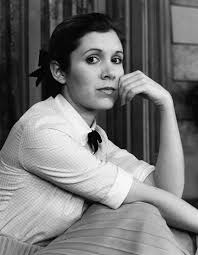
Carrie Fisher was a movie star who became a writer, which is the reverse of the usual trajectory and considerably the more interesting one. The writing she produced — the novels, the memoirs, the one-woman shows, the screenplay work, the wit deployed in every public appearance as both shield and scalpel — was the achievement of a life that had every reason to be defined by other people’s narratives and that refused, with increasing confidence and increasing skill, to be defined by anything except her own.
By Bergotte · Beverly Hills & A Galaxy Far Away · Literature & Lives
She was born into the story before she could speak. The daughter of Eddie Fisher and Debbie Reynolds — the most public marriage and the most public dissolution of the early television age — Carrie Frances Fisher arrived on October 21, 1956, as a character in a drama whose other principals had been assigned their roles before her birth: her mother the wronged innocent, her father the weak man, Elizabeth Taylor the temptress, and the child between them the living evidence of what the marriage had been before it became a scandal. She grew up understanding, in the way that children of celebrities understand things, through atmosphere rather than instruction, that her existence was public property in some fundamental sense that she had not consented to and could not revoke. The only available responses to this condition were to disappear into privacy, which was not her temperament, or to seize the narrative and make it her own, which was. She spent the rest of her life doing the latter, with a skill and a courage and a wit that became, in the end, one of the more remarkable literary and personal achievements of her generation.
The wit arrived first, or was the first thing visible. The Fisher wit — rapid, associative, self-deflecting, capable of turning the most painful material into the funniest sentence in the room without diminishing the pain — was her primary public instrument from the beginning, and its function was both obvious and complex: it was armour, and it was performance, and it was genuine, and it was a way of controlling the terms of engagement with a world that wanted to discuss her in ways she found reductive, and it was also, simply, how her mind worked. She was funny the way some people are left-handed: not as a choice but as a constitution, and the comedy was the form in which her intelligence expressed itself most naturally, which meant that the comedy was never merely comedy but always also something else — observation, analysis, the precise location of the absurdity in any given situation, which in her case was almost always the situation itself.
Star Wars and the Prison of the Icon
She was nineteen when she filmed Star Wars, cast as Princess Leia Organa by George Lucas in a production whose cultural impact no one on set, including Lucas, fully anticipated. The film was released in 1977 and changed everything — not just the film industry, which it changed comprehensively and in ways that are still being worked through fifty years later, but the careers and the lives of the three young actors at its centre, in ways that were not always welcome and were rarely simple. Harrison Ford became the biggest movie star in the world and wore the fame with the ease of someone who had always suspected it was coming. Mark Hamill found the role defining in ways he negotiated with varying degrees of comfort. Fisher found it defining in ways she spent twenty years finding intolerable and the following twenty making funny.
Princess Leia was an icon from the moment the film opened, which meant that Carrie Fisher was an icon from the moment the film opened, which meant that the person and the character were fused, in the public imagination, with a completeness that left very little room for the person. The gold bikini of Return of the Jedi — worn in 1983, when she was twenty-six, at the direction of a male director in a male-dominated industry, over her own strenuous objections — became, in the culture’s collective imagination, one of the defining images of female objectification in popular cinema, and Fisher’s response to it evolved, over the years, from mortification to mordant acceptance to something that was almost ownership: she made jokes about it, turned it into material, discussed it in terms that were simultaneously feminist and self-mocking and completely clear about whose body it was and what had been done with it without her full consent. The gold bikini became, in her handling of it, not a humiliation but an argument, which is a considerable transformation and required considerable skill.
“I am not a sex symbol. I am a symbol of something, but I’m still working out what.” — Carrie Fisher, in interview, 1983
The Drugs and the Diagnosis
Fisher began using drugs in her late teens, in the manner of her generation and her milieu and with the particular intensity of someone who has discovered, in the chemical alteration of consciousness, temporary relief from a mental state that is otherwise unmanageable. The drugs were partly recreational and partly, as she came to understand much later, self-medication: the energy and the racing thoughts and the periods of extraordinary productivity followed by periods of collapse that characterised her young adulthood were the symptoms of bipolar disorder, diagnosed eventually in her mid-twenties, a diagnosis that reframed her history and, in some respects, her sense of herself.
Her relationship to the diagnosis was, characteristically, complicated and public and ultimately brave. She was not, after the initial shock of recognition, a person who retreated from the knowledge of her own condition. She engaged with it, wrote about it, discussed it in interviews and on stage and in her books with a directness that was, in the 1980s and 1990s, genuinely unusual — the stigma around mental illness was such that public figures, when they acknowledged it at all, tended to do so in the careful, mediated language of recovery and management. Fisher was not careful. She was funny and frank and specific, and the specificity was the point: she was not describing a condition in the abstract but her condition, the actual texture of what it felt like to live inside a mind that worked the way hers did, and the description was both personally honest and, for the people who recognised themselves in it, an act of solidarity of considerable importance.
This is one of the things she did that the cultural narrative about her — film star’s daughter, Star Wars princess, Hollywood survivor — has not always adequately acknowledged: she changed, in a small but real way, what it was possible to say publicly about mental illness in America. She made the conversation less shameful by being completely unashamed, and the unashamed-ness was not bravado or performance but a considered position, arrived at after years of the alternative and found to be, in every practical and moral sense, better.
The Novels and the Discovery of the Literary Voice
Postcards from the Edge, published in 1987, was Fisher’s first novel and was received, initially, with the slightly condescending warmth that the literary establishment tends to extend to celebrity authors who turn out to be better than expected: the acknowledgement that the book was funny and smart was accompanied, in some quarters, by the faint suggestion that its qualities were surprising, which tells you more about the expectations than about the book. The book is a roman à clef about a young actress in a Los Angeles rehabilitation facility, and it is extraordinary — not because it is revealing about Hollywood, though it is, but because it demonstrates, from the first page, a prose style of genuine distinction: an ear for dialogue that is simultaneously stylised and completely natural, a structural intelligence that organises the material with the compression of someone who has thought carefully about what a novel needs to do and what it can afford to leave out, and a tonal control that holds comedy and pathos in the same sentence without letting either collapse into the other.
The voice in the novel is not quite Carrie Fisher’s voice — it is filtered through the fiction, shaped by the demands of character and plot — but it is unmistakably the product of the same sensibility, and reading it alongside the memoirs that followed is to watch a writer discovering and refining an instrument that became, over twenty years of use, one of the more distinctive voices in American prose. She published three more novels — Surrender the Pink (1990), Delusions of Grandma (1993), and The Best Awful (2004) — and each of them extended and complicated the territory staked out by the first, moving between autobiography and invention with the freedom of a writer who has understood that the distinction is less important than the quality of the attention brought to either.
Wishful Drinking and the Memoir as Stand-Up
The memoirs are where Fisher’s achievement is most fully visible to most readers, and the achievement is genuine enough to deserve that visibility. Wishful Drinking (2008) — drawn from the one-woman stage show she had performed for several years, and transformed on the page into something that works equally well as a read as a performance — is the best introduction to her particular gifts: the combination of memoir and comedy and cultural criticism and genuine emotional honesty that she had been moving toward for twenty years. The writing is fast and associative and very funny and, beneath the funny, the sadness is always present, held at a specific distance — close enough to be felt, far enough to be survived, which is the emotional arithmetic of all good comedy and which Fisher had worked out, through trial and error and considerable personal cost, with unusual precision.
Shockaholic (2011) and the posthumously published The Princess Diarist (2016) — drawn from the journals she kept during the filming of the original Star Wars — extended the project, each book adding to a body of autobiography that constitutes, in aggregate, one of the more honest and more fully realised accounts of a specific kind of American female experience available in the literature: the experience of being born famous, of growing up in public, of navigating the industry that your parents’ story deposited you in, of managing the gap between the person you are and the person the culture has decided you are, of being mentally ill in a world that was only slowly learning to acknowledge mental illness as a real rather than a moral condition.
“I am mentally ill. I can say that. I am not ashamed of that. I survived that, I’m still surviving it, but bring it on.” — Carrie Fisher, in interview, 2013
The Script Doctor and the Work Nobody Saw
A significant portion of Fisher’s professional life was invisible to the public because it was conducted, by definition, without credit: she was one of the most sought-after script doctors in Hollywood, called in to fix dialogue, sharpen characters, add wit to material that needed it, and she was, by the accounts of the directors and producers who used her, extraordinarily good at it. The work required exactly the skills she had developed as a novelist and a memoirist — the ear for how people actually speak, the understanding of character as expressed through language, the ability to identify where a scene was failing and what it needed — and she brought to it the same professionalism and the same intelligence that she brought to everything else, without the recognition that the novels and the memoirs received because the nature of the work precluded recognition.
The list of films she worked on, uncredited, is long and includes some of the most commercially successful Hollywood productions of the 1990s, and the fact that her contribution is not publicly documented is not incidental to the broader story of her career: it is a version of the same story, the story of a woman whose work was used, valued, paid for, and not acknowledged, and who found ways to make the acknowledgement unnecessary by doing the other work — the novels, the shows, the memoirs — so publicly and so well that the public invisibility of the script work became, in the context of everything else, simply one more element of a professional life that refused to be reduced to any single definition.
The Return to Leia and the Final Chapter
When Disney acquired Lucasfilm in 2012 and announced a new trilogy of Star Wars films, the return of Fisher — alongside Ford and Hamill — was both commercially essential and, for Fisher, an opportunity she approached with the mixture of wariness and affection that the franchise had always produced in her. She was fifty-nine when The Force Awakens was released in 2015, and Leia was sixty, and the film treated the character’s age with a respect and a seriousness that the earlier films had not always extended to their female characters. Fisher was present in the role with a gravity and a specificity that surprised reviewers who had expected the iconic image and received, instead, a fully inhabited person: a woman who had lived, in the thirty years since we last saw her, a life whose weight was visible in her face and her bearing and the quality of her attention.
She was preparing for The Last Jedi when she died, on December 28, 2016, four days after suffering a cardiac arrest on a flight from London to Los Angeles. She was sixty years old. Her mother, Debbie Reynolds, died the following day. The proximity of the two deaths — the mother following the daughter by twenty-four hours — was received by the public with the kind of overwhelming emotion that accumulates around losses that arrive too close together to be processed separately, and the tributes that followed were genuine and numerous and, in many cases, reached for the Star Wars imagery rather than the literary achievement, which was understandable and somewhat beside the point.
What She Actually Did
The achievement of Carrie Fisher’s life is not the achievement of Princess Leia, though Leia is part of it. It is the achievement of a woman who was handed a set of circumstances — the famous parents, the unstable childhood, the early stardom, the mental illness, the addictions, the marriages, the losses — that would have defeated or silenced most people, and who transformed those circumstances, through intelligence and humour and relentless honesty and genuine literary skill, into a body of work that illuminated those circumstances for everyone who recognised themselves in any part of them.
She wrote about mental illness when it was not done. She wrote about addiction when it was not done. She wrote about the specific absurdities of Hollywood with the authority of someone who had been inside them and the distance of someone who had thought carefully about what they meant. She wrote about her mother with love and with honesty in the same sentence, which is the hardest combination, and she wrote about herself with a clarity that was never cruel and never falsely flattering and never, even at its most comic, dishonest about the cost of the life she had lived.
The gold bikini is still there, in the cultural imagination, and it will remain there, and Fisher made her peace with it and then her argument with it and then her joke about it, and all three of those moves were right in their moment. But the books are also there, and the shows, and the interviews, and the quality of mind that produced all of them — quick and dark and funny and completely, undefendably itself — and they will outlast the bikini, as the work always outlasts the image, as the writer always outlasts the icon, which is the one form of revenge available to the person the culture tried to reduce to a single photograph, and which Fisher, who was a writer before she was anything else and a writer after everything else was done, understood and used and left behind for anyone willing to read it.
This essay draws on Carrie Fisher’s novels Postcards from the Edge (1987), Surrender the Pink (1990), Delusions of Grandma (1993), and The Best Awful (2004), her memoirs Wishful Drinking (2008), Shockaholic (2011), and The Princess Diarist (2016), and published interviews across four decades. Carrie Frances Fisher was born October 21, 1956, in Burbank, California, and died December 28, 2016, in Los Angeles. She is survived by her daughter Billie Lourd.
Discover more from My World of Interiors
Subscribe to get the latest posts sent to your email.

