Essay · Literature & Ideas
A Novel About Everything That Can Go Wrong, Written With Love
The World According to Garp is a novel about a novelist, which gives John Irving permission to make it about everything else: about mothers and sons, about feminism and its discontents, about the randomness of violent death, about the relationship between life and art and the insufficiency of both, about bears. It is one of the great American novels of the twentieth century and it has been consistently underestimated, partly because it is so entertaining and partly because the entertainment disguises, for readers moving too quickly, how much is actually going on.
By Bergotte · Vienna & New England · Literature & Ideas
There is a passage near the beginning of The World According to Garp in which Jenny Fields, nurse and future feminist icon, explains her philosophy of desire. She wants a child but not a husband. She wants a son but not a relationship. She finds her solution in a dying ball turret gunner named Technical Sergeant Garp, whose brain damage has left him with the sexual instincts and the conscious awareness of a large, docile animal, and she uses him, with his uncomplicated cooperation, to conceive the child she wants, and then she watches him die, and she feels, the novel tells us, sad but not complicated. Jenny Fields throughout the novel feels sad but not complicated about most things, and this quality — the capacity to want what she wants without the self-doubt and the qualification and the apologetic hedging that the world requires of women who want things — is simultaneously her greatest strength and the quality that makes her, to the world around her, permanently threatening.
Her son T.S. Garp — who takes his father’s name because it is all he has of him — is her opposite in almost every particular. He is complicated about everything. He is a writer, which means his business is complication, the finding of the ambiguity in the apparently simple and the humanity in the apparently monstrous, and he practices this business with the seriousness and the anxiety of someone who understands that the work matters and is not at all certain that he is equal to it. He is also, the novel makes clear from the beginning, going to die young, in the random and senseless and almost comic manner that the novel has been preparing us for across five hundred pages, and the knowledge of this — which the novel provides early and then withholds and then returns to in the book’s devastating final section — gives every scene in which Garp is alive and writing and loving and being terrible and being wonderful a quality of elegy that the comedy does not diminish but intensifies.
Irving and the Novel That Changed Everything
John Irving published The World According to Garp in 1978, his fourth novel, and it was the book that turned him from a respected literary writer with a modest readership into a phenomenon — a bestseller, a cultural event, the kind of novel that people pressed on strangers and argued about at dinner and that produced, in its readers, the particular combination of laughter and grief that only the most fully realised fiction can achieve. The three novels that preceded it — Setting Free the Bears, The Water-Method Man, and The 158-Pound Marriage — had established him as a writer of considerable gifts and a sensibility that was distinctly his own: comic and dark simultaneously, preoccupied with Vienna and with wrestling and with bears and with the violence that lurks beneath the surface of ordinary domestic life, and written in a prose that was generous and accessible without being simple.
Garp gathered all of these preoccupations and expanded them to a scale that the earlier novels had not attempted, and the expansion produced something that the literary culture of 1978 had not quite seen before: a novel that was simultaneously a family saga and a meditation on art and a feminist text and a comedy and a tragedy, that moved between modes with a fluency that looked effortless and was not, that contained within its generous, digressive, sometimes overwhelming structure a formal intelligence that the entertainment kept politely concealing.
“In the world according to Garp, we are all terminal cases.” — John Irving, The World According to Garp, 1978
Jenny Fields and the Invention of a Feminist
Jenny Fields is one of the great characters in American fiction, and she is great in a way that is easy to miss because she is never the centre of her own story, always on the periphery of Garp’s, always doing the thing that mothers of protagonists do in novels, which is to exist in relation to the protagonist rather than in relation to themselves. What Irving does with her — quietly, without announcing it, with the same trick he uses throughout the novel of burying the serious argument inside the comic scene — is to make her the novel’s moral intelligence, the character whose instincts are most reliable and whose understanding of the world is deepest, while simultaneously showing how a woman of this quality and this conviction is received by the culture around her.
She writes a memoir, A Sexual Suspect, which becomes a feminist classic and makes her famous, and the fame is a trap as well as a liberation: it attaches her to a movement she supports but does not entirely belong to, makes her a symbol when she is a person, brings to her estate in New Hampshire a community of women — the Ellen Jamesians, who have cut out their tongues in solidarity with a rape victim — whose radical gesture she finds both moving and wrongheaded. She does not have uncomplicated feelings about the feminist movement because she does not have uncomplicated feelings about anything, but she also does not perform complication in the way that Garp does, does not turn it into art or anxiety. She simply holds it, with the steadiness of someone who has learned that steadiness is the most useful thing available.
Her death — shot by a man who objects to her politics, at a campaign rally, in a moment so random and so public and so devoid of drama that the novel refuses to give it the weight of a set piece — is the event around which Garp’s grief organises itself for the rest of the book, and it is handled with the same refusal of sentimentality that characterises everything Irving does in the novel when he is at his best: he tells you it happened, and he tells you what happened after, and he trusts the accumulation of prior feeling to do the emotional work without his assistance.
The Stories Within the Novel
Garp contains several stories by Garp himself, rendered in full, and the inclusion of these fictional-within-fictional texts is one of Irving’s most audacious formal decisions and one of the novel’s most interesting arguments. The stories are good — genuinely good, by any standard that applies to short fiction, not merely adequate as plot devices — and this matters because the novel’s claim for Garp as a serious artist has to be substantiated rather than asserted. Irving substantiates it. The story “The Pension Grillparzer,” which appears early in the novel as Garp’s first mature work, is a miniature masterpiece of comic-elegiac fiction — a story about a family of travelling entertainers in Vienna that manages, in a few pages, to contain the same preoccupations as the novel surrounding it: love and loss and the comedy of human aspiration and the violence that arrives without warning to rearrange everything.
The argument that the stories make, embedded in the novel, is about the relationship between experience and art — about how the writer transforms the raw material of a life into something that exceeds the life, that is available to people who have not lived the life, that becomes, in some sense, more real than the events it is drawn from. This is a familiar argument in the novel-about-a-novelist tradition, but Irving makes it freshly because he is also, simultaneously, making the counter-argument: that the transformation is not without cost, that the life is always more than the art can contain, that Garp’s habit of turning his experience into fiction is both his gift and his failure as a husband, a father, a person present to the people who need him. The novel about a novelist is also a novel about the limits of the novel.
Lust, Violence, and the Under Toad
The Under Toad is what Garp’s son Walt mishears when his parents warn him about the undertow in the sea — he imagines a toad lurking beneath the surface, patient and enormous, waiting to drag him under. The family adopts the phrase as their private language for a feeling they all recognise: the sense of disaster waiting beneath the ordinary surface of things, the knowledge that the worst can happen at any moment, the particular anxiety of people who love each other in a world that does not guarantee the continuation of anything.
The Under Toad arrives, as it always does, in the most ordinary of circumstances. The accident in the driveway — Garp and his son and his wife’s lover, a collision in the dark that kills one child, blinds another, and ends a marriage — is the novel’s central trauma, and it is rendered with a restraint that makes it more devastating than any amount of elaboration would have done. Irving does not linger. He does not explain. He describes what happened in plain, fast prose, and then he describes what happened after, and the after — the grief, the guilt, the marriages that reform and reform around the wound — is where the novel lives for its final hundred pages.
The violence in the novel — and there is a great deal of it, more than readers who remember the comedy tend to remember — is never gratuitous and never decorative. It is the Under Toad made visible, the reminder that the world in which Garp wrestles and writes and loves and is funny is also the world in which the worst things happen without preparation or meaning or the narrative satisfaction of cause and effect. The randomness is the point. Garp is shot by a woman who was also once shot at — a reversal so tidily ironic that it would feel contrived in a lesser novel and feels, in this one, simply true, in the way that the most terrible ironies of actual lives feel true: too neat to have been invented, too senseless to have been intended.
The Feminism the Novel Is Actually Doing
Garp was published at the height of second-wave feminism and was immediately controversial among feminist readers, some of whom found in its treatment of women — particularly the Ellen Jamesians, whose gesture of solidarity is presented as simultaneously admirable and absurd — evidence of Irving’s hostility to the movement. The reading was not without basis. The Ellen Jamesians are comic figures as well as sympathetic ones, and the comedy is at their expense as much as at anything else’s. Garp’s frustration with them is rendered with a sympathy that can read as authorial endorsement.
But the novel’s feminism — and it is a feminist novel, more fully and more thoughtfully than its detractors allowed — operates at a different level than the representation of any individual group. It operates at the level of structure: in the fact that the novel’s moral centre is a woman, that the most admirable and the most fully realised intelligence in the book belongs to Jenny Fields, that the novel takes as its central subject the question of what a woman’s life can be when it is not organised around a man’s needs. Jenny’s answer is radical and consistent and presented with full authorial endorsement. That the novel is narrated from Garp’s perspective, through Garp’s complications and anxieties about his mother’s radicalism, does not undermine the endorsement. It dramatises it — shows how even the son who loves his mother most cannot quite see her clearly, cannot quite free himself from the assumptions that her life was explicitly designed to challenge.
The Bears, the Wrestling, and What They Are For
The bears in Irving are never only bears. In Setting Free the Bears they are the prisoners of history. In Garp they appear in a more domestic register — the performing bear of Garp’s beloved story, the wrestling bears that haunt the novel’s imagery — and they function as they always do in Irving’s work: as the emblem of something that is simultaneously dangerous and gentle, powerful and vulnerable, capable of great tenderness and sudden violence, which is to say they are the emblem of the human condition as Irving understands it.
The wrestling matters in the same way. Garp wrestles throughout the novel — as a student, as an adult coach, finally as an old woman in a wig, in disguise at his mother’s memorial, watching the sport he loves without being able to claim it. Wrestling is a form of controlled violence, a discipline that channels the body’s capacity for harm into something structured and rule-governed and even beautiful. It is what Garp would like his fiction to be — and what his fiction, at its best, is: the thing that takes the raw material of damage and holds it in a form that can be witnessed without destroying anyone.
What the Novel Does That the Novel About Death Usually Doesn’t
The deaths in Garp accumulate, and they accumulate in a way that should, by any conventional narrative logic, produce despair. A child dies. Another is blinded. Jenny dies. Garp dies. Helen’s lover dies. The Ellen Jamesian who shoots Garp dies. The novel’s final pages are a catalogue of deaths — of every major character, dispatched in a sentence or two each, in a passage that reads like the final chapter of a Russian novel and that has made some readers feel that Irving is showing off, is making a point about mortality with more emphasis than the point requires.
The reading misses what the passage is doing, which is not making a point but completing an argument. The argument is that everything ends, that the Under Toad gets everyone eventually, that the love and the comedy and the wrestling and the writing and the bears and the extraordinary, infuriating, irreplaceable people are all temporary, and that the temporariness is not the tragedy but the condition — the condition within which the love and the comedy and the wrestling and the writing acquire their meaning, which is a meaning they could not have if they were permanent. Garp dies young, as the novel has always known he would, and the knowledge of his death gives everything he does while alive the quality of something precious precisely because it is not going to last, which is, the novel insists with the stubbornness of a deeply held conviction, the only kind of preciousness there is.
Jenny Fields believed this, though she would not have said it in these words. She simply acted as though every moment of her life was worth exactly what it was and not a penny more, and she did not apologise for wanting what she wanted, and she did not flinch from what she saw, and in this she was wiser than everyone around her and most characters in American fiction, and her son, who loved her and could not quite see her, spent his whole life — which was also his whole career — trying to write his way toward understanding her.
He did not entirely succeed. The novel does.
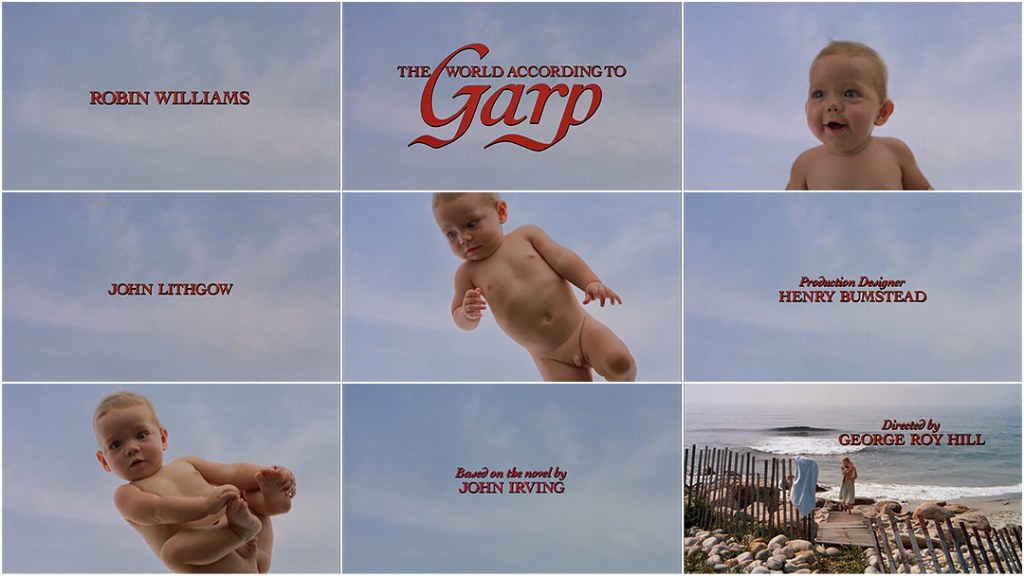
This essay draws on John Irving’s The World According to Garp (1978, E.P. Dutton) and his essays on fiction collected in The Imaginary Girlfriend (1996). Irving’s earlier novels referenced are Setting Free the Bears (1969), The Water-Method Man (1972), and The 158-Pound Marriage (1974). The novel was adapted for film by George Roy Hill in 1982, with Robin Williams as Garp and Glenn Close as Jenny Fields, in a performance that earned Close her first Academy Award nomination.

Leave a Reply