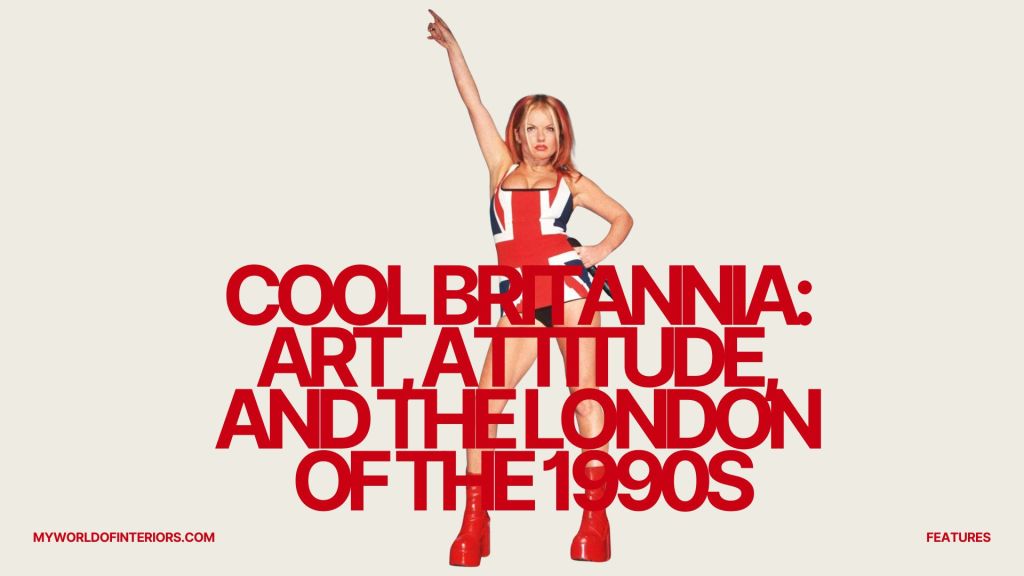
It was the summer of 1997 and Downing Street had turned into a nightclub. Tony Blair, barely weeks into his premiership, was playing host not to diplomats but to designers, artists, models, and rock stars. In the garden, Kate Moss smoked cigarettes with Noel Gallagher of Oasis. Tracey Emin and Damien Hirst, the enfant terribles of British art, mingled with cabinet ministers. Alexander McQueen strutted in from the fashion world, all sharp tailoring and sharper tongue. For a brief, heady moment, Britain was not the gray, post-Thatcher nation it had been but a cultural powerhouse. The phrase was on every tabloid: Cool Britannia.
Freeze to Fame
The art half of Cool Britannia was born in 1988 in a derelict London Docklands warehouse, where a young Damien Hirst staged Freeze, an exhibition of his fellow Goldsmiths graduates. The works were audacious, raw, and strangely self-assured. There was Sarah Lucas with her bawdy humor, Gary Hume with his glossy abstractions, Angus Fairhurst with his dark wit. The show caught the eye of adman-turned-collector Charles Saatchi, whose deep pockets and sharper instincts would fuel an entire generation.
By the mid-1990s, the Young British Artists (YBAs) were everywhere. They filled the tabloids, they filled Saatchi’s North London gallery, they filled the Royal Academy with the landmark exhibition Sensation in 1997. The press adored them and loathed them in equal measure. Emin’s tent (Everyone I Have Ever Slept With), Hirst’s shark in formaldehyde, Chris Ofili’s elephant-dung Virgin Mary — each became both scandal and sensation.
Art Meets Politics
Blair’s New Labour government was quick to co-opt the scene. The YBAs were young, media-savvy, anti-establishment — exactly the image Blair wanted for Britain’s rebrand. When Tracey Emin’s My Bed was shortlisted for the Turner Prize in 1999, tabloid outrage only fueled her celebrity. When Hirst won the same prize in 1995, he collected it in a shiny silver suit, equal parts Andy Warhol and rock star.
Number 10 became a stage for this new Britishness. The guest lists blurred politics, fashion, and art: Damien Hirst next to Princess Diana, Kate Moss drinking champagne with cabinet ministers, Blur and Oasis supplying the soundtrack. Critics scoffed that it was branding, not governance — but the branding worked. For a moment, London really did feel like the center of the world.
Sex, Drugs, and the Turner Prize
The Turner Prize, once an obscure award, turned into prime-time scandal. The tabloids had a field day: “Is This Art?” screamed headlines next to photos of Lucas’s sausages arranged as genitalia or Emin’s vodka-stained bed. But controversy was oxygen to the YBAs. “Bad publicity is better than no publicity,” said Hirst — and collectors agreed. Prices skyrocketed, and the artists became as famous for their personalities as for their works.
Emin embodied the confessional culture of the era — part punk poet, part tabloid star. Lucas played the bawdy provocateur, her works a feminist satire of laddish Britain. Hirst, always the showman, compared himself to Walt Disney and filled warehouses with vitrines of animals. Together, they turned art into theater.
Fashion, Parties, and the Glamorous Hangover
The YBAs were never alone. Their scene bled into fashion and music. Alexander McQueen sent models down the runway in armadillo shoes and blood-spattered gowns, his provocations echoing Hirst’s. Kate Moss, the era’s ultimate muse, drifted between catwalks, Britpop gigs, and YBA parties, her waifish image as iconic as any painting. Blur’s Damon Albarn and Oasis’s Gallagher brothers battled it out for pop supremacy, their swagger matching the YBAs’ shock tactics.
Nightlife was central: openings at White Cube gallery spilled into Soho clubs, champagne flowed at Saatchi’s dinners, Emin’s chaotic interviews became gossip-column gold. The art wasn’t just in galleries — it was in tabloids, on the streets, in the parties that never seemed to end.
The Market and the Myth
Behind the glamour was commerce. Charles Saatchi acted as impresario, buying up YBA works and flipping them into cultural phenomena. By the 2000s, Damien Hirst bypassed galleries altogether, selling directly at Sotheby’s in a record-breaking auction. The enfant terribles became millionaires; the rebels became brands.
Critics charged them with selling out, with turning provocation into commodity. But even this was part of the Cool Britannia ethos: in a country where style and image had become politics, the YBAs were simply reflecting the times.
After Cool Britannia
By the early 2000s, the shine had dulled. Blair’s politics soured, Britpop imploded, and the YBAs were no longer outsiders but establishment. Hirst opened restaurants and mega-exhibitions. Emin became a Royal Academician. Lucas represented Britain at the Venice Biennale. What had been rebellion was now heritage.
Yet the legacy endures. The YBAs changed British art forever, dragging it out of genteel obscurity and into public life. They blurred art, celebrity, politics, and commerce into one spectacle. They anticipated the age of reality TV, social media, and Instagrammable controversy.
Essential Cool Britannia Moments
- 1988 – Damien Hirst stages Freeze, launching the YBA movement.
- 1995 – Hirst wins the Turner Prize with his shark in formaldehyde.
- 1997 – Sensation at the Royal Academy shocks London, outrages tabloids.
- 1997 – Tony Blair hosts Britpop and the YBAs at 10 Downing Street.
- 1999 – Tracey Emin’s My Bed shortlisted for the Turner Prize.
- 2008 – Hirst bypasses galleries, sells directly at Sotheby’s, cementing the art-as-brand model.
Cool Britannia, Then and Now
Looking back, the 1990s London art scene seems both intoxicating and naïve — a time when Britain believed it could brand itself into relevance, when art could scandalize a nation, when politics and pop culture mingled without shame.
Cool Britannia was not a movement so much as a mood, a collision of art, music, fashion, and politics. It was brash, messy, self-promotional, and intoxicating. And though the moment passed, its influence lingers: in the way art courts celebrity, in the commodification of rebellion, in the belief that culture itself can be a nation’s calling card.
For a decade, London was loud, dazzling, outrageous — and yes, cool.

Leave a Reply