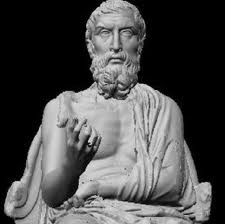
History has been extraordinarily unkind to Epicurus in a specific way: it remembered his name and forgot his philosophy, and substituted in its place a caricature so opposite to what he actually said that it constitutes one of the great intellectual crimes of the Western tradition. He did not advocate luxury. He did not celebrate excess. He taught in a garden outside Athens with a group of friends that included women and slaves — which was itself a scandal — and he said that the good life was simple, that pleasure was the removal of pain, that the fear of death was the greatest obstacle to living, and that friendship was the greatest gift available to a mortal being. He was right about all of it, and the world has been ignoring him ever since.
The word Epicurean, in contemporary usage, denotes a person of refined and expensive tastes — someone who takes particular pleasure in fine food and wine, who cultivates the sensory pleasures with a connoisseur’s discrimination, who has elevated the enjoyment of material goods into something approaching an art form. This is the precise opposite of what Epicurus taught, and the inversion is not merely a linguistic accident. It is the record of a specific historical process: the absorption of a genuinely radical philosophy into the service of the social arrangements it was developed to oppose, the domestication of a way of life designed to produce genuine freedom into a brand name for sophisticated consumption.
Epicurus was born in 341 BCE on the island of Samos, the son of an Athenian colonist who was a schoolteacher. He came to philosophy early and seriously — he reportedly told his biographers that he began to philosophise at fourteen, when his teachers could not satisfactorily explain to him what Hesiod meant by the primordial Chaos out of which everything had come into being. He studied at Athens, encountered the work of Democritus on the atomic theory — the theory that everything that exists is composed of indivisible particles moving through void — and built from it the most comprehensive materialist philosophy the ancient world produced.
In 306 BCE he established himself in Athens, purchasing a property with a garden — the Garden, as it came to be known — outside the city walls, and founding there a philosophical community that was immediately and deliberately different from the other philosophical communities of Athens. The Academy and the Lyceum were institutions for the education of the citizen class — of the young men who would eventually take their place in the political and intellectual life of the city. The Garden was open to everyone. Women were admitted — Leontion, a former courtesan who became a significant philosopher in her own right, was among its members. Slaves were admitted. Friends of varying social classes lived together, sharing a common life organised around the pursuit of philosophical understanding and the specific kind of pleasure that philosophical understanding, in Epicurus’s account, produces.
He was extraordinarily prolific — ancient sources credit him with approximately three hundred rolls of papyrus — and almost everything he wrote has been lost. What survives consists primarily of three letters preserved in Diogenes Laërtius’s Lives of the Eminent Philosophers, a collection of short sayings called the Principal Doctrines and the Vatican Sayings, and — at a greater remove but of enormous philosophical importance — the De Rerum Natura of Lucretius, the Roman poet who wrote in the first century BCE the fullest and most beautiful exposition of the Epicurean system in any ancient source. From these fragments and this elaboration, the philosophy must be reconstructed — and the reconstruction reveals something that the caricature has almost entirely obscured: a genuinely serious and genuinely radical account of the human condition and of what the human being requires for a life that is genuinely worth living.
Atoms and the Void: The World Without Mystery
The foundation of the Epicurean philosophy is not ethical but physical — or rather, the ethics are built on a physics, on an account of what the world actually consists of, and the physics is chosen in part because of the ethical consequences it makes available.
Epicurus took from Democritus the atomic theory: everything that exists is composed of atoms — tiny, indivisible particles — moving through void. The atoms have size and shape and weight but no secondary qualities: no colour, no smell, no taste, no sound. The colours and smells and tastes and sounds that we perceive are produced by the interaction of atoms with our sense organs — they are not properties of the atoms themselves but of the encounter between the atomic world and the perceptual apparatus we bring to it.
This is, in its broad outlines, a position that modern physics has vindicated — though the details are very different and Epicurus would not have recognised his atoms in quarks and leptons. What matters philosophically is not the specific physical theory but the consequence Epicurus draws from it: a world of atoms and void is a world without divine intervention, without fate, without the arbitrary exercise of supernatural power over human lives. The gods, if they exist — and Epicurus thought they did, in a carefully circumscribed sense — inhabit the spaces between worlds and are entirely indifferent to human affairs. They do not reward the virtuous or punish the wicked. They do not send diseases or grant victories. They have their own blessed existence, undisturbed by the prayers and the sacrifices and the ritual placations of ordinary religious life.
The consequence is liberating and terrifying in equal measure. Liberating, because the world is not a place of arbitrary divine power in which the human being is the plaything of forces she cannot predict or control. The world operates according to regular, understandable principles — the motions of atoms through void, the laws of combination and dissolution — and the human being who understands these principles has, to that extent, freed herself from the fear that the arbitrary universe generates. Terrifying, because a world of atoms and void is also a world without inherent meaning — without the teleological structure that Aristotle had argued for, without the Forms that had given Plato’s world its orientation toward the Good, without the logos that had given Heraclitus’s world its rational coherence.
Epicurus embraces the terror and extracts from it the liberation. The world without inherent meaning is also the world without inherent threat — the world in which the human being is not subject to arbitrary punishment, in which the fear of divine anger is groundless, in which the anxiety about fate and fortune that dominated ordinary Greek religious life has no rational basis. The physics is the first step in the therapy.
The Fear of Death: The Greatest Obstacle
“Death is nothing to us.” The sentence — one of the most famous in ancient philosophy — is the Principal Doctrine that Epicurus places first, and its placement is not accidental. The fear of death is, in his account, the greatest obstacle to the good life — the source of the anxiety that pervades ordinary human existence, the root of the frantic pursuit of wealth and power and distraction that constitutes what most people take for the good life and that is, in his account, the exact opposite of it.
The argument for the claim that death is nothing to us is disarmingly simple: “Where death is, I am not; where I am, death is not.” Death is the cessation of experience — the state in which there is no one present to experience anything, including the bad experience of being dead. The fear of death is therefore the fear of a state in which there will be no one present to be frightened. There is no subject of the experience of death — no one to whom the death is happening in the way that experiences happen to subjects. The fear of death is as irrational as the fear of the time before one was born: neither state involves any experience of any kind, and therefore neither state is capable of being bad for the person who is in it.
This is the argument, and it has attracted two and a half thousand years of objection, most of which takes one of two forms. The first objection is that we can be harmed by states we do not experience — that being dead deprives us of the goods we would have had if we had lived longer, and that this deprivation is a genuine harm even if there is no subject present to feel it as a harm. This is the deprivation argument, and Epicurus’s response is that a deprivation is only a harm to a subject, and there is no subject to whom the deprivation applies. The second objection is that the fear of death is not really the fear of the state of being dead but the fear of the process of dying — and to this Epicurus has a less satisfactory response, essentially conceding that dying can be bad but arguing that its badness is typically exaggerated and that philosophical understanding can significantly reduce it.
Neither response is entirely persuasive, and the Epicurean argument about death has never achieved the universal acceptance its elegance seems to deserve. But the argument’s failure to persuade is itself philosophically instructive. The fear of death is not primarily a rational response to a rational assessment of what death involves. It is a constitutive feature of conscious existence — the background anxiety of the being that knows it will die, that cannot quite believe it, that organises its life partly around the management of this knowledge. Epicurus offers a philosophical argument against the irrationality of this fear. What he cannot offer — what no philosophical argument can quite offer — is the dissolution of the anxiety that the argument is directed against.
What he can offer, and what the philosophical life he describes is designed to produce, is a different relationship to the anxiety: not its elimination but its diminution, the specific quality of equanimity that comes from having thought clearly about the conditions of one’s existence and having accepted them without the distortions that fear produces. This is, again, the ancient Camus — the philosopher who looks at the absurd condition of the mortal being in an indifferent universe and proposes not transcendence but acceptance, not consolation but clarity.
Pleasure as the Absence of Pain: What Hedonism Actually Means
Epicurus was a hedonist — he believed that pleasure was the highest good, the ultimate criterion of value, the standard by which everything else should be assessed. This much is universally acknowledged. What is almost universally misunderstood is what he meant by pleasure.
The confusion arises because the Greek word for pleasure — hēdonē — covers a range of experiences that English separates into distinct categories, and because Epicurus’s account of pleasure is the systematic contrary of the ordinary Greek understanding. The ordinary understanding took pleasure to be primarily positive: the enjoyment of food and drink and sex and music and the other good things that the sensory world provides. Epicurus’s account takes the primary form of pleasure to be negative: the absence of pain, the state of ataraxia — tranquillity, freedom from disturbance — in which the body is free from pain and the mind is free from anxiety.
Ataraxia — the undisturbed mind — and aponia — the painless body — are the twin summits of Epicurean pleasure, and once they are achieved, the addition of further pleasures does not increase the happiness of the person who has them. “The magnitude of pleasure reaches its limit in the removal of all pain. When pleasure is present, so long as it is uninterrupted, there is no pain of body or of mind, or of both together.” The person who has achieved ataraxia and aponia is as happy as a person can be — as happy as Zeus, Epicurus says, in the one moment of characteristically Greek hyperbole that punctuates the usual austerity of his formulations.
This means that the pursuit of intense positive pleasures — the luxuries and the banquets and the elaborate entertainments that the Epicurean tradition has been associated with — is not only unnecessary but counterproductive. The intense positive pleasure is typically preceded by an intense desire that is itself a form of pain — the pain of wanting what one does not have — and is followed by a satiation that quickly gives way to a new desire. The pursuit of intense pleasure is the pursuit of a moving target, and the person who pursues it is never at rest, never genuinely at peace, never in possession of the ataraxia that genuine pleasure consists of.
The pleasures that Epicurus recommends are modest and reliable: bread and water (with cheese on feast days, he notes, with a specific and charming particularity), the company of friends, philosophical conversation, the enjoyment of the natural world. These pleasures are not intense. They are sustainable — capable of being repeated indefinitely without satiation, without the anxiety of desire, without the disappointment of the gap between anticipation and fulfilment. They are the pleasures of the person who has reduced her desires to what the world can reliably provide and has therefore freed herself from the dependence on uncertain goods — on wealth, on political success, on the favour of others — that is the source of most ordinary human suffering.
This is the philosophy of the Garden: a life of deliberate simplicity, of reduced desire, of the specific pleasure that comes from having enough rather than from having more. It is not asceticism — Epicurus is not recommending the mortification of the body or the renunciation of pleasure. He is recommending the careful, considered management of desire so that the pleasures available to the human being are the pleasures that the human being can reliably obtain. The pleasures of the natural and the necessary — food, shelter, warmth, friendship — are always available. The pleasures of the conventional and the vain — wealth beyond sufficiency, political power, the admiration of crowds — are never reliably available and are not worth the anxiety of their pursuit.
The Tetrapharmakos: The Four-Fold Cure
The Epicurean tradition preserved, in a phrase attributed to Epicurus or to his followers, the tetrapharmakos — the four-fold cure for the diseases of the soul. It runs:
Do not fear god. Do not fear death. What is good is easy to get. What is terrible is easy to endure.
The first two have already been addressed: the physics has dissolved the rational basis for the fear of divine punishment, and the argument about death has dissolved the rational basis for the fear of dying. The third — what is good is easy to get — follows from the account of pleasure as ataraxia: if the highest pleasure is the absence of pain and anxiety rather than the presence of intense positive experience, then the highest pleasure is available to almost anyone who has understood what pleasure actually consists of. The natural and necessary goods — the food and water and shelter and friendship that constitute the Epicurean life — are genuinely available, genuinely sufficient, genuinely reliable in a way that the goods of conventional ambition are not.
The fourth — what is terrible is easy to endure — is the most philosophically ambitious and the most personally demanding of the four. Epicurus suffered from significant physical illness throughout his life — there are references in the ancient sources to painful kidney stones and digestive disorders — and he wrote, in a letter composed on what appears to have been his deathbed, that the physical pleasures of the day outweighed the physical pains. Whether this was honest stoicism or the specific cognitive achievement of a man who had spent his life practising the detachment from bodily suffering that his philosophy recommended is not a question the letter resolves. It is, however, the most direct possible demonstration of the fourth element of the tetrapharmakos: that what is terrible, if faced with the right quality of philosophical preparation, is not as terrible as the unphilosophical mind anticipates.
The tetrapharmakos is the most compressed statement of the therapeutic ambition of Epicurean philosophy — the ambition to cure the diseases of the soul in the way that medicine cures the diseases of the body. Epicurus was explicit about this analogy: “Vain is the word of a philosopher which does not heal any suffering of man. For just as there is no profit in medicine that does not heal the sick, so too there is no profit in philosophy unless it removes the suffering of the soul.” Philosophy, in this account, is not the pursuit of abstract truth for its own sake. It is a practice — a set of exercises and understandings and dispositions that the person who has acquired them will find genuinely useful in the specific practical situation of being a mortal being in an indifferent universe.
Friendship: The Crown of the Sufficient Life
“Of all the things that wisdom provides for a blessed life, by far the greatest is the possession of friendship.”
The sentence is startling in its context, and its startlingness is part of its point. Epicurus has spent his philosophy arguing against the conventional goods — against wealth and political power and the pursuit of intense sensory pleasure — and for the simple, the sufficient, the available. And then, at the summit of the available goods, he places not solitude or contemplation or the private pleasures of the philosophical mind but friendship. Not the Aristotelian friendship of virtue — though there are similarities — but something that sounds, in the Epicurean context, warmer and more immediate: the friendship of people who have chosen each other, who have built a common life around the shared pursuit of the goods that philosophy has revealed to be the genuine ones.
The Garden was the institutional expression of this conviction. Epicurus and his friends lived together, ate together, talked together, took care of each other in illness. The community was not organised around formal philosophical instruction — around the hierarchy of teacher and student that organised the Academy and the Lyceum. It was organised around friendship: around the mutual recognition of people who had chosen the same way of life and who had found in each other the specific pleasure of being genuinely known and genuinely cared for.
The philosophical justification for the primacy of friendship in the Epicurean system is interesting precisely because it has to work against the system’s own apparent logic. If the highest pleasure is ataraxia — the undisturbed mind, the freedom from anxiety and longing — then friendship, which involves genuine attachment to another person and therefore genuine vulnerability to the loss of that person, seems to be a source of disturbance rather than its elimination. The Stoics drew this conclusion and recommended a detachment from particular attachments that they called apatheia — freedom from passion, including the passion of particular love.
Epicurus refused the conclusion. Friendship, in his account, is not a source of the anxiety it might seem to be, because genuine friendship — the friendship of people who share a philosophical understanding of what matters and what does not — is characterised by a specific quality of security that makes it a source of stability rather than disturbance. The friend knows that the other friend is well-disposed, knows what the other values and why, can predict with confidence what the other will do in the situations that matter. This knowledge produces a specific kind of trust that is itself a source of ataraxia — a ground of security in a world that is, in other respects, uncertain and uncontrollable.
There is also, in the Epicurean account of friendship, something that resists the purely instrumental reading — something that sounds less like the calculation of a philosopher and more like the testimony of someone who has experienced genuine friendship and knows that it cannot be entirely reduced to its components. “Friendship dances around the world, announcing to all of us that we should wake to blessedness.” The sentence is not a philosophical argument. It is a description — of the specific quality of the world that genuine friendship produces, of the specific quality of attention to the world that the friendship of genuinely philosophical people makes available.
The Garden was, in this sense, not merely a philosophical institution. It was an experiment in the good life — an attempt to demonstrate, in the specific texture of a shared daily existence, that the life of philosophical simplicity, of reduced desire, of genuine friendship, was not merely theoretically superior to the life of conventional ambition but practically achievable and practically better: more pleasurable, more stable, more genuinely satisfying than the alternative.
The Self and Its Desires: The Therapy of Want
The therapeutic ambition of Epicurean philosophy — the goal of curing the diseases of the soul — focuses, more than on any other disease, on the disease of desire. Not desire as such, which is natural and necessary and the source of the pleasures that the good life consists of, but the specific form of desire that Epicurus calls vain and empty: the desire for goods that are not genuinely good, that the person who pursues them has been convinced by convention and social pressure and the simple force of habit to want, without genuinely examining whether the wanting is rational.
The therapeutic exercise he recommends is deceptively simple: ask, of any desire you notice in yourself, whether its satisfaction is genuinely necessary for happiness. The classification he proposes is tripartite: desires that are natural and necessary (food when hungry, shelter from cold, friendship — the desires whose satisfaction is required for the maintenance of the body and the soul in their proper condition); desires that are natural but not necessary (fancier food, sexual pleasure, most of what ordinary life takes for comfort rather than necessity — the desires whose satisfaction is pleasant but whose absence is not painful); and desires that are neither natural nor necessary (the desire for wealth beyond sufficiency, for political power, for fame, for the specific kinds of status that conventional society distributes and conventional ambition pursues — the desires that are entirely the products of convention and that convention has convinced us we need).
The therapeutic examination is the practice of distinguishing these three categories in one’s own desires — of noticing which desires are genuinely natural and necessary, which are pleasant but optional, and which are the products of a social environment that has no interest in one’s genuine happiness and considerable interest in producing in one the specific pattern of desire that its own economy and its own politics require.
This is, again, something that the serious reader recognises as precisely and permanently applicable to the present. The desires that the contemporary economy produces and sustains — the desire for the next upgrade, the next acquisition, the next level of consumption that will finally provide the satisfaction that the previous level failed to produce — are, in Epicurean terms, vain and empty desires: desires whose satisfaction does not provide genuine pleasure because genuine pleasure is not what they are calibrated to produce. They are calibrated to produce the experience of temporary satisfaction followed by renewed desire — the cycle of consumption that keeps the economy running and keeps the person running on the wheel of conventional ambition.
The Epicurean therapy does not require the renunciation of all pleasure, the withdrawal from all social engagement, the adoption of an ascetic life that most people would find intolerable. It requires the examination of desire — the specific, patient, philosophically disciplined practice of asking, of each thing one wants, whether the wanting is rational and the satisfaction genuine. This examination, Epicurus thought, could be conducted anywhere and in any social circumstance, and its practice was the primary activity of the philosophical life.
The Hidden Life: Withdraw and Live
“Live hidden” — lathe biōsas — is the Epicurean maxim that most directly opposes the Aristotelian account of the political animal and the Platonic account of the philosopher who must return to the cave to govern. Epicurus recommended withdrawal from political life, from the pursuit of fame and power, from the public engagement that the dominant Greek philosophical tradition had treated as the highest expression of the human good.
The recommendation was not based on indifference to the community or on the belief that political life was inherently corrupt. It was based on the specific therapeutic logic of the Epicurean system: political life is inherently anxiety-producing, inherently dependent on the outcomes of processes beyond the individual’s control, inherently organised around the pursuit of the conventional goods — power, fame, the admiration of crowds — that the philosophical analysis has revealed to be vain and empty. The person who enters political life is the person who has decided to stake her happiness on uncertain goods, to make her ataraxia dependent on the approval of others and the outcomes of political contests that she cannot control.
This is not cowardice. It is the rational response to a clear-eyed assessment of what political life actually involves and what it actually costs. The person who lives hidden — who withdraws from the public arena, who confines her ambitions to the circle of the sufficient life and the friends who share it — is not refusing the human community. She is choosing a different form of community: smaller, more genuine, more thoroughly under the control of the values that philosophy has shown to be the genuinely valuable ones.
The Garden was the institutional form of this choice: a community deliberately located outside the public life of Athens, organised around different values, demonstrating by its existence that the life of philosophical simplicity and genuine friendship was not merely a theoretical possibility but a practical achievement. It was, in the most literal sense, an alternative to the world — not a rejection of the world but a demonstration that the world as convention had organised it was not the only possible organisation, and that the alternative organisation produced a life that was, by the only measure that mattered, better.
Who We Are According to Epicurus
We are mortal animals in a universe without gods who intervene and without fate that determines, composed of atoms that will eventually disperse and reconstitute as other things, subject to pleasures and pains that are the only genuine measures of value available to us, capable of the ataraxia that is the highest pleasure and the aponia that is its physical correlate — and far more capable of achieving both than the conventional world’s organisation of desire and ambition allows us to recognise.
We are beings whose suffering is largely self-inflicted — not in the moralistic sense of personal responsibility for every misfortune, but in the specific philosophical sense that the greatest sources of human suffering are the fear of death, the fear of divine punishment, and the pursuit of vain and empty desires, and that all three of these sources are amenable to the therapeutic work of philosophy. The world cannot be made free of pain. The human being can be made free of the specific pains that the unexamined mind produces in addition to the ones that are unavoidable.
We are beings for whom friendship is not merely pleasant but essential — the crown of the sufficient life, the good that is most reliably available and most consistently undervalued, the relationship in which the human being is most fully herself and most fully in possession of the ataraxia that the good life consists of.
We are beings whose desires can be examined, whose wants can be sorted into the genuine and the empty, whose happiness depends not on the acquisition of uncertain external goods but on the specific quality of attention with which we engage with the goods that are genuinely available to us: the warmth of bread, the coolness of water, the company of a friend, the specific pleasure of a philosophical conversation that goes on into the evening while the garden is quiet around it.
He sat in the garden with his friends and he was content. Not passively content — not the contentment of the person who has given up — but the active contentment of the person who has examined the alternatives and found them wanting, who has reduced her desires to what the world can reliably provide, who has discovered in the reduction not poverty but freedom. The garden was not a prison. It was the world, correctly understood.
We still do not understand it. But the invitation is still open.
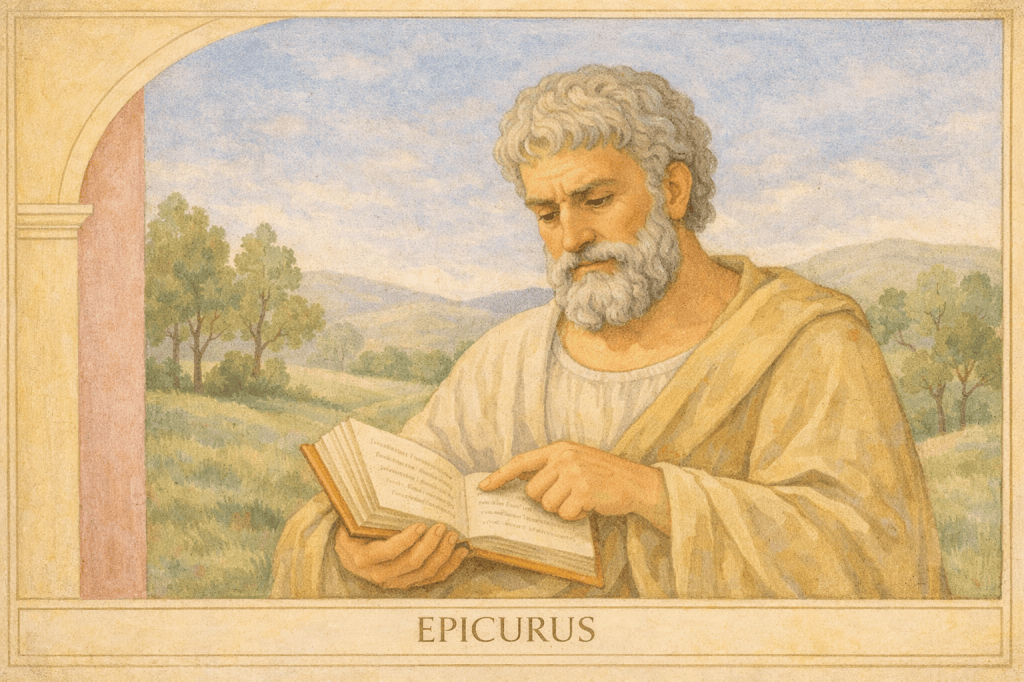
The primary sources for Epicurus are collected in The Epicurus Reader, translated and edited by Brad Inwood and L.P. Gerson (Hackett), which includes the three letters, the Principal Doctrines, and the Vatican Sayings with commentary. Lucretius’s De Rerum Natura is available in the A.E. Stallings verse translation (Penguin), which is the most beautiful English rendering, and the W.H.D. Rouse prose translation in the Loeb Classical Library. For philosophical reconstruction and analysis, A.A. Long and D.N. Sedley’s The Hellenistic Philosophers, Volume 1 (Cambridge University Press) is the standard scholarly reference. Catherine Wilson’s Epicureanism at the Origins of Modernity (Oxford University Press) traces the philosophical legacy. Stephen Greenblatt’s The Swerve (Norton) is an accessible and entertaining account of the rediscovery of Lucretius in the Renaissance, though its philosophical claims should be treated with some caution.

