Makers & Rooms — Essay VIII
Flaminio Bertoni gave the world the DS and the 2CV — the most beautiful car ever made and the most useful, two objects of genius separated by a decade and united by a single Italian hand working in a Paris suburb. He died almost unknown. The cars are immortal.
By Bergotte
On an October morning in 1955, at the Paris Motor Show in the Grand Palais, a crowd gathered around a car that most of them had never seen and that none of them had been entirely prepared for. The car had been unveiled the previous day — the show opened on the fourth, and in the first forty-five minutes of opening, Citroën received orders for over twelve thousand of them, a number that overwhelmed the order-taking staff and has become one of the most repeated statistics in automotive history, though its repetition has not diminished its power to astonish. By the end of the show the orders exceeded eighty thousand. The car was the Citroën DS, and it looked like nothing that had ever been on a road.
To say that it looked like nothing that had ever been on a road is not hyperbole. It was genuinely unprecedented — a body of such sculptural fluency, such apparent inevitability of form, that observers reached immediately for comparisons outside the automotive world. Roland Barthes, who was almost certainly at the show and who published his famous essay on the DS the following year in Mythologies, wrote that it fell from the sky, that it was a superlative object, that its smooth and joining surfaces made it look as though it had been extruded from a single material rather than assembled from parts. He compared it to the Gothic cathedral: an object in which the technical and the spiritual were fused so completely that the distinction between them ceased to be meaningful. This is not the usual register of automotive journalism. It was, and has remained, the only register adequate to the object.
The man who designed the body of the DS was not French. He was an Italian from Varese named Flaminio Bertoni, who had been working for Citroën since 1932, who had already designed the Traction Avant — itself a landmark of automotive design, the first mass-production front-wheel-drive car, whose low, sleek body established a new standard for what a modern French car should look like — and who had, in the years between the Traction Avant and the DS, designed the other car for which Citroën is beloved: the 2CV, the small, unpretentious, entirely functional vehicle that was the antithesis of the DS in almost every visual respect and whose creation by the same hand constitutes one of the most extraordinary creative facts in the history of industrial design. Bertoni designed the most beautiful car of the twentieth century and the most useful. The distance between them, aesthetically, is enormous. The intelligence behind them is the same.
Varese, 1903
Flaminio Bertoni was born on 10 January 1903 in Varese, in the Lombardy region of northern Italy, into a family of craftsmen. His father was a blacksmith, and the combination of material intelligence and physical making that the blacksmith’s craft requires — the understanding of metal as something that can be shaped and coaxed and transformed by skilled hands — seems to have entered Bertoni at a level below conscious formation, as the most formative influences tend to do. He was a sculptor before he was a designer, and he remained a sculptor throughout his life — producing, alongside his industrial work, a body of fine art sculpture in bronze and marble that was exhibited in France and Italy and that constitutes a significant body of work in its own right, largely unknown outside the specialist world of mid-twentieth century French art.
This sculptural formation is crucial to understanding what Bertoni did with cars and why he was able to do it in ways that trained automotive designers could not. The sculptor’s understanding of form — of volume and surface and the way that light moves across a three-dimensional object, of the relationship between mass and space, of the moment when a form is resolved and the moment when it is not — is not the same as the automotive engineer’s understanding, or the industrial designer’s, or the stylist’s. It is more fundamental and in some ways more demanding, because it has no functional specification to hide behind. A sculpture is its form. There is nothing else. The form is either right or it is not, and the rightness is not determined by anything outside the object itself.
Bertoni came to Paris in 1931, drawn by the same gravitational pull that brought artists and makers from across Europe to the city that was still, in the early 1930s, the undisputed centre of the Western cultural world. He arrived with his sculptural training, his craftsman’s hands, his provincial Italian formation, and no particular connection to the automotive industry. What he had, and what Citroën recognised when they hired him in 1932, was an eye for form of unusual acuity — the ability to see a three-dimensional object whole, to understand what it needed in the way that a sculptor understands what a block of marble needs, and to move toward that understanding with the patient certainty of someone who has learned to trust their spatial intelligence above all other guidance.
The Traction Avant and the Education
The car that Bertoni first shaped at Citroën was the Traction Avant, launched in 1934. It was, technically, a revolution — front-wheel drive, unitary body construction, independent front suspension, a combination of engineering advances that transformed the driving experience and established a template for the modern car that persists to this day. But it was also, in its body, a visual statement of unusual confidence: low, long, horizontally emphatic, with a fastback roofline that sloped from roof to tail in a continuous curve and a front end whose wide grille and enclosed headlamps suggested an animal crouching rather than a machine standing still.
The Traction Avant was Bertoni’s apprenticeship in the specific discipline of automotive form — in the constraints and freedoms that distinguish a car body from sculpture in the round. A car body must accommodate a specific mechanical package: engine, transmission, suspension, passenger compartment, fuel tank. It must be manufacturable in large quantities from pressed steel. It must be stable at speed and legible in traffic and practical in use. These are not trivial constraints, and they distinguish the automotive designer’s problem from the sculptor’s in ways that require a specific kind of creative adaptation. The sculptor can follow the form wherever the form leads. The automotive designer must follow the form to the place where it is both beautiful and possible.
Bertoni mastered this adaptation on the Traction Avant and continued to refine it through the 1930s and 1940s, years that were, for France and for Citroën, defined by the disruptions of war and occupation and reconstruction. The company continued to operate under German occupation, producing vehicles for the occupying forces while concealing development work on future cars, and Bertoni continued to work, designing and modelling and thinking about what cars needed to become. The 2CV was conceived in this period — a pre-war brief, developed through the war years and launched in 1948 — and its gestation is, in retrospect, the clearest evidence of what Bertoni understood that his contemporaries did not: that usefulness and beauty were not different values but different expressions of the same value, and that the discipline required to make something fully useful was not opposed to the discipline required to make something beautiful but was, at its best, continuous with it.
The 2CV and the Genius of Reduction
The brief that produced the 2CV was, in its original formulation, almost brutally limiting. Pierre-Jules Boulanger, the Citroën director who commissioned it in 1936, specified a car that could transport four people and fifty kilograms of luggage at sixty kilometres per hour, that could cross a ploughed field without breaking the eggs in a basket placed on the rear seat, that was simple enough to be maintained by a rural farmer with minimal mechanical knowledge, and that could be produced and sold at a price accessible to French working people who had never owned a car. He famously said that the car should be able to be driven by a woman in a skirt, which tells you something about the period’s assumptions and something about the seriousness of the usability requirement, whatever one thinks of its formulation.
What Bertoni made of this brief is one of the great exercises in reduction in the history of design — comparable, in its rigour and its results, to what Dieter Rams would later do at Braun, or what Henningsen had done with the PH lamp: the stripping away of everything that was not necessary until what remained was not poverty but clarity, not deprivation but precision. The 2CV’s body is as simple as a car body can be without ceasing to function. The surfaces are minimal, the lines few, the ornament absent. The roof is canvas, the windows are perspex, the seats are hammocks of fabric stretched over steel tubes. Everything that could be removed has been removed. What is left is a vehicle of such internal coherence that it achieves, paradoxically, something very close to elegance — the elegance of the thing that has been thought about until thinking can go no further, until the form is exactly as simple as the function requires and no simpler.
The 2CV was not universally admired when it was launched in 1948. The French automotive press was, in some quarters, unkind: it was called an umbrella on wheels, a garden snail, a tin can. It looked, to eyes formed on the sleek American cars of the postwar period, like a joke about what a car could be. The people who bought it were not buying a joke. They were buying exactly what Boulanger had specified: a car that could be trusted, maintained, and loved by people who needed it to work rather than to impress. It worked. It was loved. It remained in production until 1990, forty-two years after its launch, and the affection that people who owned 2CVs felt for them was not the affection of automotive enthusiasm but the affection of people for a tool that had served them faithfully through decades of life. This is, in design terms, the highest possible achievement. Bertoni would not have put it that way, but the evidence of the cars suggests that he understood it.
The DS: Form as Vision
The DS took ten years to design. The development programme began in the late 1930s, was suspended by the war, and resumed in the late 1940s under the engineering direction of André Lefèbvre, whose ambitions for the car’s mechanical specification were as radical as Bertoni’s ambitions for its form. Lefèbvre wanted hydropneumatic suspension — a system using pressurised fluid to maintain the car at a constant height regardless of load, to provide a ride quality unprecedented in a production vehicle, to make the DS handle and feel like no car that had previously existed. Bertoni wanted a body that was as far beyond the existing automotive vocabulary as the suspension was beyond the existing automotive technology. The two ambitions met, in the finished car, with a completeness that is almost never achieved when engineering and design are developed simultaneously — each justifying and enabling the other, the extraordinary mechanical specification made visible and comprehensible in the extraordinary form.
The body Bertoni made for the DS is an extended exercise in the resolution of surfaces. There is, in the DS, almost no angle: the entire body is composed of curves, surfaces that flow into each other without the sharp transitions that define most automotive bodies, that suggest continuous organic form rather than assembled panels. The roof line descends to the rear in a long, low arc. The front is a single volume, smooth and uninterrupted, from which the headlamps emerge as organic protrusions rather than as mechanical fittings. The rear tapers to a point — a pointed tail that, in the context of 1955 automotive design, was startling to the point of apparent recklessness, a formal decision that could only have been made by someone who was thinking primarily as a sculptor and only secondarily as a designer of production vehicles.
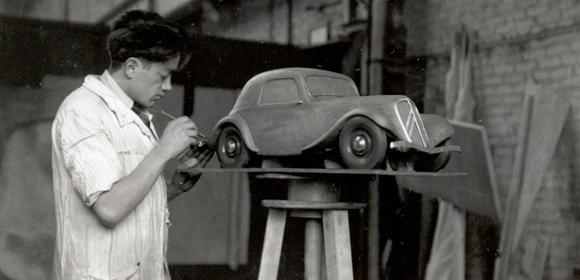
Bertoni’s method throughout the design process was to work in clay — building and reworking the body form at full scale, modelling it with his hands in the way that a sculptor models clay, feeling the surfaces rather than calculating them. This was not unusual in automotive design even in the 1950s, but the degree of control Bertoni exercised over the clay model, the extent to which the finished form reflected his sculptural intelligence rather than any process of stylistic iteration or committee compromise, was exceptional. The DS is the form of one man’s eye, translated through his hands into clay and then into steel, and the coherence of vision that this process produced is legible in every surface of the finished car. It does not look like a design by committee. It looks like a sculpture. It is a sculpture. It happens to also be an automobile of the first rank.
Barthes was right to reach for the Gothic cathedral. There is something in the DS that resists purely functional analysis in the same way that a great cathedral resists it — that exceeds its specifications, that produces in the person who encounters it an experience that cannot be accounted for by listing what the object does. The DS drove extraordinarily well. Its hydropneumatic suspension gave it a ride quality that cars twice its price could not match. Its directional headlamps, which turned with the steering, illuminated corners in ways that conventional headlamps could not. It was fast, reliable, and, in its hydropneumatic complexity, almost entirely beyond the home mechanic — a car that demanded the attention of trained technicians, that carried within it a level of engineering ambition that routine maintenance could not satisfy. But none of this is why people loved it, or why they still love it, or why the sight of a DS on a contemporary street still produces in passers-by the slightly arrested quality of attention that beautiful things produce. They love it because it is beautiful. Because Bertoni, working in a Paris suburb over ten years, found the form that a car could take if a sculptor rather than a stylist were in charge of its skin.
The Paradox Examined
The coexistence of the 2CV and the DS in one career demands more than acknowledgement. It demands examination, because the two cars are not merely different in style or market position or mechanical specification. They are formally antithetical: one is all reduction, the other all elaboration; one celebrates the minimum, the other the maximum; one asks almost nothing of the eye and the other asks everything. To have designed both, with full conviction and full mastery, is to have demonstrated a range of creative intelligence that is almost without precedent in the history of industrial design.
The temptation is to resolve the paradox by subordinating one car to the other — to say that the 2CV was the commission Bertoni executed with professional competence while the DS was the work in which his real ambitions were expressed, or conversely that the 2CV was the more honest achievement, the constraints of the brief producing a purity that the DS’s formal ambition complicated. Both resolutions are available, and both are inadequate. They are inadequate because they assume that creative intelligence operates on a single scale, that a maker who is doing their best work must be doing it at one extreme or the other and that the other extreme is either duty or digression.
What Bertoni’s career suggests, and what the two cars embody with unusual clarity, is that the genuine creative intelligence is not attached to any particular formal position but is responsive — responsive to the specific requirements of the specific brief, capable of going wherever the work needs to go, finding in the constraints of the utilitarian commission exactly the same quality of resolution that it finds in the unlimited brief of the visionary one. This is not versatility in the shallow sense of the designer who can work in any style. It is something deeper: the capacity to understand what a given problem needs, at the level of form rather than function, and to give it that. The 2CV needed reduction. The DS needed elaboration. Bertoni gave each what it needed because his intelligence was not invested in any particular answer but in the question itself — in the perpetual inquiry into what form requires.
The Sculptor in the Factory
Throughout his years at Citroën, Bertoni maintained his identity as a sculptor in a way that was unusual and, in some quarters of the company, apparently regarded with a mixture of admiration and perplexity. He sculpted in his studio at home and exhibited regularly — a practice that kept him connected to the world of fine art even as his working life was conducted entirely within the world of industrial production, and that may have been, in part, a form of self-preservation: a way of maintaining the independent artistic identity that the institutional context of a large manufacturer tends, over time, to erode.
The relationship between his sculptural practice and his automotive work is not one that Bertoni discussed at length — he was, by all accounts, a modest and relatively private man, disinclined to the kind of theoretical self-presentation that has become standard for designers of significant reputation, and the interviews and essays he left behind are fewer and thinner than the importance of his work would seem to justify. But the relationship is visible in the work itself: in the way that the DS in particular is organised around sculptural principles rather than automotive ones, in the primacy of the surface and the volume over the mechanical and the functional, in the treatment of the car as a thing to be experienced visually in the round, from all angles and in all qualities of light, rather than as an assemblage of styled panels.
The DS is most beautiful in certain qualities of light — in the low sun of early morning or late afternoon, when the long curved surfaces catch the light at oblique angles and the form reveals its complexity most fully. This is a sculptor’s understanding of how objects live in the world, how the same form can produce different experiences depending on where the light comes from and where the viewer stands. It is not an understanding that the automotive industry’s standard design processes reliably produce, and its presence in the DS is the clearest evidence of Bertoni’s sculptural intelligence operating within the automotive brief at the level of principle rather than merely of surface.
Obscurity and Its Reasons
Flaminio Bertoni died in February 1964, in Paris, at the age of sixty-one. He had been at Citroën for thirty-two years. He had designed three of the most significant automotive bodies of the twentieth century — the Traction Avant, the 2CV, and the DS — and had contributed to others. He died in relative obscurity, known within the automotive and design worlds but essentially unknown to the general public that drove his cars and loved them. The DS had been in production for nine years when he died. It would continue for another eleven. The 2CV was in its sixteenth year of production and would continue for another twenty-six. Millions of people across Europe and the world were living their daily lives in bodies he had made. Almost none of them knew his name.
The obscurity has several explanations. One is institutional: Citroën, like most manufacturers of its era, did not cultivate the public identities of its designers. The car was a Citroën, not a Bertoni, and the company’s commercial interest lay in the brand rather than in the individual creator. Another is temperamental: Bertoni was not, by any account, a man who sought public recognition or who was comfortable with the machinery of celebrity. He was a maker, formed in a tradition of making in which the work spoke and the maker was secondary to it, and the idea of promoting himself through the work would have been, in the context of his formation, a form of vulgarity.
A third explanation is more uncomfortable: the history of design has been written, predominantly, from a perspective that privileges the avant-garde and the institutionally validated over the popular and the industrial. Bertoni worked in a factory, for a manufacturer, producing objects that were sold to ordinary people for ordinary purposes. The design establishment of the mid-twentieth century — oriented toward the museum and the monograph, toward the design that could be exhibited and theorised and absorbed into the canon of modern art — was not well equipped to account for the significance of a man whose greatest achievements were an inexpensive people’s car and the best automobile body ever pressed from steel. Barthes understood. The institutions were slower.
What the DS Proved
The DS proved several things that the design world has been slow to fully absorb. It proved that industrial production — the mass manufacture of objects in steel and glass and rubber, objects designed to be used rather than exhibited, objects whose aesthetic qualities are inseparable from their functional ones — was capable of producing work of genuine artistic significance. It proved that the sculptural intelligence cultivated in the fine art tradition was not wasted in the industrial context but was, in the right hands and the right commission, the most powerful tool available for the creation of objects of lasting formal quality. And it proved that the beautiful and the useful were not in opposition — that the same intelligence that could produce the radical functionalism of the 2CV could, given a different brief and a different decade, produce the most beautiful car ever built.
The DS remained in production until 1975, twenty years after its launch, a run that is extraordinary for any car and more extraordinary for one so formally radical. In its later years it was joined and then replaced by its successor, the CX, which was itself a fine car but which demonstrated, by contrast, what the DS had been: the CX was designed by a studio rather than a sculptor, and it showed. The continuity of line was there, the hydropneumatic sophistication was there, but the quality of vision — the single controlling intelligence that made every surface of the DS an expression of the same formal understanding — was not there in the same way. The DS was not replicable because the intelligence that produced it was not replicable. You cannot manufacture a Bertoni. You can only, if you are Citroën in the late 1940s, hire one and give him the time and the clay and the freedom that the work requires.
There is a DS in the permanent collection of the Museum of Modern Art in New York. There is one in the Musée des Arts Décoratifs in Paris. There are examples in the design collections of museums across Europe. Bertoni is buried in the cemetery of Montrouge, south of Paris, in a grave that is not widely visited. The cars that carry his intelligence are still on the roads — maintained by devotees, driven with the particular pleasure that a well-made object produces in the person who handles it, standing in the low morning light with their curved surfaces catching the sun at angles that continue to stop people in their tracks, more than half a century after the sculptor who made them died in the city where he had spent his working life, almost unknown, still thinking about form.
