
Makers & Rooms — Essay VII
The House That Remembers You
Gil Schafer builds houses that feel as though they have always been there. This is not an accident, a stylistic affectation, or a retreat from the present. It is the result of a very particular theory about what a house is for — and a conviction that the most important thing architecture can give a family is the feeling of having come home.
By Bergotte
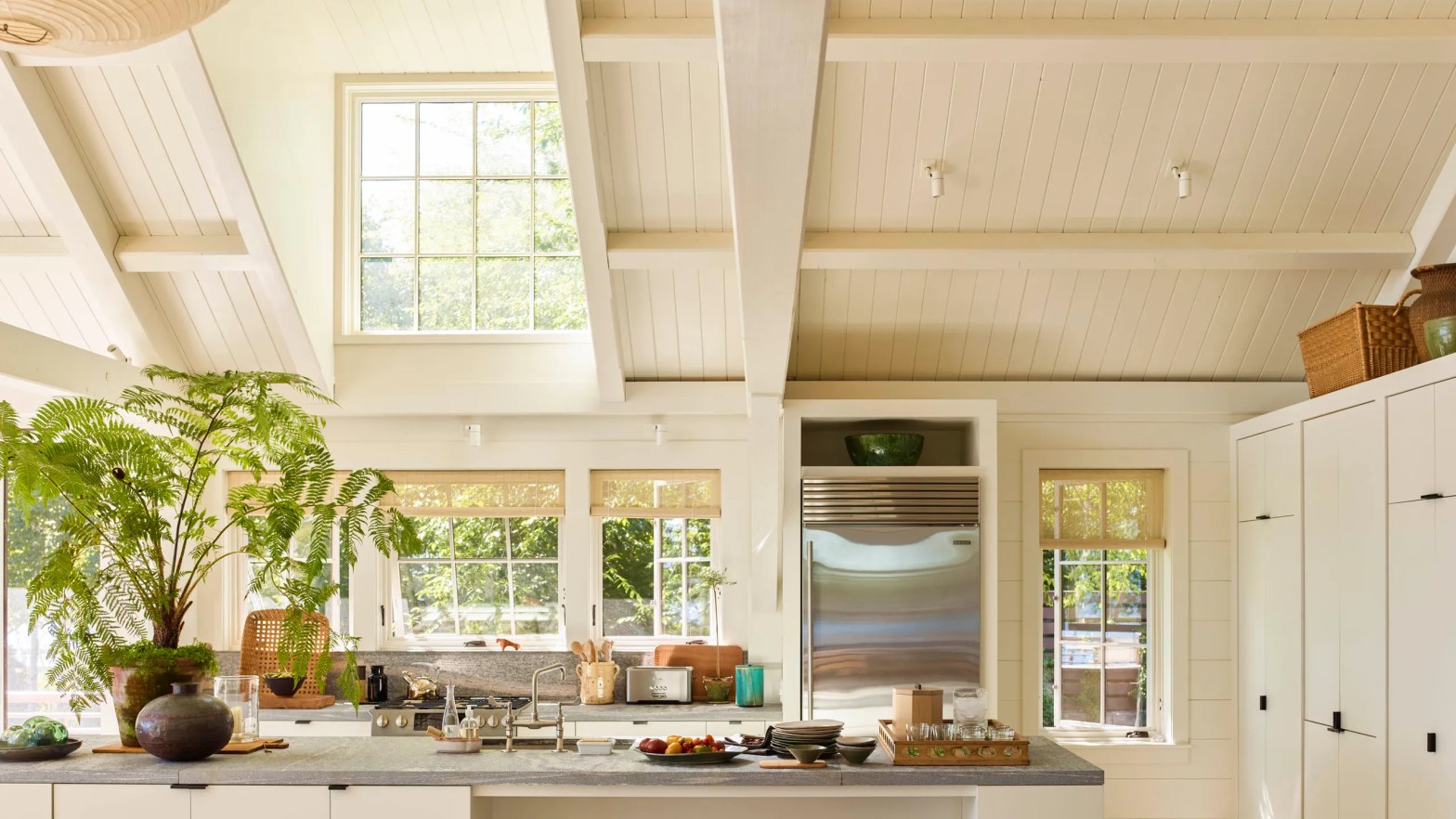
There is a quality that the best traditional houses have — old ones, the ones that have been in families for generations, that have absorbed the particular residue of long habitation — that is almost impossible to specify and immediately recognisable when you encounter it. It has to do with proportion, partly: rooms whose dimensions have been worked out in relation to the human body rather than in relation to the building’s structural grid. It has to do with light: windows placed to catch the morning or the afternoon sun, to frame a particular view of a garden or a hillside, to make the quality of the hour legible in the room. It has to do with the kind of detail that accrues only when someone has thought not just about how a thing looks but about how it will be touched — the weight of a door handle, the depth of a window seat, the height of a mantelpiece in relation to the person standing before it. And it has to do with something harder to name: a sense that the house was made with knowledge of what houses are for, what they do to the people who live in them, what it means to come home.
Gil Schafer builds houses that have this quality. He builds them new, typically from scratch, for clients who have asked him for a home rather than a statement, and the fact that the quality can be achieved in a house completed last year as fully as in one completed a century ago is the central demonstration of his practice — the thing that his work proves, quietly and without argument, simply by existing. That it can be proven at all is not obvious. The accumulated character of an old house, the texture of a life absorbed into the walls over decades, seems like something that only time can produce. Schafer’s contention — expressed in buildings and in the book he published in 2012, which is called, without irony or qualification, The Great American House — is that this character is not an accident of time but a product of intention: that it can be designed in from the beginning, if the designer understands what produces it and has the skill and the patience to build it in from the first stone.
This is a more radical position than it sounds. It requires believing that the traditional forms of domestic architecture — the centre-hall Colonial, the shingle-style house, the Federal townhouse, the farmhouse that has been added to over generations in ways that read as organic rather than calculated — are not merely historical records but living tools, available to architects who are willing to master them, capable of producing in the present the same quality of domestic experience they produced when they were new. Schafer believes this with the calm certainty of a person who has tested the proposition repeatedly and found it reliable. The buildings are the test results.
Formation and the American Tradition
Gil Schafer grew up in Ohio, in a family that moved between houses of different types and periods — a background that gave him, before any formal training, an empirical understanding of how different domestic architectures felt from the inside, how the rooms of a Victorian house produced different experiences from the rooms of a mid-century ranch, how light and proportion and the organisation of space shaped the texture of daily life in ways that the people living the life often registered only subconsciously. This early, lived education in the experiential reality of houses is something Schafer returns to regularly in his writing and conversation, and it grounds his architectural thinking in a way that purely academic formation rarely does. He did not arrive at his convictions about domestic architecture through theory. He arrived at them through living in houses and paying attention.
He studied architecture at Tulane, which has a stronger tradition of engagement with classical and vernacular American architecture than most of the Ivy League schools, and later at Columbia, where he encountered the same intellectual environment that shaped Pennoyer a decade earlier. The Columbia of the 1980s and early 1990s was, as noted, a place in which postmodernism’s dialogue with history was the dominant conversation, and Schafer emerged from it with a sophistication about the uses of historical reference that distinguishes his work from both the simple pastiche that the word traditional sometimes implies and from the ironic deployment of historical forms that postmodernism tended to favour. He was not interested in quotation. He was interested in inhabiting a tradition fully enough to use it rather than merely refer to it.
After Columbia he worked in the office of Peter Pennoyer, an apprenticeship whose influence on his development he has acknowledged with the directness of someone who does not feel that acknowledging influence diminishes the distinctiveness of what followed. The two architects are regularly discussed together, as representatives of the same tendency in American architecture, and there are genuine family resemblances in their work — the commitment to the classical tradition, the seriousness about urban context, the quality of detail, the belief that beauty is an obligation rather than a luxury. But the differences are as significant as the resemblances, and they are differences of temperament as much as of programme.
Where Pennoyer’s classicism is rigorous in a way that tends toward the formal and the civic — at its best in buildings that address an institution or a street with the full weight of the tradition behind them — Schafer’s is warmer, more relaxed, more specifically domestic in its ambitions and its methods. His houses do not feel like demonstrations of classical principle, even when the principles are there, correctly applied, in the structure of every room. They feel like houses. This distinction sounds modest and is actually the hardest thing in traditional architecture to achieve.
What Makes a House a Home
The question Schafer has spent his career trying to answer — what distinguishes a house that functions as a home from one that merely functions as a house — is older than architecture as a discipline and has generated an enormous literature of varying quality. Most of that literature is either so abstract as to be useless or so specific as to be inapplicable beyond its particular cultural and historical context. Schafer’s contribution to it, in his buildings and in his writing, is to identify a set of concrete, achievable design decisions that reliably produce the quality he is after — decisions that are not mysterious or expensive or dependent on rare materials, but that require the kind of sustained thought about how people actually live that the mainstream of contemporary residential architecture does not consistently provide.
The first is proportion. Schafer’s rooms are proportioned in accordance with the classical tradition — the relationship between height and width and length governed by ratios that have been developed and refined over centuries to produce spaces in which the human body feels correctly scaled. This is not a matter of making rooms large. Some of Schafer’s most successful rooms are quite small. It is a matter of ensuring that the dimensions of the room relate to each other, and to the dimensions of the human being in it, in ways that produce ease rather than the mild, chronic discomfort of a room that is slightly wrong without the occupant being able to identify why.
The second is light. Schafer thinks about windows not as sources of illumination or as openings in a facade but as instruments for the management of light over time — tools for bringing the quality of the hour and the season into the interior, for making the room responsive to the day in the way that rooms in old houses are responsive. He places windows to catch specific qualities of light at specific times: the eastern windows that fill a bedroom with morning sun, the western windows that make a library warm in the late afternoon, the high windows in a stair hall that track the movement of the sun across the sky without flooding the space with glare. This attentiveness to light as a temporal as well as a spatial phenomenon is one of the things that most clearly distinguishes his houses from those of architects who think about windows primarily as compositional elements in a facade.
The third is sequence. The organisation of rooms in a Schafer house is not a plan that optimises the adjacency of functions — kitchen near dining room, bedrooms grouped together, bathrooms distributed efficiently — but a narrative: a series of spaces through which movement produces a succession of experiences, compressions and expansions, views revealed and then concealed, the private and the public carefully separated without being rigidly segregated. The entrance of a Schafer house is always an event rather than a passage: a place where the transition between the public world outside and the domestic world inside is marked architecturally, given the weight it deserves as one of the daily rituals of life. The stair is always a space rather than a circulation element. The garden, where there is one, is brought into conversation with the interior in ways that make the threshold between inside and outside something to be experienced rather than merely crossed.
The Shingle Style and Its Lessons
Among the American architectural traditions that Schafer draws on most consistently, the shingle style of the late nineteenth century occupies a special place. The great shingle-style houses of the 1880s and 1890s — designed by McKim, Mead and White, by Bruce Price, by Wilson Eyre, and by dozens of other architects working on the New England and mid-Atlantic coast — represented the moment when American domestic architecture was most fully itself: grounded in the vernacular traditions of the region, responsive to the particular conditions of the American landscape, capable of a spatial freedom and a formal inventiveness that the more rigidly rule-governed classical architecture of the Beaux-Arts period sometimes constrained.
The shingle-style house sits low in its landscape. Its rooms open to each other in ways that the formal classical plan typically does not permit. Its materials — the cedar shingles that weather to silver-grey, the rough fieldstone of the base, the wide porches that mediate between interior and exterior — are not the materials of civic grandeur but of domestic ease, of a house that has been made for the specific place and climate it occupies rather than for the universal ambitions of the academic tradition. It is a more relaxed architecture than the Beaux-Arts, and its relaxation is not a failure of ambition but a different kind of ambition: the ambition to make a house that feels genuinely at home in its landscape, that has the quality of having grown there rather than been placed there.
Schafer absorbs these lessons and applies them with the kind of discrimination that distinguishes influence from imitation. His houses are not shingle-style houses in the historical sense — they do not reproduce the forms of the 1890s any more than Pennoyer’s houses reproduce the forms of McKim, Mead and White. They use the knowledge embedded in those forms: the knowledge of how to make a house sit in its landscape, how to organise rooms for the flow of domestic life, how to make material choices that will age well and that will read, in twenty years and in a hundred years, as having been made with the specific place in mind. This knowledge is not style. It is intelligence accumulated through practice, available to anyone willing to do the work of learning it.
The Great American House
The book Schafer published in 2012 — with a foreword by Bunny Williams, photographs by Pieter Estersohn, and a title that announces its ambitions without apology — is the most complete statement of his architectural philosophy available in a single volume, and it is a more interesting book than its coffee-table format might suggest. The houses it documents are beautiful, and their documentation is generous and precise, but what distinguishes it from the standard architectural monograph is the quality of the accompanying text: essays in which Schafer sets out, with unusual clarity and without the jargon that afflicts most architectural writing, what he is trying to do and why.
The central argument of the book is that the American domestic architectural tradition — the accumulated body of knowledge about how houses should be built and organised and situated that was developed over three centuries of making homes in a specific landscape and climate and cultural context — is a genuine inheritance, as rich and as useful as the European traditions from which it drew and as the modernist tradition that largely displaced it in the mid-twentieth century. This inheritance is not a museum piece. It is a living resource, available to architects who take it seriously, capable of producing houses that serve contemporary life as fully as any house designed from purely contemporary premises and that do so with a quality of experience — of warmth, of rootedness, of the feeling of having come home — that contemporary premises struggle to generate.
This is, stated plainly, a conservative argument in the architectural sense — an argument for the value of tradition as a source of design intelligence rather than as a constraint on design freedom. Schafer makes it without embarrassment and without the defensive crouch that such arguments sometimes produce in a culture that equates novelty with progress. He is not arguing against new architecture. He is arguing for a specific kind of knowledge that new architecture has largely abandoned, and for the proposition that the abandonment was a mistake — not an ideological mistake, necessarily, but a practical one, a loss of hard-won understanding about what domestic space needs to do for the people who inhabit it.
The houses in the book make the argument more eloquently than the text does, because the argument is ultimately not a verbal one. It is an argument made in rooms — in the height of a ceiling and the depth of a cornice and the quality of the light falling through a window onto a wooden floor in the late afternoon. You cannot understand what Schafer is doing from a description of it. You have to be in the rooms.
The Client Relationship
The houses Schafer builds are built for specific people, and his account of the design process emphasises the importance of listening — of understanding not just the programmatic requirements of the client but the texture of their domestic life, the way they move through a house, the rituals that structure their days, the memories of houses they have loved. This attentiveness to the specific human life that a house will contain is not unusual in residential architecture as a stated value, but it is unusual as a consistent practice: most architects, even good ones, tend to impose their own preferences more heavily than they acknowledge, and the result is often a house that is recognisably the architect’s rather than the client’s.
Schafer’s houses are recognisably his — there is a coherence of sensibility across his work that makes the authorship clear — but they are also, and more importantly, recognisably inhabited by the people who live in them. This is the hardest balance to achieve in residential architecture: between the architect’s own intelligence and vision, which is what the client is paying for, and the client’s own life and personality, which is what the house must serve. Schafer manages it by understanding that the two are not in opposition — that the tradition he works in is flexible enough to accommodate a great variety of lives and personalities, that a classical room is not one specific room but a set of spatial principles capable of producing very different experiences depending on how they are applied and what fills them.
His clients tend to be people who have thought carefully about how they want to live — who have, often, lived in several houses and absorbed from each of them a set of lessons about what works and what does not, what they need from a home and what they have previously been denied. These are not always clients with clear architectural opinions; they are clients with clear domestic opinions, which is a different thing and in some ways more useful. The person who knows exactly what quality of light they want in their kitchen at eight in the morning, who knows that they need a room small enough to feel enclosed for evening reading and a room large enough to feel expansive for winter entertaining, who knows that the connection between the kitchen and the garden is the most important spatial relationship in their domestic life — this person gives the architect more to work with than the person who has a clear aesthetic programme but an underdeveloped understanding of how they actually live.
Craft and the Making of Detail
The quality of detail in a Schafer house is, for anyone who has spent time in rooms that have been poorly detailed — and most rooms in most contemporary houses have been poorly detailed, not from lack of budget but from lack of thought — immediately and viscerally apparent. The mouldings have correct profiles. The doors have the right weight. The hardware has been chosen for the specific room it is in rather than from a universal specification. The transitions between materials — between wood floor and stone threshold, between plaster wall and timber window frame — are resolved with the care that makes transitions invisible rather than drawing attention to the awkwardness of the joint.
This quality of detail is expensive, in the sense that it requires time and skill and the involvement of craftspeople who still know how to do things that most of the building industry has forgotten. But it is less expensive than it appears, partly because the detail in a well-made traditional room is less complicated than the detail in a poorly made contemporary one, and partly because the investment in detail at the point of construction is an investment in durability — the room that is correctly detailed will not need to be remediated in twenty years because the joints are failing and the mouldings have warped and the hardware has worn through its finish.
Schafer works with a network of craftspeople — woodworkers, plasterers, ironworkers, painters of decorative surfaces — who are, in some cases, among the last practitioners of techniques that were once common in American building and that have become rare enough to be difficult to source. Part of the institutional labour of his practice has been the maintenance of these relationships, the keeping alive of a supply chain for traditional craft that the market, left to its own devices, would have eliminated through simple lack of demand. This maintenance is not altruistic — he needs the craftspeople to do the work he designs — but it has the character of a preservation project, of someone who understands that skills not practiced are skills lost and that lost skills produce a world with fewer possibilities in it than the world that preceded them.
The Rural and the Urban
Schafer’s work encompasses both urban houses and rural ones, and the two types illuminate each other in instructive ways. The urban houses — townhouses and apartments in New York and other cities — demonstrate his mastery of the classical urban tradition, the tradition of domestic architecture that understands the city as a collective enterprise and the individual building as a responsible participant in it. The rural houses — in Connecticut, in upstate New York, in the Hudson Valley, in more distant landscapes — demonstrate something else: his understanding of how a house can be of its place rather than merely in it, how the relationship between a building and its landscape can be as carefully considered as the relationship between the rooms inside.
The rural houses draw heavily on the American farmhouse tradition — on the accumulated wisdom of vernacular building in the specific landscapes of the northeastern United States, the understanding of how a house should sit in relation to the prevailing wind and the winter sun and the natural topography of a site that was developed by generations of builders who had no theory of architecture but an excellent empirical understanding of what worked. Schafer systematises this empirical understanding — brings to it the formal knowledge of the classical tradition and the spatial intelligence of the architect — without losing the quality of naturalness that makes the farmhouse sit so comfortably in its landscape. His rural houses feel settled in a way that even very good architect-designed houses in rural settings often do not, because they have been designed with the landscape in mind rather than placed in the landscape as objects.
The garden, in the rural houses particularly, is understood as a continuation of the architectural project rather than as its setting. The relationship between the house and the garden — the alignment of axes, the framing of views, the management of the transition between the cultivated space near the house and the less managed landscape beyond — is worked out with the same care as the relationship between the rooms inside. A Schafer garden is not a backdrop for photography. It is a sequence of spaces continuous with the sequence of spaces inside, a further elaboration of the same spatial intelligence that organises the rooms, extended into the landscape that the house inhabits.
Against Novelty
Schafer is, like Pennoyer, subject to the charge that his architecture is conservative in a pejorative sense — that the choice to work in traditional forms is a refusal of the contemporary, a retreat from the obligation that architects supposedly have to engage with the present moment and produce work that reflects it. This charge is worth taking seriously, because it contains a version of something true: Schafer’s houses do not look like the present moment, in the sense that they do not reflect the formal language of contemporary architecture, and the present moment has produced architectural achievements — structural innovations, environmental technologies, spatial ideas — that a traditional practice cannot fully absorb.
But the charge rests on a conflation of novelty with seriousness that does not survive examination. The present moment is not only the formal language of contemporary architecture. It is also the specific lives of specific people who need houses, who wake up in the morning and eat breakfast and read and entertain and raise children and grow old, and who need the spaces in which they do these things to be organised with intelligence and built with care. The house that serves these needs most fully is not necessarily the newest or the most formally unprecedented. It may be, and Schafer’s work consistently suggests that it is, the house that draws on the longest and richest tradition of thinking about domestic space, that brings to the specific client and the specific site the accumulated knowledge of several centuries of making homes for people whose needs were not, in the essentials, so different from the needs of the people living in them today.
This is a position that requires, as Pennoyer’s position requires, the particular kind of confidence that comes from having tested a proposition repeatedly and found it reliable. Schafer has been building houses for thirty years. The people who live in them, by consistent account, love them — not in the way that people love a beautiful object that asks nothing of them, but in the way that people love a home: with the deep, habitual, taken-for-granted love of a place that has absorbed their life and given it back to them in the form of rooms that remember them, that carry in their proportions and their light and their detail the accumulated evidence of someone having thought very carefully about what this life needed and how to hold it.
The house that feels as though it has always been there: this is what Schafer builds. That it can be made new, that it is being made new, right now, on sites in the American landscape that had nothing on them last year and have on them today a house that will still be standing and still be loved when everyone now living in it is gone — this is the demonstration. The tradition is not finished. It is being continued, carefully and well, by a man in a midtown Manhattan office who wakes up every morning thinking about the height of ceilings and the fall of light and what it means to come home.
Discover more from My World of Interiors
Subscribe to get the latest posts sent to your email.

