
Makers & Rooms — Essay I
The Light He Couldn’t Stop Arguing About
Poul Henningsen designed the most beloved lamp in the world. He also wrote cabaret songs, picked fights with the bourgeoisie, and fled to Sweden ahead of the Gestapo. The lamp was almost the least interesting thing about him.
By Bergotte
There is a lamp you have seen a thousand times without knowing its name. It hangs over kitchen tables and in the windows of Copenhagen apartments, a layered white sculpture suspended from the ceiling like a frozen flower mid-bloom. You may have encountered it in a restaurant, or in the pages of a design catalogue, or in the background of a photograph of someone’s beautifully composed Scandinavian life. The lamp produces light of a particular quality — warm, diffuse, without edge or glare — that does something generous to the faces beneath it. It makes dinner feel like a conversation worth having. It makes rooms feel, against all rational expectation, kind.
The lamp is the PH 5. It was designed in 1958 by a Dane named Poul Henningsen, and it has been in continuous production ever since, manufactured by the Copenhagen firm Louis Poulsen. Somewhere in the region of a hundred thousand are sold each year. Interior designers specify it reflexively. Young couples acquiring their first serious furniture tend to agree on it before they agree on much else. It has outlasted every trend that has tried to supersede it. When design journalists run out of things to say about Scandinavian minimalism, they write about the PH 5 — its perfect proportions, its rational geometry, its elegant solution to the problem of the naked bulb. And they are not wrong, exactly. It is all of those things.
But the lamp was never just a lamp, and Poul Henningsen was never just a designer. He was, in roughly equal measure, an architect, a critic, a polemicist, a lyricist, a provocateur, and one of the most persistently inconvenient voices in twentieth-century Danish cultural life. The story of the PH lamp is the story of a man who thought that the way a society lights its rooms reveals everything about the society itself — its comfort with truth, its tolerance for beauty, its relationship with the human body and with pleasure and with the poor. He was not wrong about that either. He just said it in ways that made a great many comfortable people very uncomfortable indeed, which was, by all accounts, more or less his intention.
A Childhood Conducted in Irregular Circumstances
Poul Henningsen was born on 9 September 1894 in Ordrup, a suburb north of Copenhagen, the illegitimate son of the writer Carl Ewald and the actress Olga Jørgensen. The circumstances of his birth were, in the language of the time, irregular, and they shaped him in ways both obvious and subtle. Carl Ewald was a well-known figure — a naturalist writer in the tradition of Hans Christian Andersen, with a gift for fable and a talent for making science legible to children — but he was already married to another woman, and the relationship with Olga was conducted at a remove from respectable society. Poul grew up in a household that was cultured, articulate, and structurally outside the bourgeois order it nonetheless observed closely.
This position — intimate with Danish middle-class culture, constitutionally unable to accept it on its own terms — never left him. His writing throughout his life returns again and again to the hypocrisies of respectability, the cowardice of conventional taste, the way that comfort hardens into complacency and complacency into something worse. He was not a Marxist in any disciplined sense, but he was a man of the left who understood, viscerally and personally, what it meant to stand slightly to one side of the world that was telling you what was proper and what was not.
He trained as an architect — or rather, he studied architecture, which is not quite the same thing. He enrolled at the Copenhagen Technical School in 1911 and later at the Danish Technical University, but he never completed his degree. The reasons are typically glossed over in the hagiographies, but the texture of it seems clear enough: Henningsen was constitutionally unsuited to institutional discipline. He was brilliant, argumentative, and easily bored by curricula that moved more slowly than his mind. He left without graduating and spent his early twenties doing what talented, impatient young men did in early twentieth-century Copenhagen: writing, arguing, designing things on commission, and worrying about whether Danish culture was capable of becoming what it needed to become.
The Problem of the Bulb
The lamp problem, as Henningsen understood it, was actually a civilisational problem in miniature. Before electrification, the dominant domestic light sources — candles, oil lamps, gas — were all warm, diffuse, and fundamentally without glare. They produced light from extended, relatively low-intensity sources that spread evenly through a room, flattered faces and surfaces, and created the conditions for what we might call inhabited space: rooms in which human beings felt comfortable being human beings. Then came the electric bulb, and everything went wrong.
The bare electric bulb — even in the 1920s, when Henningsen was beginning to think seriously about light — was an affront. It was hard, it was harsh, it cast violent shadows, it made people look ill and rooms look institutional. The standard response of the era was to hide it behind a shade: a fabric or paper or glass dome that dimmed the source without solving the fundamental problem of where the light actually went or how it interacted with the surfaces of a room. Most lamp design of the early twentieth century was, in Henningsen’s view, just decoration applied to a bad solution. The shades were often beautiful, in the conventional sense, but they didn’t make the light better. They just made the lamp easier to look at.
Henningsen’s insight — deceptively simple in retrospect, genuinely revolutionary at the time — was to attack the problem from first principles. Light quality, he understood, was a function of geometry: of the angles at which light fell on surfaces, the ratios of direct to reflected illumination, the presence or absence of visible glare from the source itself. What you needed was not a prettier shade but a mathematically precise system of shades that would redirect light in exactly the right proportions. Every surface of the shade should contribute. The bulb itself should be invisible from any normal viewing angle. The light reaching the room should be composed almost entirely of reflection — soft, warm, directionless — rather than direct radiation from the source.
He worked out the mathematics of this in the early 1920s, collaborating with the engineer Sophus Kaastrup-Olsen on what would become the theoretical foundation of the PH system. The key was the logarithmic spiral: a curve that, when rotated around an axis, produces a surface of constant angle. By designing a series of shades whose profiles followed this curve, Henningsen could ensure that every ray of light striking any part of any shade was reflected at precisely the same angle — creating the even, glare-free luminescence he was after. It sounds, described this way, like a fairly dry piece of applied mathematics. It produced lamps of heartbreaking beauty. The two facts are not unrelated.
Paris, 1925
The first version of what would become the PH lamp was exhibited at the 1925 Exposition Internationale des Arts Décoratifs et Industriels Modernes in Paris — the exhibition that gave Art Deco its name, though Henningsen would have had little patience for Art Deco as a movement, and still less for its name. He was thirty years old, largely unknown outside Denmark, and he arrived in Paris with a lamp that looked like nothing else at the exhibition.
The Paris of 1925 was a city in the grip of a very particular idea about modernity: decorated, exuberant, committed to the proposition that the future was essentially a more elaborate version of the present. Le Corbusier had his own pavilion at the same exposition — the Esprit Nouveau, clean and white and provocative — and the tension between his stripped functionalism and the decorative excess of the main pavilions defined the cultural argument of the age. Henningsen’s lamp sat, in a way, between these poles. It was strictly functional in its conception — every curve justified by physics — and yet it produced an aesthetic result of unusual warmth and sensuousness. It was, in this sense, the most Danish thing imaginable: utility that arrives at beauty not despite itself but through itself.
The lamp won the gold medal. More importantly, it caught the attention of the firm Louis Poulsen, which had been making electrical fittings since the late nineteenth century and recognised, in Henningsen’s design, something that transcended the merely marketable. The relationship that developed between Henningsen and Louis Poulsen would last the rest of his life — not without friction, not without the occasional bitter disagreement about commercial compromises versus design integrity, but fundamentally productive in a way that few relationships between artists and manufacturers ever are.
He began developing the PH system in earnest after Paris. The lamps that emerged over the following decades — the PH 2, the PH 3/2, the PH 4, the Snowball, eventually the PH 5 in 1958 and the Artichoke, also 1958 — were all variations on the same principle, the same obsessive refinement of the relationship between source, geometry, and light quality. Henningsen tweaked the proportions, adjusted the number of shades, experimented with different materials and finishes, and returned again and again to the question of whether the light was as good as it could be. His notebooks from this period have the character of a man pursuing something he can never quite catch: every solution reveals a new problem, every improvement a new inadequacy. The perfectionism was genuine, and it was also, one suspects, temperamentally necessary. He was not a man who could let things be.
The Critic as Citizen
Design was only one arena in which Henningsen pursued his arguments. From the early 1920s onward, he wrote — prolifically, combatively, and with a literary quality that set him apart from every other design polemicist of his generation. His essays appeared in newspapers and magazines across the Danish press. He edited his own journal, Kritisk Revy — Critical Review — from 1926 to 1928, a short-lived but genuinely influential publication that attacked what he saw as the complacency and false comfort of Danish cultural life. He wrote about architecture, about theatre, about film, about sex, about the hypocrisies of the church, about the city and what it owed its citizens. He was funny, often. He was cruel, sometimes. He was almost always right.
The core of his cultural argument was a version of the same logic that animated his thinking about light. Danish society, he believed, was deeply invested in a certain kind of comfort — aesthetic, moral, and political — that was actually a form of dishonesty. The country’s bourgeoisie had constructed a liveable world for itself by declining to look directly at anything that might disturb it: poverty, sexuality, class, the brute facts of how modern life was actually organised. This was, in Henningsen’s view, the social equivalent of the bad lamp: a system that hid its own workings behind an acceptable surface, that made the room feel inhabitable by making it impossible to see clearly. What was needed, in culture as in lighting, was not decoration but honestly engineered illumination.
This made him loved by some and genuinely detested by others. He was accused of nihilism, of indecency, of communist sympathies — the last charge was not entirely without foundation, though Henningsen’s politics were always more emotional than ideological. What he could not bear was the idea that a society might choose not to look at itself, might prefer comfortable dimness to the honest if uncomfortable light of examination. He said so, repeatedly and loudly, in print and on stage and at dinner parties and anywhere else he found himself with an audience.
Songs and Stages
The stage, in fact, became one of his primary platforms. From the early 1930s onward, Henningsen wrote for the revue theatre — that peculiarly Danish genre of political cabaret that combined popular songs, sharp comedy, and pointed social commentary in formats that could reach audiences far beyond the readership of literary journals. He collaborated with composers and performers at venues like Riddersalen in Copenhagen, writing lyrics that were, by all accounts, remarkable: melodically appealing and politically vicious in roughly equal measure. The songs addressed censorship, sexual repression, the cowardice of the press, the complacency of the middle class, the menace gathering in Germany across the water.
The German menace was not metaphorical. Through the 1930s, as National Socialism consolidated its grip on Germany and its cultural influence began to extend across Scandinavia, Henningsen was one of the most consistently anti-fascist voices in Danish public life. He wrote against it in essays, in lyrics, in direct public argument. This was not without personal cost. The Danish cultural and political establishment of the 1930s was, like establishments generally, more interested in accommodation than confrontation, and a man who insisted on naming what was happening in Germany tended to make his colleagues uncomfortable. Henningsen insisted anyway.
When the Germans occupied Denmark in April 1940, Henningsen’s position became immediately precarious. His writings were well enough known, and his hostility to National Socialism well enough documented, that he was a plausible target. He continued writing — the German authorities in Denmark operated under a policy of relative cultural tolerance in the early years of the occupation, using Denmark as a model protectorate — but the constraints tightened as the war progressed. In 1943, as the occupation hardened into something more like the thing it had always been, Henningsen was warned that his name was on a Gestapo list. He went underground briefly and then, in the same autumn that saw the famous rescue of Danish Jews, he was evacuated to Sweden, where he spent the remainder of the war.
The Swedish exile was, by most accounts, miserable. He was fifty years old, separated from his country and his work, living on the charity of Swedish cultural institutions that were generously disposed toward Danish refugees but could not offer him the particular audience he needed. He wrote. He waited. He thought about light.
The Architecture That Wasn’t
It is worth pausing, at this point, to consider what Henningsen did not build. He was trained as an architect, thought of himself throughout his life as an architect in some fundamental sense, and yet his architectural output was strikingly small. The most significant completed building he produced was the Langelinie Pavilion in Copenhagen — a pleasingly elegant structure on the harbour, built in 1958, the same year as the PH 5, and now a celebrated event venue. There were a handful of residential projects, some interiors, some unrealised schemes. For a man of his intelligence and his theoretical convictions about the built environment, the thinness of the architectural record is striking.
The reasons are multiple. He was a difficult collaborator, insufficiently interested in the practical compromises that buildings require, and inclined to see every structural or economic constraint as a form of philistinism to be resisted rather than a problem to be solved. He was also, by temperament, more interested in the theory of architecture than its execution — in what buildings should be doing for the people inside them, rather than in the technical problem of how to get them built. The lamp was, in this sense, the perfect vehicle for him: small enough to be fully controlled, complex enough to require real thought, and with a direct, unmediated relationship to human experience that buildings could only approximate.
His architectural writing, though, was as significant as anything he built. His essays on housing — on the obligation of the modern state to provide its citizens with light and space and dignity — were among the most important contributions to the Danish debate on social housing in the interwar period. He understood, before most, that the question of how ordinary people lived was the central architectural question of the twentieth century, and that the Danish design establishment’s tendency to focus on beautiful objects for prosperous interiors was a form of evasion as dishonest as the society it served. Good design was not a luxury. It was a right.
The PH 5 and What It Solved
By 1958, when Henningsen designed the lamp that would become the most successful of his career, he had been refining his ideas about light for over three decades. The PH 5 — the number refers to the diameter of its largest shade, fifty centimetres — was in many ways a summation: a distillation of everything he had learned about the relationship between geometry and light quality, housed in a form of unusual elegance.
The specific problem the PH 5 solved was the problem of the new bulb. The introduction of opaque bulbs — designed to eliminate the visual harshness of clear filaments — had disrupted the light calculations Henningsen had been working with since the 1920s. Opaque bulbs distributed their light differently, creating colour inconsistencies and unexpected shadows in the earlier PH designs. Henningsen went back to the mathematics. The PH 5 incorporated a series of small supplementary shades — a blue shade above the main body to add warmth to the ceiling light, a red inner cone to enrich the light at the lowest point — that corrected these inconsistencies. The result was a lamp that performed correctly with any available bulb technology, which turned out to be a significant practical virtue as bulb technology continued to change throughout the following decades.
But the PH 5’s success cannot be reduced to its engineering. There is something about its proportions — the way the three main shades step outward from the centre, the slight upward curve of the lowest shade, the relationship between the white of the outer surfaces and the warmer colours concealed within — that has proven indefinitely agreeable to the human eye. It sits in a room without demanding attention, without competing with the people beneath it, without insisting on being noticed. And yet it is noticed, eventually, always: there is something there that rewards looking, that reveals its intelligence gradually, that proves, on examination, to have been more thought about than it appeared.
This was, one feels, precisely what Henningsen intended. The best design, in his view, was not design that performed its virtue ostentatiously. It was design that quietly and without fuss made things better — that created conditions in which people could see each other clearly and feel comfortable in their own skins and forget, at least for an evening, about all the things that the world kept demanding they worry about. The lamp that makes the dinner feel like a conversation worth having: that was the goal. It was not a modest goal.
Late Work, Late Life
The Artichoke lamp, also designed in 1958 and originally created for the Langelinie Pavilion, is in some respects the more spectacular achievement: seventy-two leaves arranged in twelve rows, each leaf precision-engineered to conceal the light source from any angle, the whole assembly producing a play of light and shadow that manages to be both mathematically rigorous and genuinely lyrical. It has become, if anything, even more culturally totemic than the PH 5 in recent years — a fixture of the global design imagination, reproduced endlessly and poorly in cut-price versions, its presence in any sufficiently aspirational interior a kind of shorthand for serious aesthetic intention.
Henningsen did not live to see quite how thoroughly his work would pervade the world’s interiors. He died in 1967, at seventy-two, still writing, still arguing, still — by all accounts — profoundly dissatisfied with the direction of Danish culture and the insufficient radicalism of its design establishment. His last years were marked by the increasing irrelevance of some of his political positions — the left he had embodied in the 1930s was fragmenting into forms he did not entirely recognise — but also by a growing recognition of his importance that he received with the ambivalence it probably deserved. Prizes and retrospectives are more comfortable for the institutions that give them than for the people who receive them. Henningsen had spent his life being inconvenient. Being celebrated felt, one imagines, like a mild form of defeat.
He was married twice: first to Inger Margrethe, with whom he had children, and later to Karen Margrethe Ferslev, who was his partner in the latter decades of his life. The domestic record is, by the standards of his generation and class, relatively unremarkable — which is to say that he was a man whose primary life was conducted in public, in argument, in the relentless production of things and words. What he was like to live with, what the lamp looked like on the table in his own dining room, what conversations happened beneath it: these are the things the record does not preserve, which is perhaps as it should be. The work is what remains.
What the Light Actually Does
It is worth asking, at the end, what it means for a lamp to be great. Not successful, not influential, not canonised — those are institutional judgements, interesting in their way but finally beside the point. Great.
Henningsen’s answer, implicit in everything he designed and explicit in much of what he wrote, was that a great lamp was one that served the people beneath it honestly and without condescension. It did not show off. It did not pretend that its function was more complicated than it was. It solved the problem — human beings need to see each other in spaces that feel habitable — with the minimum of material and the maximum of thought, and it did so in a way that would hold up not just next season but in fifty years, in a hundred, in all the futures that could not yet be imagined.
By that standard, the PH 5 is great. It has been in production for nearly seven decades, through changes in manufacturing, in materials, in bulb technology, in taste, in everything that design trends have thrown at it. It sits in the homes of people who have never heard of Poul Henningsen and in the homes of people who have read everything he wrote. It makes the light better. It makes the room feel like a place where conversation is possible. It does this without asking for credit.
Henningsen himself, of course, could not resist asking for credit. He was constitutionally incapable of the quiet virtue his own best work embodied. He needed to be heard, needed to argue, needed to tell Denmark — and through Denmark, the world — exactly what was wrong with the way it lived and lit its rooms and organised its pleasures and avoided its responsibilities. The lamp was, in this sense, the better version of the man: the aspiration clarified of the ego, the insight freed from the argument that surrounded it.
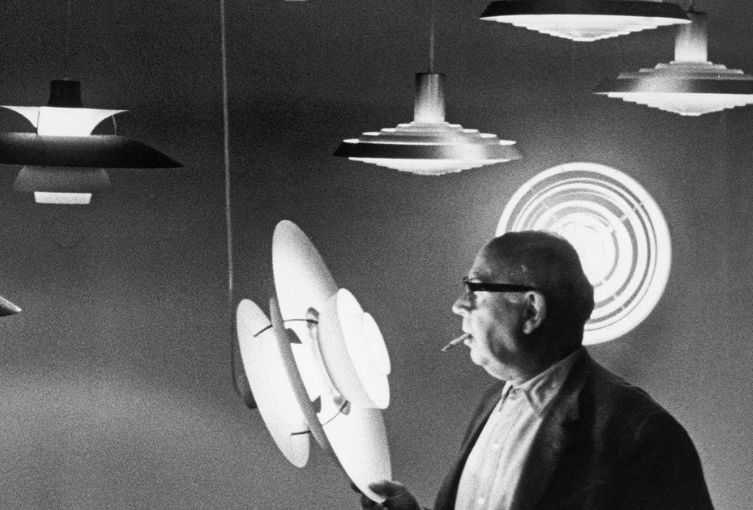
There is a photograph of him from the late 1950s, taken around the time he designed the PH 5. He is sitting at a table, the lamp overhead — his lamp, the lamp he has been perfecting for thirty years — and he is looking at something out of frame with an expression that is difficult to read: part satisfaction, part displeasure, part the permanent slight irritation of a man who has seen exactly what is possible and cannot stop noticing how far short of it the world consistently falls. The light falling on his face from the lamp above him is very good. It is warm and even and kind. He does not appear to have noticed.
Discover more from My World of Interiors
Subscribe to get the latest posts sent to your email.

